Showing posts with label NATO. Show all posts

Sunday, December 21, 2008

U.S. sees FSU role in Afghan supplies; NATO on Russia, Ukraine, Georgia; Azeris, Turks seek Turkmen links

First published in December 6, 2008 Armenian Reporter

Washington Briefing
by Emil Sanamyan

U.S. considers Caucasus to Central Asia route to supply Afghanistan forces


Gen. Duncan McNabb. . AP.

With an increasingly unstable Pakistan, the United States is looking into the possibility of supplying its forces in Afghanistan via the Caucasus and Central Asia, the Washington Post reported on November 18 citing Pentagon documents. Since President-elect Barack Obama has pledged to increase the U.S. military presence in Afghanistan, the need for additional supplies may add to existing concerns.

There are currently 67,000 allied soldiers in Afghanistan, of whom about half are Americans. According to the Post, 75 percent of all supplies to these forces, such as food, gas, and military equipment, currently come from Pakistan or through its port of Karachi, from where they are taken by truck into Afghanistan. Truckers have come under increased Taliban attacks in Pakistan and Afghanistan.

A spokesperson for U.S. forces in Afghanistan denied the attacks have affected military operations. Nevertheless, the Defense Department dispatched head of the U.S. Transportation Command Gen. Duncan McNabb to Azerbaijan and Kazakhstan in mid-November.

Since 2001, the U.S. has used the Caucasus to Central Asia air corridor, but not the land route which would have to start at one of Georgian ports then cross Azerbaijan, the Caspian Sea, and one or more Central Asian states before reaching Afghanistan. Shipments would be conducted by a contractor who would need to hire local security.

Pentagon documents cited by the Post suggest that the U.S. already secured Georgia's approval for what it called a "northern route," and was in talks with Azerbaijan and Kazakhstan. The Pentagon said it did "not expect transit agreements with Iran or Uzbekistan."

But according to a Strategic Forecasting (Stratfor) analysis published on November 19, the United States will have to continue to rely on Pakistan for most of its supplies, with a much longer and more complicated Central Asian route potentially serving as a reserve option. In addition to the logistics of that route, the United States would have to take into account Russia's increasingly prominent role in Central Asia.

According to the Post, this year Russia agreed to facilitate nonlethal supplies to pass from Europe through its rail system into Central Asia and from there by truck to Afghanistan.

NATO: contacts to resume with Russia; no new decisions on Georgia, Ukraine


de Hoop Scheffer talking to Tkeshelashvili

Meeting on December 2, NATO foreign ministers agreed to resume some of of the alliance's contacts with Russia, Radio Free Europe / Radio Liberty (RFE/RL) reported. The relations were suspended three months earlier over Russian military intervention in Georgia.

The United States has pushed for a tougher international reaction to Russian treatment of America's close ally, leading to temporary suspension of NATO and European Union contacts with Russia.

But last month, shortly after the U.S. presidential elections, the EU resumed partnership talks with Russia over Georgian objections. (See this page in the November 15 Armenian Reporter.)

NATO Secretary General Jaap de Hoop Scheffer said this week that NATO's "graduated re-engagement" with Russia does not mean that the alliance agrees with Russian policies in Georgia.

In another anticipated decision, NATO officials again declined to grant Georgia and Ukraine membership action plans (MAPs). At the same time, they reiterated the NATO's Bucharest summit statement that promised eventual membership to both countries last April, and promised to continue to assist Ukarine and Georgia to achieve "NATO standards."

Reacting to these developments, Russian President Dmitry Medvedev said on November 28 that he was "pleased that reason has prevailed, unfortunately only at the end of the current U.S. administration. But this at least ascertains the current state of affairs."

Mr. Medvedev made his comments in Cuba where he arrived from Venezuela, whose forces just held joint exercises with a Russian naval group currently in the Carribean.

Russia has strongly opposed NATO's expansion into Ukraine and Georgia.

As Eugeniusz Smolar of the Polish Center for International Relations told RFE/RL, "The Georgia war, in the opinion of most NATO members, is not only an example of Russian aggression - which it was. It was also an example of the irresponsible behavior of the present Georgian leadership."

Last week the Polish security service blamed Georgian leaders for endangering the life of the Polish president on a visit to Georgia when his convoy abruptly turned toward Ossetian territory, causing a shooting incident. Poland has been one of Georgia's staunchest supporters in NATO and the EU.

"In this context, many NATO members - and not just Germany and France - say that they are not politically ready to defend a country that is behaving in such a manner," Mr. Smolar said.

But proponents of NATO expansion suggest the incoming administration of Barack Obama could help mend ties between the United States and Europe, probably at Russia's expense.

"If you imagine in three years' time, if we have a stable government in Ukraine, a different Georgian leadership, a Russia that is preoccupied with its own problems, and a more popular American administration, NATO expansion might not look so crazy," Edward Lucas, deputy editor at the Economist, told RFE/RL.

Azerbaijan, Turkey seek Turkmenistan gas, ferry link up

Ilham Aliyev wearing national garb with Turkmen prez. looking on from portrait.
The presidents of Azerbaijan and Turkey were in Turkmenistan last week in another effort to encourage routing of that country's natural gas exports via the Caspian, the Caucasus, and Turkey. The United States has long supported the trans-Caspian gas pipeline, having in August 2007 allocated funds to study its feasibility.

But Azerbaijan and Turkmenistan have had difficult relations since independence, with their past dictators Heydar Aliyev and Saparmurad Niyazov arguing over offshore Caspian oil fields.

In recent years, while disagreements about the maritime border have not been resolved, there have been more contacts. Last May Mr. Niyazov's successor, Gurbanguly Berdymuhamedov, went to Baku for talks with Ilham Aliyev.

On November 28-29 Mr. Aliyev paid a return visit, with Turkish president Abdullah Gül arriving apparently to mediate the dispute between the two "brotherly" nations.

The three leaders agreed to reestablish a ferry link between Baku and Turkmenbashi (formerly Krasnovodsk), suspended since the collapse of the USSR, and to continue talks on the disputed Kapaz/Sardar oil field in the middle of the Caspian and on a potential trans-Caspian gas pipeline.

In December 2007 Turkmenistan hosted the presidents of Russia and Kazakhstan and agreed to build a new pipeline to export additional natural gas through their territories. The Central Asian nation is believed to have fourth largest gas resources in the world behind Russia, Iran, and Qatar.

Pallone on U.S. support for NKR; Erdogan on Bush & Obama; Vatican on Armenian Genocide; EU's new FSU plan; Caucasus on NATO ties

First published in November 29, 2008 Armenian Reporter

Washington Briefing
by Emil Sanamyan

Rep. Pallone: U.S. should step up support for Karabakh


"It is necessary that the United States place an importance on the existence of the smaller states in the Caucasus," Rep. Frank Pallone (D.-N.J.) said in a statement released following his meeting with president of the Nagorno-Karabakh Republic, Bako Sahakian, on November 22 in New York.

"The United States must not ignore the unique cultural identities of the people of Nagorno-Karabakh," the co-chair of the Congressional Armenian caucus went to say. "As a country founded on self-determination, we must champion the rights of people everywhere to self-determination."

While welcoming the November 2 Moscow declaration on Karabakh signed by the presidents of Armenia and Azerbaijan, Mr. Pallone also called for more "robust" U.S. role in the peace process under the incoming administration of Barack Obama.

Speaking on November 23 in Los Angeles, Mr. Sahakian welcomed President-elect Obama's "readiness to help meet the challenges faced by the Armenian nation." Karabakh's president is in the United States for the annual fundraising effort organized by the Armenia Fund in Los Angeles.

Turning to specific priorities for next year, Mr. Pallone said that as this year he will "urge a shift in U.S. aid to Nagorno-Karabakh from humanitarian to developmental programs [to] help rebuild Nagorno Karabakh's infrastructure [and] secure the health and safety of [its] people."

Turkish leader derides Bush, lobbies Obama

Turkey's Prime Minister Recep Tayyib Erdogan used an invitation from President George W. Bush to an economic summit in Washington to lecture President-elect Barack Obama and to lambast the Bush administration's policies as "disastrous."

Although Mr. Obama himself declined to take part in the summit, he asked former Secretary of State Madeleine Albright, former Rep. Jim Leach (R.-Iowa), and Philip Gordon of the Brookings Institution to meet with foreign leaders on his behalf.

According to Turkish media, in meetings with Mr. Obama's representatives and in speeches at Brookings on November 14 and a day earlier at the Columbia University, Mr. Erdogan touted Turkey's importance and warned President-elect Obama about Turkey's "sensitivities" such as its insistence on denial of the Armenian Genocide and opposition to a de facto Kurdish state in Iraq.

In his presidential campaign, Mr. Obama repeatedly pledged to drop the Bush administration's policy and stop deferring to the Turkish lobby when it came to U.S. policy on the Armenian Genocide.

Separately, Mr. Obama pledged to pull U.S. troops out of Iraq within sixteen months.

Mr. Erdogan criticized the withdrawal plan as "premature" and the recognition pledge as "immature."

At Brookings, the Turkish leader claimed that "U.S. support is essential for maintaining the dialogue" between Turkey and Armenia, implying that Ankara would stop seeking normal relations with Yerevan if President Obama, in Mr. Erdogan's words at Columbia, acquiesced to Armenian-Americans' "cheap political lobbying" and speak clearly on the genocide in Ottoman Turkey.

Also at Columbia, Mr. Erdogan spoke of his desire to follow the recent Russian example and host a meeting between the Armenian and Azerbaijani presidents.

And in Washington, Mr. Erdogan repeated his offer to mediate between the United States and Iran, while suggesting that Tehran cannot be forced to drop its nuclear program while other countries (presumably Israel, India, and Pakistan in addition to the United States, Russia, France, Britain, and China) retain nuclear weapons.

Vatican: Memories of Armenian Genocide need to be overcome


"The Holy See's official position was expressed in Pope John Paul II visit in Armenia [where he] spoke about genocide," Cardinal Walter Kasper, president of the Pontifical Council for Promoting Christian Unity and the Vatican's voice on interfaith relations told Vatican Radio on November 22 (audio of the program is available at www.vaticanradio.org).

Cardinal Kasper was asked about the issue on eve of a meeting between Pope Benedict XVI and Catholicos Aram I of Cilicia who visited the Vatican from November 23 to 27.

In Armenia, "we visited the memorial of victims of what is called genocide, even though the Turkish [government] does not recognize this term. Normally it is called in this way," the cardinal recalled.

"In any case, the problem is not the term. It is a fact that thousands of Armenians were killed and starved and the terrible memories are there and we must help overcome these memories and also to improve if possible the relations between Armenia and Turkey, which are neighboring states but which have no relations with each other. And I don't know if the Holy See can do anything in this regard but of course we are always with the victims and not with those who did the bad things."

During his November 2006 trip to Turkey, Benedict XVI referred to "tragic circumstances [Armenians] endured in the last century," according to a report by www.asianews.it.

According to the Catholic News Service, in meeting with the Armenian delegation on November 24, Pope Benedict XVI also referred to Armenians' "unspeakable suffering."

In turn, Aram I said it was essential that the Armenian Genocide is explicitly acknowledged to help prevent new genocides "by affirming the rights of all people to dignity, a dignified life, freedom, and self-determination."

The Holy See last May hosted Karekin II, the Catholicos of All Armenians, who at the time appealed "to all nations and lands to universally condemn all genocides that have occurred throughout history," saying that "denial of these crimes is an injustice that equals the commission of the same."

In the meeting this week, Benedict XVI also noted "the escalation of persecution and violence against Christians in parts of the Middle East and elsewhere," apparently referring to attacks on Christians, including the Armenian community, in the U.S.-occupied Iraq.

"Only when the countries involved can determine their own destiny, and the various ethnic groups and religious communities accept and respect each other fully, will peace be built on the solid foundations of solidarity, justice and respect for the legitimate rights of individuals and peoples," the pope said.

European Union weighing ties with Russia, ex-Soviet republics

"In recognition of European aspirations" of Belarus, Moldova, Ukraine, Georgia, Armenia, and Azerbaijan, the European Commission is set to propose a new Eastern Partnership project to encompass the six republics in June 2009, www.EUObserver.com reported on November 24.

The EU Commission's draft communication seen by EU Observer describes relations between the European Union and Russia would take priority over the proposed new project.

At the same time, in an implicit swipe at Russia, the document notes that "the conflict in Georgia in August 2008 and its broader repercussions have resulted in increased awareness of the vulnerability of Eastern partners.... There is a sense of urgency among member states as to the need to enhance relations with our Eastern neighbors to support them in drawing closer to the EU."

Until now, EU engaged the six countries through its European Neighborhood initiative, which also involves the countries of the Levant and North Africa.

The new initiative, first floated by Poland and Sweden last May, is meant to send "a clear and lasting political message of EU solidarity" and to "produce benefits perceived and recognized by citizens of the partner countries."

Among them would be increased European aid to the six ex-Soviet countries, easing of visas for travel, and "a single deep and comprehensive Free Trade Area, providing the basis for the development of a common internal market, such as the European Economic Area [EEA]," such as EU now enjoys with Iceland, Norway, and Liechtenstein.

But to qualify, the six states would be required to "take over [the entire EU legal code], including the acceptance of European Court of Justice rulings."

Caucasus countries clarify NATO policies

NATO foreign ministers will meet in Brussels on December 2-3 to find face-saving solutions that would help postpone immediate membership action plans (MAPs) for Ukraine and Georgia, news agencies report. Both countries were promised eventual membership at the NATO summit last April.

"At the moment [NATO membership] is not on Armenia's agenda," President Serge Sargsian told Euronews TV during his trip to European Union and NATO headquarters in Brussels in early November, reiterating a longstanding policy.

At the same time Mr. Sargsian added that Armenia wants to continue to partner with NATO, calling such cooperation "integral to [Armenia's] real security."

And in an interview with Frankfurter Allgemeine Zeitung published on November 11, Mr. Sargsian disagreed with the view that one of the lessons of the war in Georgia is that NATO should no longer be in the Caucasus. At the same time he noted that Armenia does not want to become an alliance member and is against "dangerous dividing lines" being drawn in the Caucasus.

In Baku, spokesperson for President Ilham Aliyev said on November 20 that Azerbaijan has no plans to enter NATO, Mediamax news agency reported.

"The talks concerning this issue do not reflect reality," said Elnur Aslanov. And in what may be the most belated correction in history, he added that the "statements about placing of NATO military bases in the territory of Azerbaijan," initiated in 1999 by Vafa Gulizade, senior aide to then-President Heydar Aliyev, "are also groundless."

For years, Azerbaijani officials have been more ambivalent about country's NATO aspirations.

Meanwhile, Georgia remains committed to NATO membership and "the decision, made in Bucharest, according to which Georgia will become a member of the Alliance, is still in effect", Foreign Minister Eka Tkeshelashvili said last week.

But speaking to Reuters on November 25, Ms. Tkeshelashvili appeared to concede that no action plan that could put a timeframe on future membership was forthcoming.

Monday, April 16, 2007

U.S. foreign aid, Turkey's Akhtamar ploy, looking for intelligence in Azerbaijan,

Published in April 7, 2007 Armenian Reporter

From Washington, in Brief
by Emil Sanamyan

Armenian-American organizations offer spending recommendations to Congress

The Armenian Assembly of America (AAA), the Armenian National Committee of America (ANCA), and the U.S.-Armenia Public Affairs Committee (USAPAC) submitted recommendations for the March 29 public hearing held by the House Appropriations Subcommittee on Foreign Operations about spending in Fiscal Year 2008. The subcommittee, along with its counterpart in the Senate, sets U.S. foreign assistance levels.

The three organizations’ recommendations were nearly identical on four items: (1) no less than $75 million in economic assistance for Armenia; (2) no less than $10 million in humanitarian and development aid to Nagorno-Karabakh; (3) equal amounts of Foreign Military Financing ($4.3 million) and International Military Education and Training ($1 million) to Armenia and Azerbaijan; and (4) strict monitoring of the conditions to the waiver of Section 907, which restricts U.S. assistance to Azerbaijan.

For the first time, the three organizations have also requested that the U.S. Congress take a closer look at the $100 million 8-year Caspian Security (Guard) initiative which has been underway since 2004. Under this program, the U.S. has helped upgrade sea and air bases, install radar equipment, and train special forces in Azerbaijan.

Additionally, the AAA requested U.S. support for Armenia’s energy security and Armenia’s participation in regional development projects. Both AAA and USAPAC specifically recommended congressional funding for confidence-building measures to support peace in Karabakh. For its part, ANCA requested U.S. funding for the California Trade Office in Armenia.


Rep. Watson warns colleagues of Turkey’s Akhtamar ploy

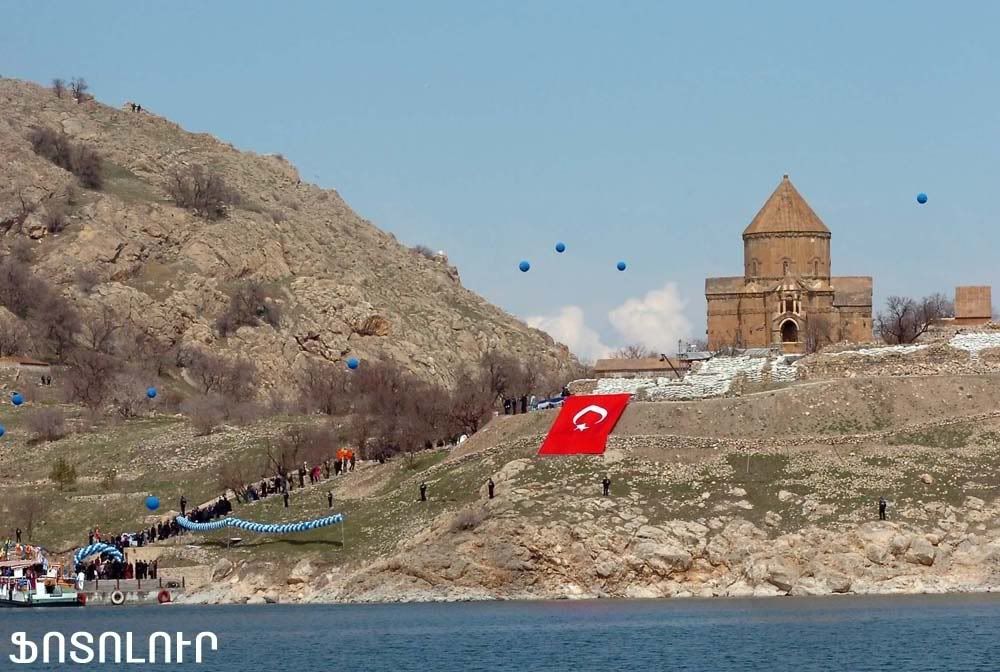
On March 29, Rep. Diane Watson (D.-Calif.) sent a letter to congressional colleagues titled, “The Truth about Armenian Churches in Turkey,” the Armenian National Committee of America reports. The letter came in response to Turkey’s efforts to advertise its renovation of the Holy Cross Church on the Aghtamar island in Lake Van.

Ms. Watson noted that while the Turkish government “is holding an event to tout the rehabilitation of an Armenian Church . . . hundreds of [such] Churches in Turkey, some dating as far back as the 4th century, have been neglected and even egregiously abused.” She added that this was part of “a desperate and malicious campaign, which began in 1915, to erase the Armenian people's physical and cultural existence in their historic homeland.” For more information about the issue, see www.teachgenocide.com/background/hist_sites.htm.

Rep. Hoekstra looking for intelligence in Azerbaijan

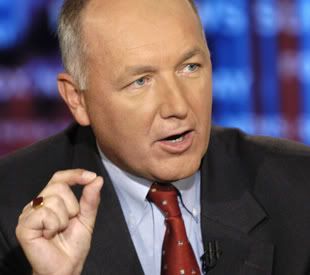
Rep. Pete Hoekstra (R.-Mich.), ranking member of the House Permanent Select Committee on Intelligence, was in Baku this week. Official reports suggested that Mr. Hoekstra’s April 3 meetings with Azerbaijani officials focused on the “development of inter-parliamentary relations,” but the representative is better known for his concerns about Azerbaijan’s southern neighbor.

In a March 4 television interview with Fox News, Mr. Hoekstra complained that "we still don't have the intelligence community overall to give us, as policy-makers, the information that we need to make good decisions in North Korea, Iran and other places." On March 27 he told the Holland Sentinels, his hometown paper, that his frequent foreign travel helped him fill in the gap.

State Dept. plays down Caucasus missile defense talk amid tensions with Iran

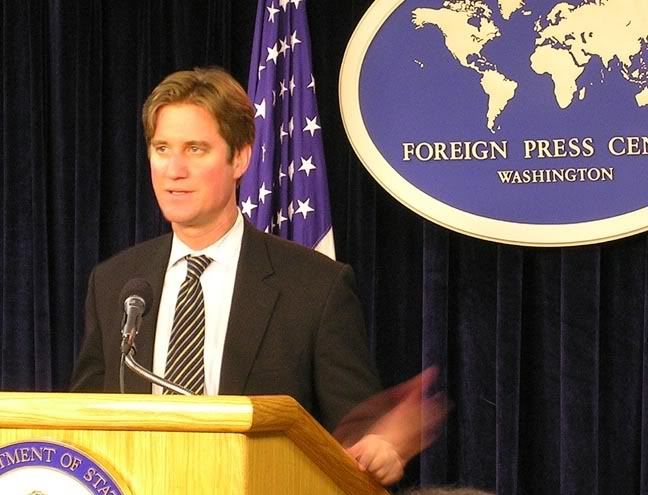
Deputy Assistant Secretary of State Matt Bryza was in Georgia last week. Speaking to the press in Tbilisi on March 30, he said, “the United States does not intend to deploy a missile-defense system in the Caucasus,” the Azerbaijan Press Agency (APA) reported.

Earlier this year, the United States announced plans to place parts of a European-theater missile-defense system in Poland and the Czech Republic. U.S. Missile Defense Agency Director Gen. Henry Obering added on March 1 that the United States would like to be able to deploy mobile anti-missile radar in one of the countries of the Caucasus.

Armenia, Azerbaijan, and Georgia have all denied receiving any deployment requests from the United States.

A retired U.S. Air Force planner, Col. Sam Gardiner, told the Armenian Reporter that while Iran does not yet have missiles capable of reaching Europe, U.S. missile defense plans were clearly part of an overall effort to put pressure on Iran. He added that having mobile radar units in the Caucasus might make sense to provide additional early warning to U.S. allies.

“This is a game of strategic chicken,” Mr. Gardiner said. It entails the ratcheting up of U.S. pressure, including a military buildup in the Persian Gulf and the detention of alleged Iranian operatives in Iraq. In recent months U.S. official have also expressed concerns about Iran’s policies on ethnic minorities, including Kurds, Arabs, and Azeris.

***
While in Tbilisi, Mr. Bryza noted that the United States would “want to have an opportunity” to use air bases in Azerbaijan “in emergencies,” according to APA. As part of its Caspian Security (Guard) initiative, the United States helped modernize several of Azerbaijan’s air bases.

(A day before Mr. Bryza’s statement, on March 29, the Azerbaijani government invited foreign diplomats to Haji Zeynalabdin Tagiyev [previously Nasosnaya] air base to showcase the MiG-29 fighter jets it just acquired from the Ukraine [see the March 24 edition of the Reporter for details]. On March 30, the muscle-flexing continued as Azerbaijani aircraft flew near Karabakh.)

In response to speculations that the United States would like to use Azerbaijan for strikes against Iran, the Azerbaijani Defense Ministry issued a statement on April 1 confirming Azerbaijan’s previously articulated position that it "will not create opportunities or conditions allowing foreign countries to use its territory against neighboring countries," RFE/RL reported.

Meantime, Vafa Guluzade, top advisor to at least three Azerbaijani presidents (1991–99) predicted that the United States intends to destroy and dismember Iran because it is an anti-American state that is “ignoring UN resolutions, which makes war inevitable,” day.az reported on April 3. Mr. Guluzade went on to warn that “since the U.S. is trying to weaken regional states, [in the future] Turkey might end up in the same situation as Iran today.”

Georgia’s NATO membership increasingly likely

On March 30, Mr. Bryza confirmed that the United States and Georgia share a common goal: “Georgia’s membership at a right time in NATO,” Civil Georgias reported. The “right time for Georgian membership in NATO is when Georgia has completed all of its reforms . . . and has continued what it’s been doing now for several month, which is pursuing constructive and peaceful [efforts] to resolving separatists conflicts in Abkhazia and South Ossetia within Georgia.”

NATO Secretary General Jaap de Hoop Scheffer had said on February 9 that the alliance should be "coming closer to honoring the ambitions of Ukraine and Georgia." Both chambers of the U.S. Congress have voted to support the two countries’ accession to NATO financially.

President Mikhail Saakashvili of Georgia in turn recently promised to more than double Georgia’s force in Iraq to 2,000, which would make it one of the largest contingents in the U.S.-led coalition there. Mr. Saakashvili is optimistic that Georgia could become a NATO member by 2009.

Cory Welt from the Washington-based Center for Strategic and International Studies told the Reporter that there has been more enthusiasm for Georgian membership lately. “They still have a lot to do, but the 2009 possibility is more realistic now.”

Last month, Georgia’s parliament voted 160-0 in favor of joining NATO. This policy is supported by most Georgians, but has caused lingering tensions with Russia. In apparent reference to their northern neighbor, Mr. Bryza assured Georgians last week that “no country that is not a member of NATO has any say over Georgia’s future within the alliance.”

Neither Armenia nor Azerbaijan has expressed a desire to join the alliance yet, but Mr. Welt believes that the two will likely “reassess their current position in light of Georgia’s membership.”