First published in May 24, 2008 Armenian Reporter.
Washington Briefing
by Emil Sanamyan
Senator proposes Millennium Challenge program cut
An amendment to Fiscal Year 2008 and 2009 U.S. foreign assistance would reallocate $225 million in funds set aside for but still unspent by the Millennium Challenge Corporation (MCC) to other foreign aid programs, the amendment’s sponsor Sen. Judd Gregg (R.-N.H.) initially reported on May 15.
The amendment has since passed as part of the Senate spending bill on May 20 and will next be considered in a conference with the House appropriators.
Sen. Gregg, who is ranking member (most senior GOP senator) on the Senate Appropriations Subcommittee on Foreign Operations, proposed to spend the funds for alleviating the Burma cyclone disaster as well as food aid programs elsewhere, to address rising prices.
Last June, Sen. Gregg already succeeded in cutting MCC’s FY 2008 budget to $1.2 billion from $1.4 billion, reallocating the difference to military aid for Jordan. That came on top of the Senate Democrats’ cut of the original Bush Administration request of $3 billion for MCC.
It is so far unclear whether MCC’s Armenia program, valued at $236 million over five years, will be in any way affected. Armenia’s eligibility for the program has received additional scrutiny following the recent post-election crisis.
Since its establishment earlier in the Bush Administration, MCC has consistently received larger congressional allocation than it has been able to expend, because it employed a stricter eligibility criteria for qualification than have other U.S. aid programs in the past.
Armenia left out of new debt relief program
Because of its improved economic performance, Armenia was left out of the new congressional proposal to forgive the debt of lower-income countries.
The Jubilee Act for Responsible Lending and Expanded Debt Cancellation of 2007 (H.R. 2634/S. 2166) would make several dozen countries in the lower and lowermiddle income category, including Georgia, Moldova, Kyrgyzstan, and Tajikistan, eligible for partial or full foreign debt cancellation.
The act has passed the House of Representatives and is expected to be considered by the Senate Foreign Relations Committee this month. The country qualifications are based on the World Bank’s lending category criteria.
Although Armenia and 14 other countries (including Azerbaijan, India, and Pakistan, among others) are also in the lower-middle income category, because of their somewhat higher incomes they receive World Bank assistance through both the International Development Agency (IDA) and other programs (the so-called “Blend”
category), making them ineligible for debt relief under this legislation.
According to sources familiar with the developments, last month a leading member of the congressional Armenian Caucus sought to amend the criteria to include Armenia, but since the change would make large debtors like India and Pakistan also eligible, the amendment did not succeed.
Armenia’s foreign debt amounted to $1.45 billion at the end of 2007.
UN General Assembly passes pro-Georgia resolution on Abkhazia
The General Assembly of the United Nations on May 16 voted 14-11 to pass a Georgia-sponsored nonbinding resolution affirming its claims on the breakaway and de facto independent republic of Abkhazia. Fully 105 countries abstained, and the rest did not vote.
The vote came two months after the General Assembly passed an Azerbaijan-sponsored resolution on Karabakh. In that vote Georgia sided with Azerbaijan, even though the three leading mediators in the Karabakh peace process, France, Russia and the United States, voted against the resolution.
In the May 16 vote, Armenia in turn sided with Russia, voting against the Georgian proposal.
Georgia was backed by the United States, Sweden, 10 eastern European states, as well as Azerbaijan. Most Western European states, as well as Turkey, abstained.
According to the UN news release, Armenia’s representative argued against the draft, saying that it focused on consequences of the conflict rather than addressing the core issues and was thus counterproductive to the conflict-resolution process.
A spokesperson for the Georgian Embassy in Armenia, Georgi Saganelidze, revealed on May 6 that Georgia had actively lobbied Armenia not to vote against the resolution. According to the Mediamax news agency, Mr. Saganelidze defended Georgia’s vote in favor of Azerbaijan, but still expected Armenia to continue to take a more neutral position on the Abkhazia issue, suggesting that a “no” vote could have consequences for bilateral relations.
Turkish lobby continues to target Genocide resolution
Pro-Turkey lobby groups remain focused on the congressional proposal affirming the U.S. record on the Armenian Genocide. In a Washington conference on U.S.-Turkey relations held on May 16, the Turkish Industrialists’ and Businessmen’s Association (TUSIAD), an influential business lobby, released an analysis it funded challenging the substance of the congressional resolution, Turkish media reported.
House Resolution 106, backed House Speaker Nancy Pelosi (D.-Calif.) and Majority Leader Steny Hoyer (D.-Md.) passed the Foreign Affairs Committee last October but has remained stalled in the House because of opposition from the Bush Administration and from several key Democrats in Congress.
The TUSIAD-sponsored analysis was prepared by David Saltzman of the Washington-based
Saltzman and Evinch LLP, the Turkish government’s veteran legal aides.
Also on May 19, Turkey’s ambassador to the U.S., Nabi Sensoy, discussed U.S.-Turkish cooperation at a session held on Capitol Hill. In recent months, events on U.S.-Turkish relations have taken place on nearly a weekly basis, suggesting a concerted public relations campaign by Turkey.

Showing posts with label United Nations. Show all posts
Showing posts with label United Nations. Show all posts
Wednesday, September 3, 2008


Monday, April 16, 2007
UN dismantles a Rwandan genocide exhibit after Turkey protests
Published in April 14, 2007 Armenian Reporter
UN dismantles a Rwandan genocide exhibit after Turkey protests
* Armenia's Foreign Ministry calls the decision "shameful"
by Emil Sanamyan
 WASHINGTON – A photo exhibition on genocide titled “Lessons from the Rwanda Genocide,” scheduled to open on April 9, has been dismantled and postponed because Turkey took issue with one of its sections that referred to the Armenian experience. UN Secretary General Ban Ki-moon was scheduled to offer opening remarks.
The event was planned by the U.K.-based Aegis Trust, which seeks to prevent genocide worldwide. After receiving approval from the UN Secretariat, it began to install the exhibit on April 5. The Turkish mission intervened after one of its diplomats noticed the reference, which read: “Following World War I, during which one million Armenians were murdered in Turkey.”
The Armenian mission sought to prevent the postponement by negotiating a compromise language that would remove the words “in Turkey” while maintaining the reference to Armenians.
Ambassador Armen Martirossian, Armenia’s Permanent Representative to the United Nations, told the Reporter that in a meeting last week with the Undersecretary-General for Public Information, Kiyotaka Akasaka, Martirossian wanted to make sure the Rwanda exhibit goes ahead.
“We take the Rwandan Genocide, the anniversary of which is also marked in April, as our own pain. As a nation that survived the Genocide, we understand the importance of honoring the memory of the victims," Ambassador Martirossian said.
 But according to Aegis chief executive Dr. James Smith, officials from the U.N Secretariat told him over the weekend that “the sentence [referring to Armenians] would have to be eliminated or the exhibition would be struck.”
“We felt as a matter of principle you can't just go around striking things out," Mr. Smith told The Associated Press. "It is a form of denial, and as an organization that deals with genocide issues, we couldn't do that on any genocide, and we can't do this."
Armenia's Foreign Ministry issued a strongly worded statement on the matter on April 10: "It is unacceptable that a UN member-state, committed to world peace, dares to export such intolerance to the United Nations. Armenia cannot accept that the history of the world, the current experiences of suffering of the people of Rwanda, of Darfur, and Armenians’ memories of injustice are subjected to such callous, cynical dismissal.”
"It is ironic and shameful that this Turkish-led postponement should befall an event which was to provide lessons on how to respect human rights and prevent genocides. Instead, the lesson here is one of total disrespect for history and memory," the Foreign Ministry statement concluded.
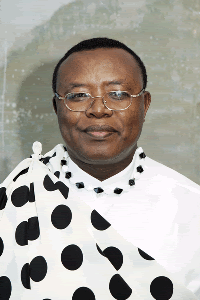 Ambassador Joseph Nsengimana, Rwanda’s Permanent Representative to the UN, wrote to the UN Secretary-General to express “profound regret” that the exhibit was postponed over “reasons unrelated” to the UN mandate on the Rwanda Genocide reported on April 9 (see www.InnerCityPress.com for details).
"If we can't get this right, it undermines all the values of the UN," Mr. Smith of Aegis said. "It undermines everything the UN is meant to stand for in terms of preventing'' genocide.
He continued: ''You can't learn the lessons from history if you're going to sweep all of that history under the carpet. And what about accountability? What about ending impunity if you're going to hide part of the truth? It makes a mockery of all of this.''
UN dismantles a Rwandan genocide exhibit after Turkey protests
* Armenia's Foreign Ministry calls the decision "shameful"
by Emil Sanamyan
WASHINGTON – A photo exhibition on genocide titled “Lessons from the Rwanda Genocide,” scheduled to open on April 9, has been dismantled and postponed because Turkey took issue with one of its sections that referred to the Armenian experience. UN Secretary General Ban Ki-moon was scheduled to offer opening remarks. The event was planned by the U.K.-based Aegis Trust, which seeks to prevent genocide worldwide. After receiving approval from the UN Secretariat, it began to install the exhibit on April 5. The Turkish mission intervened after one of its diplomats noticed the reference, which read: “Following World War I, during which one million Armenians were murdered in Turkey.”
The Armenian mission sought to prevent the postponement by negotiating a compromise language that would remove the words “in Turkey” while maintaining the reference to Armenians.
Ambassador Armen Martirossian, Armenia’s Permanent Representative to the United Nations, told the Reporter that in a meeting last week with the Undersecretary-General for Public Information, Kiyotaka Akasaka, Martirossian wanted to make sure the Rwanda exhibit goes ahead.
“We take the Rwandan Genocide, the anniversary of which is also marked in April, as our own pain. As a nation that survived the Genocide, we understand the importance of honoring the memory of the victims," Ambassador Martirossian said.
But according to Aegis chief executive Dr. James Smith, officials from the U.N Secretariat told him over the weekend that “the sentence [referring to Armenians] would have to be eliminated or the exhibition would be struck.” “We felt as a matter of principle you can't just go around striking things out," Mr. Smith told The Associated Press. "It is a form of denial, and as an organization that deals with genocide issues, we couldn't do that on any genocide, and we can't do this."
Armenia's Foreign Ministry issued a strongly worded statement on the matter on April 10: "It is unacceptable that a UN member-state, committed to world peace, dares to export such intolerance to the United Nations. Armenia cannot accept that the history of the world, the current experiences of suffering of the people of Rwanda, of Darfur, and Armenians’ memories of injustice are subjected to such callous, cynical dismissal.”
"It is ironic and shameful that this Turkish-led postponement should befall an event which was to provide lessons on how to respect human rights and prevent genocides. Instead, the lesson here is one of total disrespect for history and memory," the Foreign Ministry statement concluded.
Ambassador Joseph Nsengimana, Rwanda’s Permanent Representative to the UN, wrote to the UN Secretary-General to express “profound regret” that the exhibit was postponed over “reasons unrelated” to the UN mandate on the Rwanda Genocide reported on April 9 (see www.InnerCityPress.com for details)."If we can't get this right, it undermines all the values of the UN," Mr. Smith of Aegis said. "It undermines everything the UN is meant to stand for in terms of preventing'' genocide.
He continued: ''You can't learn the lessons from history if you're going to sweep all of that history under the carpet. And what about accountability? What about ending impunity if you're going to hide part of the truth? It makes a mockery of all of this.''
Subscribe to:
Posts (Atom)
