Showing posts with label Erdogan. Show all posts

Tuesday, April 7, 2009

Erdogan spars with Peres at Davos

This was first published in February 7, 2009 Armenian Reporter

Erdogan’s verbal assault pits Turkey against Israel
Armenian Genocide recognition seen as leverage
by Emil Sanamyan

Washington
, - Turkish prime minister Recep Tayyip Erdogan's public squabble with Israeli president Shimon Peres was welcomed in Turkey and the rest of the Middle East, but created anxiety in Israel and the United States.

During a January 29 panel discussion at the World Economic Forum in Davos, Switzerland, Mr. Erdogan became increasingly agitated as Mr. Peres defended the recent Israeli military action against Palestinians in Gaza. During his speech, the Israeli president raised his voice and pointed his finger at Mr. Erdogan, who had earlier condemned Israeli action as a "crime against humanity."

In response Mr. Erdogan angrily described Israeli leaders as murderers and sadists.

"When it comes to killing, you know well how to kill," he told Mr. Peres. "I know very well how you killed children on the beaches. Two of Israel's prime ministers personally told me that they felt happy when they [invaded] Gaza."

The Turkish leader condemned those present for applauding Mr. Peres and stormed out. The packed audience at the forum included a number of foreign officials, including Valerie Jarrett, senior advisor to President Barack Obama.

"New World leader" who "humiliated the Zionists"

Thousands of Turks welcomed Mr. Erdogan as he arrived at Istanbul airport in the early hours of January 30. Waving Turkish and Palestinian flags, crowds held signs that read "welcome conqueror of Davos" and "a new world leader," according to the Jamestown Foundation's summary of Turkish TV and press reports.

"I only know that I'm responsible for protecting the honor of the Turkish Republic, the Turkish nation from A to Z," Mr. Erdogan said at the airport, the New York Times reported. "It was a matter of my country's respect and prestige. I couldn't have allowed anyone to hurt the prestige and especially the honor of my country."

Leader of Turkish ultra-nationalists Devlet Bahceli praised Mr. Erdogan, expressing hope that his assertive tone would also be reflected in dealing with Kurds and "relations with Armenians against the so-called genocide claims."

Iranian president Mahmoud Ahmadinejad chimed in, welcoming the Turkish premier's demarche, saying it "humiliated the Zionists" and "disgraced" Israel, Press TV reported. One of the Iranian ayatollahs suggested that Mr. Erdogan deserved a Nobel Peace Prize for his activism.

But Artak Shakarian, an Armenian expert on Turkey, argued that Mr. Erdogan's rhetoric was meant in part to sideline Iran and position Turkey as the "leading defender of the Muslim world," Regnum news agency reported on February 2.

And Cengiz Candar, a Turkish expert on the Middle East, told Radikal newspaper that Turkey gained "moral leadership" in the region, even though the region's Arab leaders themselves appeared to be less than thrilled with Mr. Erdogan's rhetoric.

Victim of "biased" moderation

In a press conference after the panel and before departing Switzerland, Mr. Erdogan stressed that he condemned anti-Semitism and that he had no intention to sever Israel-Turkish ties.

Instead, Mr. Erdogan channeled his anger toward the panel's moderator, David Ignatius of the Washington Post, complaining that he had allocated less time to him than to Mr. Peres.

Several Turkish and Azerbaijani media outlets focused on Mr. Ignatius's ethnicity.

Azeri Press Agency (APA) ran a short story with the revealing headline, "Moderator of panel cutting Erdogan off is of Armenian origin." In tortured English APA alleged that "Ignatius [was] supporting so-called Armenian genocide did not want his nationality was on the agenda. He bewares of opinions casting shadow upon his objectivity."

One of the leading Turkish newspapers, Hurriyet, suggested that Mr. Ignatius was in cahoots with the "Armenian lobby" and described him as "Jewish American journalist of Armenian descent."

The latter description is not surprising since, according to a recent opinion poll, a significant portion of Turks believe that Armenians are of Jewish faith, and Turkish nationalists tend to target both Jews and Armenians.

(In reality, Mr. Ignatius is of Armenian descent and has written about it. His father Paul Ignatius, born Poghos Ignatosian to a family of immigrants from Kharpert, served as Secretary of the Navy in the late 1960s and was president of the Washington Post.)

Misunderstood "friend of Israel"

In aftermath of the incident both Turkish and Israeli officials were at pains to suggest that nothing extraordinary had happened.

Israel's ambassador to Turkey, Gabby Levy, was quoted on Turkish television as saying: "There can be a difference in opinion between close, friendly countries from time to time, and we, Turkey and Israel, especially have different views on Hamas and Iran."

Abraham Foxman of the Anti-Defamation League repeated the argument to the Jerusalem Post, saying cooperation would continue despite the "inappropriate harsh statement by the [Turkish] leadership." He told the New York Times that the league had not changed its opposition to the Armenian Genocide bill in Congress.

The Economist noted that "Israel has invariably chosen to turn a deaf ear to Turkey's occasionally fierce rhetoric for the sake of that strategic liaison," recalling that Mr. Erdogan called Israel a "terrorist state" back in 2004. Nevertheless, Turkey and Israel have continued to enjoy growing commercial ties, with more than half a million Israelis vacationing in Turkey last year.

But this time around, a number of Western commentators argued the unprecedented level of mutual rancor undermined Turkey's image as a pro-Western country. Anonymous figures in the Israeli government and Jewish-American groups sought to remind Turkey of potential repercussions.

List of possible punishments

According to the Jerusalem Post, the Israeli Defense Ministry was considering imposing restrictions on types of weapons systems Israel sold to Turkey.

"Just like we don't sell advanced military platforms to Jordan and Egypt [Arab states that signed peace agreements with Israel], we may decide not to sell to Turkey," the newspaper cited a senior defense official as saying.

It also cited a senior diplomatic official as saying that Turkey "lost all credibility as an honest broker" in negotiations between Israel and Syria. And, furthermore, that "there won't be any [Israeli] communication with Erdogan himself. He went too far, and we simply can't trust him again."

And "an official with a leading American Jewish organization" warned that "next time" Jews and Israelis "might not come to Turkey's aid or equivocate quite so much on the issue" of congressional resolutions on the Armenian Genocide.

Similarly, the Economist predicted on January 29, "if anti-Israeli rhetoric in Turkey persists, the Israeli lobby in the United states could hit back by backing a congressional resolution to call the mass killings by Turks of some 1m Armenians ‘genocide'."

The British newspaper further revealed, "the Israelis persuaded the Turks to cancel a proposed essay and drawing contest for schoolchildren to air their feelings of hatred towards Israel [over the war in Gaza].

"Israeli officials were apparently poised to respond by proposing a programme in Israeli schools for discussing the genocide of Armenians by Turks in the first world war."

Sunday, December 21, 2008

Pallone on U.S. support for NKR; Erdogan on Bush & Obama; Vatican on Armenian Genocide; EU's new FSU plan; Caucasus on NATO ties

First published in November 29, 2008 Armenian Reporter

Washington Briefing
by Emil Sanamyan

Rep. Pallone: U.S. should step up support for Karabakh


"It is necessary that the United States place an importance on the existence of the smaller states in the Caucasus," Rep. Frank Pallone (D.-N.J.) said in a statement released following his meeting with president of the Nagorno-Karabakh Republic, Bako Sahakian, on November 22 in New York.

"The United States must not ignore the unique cultural identities of the people of Nagorno-Karabakh," the co-chair of the Congressional Armenian caucus went to say. "As a country founded on self-determination, we must champion the rights of people everywhere to self-determination."

While welcoming the November 2 Moscow declaration on Karabakh signed by the presidents of Armenia and Azerbaijan, Mr. Pallone also called for more "robust" U.S. role in the peace process under the incoming administration of Barack Obama.

Speaking on November 23 in Los Angeles, Mr. Sahakian welcomed President-elect Obama's "readiness to help meet the challenges faced by the Armenian nation." Karabakh's president is in the United States for the annual fundraising effort organized by the Armenia Fund in Los Angeles.

Turning to specific priorities for next year, Mr. Pallone said that as this year he will "urge a shift in U.S. aid to Nagorno-Karabakh from humanitarian to developmental programs [to] help rebuild Nagorno Karabakh's infrastructure [and] secure the health and safety of [its] people."

Turkish leader derides Bush, lobbies Obama

Turkey's Prime Minister Recep Tayyib Erdogan used an invitation from President George W. Bush to an economic summit in Washington to lecture President-elect Barack Obama and to lambast the Bush administration's policies as "disastrous."

Although Mr. Obama himself declined to take part in the summit, he asked former Secretary of State Madeleine Albright, former Rep. Jim Leach (R.-Iowa), and Philip Gordon of the Brookings Institution to meet with foreign leaders on his behalf.

According to Turkish media, in meetings with Mr. Obama's representatives and in speeches at Brookings on November 14 and a day earlier at the Columbia University, Mr. Erdogan touted Turkey's importance and warned President-elect Obama about Turkey's "sensitivities" such as its insistence on denial of the Armenian Genocide and opposition to a de facto Kurdish state in Iraq.

In his presidential campaign, Mr. Obama repeatedly pledged to drop the Bush administration's policy and stop deferring to the Turkish lobby when it came to U.S. policy on the Armenian Genocide.

Separately, Mr. Obama pledged to pull U.S. troops out of Iraq within sixteen months.

Mr. Erdogan criticized the withdrawal plan as "premature" and the recognition pledge as "immature."

At Brookings, the Turkish leader claimed that "U.S. support is essential for maintaining the dialogue" between Turkey and Armenia, implying that Ankara would stop seeking normal relations with Yerevan if President Obama, in Mr. Erdogan's words at Columbia, acquiesced to Armenian-Americans' "cheap political lobbying" and speak clearly on the genocide in Ottoman Turkey.

Also at Columbia, Mr. Erdogan spoke of his desire to follow the recent Russian example and host a meeting between the Armenian and Azerbaijani presidents.

And in Washington, Mr. Erdogan repeated his offer to mediate between the United States and Iran, while suggesting that Tehran cannot be forced to drop its nuclear program while other countries (presumably Israel, India, and Pakistan in addition to the United States, Russia, France, Britain, and China) retain nuclear weapons.

Vatican: Memories of Armenian Genocide need to be overcome


"The Holy See's official position was expressed in Pope John Paul II visit in Armenia [where he] spoke about genocide," Cardinal Walter Kasper, president of the Pontifical Council for Promoting Christian Unity and the Vatican's voice on interfaith relations told Vatican Radio on November 22 (audio of the program is available at www.vaticanradio.org).

Cardinal Kasper was asked about the issue on eve of a meeting between Pope Benedict XVI and Catholicos Aram I of Cilicia who visited the Vatican from November 23 to 27.

In Armenia, "we visited the memorial of victims of what is called genocide, even though the Turkish [government] does not recognize this term. Normally it is called in this way," the cardinal recalled.

"In any case, the problem is not the term. It is a fact that thousands of Armenians were killed and starved and the terrible memories are there and we must help overcome these memories and also to improve if possible the relations between Armenia and Turkey, which are neighboring states but which have no relations with each other. And I don't know if the Holy See can do anything in this regard but of course we are always with the victims and not with those who did the bad things."

During his November 2006 trip to Turkey, Benedict XVI referred to "tragic circumstances [Armenians] endured in the last century," according to a report by www.asianews.it.

According to the Catholic News Service, in meeting with the Armenian delegation on November 24, Pope Benedict XVI also referred to Armenians' "unspeakable suffering."

In turn, Aram I said it was essential that the Armenian Genocide is explicitly acknowledged to help prevent new genocides "by affirming the rights of all people to dignity, a dignified life, freedom, and self-determination."

The Holy See last May hosted Karekin II, the Catholicos of All Armenians, who at the time appealed "to all nations and lands to universally condemn all genocides that have occurred throughout history," saying that "denial of these crimes is an injustice that equals the commission of the same."

In the meeting this week, Benedict XVI also noted "the escalation of persecution and violence against Christians in parts of the Middle East and elsewhere," apparently referring to attacks on Christians, including the Armenian community, in the U.S.-occupied Iraq.

"Only when the countries involved can determine their own destiny, and the various ethnic groups and religious communities accept and respect each other fully, will peace be built on the solid foundations of solidarity, justice and respect for the legitimate rights of individuals and peoples," the pope said.

European Union weighing ties with Russia, ex-Soviet republics

"In recognition of European aspirations" of Belarus, Moldova, Ukraine, Georgia, Armenia, and Azerbaijan, the European Commission is set to propose a new Eastern Partnership project to encompass the six republics in June 2009, www.EUObserver.com reported on November 24.

The EU Commission's draft communication seen by EU Observer describes relations between the European Union and Russia would take priority over the proposed new project.

At the same time, in an implicit swipe at Russia, the document notes that "the conflict in Georgia in August 2008 and its broader repercussions have resulted in increased awareness of the vulnerability of Eastern partners.... There is a sense of urgency among member states as to the need to enhance relations with our Eastern neighbors to support them in drawing closer to the EU."

Until now, EU engaged the six countries through its European Neighborhood initiative, which also involves the countries of the Levant and North Africa.

The new initiative, first floated by Poland and Sweden last May, is meant to send "a clear and lasting political message of EU solidarity" and to "produce benefits perceived and recognized by citizens of the partner countries."

Among them would be increased European aid to the six ex-Soviet countries, easing of visas for travel, and "a single deep and comprehensive Free Trade Area, providing the basis for the development of a common internal market, such as the European Economic Area [EEA]," such as EU now enjoys with Iceland, Norway, and Liechtenstein.

But to qualify, the six states would be required to "take over [the entire EU legal code], including the acceptance of European Court of Justice rulings."

Caucasus countries clarify NATO policies

NATO foreign ministers will meet in Brussels on December 2-3 to find face-saving solutions that would help postpone immediate membership action plans (MAPs) for Ukraine and Georgia, news agencies report. Both countries were promised eventual membership at the NATO summit last April.

"At the moment [NATO membership] is not on Armenia's agenda," President Serge Sargsian told Euronews TV during his trip to European Union and NATO headquarters in Brussels in early November, reiterating a longstanding policy.

At the same time Mr. Sargsian added that Armenia wants to continue to partner with NATO, calling such cooperation "integral to [Armenia's] real security."

And in an interview with Frankfurter Allgemeine Zeitung published on November 11, Mr. Sargsian disagreed with the view that one of the lessons of the war in Georgia is that NATO should no longer be in the Caucasus. At the same time he noted that Armenia does not want to become an alliance member and is against "dangerous dividing lines" being drawn in the Caucasus.

In Baku, spokesperson for President Ilham Aliyev said on November 20 that Azerbaijan has no plans to enter NATO, Mediamax news agency reported.

"The talks concerning this issue do not reflect reality," said Elnur Aslanov. And in what may be the most belated correction in history, he added that the "statements about placing of NATO military bases in the territory of Azerbaijan," initiated in 1999 by Vafa Gulizade, senior aide to then-President Heydar Aliyev, "are also groundless."

For years, Azerbaijani officials have been more ambivalent about country's NATO aspirations.

Meanwhile, Georgia remains committed to NATO membership and "the decision, made in Bucharest, according to which Georgia will become a member of the Alliance, is still in effect", Foreign Minister Eka Tkeshelashvili said last week.

But speaking to Reuters on November 25, Ms. Tkeshelashvili appeared to concede that no action plan that could put a timeframe on future membership was forthcoming.

Thursday, September 25, 2008

Briefly: Azeri Muslim leader meets rabbi, insults Armenians; Armenian 'spies' captured; Turkish politics update

Washington Briefing
by Yelena Osipova and Emil Sanamyan

Azerbaijan shares its brand of tolerance with the L.A. Museum of Tolerance…


“Falsehood and treason run through Armenians’ blood,” Azerbaijan’s Muslim leader informed Rabbi Abraham Cooper, Associate Dean of the Simon Wiesenthal Center with its Los Angeles–based Museum of Tolerance, according to an Azeri-Press Agency report cited by Day.az on July 22.

During a meeting with the visiting rabbi, Sheikh-ul-Islam Haji Allahshukur Pasha-zade reportedly added, “They ate our bread, but spoke against us while leaving,” in a possible reference to hundreds of thousands of Armenian refugees expelled from Azerbaijan.

Two years ago, Mr. Pasha-zade called on Azerbaijanis to be ready for “jihad” (a holy war) against Armenians. Rabbi Cooper reportedly described Azerbaijan as “a tolerant
country, where everyone can practice his religion without any restrictions,” in a Day.az interview published the next day.

He pointed, in particular, to the presence of the Jewish community in Baku.

Rabbi Cooper went on to say that Azerbaijan should do more to “inform the US community in details about their country and especially about [the Karabakh] conflict. The United States are mostly well informed about the ‘genocide of Armenians.’ It would be good if Azerbaijanis held work for informing Americans about the Armenian-Azerbaijani conflict.”

Azerbaijan’s government and the country’s news outlets are known for frequently distorting comments by foreign visitors. The Armenian Reporter requested a clarification from the Wiesenthal Center, which could not be provided as of press time because Rabbi Cooper was traveling.

…rakes in another batch of “Armenian spies”

In spite of the massive doses of incessant anti-Armenian propaganda, a significant number of individual Azerbaijanis still cooperate with Armenian intelligence services, according to the Azerbaijani government’s declarations.

Citing the Azeri-Press Agency, Day.az reported on July 24 on the recent sentencing of five members of the Azerbaijani military to 13–14 year prison sentences for “high treason” and “violation of the military code.”

The service members reportedly served in the Fizuli district along the Line of Contact with Karabakh and were accused of “cooperation with Armenian intelligence services.”

It is unclear whether the five were counted among 13 alleged Armenian spies whose capture was mentioned among other arrests made in 2007 by Azerbaijan’s Deputy National Security Minister Ali Shafiyev in an interview to the Trend news agency last month.

Turkey in anticipation of another political crisis

Turkey’s ruling Justice and Development Party (AKP) is considering holding early elections as a backup plan for retaining power in case the Constitutional Court decides to ban Prime Minister Recep Tayyip Erdogan and 39 senior party members from joining political parties for five years.

The mildly Islamist AKP first won control of Turkish government in a 2002 election that followed an economic crisis. The party has since increased its popularity and influence; it performed strongly in the 2007 parliamentary elections and also won the presidency.

Recent polls show that even if banned, Mr. Erdogan’s party in early elections would probably retain the 300 seats it currently holds in the 550-seat parliament, and would consequently get him back into power, even if he ran as an independent, Bloomberg news agency reports.

The court, which has previously shown its antipathy toward the AKP, will start hearings on the government’s alleged antisecular tendencies on July 28.

The lawsuit against the AKP is seen as an attempt on the part of the Turkish military-secular establishment to implement another soft coup d’état against a government that it accuses of “undermining” Turkey’s secular system.

In recent months, in an apparent response by the AKP, Turkish police have arrested dozens of individuals linked to the military and security agencies, implicating them
in conspiring to commit murders and other crimes as part of a plot against the government.

Meanwhile, the Turkish parliament’s Human Rights Commission run by the AKP issued on July 23 a report on the investigation into the murder of Turkish-Armenian journalist Hrant Dink, who was killed in a nationalist plot in January 2007.

The 180-page report did not name individuals, but said “there has been negligence, fault and bad coordination both on the part of the police department and the gendarmerie,” who failed to respond to several tips on his assassination plan, Turkey’s Hürriyet newspaper reported.

So far only two security officers have been charged with negligence in Mr. Dink’s murder. The investigation has been regarded a test of the AKP’s resolve to challenge the “deep state,” the mafia that includes elements of the military, security forces, nationalists and plain criminals.

In addition to shady links between the suspects and security institutions, lawyers representing the Dink family have, at various times, accused the police of destroying vital evidence and concealing crucial information from the court and the prosecution, the pro-AKP Zaman newspaper reported.

Tuesday, July 22, 2008

Turkey’s prime minister, in U.S., seeks support against Kurds


This was originally published in November 10, 2007 Armenian Reporter.
by Emil Sanamyan

Acknowledges Kocharian’s offer on relations

WASHINGTON – Kurdish protestors and tight security accompanied Turkish Prime Minister Recep Tayyip Erdoğan as he visited here earlier this week to secure U.S. support against Kurdish rebels. He also used the opportunity to deny the Armenian Genocide again and indicated no plans to improve relations with Armenia.

No change in Turkey’s Armenia policy
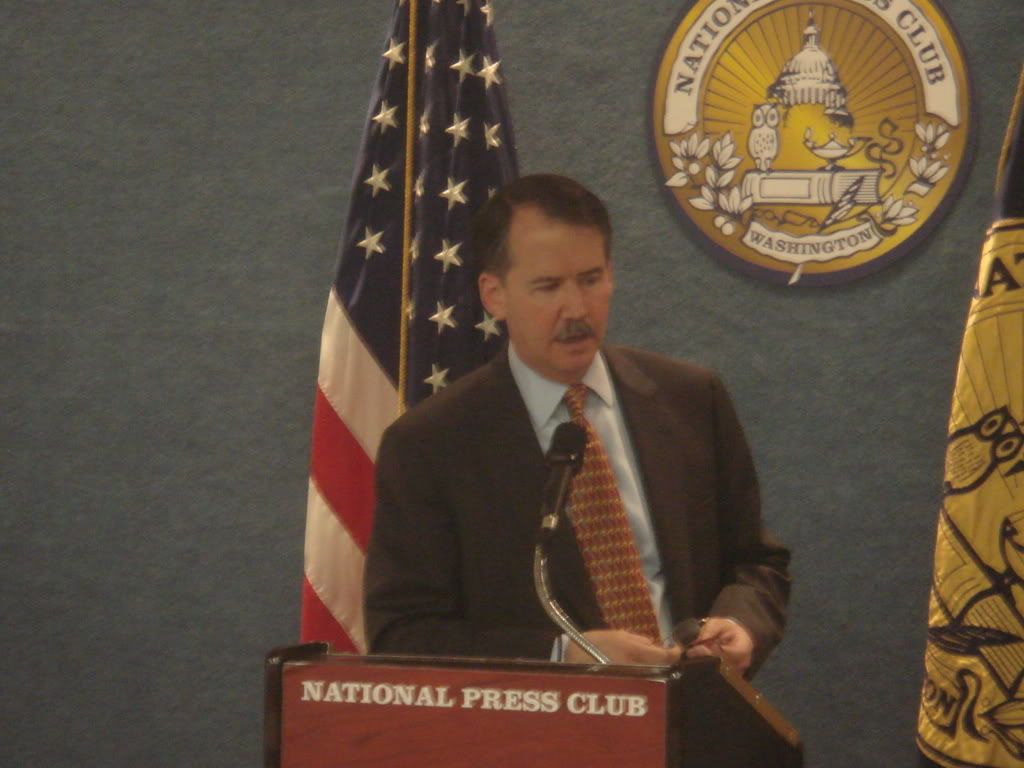
Speaking at the National Press Club on November 7, Mr. Erdoğan again denied the Genocide and claimed that Turkey wants “to reach a common understanding of this painful period in our history, but I still today have not received a response to my letter of 2005” on establishing a commission of historians. “Since we have not received a response, there is nothing I can say further on the subject.”

But just hours later at the Center for Strategic and International Studies (CSIS), the Turkish prime minister was reminded by Arman Israelian of the Armenian Embassy in Washington that Armenia’s President Robert Kocharian had in fact responded to the letter and offered to establish relations without preconditions along the lines of Armenia’s long-standing policy.

Two and a half years after that exchange, Mr. Erdoğan acknowledged the response, adding “but that was not the answer I was looking for.” He went on to insist that Turkey would not establish relations with Armenia or open the border unless Armenia agrees to what amounts to questioning the facts of the Armenian Genocide.

Turkey’s President Abdullah Gül, during a November 7 visit to Azerbaijan similarly said that “as long as Armenia initiates decisions on events in the Ottoman Empire in parliaments around the world, it should not expect normalization of relations with Turkey,” the Itar- Tass news agency reported.

Erdoğan upbeat on U.S. position on Kurds
Following talks with PresidentGeorge W. Bush, Mr. Erdoğan told Turkish press that “we got what we came for,” the Jamestown Foundation reported the next day, implying that the U.S. would not object to Turkish attacks against Kurdish rebels inside Iraq. Mr. Bush reportedly promised to provide Turkey with “good, sound intelligence delivered on a real-time basis, using modern technology” to deal with Kurdish rebels.

“Nobody told us not to launch a military operation. They just told us we were right,” Mr. Erdoğan said as hundreds of protestors waved Kurdish flags and chanted “Turkey out of Kurdistan!” and “Stop Turkish Aggression!” just outside the White House.

Much of the Turkish press appeared to agree with Mr. Erdoğan’s assessment and claimed that Turkey would continue to stage small-scale aerial and ground operations inside Iraq aided by intelligence provided by the U.S., which has opposed a large-scale invasion.

Such an invasion has been all but ruled out for now, with former Turkish Armed Forces chief Gen. Hilmi Özkök arguing that it would serve no significant military purpose. But other generals suggested that a credible threat of invasion was necessary to win the cooperation of U.S.–backed Iraqi Kurds.

Passions inside Turkey have diminished somewhat as Kurdish rebels released eight Turkish soldiers its forces captured last week.

Nareg Seferian contributed research for this report.

Saturday, July 7, 2007

In Brief on Amb. Evans, State Dept. report, Fatullayev, Dink murder, Elections in Turkey and France

First published in the Armenian Reporter on April 28, 2007

From Washington, in Brief
By Emil Sanamyan

Amb. Evans sees Turkish government’s role in his forced retirement


Pressure by Turkey may have played a role in his forced retirement, former U.S. Ambassador John M. Evans said at the National Press Club in Washington on April 24. Asked if he thought the Turkish government was involved, Mr. Evans said “I believe possibly so. I want to tell this story in my [upcoming] book. I do know that there were some telephone calls made.”

Last September, in a letter to the Senate Foreign Relations Committee, the State Department admitted that three of its officials were contacted by Turkish lobbyists from the Livingston Group within days of Mr. Evans’ comments in February 2005.

Mr. Evans also mentioned that he “did not write the apology” that was issued in his name following the remarks. “It was dictated to me and it was posted on the web site,” he said. That statement described his remarks as “personal” and “improper.”
Asked if there was a written State Department directive not to use the word Genocide in the reference to the Armenian experience, Mr. Evans responded “I have never seen such a piece of paper. It is more an omission that it is a commandment. It is simply a kind of a taboo.”

In April 2005, Mr. Evans was selected for the American Foreign Service Association’s Constructive Dissent Award. “That announcement was made in a State Department telegram signed by [the Secretary of State Condoleezza] Rice,” he recalled. But in June 2005 Mr. Evans was summoned to Washington and “interrogated about the fact that [he] did not decline the award.” The award was ultimately withdrawn on a technicality.

Speaking in reference to the proposed House Resolution 106 (H. Res. 106), Evans said that “I do believe this Congress should pass [the Armenian Genocide] resolution.” He argued that unless there is political pressure on Turkey on this issue, the “natural default reaction” there will prevail and no substantial steps towards Armenian-Turkish normalization would be taken.

A book by Mr. Evans about his experience and views on ways to address the Armenian Genocide issue is currently with an editor and is expected to be released in spring 2008.

State Department flip-flops on controversial passage in Human Rights report

The latest annual State Department Report on Human Rights Practices, first released on March 6, caused controversy in Armenia because of a sentence that sounded like official lingo in its suggestion that Armenia “continues to occupy the Azerbaijani territory of Nagorno-Karabakh and seven surrounding Azerbaijani territories.”

The sentence was at odds with the carefully crafted U.S. policy language on Karabakh. While the U.S. recognizes Azerbaijan’s territorial integrity in principle (as it does that of Iraq, for example), U.S. officials typical clarify that “Karabakh’s status is a matter negotiations.”

The implication is that while the U.S. does not officially recognize Karabakh’s de-facto independence from Azerbaijan, it does not side in favor of Azerbaijan’s claim on Karabakh either.

Furthermore, every known peace proposal that U.S. mediators have helped draft in the last seven years would, if implemented, open the way to international recognition of Karabakh’s secession.

Foreign Minister Vartan Oskanian took issue with the report’s wording and Armenian officials have requested that State Department correct the language. According to Mr. Oskanian, U.S. officials said it was an “obvious mistake on their part” and promised to “try to make a correction in that document.” Such corrections are rare because of the bureaucratic hurdles involved.

Last week, the text was revised to say that “Armenian forces occupy large portions of Azerbaijan territory adjacent to Nagorno-Karabakh. Armenian officials maintain that they do not "occupy" Nagorno-Karabakh itself.”

While the revised version included a strange negation of the obvious (Iraqi Kurds are not accused of “occupying” Iraqi Kurdistan, for example), and the Azerbaijan portion of the report remained unedited (another bureaucratic hurdle), the change still “caused bewilderment” in Baku, which protested by calling off a previously planned official visit to Washington.

On April 26, State Department, apparently as a result of the Azeri protest, went back to the initial language. The Mediamax news agency cited Armenia’s Foreign Ministry spokesman as saying that the second change was a reflection of “frivolous attitude” to the report.

Asked by the Reporter to clarify the issue, State Department’s Deputy Spokesman Tom Casey admitted that his agency can be “fallible,” but stressed that “the bottom line here is that U.S. policy with respect to Karabakh is long-standing and it has not changed.”

Azerbaijan imprisons journalist for [allegedly] taking a moderate line on Karabakh

The frequently persecuted Azerbaijani journalist Eynulla Fatullayev was sentenced to 2.5 years in prison on charges of “libel” on April 20, local and international news agencies reported. International organizations and media watchdogs criticized the move.

Mr. Fatullayev is the editor of the twice shut down “Realny Azerbaijan” and former deputy editor for even more frequently shut down “Monitor.” That publication finally closed after the March 2005 assassination of its chief editor Elmar Huseynov (who, Mr. Fatullayev believes, was killed with government’s involvement; perpetrators have not been found to date).

Unlike most of Azerbaijan’s media, Mr. Fatullayev, and the late Mr. Huseynov before him, allowed for relatively free discussion of issues related to the Karabakh conflict and refused to tow the government’s anti-Armenian hate-mongering. Mr. Fatullayev first earned nationalists’ ire after he visited Nagorno Karabakh in 2005, shortly before Mr. Huseynov’s murder.

The current “libel” charges arose from accusations that Mr. Fatullayev was “an Armenian agent of influence” who played down Azerbaijani civilian deaths during the Karabakh war, which he says he did not. In a sense, Mr. Fatullayev’s prosecution is similar to that of Hrant Dink, who was charged with writing what he did not and targeted for assassination as a result.

Turkish media soul-searching again, as Dink investigation appears stalled

Following the heinous murder of three Christians in the town of Malatya on April 18, the Turkish media is again full of introspective articles on the nature of nationalist violence in Turkey. The Turkish Daily News editor Yusuf Kanli wrote on April 20 that murders such as those in Malatya, that of Hrant Dink last January and others, continue to take place because “the real culprits,” those who organized the crimes are still “at large.”

Investigators have arrested 11 individuals in connection to Dink’s murder. The 11 are assorted nationalists from the Black Sea city of Trabzon and include the self-confessed assassin and the head of the local chapter of the nationalist Grand Unity Party. (For investigation details see February 24 Reporter). But none of the security officials believed to be involved have been legally sanctioned.

Asked by the Reporter on April 17, when organizers of the murder might be found, Chairman of the Turkish Parliament’s Foreign Relations Committee Mehmet Dulger produced a copy of a Turkish newspaper with a picture of crowds at Dink’s funeral and said that it showed how “Turkey is fed up with allegations concerning its behavior towards Armenians.” He said that “investigation is continuing and there may be some secrecy.”

Gul set to become Turkey’s President, French race still undecided

Turkey’s majority Justice and Development Party (AKP) selected Foreign Minister Abdullah Gul as their choice for Turkey’s next President, news media reported. Since presidents in Turkey are elected for a single seven-year term in a vote by Parliament (where AKP currently has a majority) Gul’s election is virtually assured. The nomination came about after AKP leader and Prime Minister Recep Tayyib Erdogan decided not to seek the presidency himself. The move is seen as a partial concession to the military-secular establishment, which has campaigned against Erdogan’s election. The formal parliamentary votes will be held in three rounds on May 2, 9 and 15.

In France, Nicolas Sarkozy from the ruling right-of center party and Socialist Segolene Royal advanced to the second round of elections on May 6. In the first round held on April 23, Sarkozy and Royal received 31 and 26 percent of the vote, respectively. Incidentally, both are supporters of the Armenian Genocide affirmation. Sarkozy, the current favorite, is also strongly opposed to Turkey’s membership in the European Union.