
Showing posts with label State Department. Show all posts
Showing posts with label State Department. Show all posts
Wednesday, July 9, 2008
Briefly: U.S. observers on Karabakh’s elections, U.S. report factually flawed, U.S.' relations with Turkey and France
First published in the September 22, 2007 Armenian Reporter
From Washington, in brief
by Emil Sanamyan
American election observers urge support for Karabakh’s democracy
In a briefing for Congress this week, members of the independent U.S. monitoring delegation praised the conduct of the recent presidential elections in Nagorno-Karabakh. The monitors urged support for continued democratization there through recognition of progress made and U.S. democracy-promotion programs that would help strengthen civil society and upgrade election infrastructure.
Currently, U.S. assistance to Karabakh is limited to humanitarian programs. Most of the American monitors are affiliated with the Public International Law & Policy Group (www.pilpg.org), a nonprofit that has monitored elections and provided advice to governments from the Balkans to Iraq to Sri Lanka. This was the fourth vote the group has monitored in Karabakh since 2002.
Speaking at the September 19 briefing, delegation head Amb. Vladimir Matic described Karabakh’s electoral conduct as one of the “best examples” of democratic practices that he and his colleagues have ever observed, having monitored elections in a dozen other conflict-affected parts of the world.
He also noted progress in the July 19 vote compared to earlier votes. Amb. Matic added that this progress has remained “largely unrecognized or even acknowledged” by the international community, including the United States and Europe.
A delegation member and former State Department lawyer Paul Williams added that while Karabakh’s democratization may be ignored publicly, in order not to antagonize
Azerbaijan while internationally mediated talks on status are ongoing, “behind the scenes it is strongly welcomed and encouraged.” Mr. Williams noted that “Karabakh has made much more progress in terms of its constitutional development” than Kosovo, whereas Kosovo was much further along in winning international recognition in spite of objections from Serbia. He urged Karabakh to take advantage of the Kosovo process and “grab the precedent” while it is on the world agenda.
The briefing was organized by the co-chairs of the Armenian congressional caucus and moderated by Nagorno-Karabakh’s Representative to the U.S., Vardan Barseghian.
State Department issues another flawed report
Yet another congressionally mandated report issued by the State Department contains flawed claims and figures apparently taking Azerbaijani allegations regarding Nagorno-Karabakh at face value. The department’s Human Rights Report issued last March contained similar passages and resulted in the department’s admission of “fallibility” and corrective letters to Congress (see this page in the June 2 Armenian Reporter ).
The International Religious Freedom Report 2007 released on September 14 calls Nagorno-Karabakh an “occupied region,” infers that certain Azerbaijani religious monuments may have been destroyed in Karabakh, and refers to the “estimated 10,000 to 30,000 ethnic Armenians,” which Azerbaijani officials frequently claim still live in Azerbaijan and present as “evidence” of its tolerance.
While Azerbaijan’s own census contradicts that last claim, there have also been no credible reports of the destruction of any monuments in Nagorno-Karabakh; on the contrary, one of the two mosques in Shushi is being currently restored.
At the same time, the report fully ignores the video and photographic evidence of the destruction of the medieval Armenian cemetery in Nakhichevan and anti-Armenian vandalism elsewhere in Azerbaijan.
Senior U.S. official: relations with Turkey need to be “restored”
Ahead of his trip to Turkey this week, Undersecretary of State Nick Burns spoke on the state of the bilateral relationship on September 13, expressing hope for a “revival” in relations that would “restore” U.S.–Turkish ties after “particularly difficult” years in relations since 2002.
Mr. Burns spoke at the AtlanticCouncil of the United States, a Washington think tank, at a lectured sponsored by Raytheon, one of the largest U.S. weapons companies with interests in Turkey, and attended by a number of former U.S. officials who have since been working on behalf of Turkey.
The State Department number three official argued that “Turkey’s importance to the United States is even more pronounced at a time when the Middle East in the 21st century has replaced Europe in the 20th century as the most critical region for America’s core national security interests.”
As part of the effort to rebuild relations, Mr. Burns promised to create “mechanisms” to clamp down on anti-Turkey Kurdish forces in northern Iraq. At the same time, he acknowledged “tactical differences” between U.S. and Turkey on Iran’s nuclear program, describing the recent Turkish-Iranian agreement on energy cooperation as “troubling.”
Mr. Burns also said that “the U.S. and Turkey face a serious challenge with regard to Armenia.” He noted that while the Bush Administration has repeatedly acknowledged and condemned the “mass killings and forced deportations” in Ottoman Turkey, it still claims that “the passage of the U.S. House of Representative’s Resolution 106, which would make a political determination that the tragedy of 1915 constituted genocide, would undercut voices emerging in Turkey for dialogue and reconciliations concerning these horrific events.”
Once again, the senior U.S. official reiterated America’s call for “Turkey to normalize its relations and reopen its border with Armenia.” This call was echoed by the event’s moderator, Mr. Burns’ predecessor as undersecretary of state and former Ambassador to Turkey Marc Grossman, who said that the border opening “without preconditions” would reflect Turkey’s “self-confidence.”
In a September 15 analysis of the speech, the Yerevan-based Media max news agency noted that such U.S. calls have gone unheeded since 1999, and that one gets “the impression that the Turkish side formed a strong immunity towards such kind of urges, and it just does not notice them.” It also described U.S. position on the Armenian Genocide an example of “political hypocrisy,” which “makes all the urges of the USA to Turkey meaningless.”
France draws nearer U.S. position on Iran
French Foreign Minister Bernard Kouchner on September 16 said on French national TV and radio that while the international community should continue to negotiate with Iran “to the end” on its nuclear program, it should also “prepare for the worst,” international news agencies reported.
Although Mr. Kouchner described a potential military conflict in Iran as “catastrophic,” he reiterated the President Nicolas Sarkozy’s earlier comments that Iran’s acquisition of nuclear weapons is “unacceptable” and appeared not to rule out a military attack on Iran.
RFE/RL cited a French security expert, Olivier Roy, as arguing that remarks reflected a change in French policy on Iran, which now “believe[s] that the threat of military action and economic pressure could put enough pressure on Iran” to suspend its nuclear program.
The comments caused consternation in Tehran, as well as Moscow, which Mr. Kouchner visited earlier in the week. Russia’s Foreign Minister Sergei Lavrov was quoted by Reuters as saying on September 18 that “we are worried by reports that there is serious consideration being given to military action in Iran,” which he argued “is a threat to a region where there are already grave problems in Iraq and Afghanistan.”
Mr. Kouchner also suggested tougher European Union sanctions on Iran that would go beyond those currently imposed by the United Nations, unless Iran suspends uranium enrichment, which Iranian leaders argue they are entitled to under existing agreements, claiming Iran’s program is peaceful.
During his visit to Washington on September 20 and 21, Mr. Kouchner reportedly urged U.S. official not to impose further unilateral sanctions on Iran, particularly on French companies doing business in Iran, and act in concert with Europe.
Mr. Sarkozy, elected president last May, has been seen as a proponent of closer ties between U.S. and France that had long been cool under his predecessor Jacques Chirac.


Saturday, July 7, 2007
In Brief on Amb. Evans, State Dept. report, Fatullayev, Dink murder, Elections in Turkey and France
First published in the Armenian Reporter on April 28, 2007
From Washington, in Brief
By Emil Sanamyan
Amb. Evans sees Turkish government’s role in his forced retirement
 Pressure by Turkey may have played a role in his forced retirement, former U.S. Ambassador John M. Evans said at the National Press Club in Washington on April 24. Asked if he thought the Turkish government was involved, Mr. Evans said “I believe possibly so. I want to tell this story in my [upcoming] book. I do know that there were some telephone calls made.”
Last September, in a letter to the Senate Foreign Relations Committee, the State Department admitted that three of its officials were contacted by Turkish lobbyists from the Livingston Group within days of Mr. Evans’ comments in February 2005.
Mr. Evans also mentioned that he “did not write the apology” that was issued in his name following the remarks. “It was dictated to me and it was posted on the web site,” he said. That statement described his remarks as “personal” and “improper.”
Asked if there was a written State Department directive not to use the word Genocide in the reference to the Armenian experience, Mr. Evans responded “I have never seen such a piece of paper. It is more an omission that it is a commandment. It is simply a kind of a taboo.”
In April 2005, Mr. Evans was selected for the American Foreign Service Association’s Constructive Dissent Award. “That announcement was made in a State Department telegram signed by [the Secretary of State Condoleezza] Rice,” he recalled. But in June 2005 Mr. Evans was summoned to Washington and “interrogated about the fact that [he] did not decline the award.” The award was ultimately withdrawn on a technicality.
Speaking in reference to the proposed House Resolution 106 (H. Res. 106), Evans said that “I do believe this Congress should pass [the Armenian Genocide] resolution.” He argued that unless there is political pressure on Turkey on this issue, the “natural default reaction” there will prevail and no substantial steps towards Armenian-Turkish normalization would be taken.
A book by Mr. Evans about his experience and views on ways to address the Armenian Genocide issue is currently with an editor and is expected to be released in spring 2008.
State Department flip-flops on controversial passage in Human Rights report
The latest annual State Department Report on Human Rights Practices, first released on March 6, caused controversy in Armenia because of a sentence that sounded like official lingo in its suggestion that Armenia “continues to occupy the Azerbaijani territory of Nagorno-Karabakh and seven surrounding Azerbaijani territories.”
The sentence was at odds with the carefully crafted U.S. policy language on Karabakh. While the U.S. recognizes Azerbaijan’s territorial integrity in principle (as it does that of Iraq, for example), U.S. officials typical clarify that “Karabakh’s status is a matter negotiations.”
The implication is that while the U.S. does not officially recognize Karabakh’s de-facto independence from Azerbaijan, it does not side in favor of Azerbaijan’s claim on Karabakh either.
Furthermore, every known peace proposal that U.S. mediators have helped draft in the last seven years would, if implemented, open the way to international recognition of Karabakh’s secession.
Foreign Minister Vartan Oskanian took issue with the report’s wording and Armenian officials have requested that State Department correct the language. According to Mr. Oskanian, U.S. officials said it was an “obvious mistake on their part” and promised to “try to make a correction in that document.” Such corrections are rare because of the bureaucratic hurdles involved.
Last week, the text was revised to say that “Armenian forces occupy large portions of Azerbaijan territory adjacent to Nagorno-Karabakh. Armenian officials maintain that they do not "occupy" Nagorno-Karabakh itself.”
While the revised version included a strange negation of the obvious (Iraqi Kurds are not accused of “occupying” Iraqi Kurdistan, for example), and the Azerbaijan portion of the report remained unedited (another bureaucratic hurdle), the change still “caused bewilderment” in Baku, which protested by calling off a previously planned official visit to Washington.
On April 26, State Department, apparently as a result of the Azeri protest, went back to the initial language. The Mediamax news agency cited Armenia’s Foreign Ministry spokesman as saying that the second change was a reflection of “frivolous attitude” to the report.
Asked by the Reporter to clarify the issue, State Department’s Deputy Spokesman Tom Casey admitted that his agency can be “fallible,” but stressed that “the bottom line here is that U.S. policy with respect to Karabakh is long-standing and it has not changed.”
Azerbaijan imprisons journalist for [allegedly] taking a moderate line on Karabakh
 The frequently persecuted Azerbaijani journalist Eynulla Fatullayev was sentenced to 2.5 years in prison on charges of “libel” on April 20, local and international news agencies reported. International organizations and media watchdogs criticized the move.
Mr. Fatullayev is the editor of the twice shut down “Realny Azerbaijan” and former deputy editor for even more frequently shut down “Monitor.” That publication finally closed after the March 2005 assassination of its chief editor Elmar Huseynov (who, Mr. Fatullayev believes, was killed with government’s involvement; perpetrators have not been found to date).
Unlike most of Azerbaijan’s media, Mr. Fatullayev, and the late Mr. Huseynov before him, allowed for relatively free discussion of issues related to the Karabakh conflict and refused to tow the government’s anti-Armenian hate-mongering. Mr. Fatullayev first earned nationalists’ ire after he visited Nagorno Karabakh in 2005, shortly before Mr. Huseynov’s murder.
The current “libel” charges arose from accusations that Mr. Fatullayev was “an Armenian agent of influence” who played down Azerbaijani civilian deaths during the Karabakh war, which he says he did not. In a sense, Mr. Fatullayev’s prosecution is similar to that of Hrant Dink, who was charged with writing what he did not and targeted for assassination as a result.
Turkish media soul-searching again, as Dink investigation appears stalled
Following the heinous murder of three Christians in the town of Malatya on April 18, the Turkish media is again full of introspective articles on the nature of nationalist violence in Turkey. The Turkish Daily News editor Yusuf Kanli wrote on April 20 that murders such as those in Malatya, that of Hrant Dink last January and others, continue to take place because “the real culprits,” those who organized the crimes are still “at large.”
Investigators have arrested 11 individuals in connection to Dink’s murder. The 11 are assorted nationalists from the Black Sea city of Trabzon and include the self-confessed assassin and the head of the local chapter of the nationalist Grand Unity Party. (For investigation details see February 24 Reporter). But none of the security officials believed to be involved have been legally sanctioned.
Asked by the Reporter on April 17, when organizers of the murder might be found, Chairman of the Turkish Parliament’s Foreign Relations Committee Mehmet Dulger produced a copy of a Turkish newspaper with a picture of crowds at Dink’s funeral and said that it showed how “Turkey is fed up with allegations concerning its behavior towards Armenians.” He said that “investigation is continuing and there may be some secrecy.”
Gul set to become Turkey’s President, French race still undecided
Turkey’s majority Justice and Development Party (AKP) selected Foreign Minister Abdullah Gul as their choice for Turkey’s next President, news media reported. Since presidents in Turkey are elected for a single seven-year term in a vote by Parliament (where AKP currently has a majority) Gul’s election is virtually assured. The nomination came about after AKP leader and Prime Minister Recep Tayyib Erdogan decided not to seek the presidency himself. The move is seen as a partial concession to the military-secular establishment, which has campaigned against Erdogan’s election. The formal parliamentary votes will be held in three rounds on May 2, 9 and 15.
In France, Nicolas Sarkozy from the ruling right-of center party and Socialist Segolene Royal advanced to the second round of elections on May 6. In the first round held on April 23, Sarkozy and Royal received 31 and 26 percent of the vote, respectively. Incidentally, both are supporters of the Armenian Genocide affirmation. Sarkozy, the current favorite, is also strongly opposed to Turkey’s membership in the European Union.
From Washington, in Brief
By Emil Sanamyan
Amb. Evans sees Turkish government’s role in his forced retirement
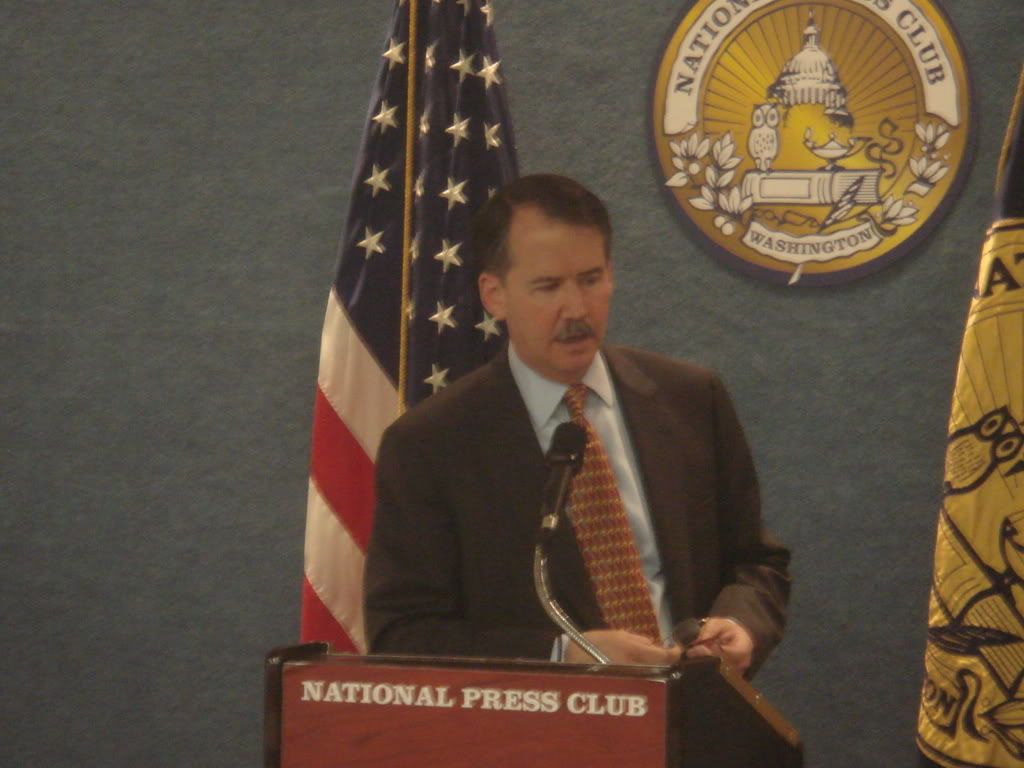 Pressure by Turkey may have played a role in his forced retirement, former U.S. Ambassador John M. Evans said at the National Press Club in Washington on April 24. Asked if he thought the Turkish government was involved, Mr. Evans said “I believe possibly so. I want to tell this story in my [upcoming] book. I do know that there were some telephone calls made.”
 Last September, in a letter to the Senate Foreign Relations Committee, the State Department admitted that three of its officials were contacted by Turkish lobbyists from the Livingston Group within days of Mr. Evans’ comments in February 2005.
Mr. Evans also mentioned that he “did not write the apology” that was issued in his name following the remarks. “It was dictated to me and it was posted on the web site,” he said. That statement described his remarks as “personal” and “improper.”
Asked if there was a written State Department directive not to use the word Genocide in the reference to the Armenian experience, Mr. Evans responded “I have never seen such a piece of paper. It is more an omission that it is a commandment. It is simply a kind of a taboo.”
In April 2005, Mr. Evans was selected for the American Foreign Service Association’s Constructive Dissent Award. “That announcement was made in a State Department telegram signed by [the Secretary of State Condoleezza] Rice,” he recalled. But in June 2005 Mr. Evans was summoned to Washington and “interrogated about the fact that [he] did not decline the award.” The award was ultimately withdrawn on a technicality.
Speaking in reference to the proposed House Resolution 106 (H. Res. 106), Evans said that “I do believe this Congress should pass [the Armenian Genocide] resolution.” He argued that unless there is political pressure on Turkey on this issue, the “natural default reaction” there will prevail and no substantial steps towards Armenian-Turkish normalization would be taken.
A book by Mr. Evans about his experience and views on ways to address the Armenian Genocide issue is currently with an editor and is expected to be released in spring 2008.
State Department flip-flops on controversial passage in Human Rights report
The latest annual State Department Report on Human Rights Practices, first released on March 6, caused controversy in Armenia because of a sentence that sounded like official lingo in its suggestion that Armenia “continues to occupy the Azerbaijani territory of Nagorno-Karabakh and seven surrounding Azerbaijani territories.”
The sentence was at odds with the carefully crafted U.S. policy language on Karabakh. While the U.S. recognizes Azerbaijan’s territorial integrity in principle (as it does that of Iraq, for example), U.S. officials typical clarify that “Karabakh’s status is a matter negotiations.”
The implication is that while the U.S. does not officially recognize Karabakh’s de-facto independence from Azerbaijan, it does not side in favor of Azerbaijan’s claim on Karabakh either.
Furthermore, every known peace proposal that U.S. mediators have helped draft in the last seven years would, if implemented, open the way to international recognition of Karabakh’s secession.
Foreign Minister Vartan Oskanian took issue with the report’s wording and Armenian officials have requested that State Department correct the language. According to Mr. Oskanian, U.S. officials said it was an “obvious mistake on their part” and promised to “try to make a correction in that document.” Such corrections are rare because of the bureaucratic hurdles involved.
Last week, the text was revised to say that “Armenian forces occupy large portions of Azerbaijan territory adjacent to Nagorno-Karabakh. Armenian officials maintain that they do not "occupy" Nagorno-Karabakh itself.”
While the revised version included a strange negation of the obvious (Iraqi Kurds are not accused of “occupying” Iraqi Kurdistan, for example), and the Azerbaijan portion of the report remained unedited (another bureaucratic hurdle), the change still “caused bewilderment” in Baku, which protested by calling off a previously planned official visit to Washington.
On April 26, State Department, apparently as a result of the Azeri protest, went back to the initial language. The Mediamax news agency cited Armenia’s Foreign Ministry spokesman as saying that the second change was a reflection of “frivolous attitude” to the report.
Asked by the Reporter to clarify the issue, State Department’s Deputy Spokesman Tom Casey admitted that his agency can be “fallible,” but stressed that “the bottom line here is that U.S. policy with respect to Karabakh is long-standing and it has not changed.”
Azerbaijan imprisons journalist for [allegedly] taking a moderate line on Karabakh
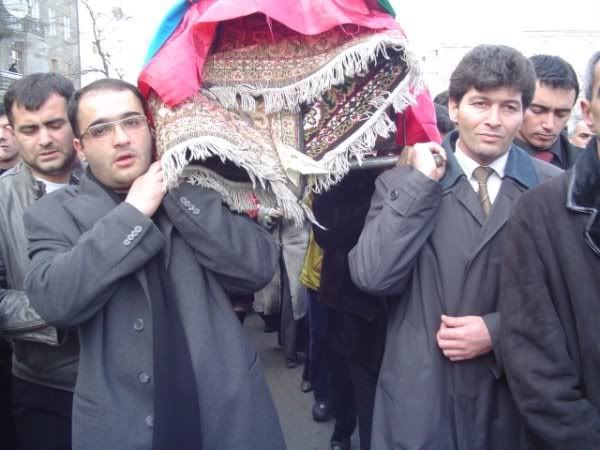 The frequently persecuted Azerbaijani journalist Eynulla Fatullayev was sentenced to 2.5 years in prison on charges of “libel” on April 20, local and international news agencies reported. International organizations and media watchdogs criticized the move.
Mr. Fatullayev is the editor of the twice shut down “Realny Azerbaijan” and former deputy editor for even more frequently shut down “Monitor.” That publication finally closed after the March 2005 assassination of its chief editor Elmar Huseynov (who, Mr. Fatullayev believes, was killed with government’s involvement; perpetrators have not been found to date).
Unlike most of Azerbaijan’s media, Mr. Fatullayev, and the late Mr. Huseynov before him, allowed for relatively free discussion of issues related to the Karabakh conflict and refused to tow the government’s anti-Armenian hate-mongering. Mr. Fatullayev first earned nationalists’ ire after he visited Nagorno Karabakh in 2005, shortly before Mr. Huseynov’s murder.
The current “libel” charges arose from accusations that Mr. Fatullayev was “an Armenian agent of influence” who played down Azerbaijani civilian deaths during the Karabakh war, which he says he did not. In a sense, Mr. Fatullayev’s prosecution is similar to that of Hrant Dink, who was charged with writing what he did not and targeted for assassination as a result.
Turkish media soul-searching again, as Dink investigation appears stalled
Following the heinous murder of three Christians in the town of Malatya on April 18, the Turkish media is again full of introspective articles on the nature of nationalist violence in Turkey. The Turkish Daily News editor Yusuf Kanli wrote on April 20 that murders such as those in Malatya, that of Hrant Dink last January and others, continue to take place because “the real culprits,” those who organized the crimes are still “at large.”
Investigators have arrested 11 individuals in connection to Dink’s murder. The 11 are assorted nationalists from the Black Sea city of Trabzon and include the self-confessed assassin and the head of the local chapter of the nationalist Grand Unity Party. (For investigation details see February 24 Reporter). But none of the security officials believed to be involved have been legally sanctioned.
Asked by the Reporter on April 17, when organizers of the murder might be found, Chairman of the Turkish Parliament’s Foreign Relations Committee Mehmet Dulger produced a copy of a Turkish newspaper with a picture of crowds at Dink’s funeral and said that it showed how “Turkey is fed up with allegations concerning its behavior towards Armenians.” He said that “investigation is continuing and there may be some secrecy.”
Gul set to become Turkey’s President, French race still undecided
Turkey’s majority Justice and Development Party (AKP) selected Foreign Minister Abdullah Gul as their choice for Turkey’s next President, news media reported. Since presidents in Turkey are elected for a single seven-year term in a vote by Parliament (where AKP currently has a majority) Gul’s election is virtually assured. The nomination came about after AKP leader and Prime Minister Recep Tayyib Erdogan decided not to seek the presidency himself. The move is seen as a partial concession to the military-secular establishment, which has campaigned against Erdogan’s election. The formal parliamentary votes will be held in three rounds on May 2, 9 and 15.
In France, Nicolas Sarkozy from the ruling right-of center party and Socialist Segolene Royal advanced to the second round of elections on May 6. In the first round held on April 23, Sarkozy and Royal received 31 and 26 percent of the vote, respectively. Incidentally, both are supporters of the Armenian Genocide affirmation. Sarkozy, the current favorite, is also strongly opposed to Turkey’s membership in the European Union.
Subscribe to:
Posts (Atom)

