Showing posts with label Gul. Show all posts

Thursday, July 31, 2008

Briefly: Bush & Gül tout “strategic partnership,” Kosovo promises independence and Azeris install 2nd tallest flag


This was originally published in January 12, 2008 Armenian Reporter.

by Emil Sanamyan

Bush and Gül tout “strategic partnership”
President George W. Bush described Turkey as “great strategic partner” with which the United States shares a “common enemy” – the Kurdistan Workers Party or PKK – during a brief joint appearance with Turkish President Abdullah Gül at the White House Rose Garden on January 8.

According to Turkish media, meeting with Mr. Bush and senior administration officials, Mr. Gül secured pledges of continued U.S. intelligence support for Turkey’s operations against rebel Kurdish forces in northern Iraq, heralding a “new era” in U.S.-Turkish ties.

Mr. Gul then travelled to New York for a January 9 dinner meeting with United Nations Secretary General Ban Ki-Moon, whom he urged to launch a new initiative that would help lift international sanctions against Turkish-occupied northern Cyprus.

Mr. Gül also met with former Secretary of State Madeleine Albright and former U.S. ambassador to the UN Richard Holbrooke, two key foreign policy advisors in the presidential campaign of Sen. Hillary Clinton (D.-N.Y.).

While in New York, Mr. Gül was also due to meet with leaders of Jewish American organizations, including the Anti-Defamation League (ADL), as well as Turkish groups, including Meskhetian Turks who have received asylum in the U.S. following their expulsion from Central Asia.

Throughout the visit, Mr. Gül spoke only with Turkish journalists at his hotel. There were no opportunities for media questions during a lecture he gave at the Woodrow Wilson Center for International Scholars in Washington, moderated by its president Lee Hamilton, and a talk at the Council on Foreign Relations in New York was reportedly off the record.

At the Wilson Center, Mr. Gül spoke of Turkey’s achievements and importance in arious matters. While he did not address any Armenian issues directly, he did broadly refer to unresolved conflicts in the Caucasus and Central Asia that needed to be addressed through regional cooperation.” He listed oil and gas pipelines, as well as the ongoing construction of the Akhalkalaki-Kars Armenia rail bypass as examples of such cooperation.

Kosovo promises to declare independence next month
Hashim Thaci, the newly elected prime minister of United Nations-controlled Kosovo, promised to formally declare independence from Serbia next month, news agencies reported on January 9.

The ethnic Albanian province has been out of Serbia’s control since its 1999 occupation by U.S.-led NATO forces which accused the former Serbian government of ethnic cleansing.

“I assure you that within a few weeks we will declare independence,” Mr. Thaci said. “Kosovo’s independence is a done deal. We just need to declare it.”

United States and some European countries support Kosovo’s independence, which Serbia opposes. But they have reportedly urged Kosovars to postpone its formal declaration as part of their bargaining with Russia, which promised to block any formal recognition by the UN or transfer of its mandate to the European Union.

EU officials have said that under a new, transition arrangement Kosovo would not have total independence” but be under EU supervision, while NATO forces would continue a peacekeeping mission.

Reports coming up…
Over the next week, the New York-based Human Rights Watch and Washington-based Freedom House are due to release their annual reports on the global state of human rights in 2007.

The Heritage Foundation and the Wall Street Journal are also due to release their annual Index of Economic Freedom. The last two reports count toward eligibility for U.S. Millennium Challenge Assistance.

In Other News: Azerbaijan plans to install world’s tallest flag
But North Korea may already have a taller flagpole

WASHINGTON – The Azerbaijani government hired U.S. Trident Support Corp. to build the world’s tallest flag to be visible through much of the capital Baku, the official Azertag news agency reported on December 30. The “national project,” as it has been called, is due to be completed by May 2008.

President Ilham Aliyev and Defense Minister Safar Abiyev formally launched the construction at the newly established National Flag square in Bayilovo. According to the news agency report, the flagpole rising 150 meters (493 ft) and weighing 220 metric tons will support a 35-by-70 meter (115 x 230 ft) blue-red-and-green Azerbaijani flag that will weigh 350 kilograms.

Mr. Aliyev said that this “huge” and “very heavy” flag was meant to symbolize Azerbaijan’s independence and freedom. The Azerbaijani president said that he decreed
the flag’s construction also to mark the fact that “our great leader [official speak for his father and predecessor Heydar Aliyev]… was first to raise the Azerbaijani flag in November 1990 in Nakhichevan.”

To be able to hoist the flag, Azerbaijan imported a special crane with a lift capability of 600 tons and operational at 188-meter heights. No cost estimates were reported.

According to Trident Support, the San Diego, Calif. company built the current record-holders for the tallest free-standing flagpoles: the 127 meter-tall flagpole in Amman
and 131 meter-tall flagpole in Aqaba, both in Jordan, but also visible from nearby Israel. But, according to CNN, it is North Korea that boasts the highest flagpole in the world, rising to 160 meters (525 feet) near the demilitarized zone (DMZ) with South Korea.

But North Korea’s flag weighs 20 percent less than Azerbaijan’s. f —E.S.

Friday, June 27, 2008

Markarian, Defense Attaché in Pentagon; US-Azeri consultations; Gul renominated


This was originally published in August 18, 2007 Armenian Reporter.

From Washington, in brief
by Emil Sanamyan

More than 400 believed killed in attack on Iraqi Yezidis

Four trucks packed with explosives and fuel detonated in a Yezidi-populated area in northern Iraq on August 15, killing at least 400 people and wounding hundreds more. The
Sinjar district where the attack occurred is 75 miles west of Mosul, the area that is home to most of the world’s half a million Yezidis and a stronghold of Sunni Muslim militants.

While the bulk of the Yezidis reside in northern Iraq, they are also the biggest minority group in Armenia, where most of them fled in the early 20th century due to persecution in Ottoman Turkey. The group, which is considered to be ethnically Kurdish, follows a pre-Muslim faith that is typically described as a mix of Zoroastrianism and Manichean beliefs. Yezidis have been persecuted both under Saddam Hussein and since his overthrow. Last April, gunmen shot 23 Yezidis in Mosul.

The Sinjar district massacre, centered on villages of Kahtaniya, al-Jazeera, and Tal Uzair, became the deadliest single incident since the U.S. invasion of Iraq in 2003. The Guardian newspaper reported that “the Islamic State in Iraq, an al-Qaida front group, warned residents last week that an attack on Yezidis was imminent,” and the U.S. military spokesman in Iraq said he believed the group carried out the attack. According to Kurdish intelligence officials, cited by the newspaper, Sunni extremists have become more active in northern Iraq following the “surge” in U.S. military presence in Baghdad, as well as in Anbar and Diyala provinces to the south of Mosul.

Armenia’s Ambassador, Defense Attaché meet top Pentagon official

Deputy Secretary of Defense Gordon England met with Armenia’s Ambassador to the U.S. Tatoul Markarian and Defense Attaché Col. Armen Sargsyan on August 14, the Armenian Embassy reported. Secretary England is the second most senior official in the Pentagon hierarchy.

According to the Embassy release, the meeting focused on “bilateral military cooperation and regional security issues.” Since 2002 the U.S. has provided the Armenian army with more than $10 million in aid and the two countries have stepped up security cooperation.

Amb. Markarian also relayed the Armenian government’s gratitude for “organizing the full medical treatment and rehabilitation of Lt. Georgi Nalbandian at Washington’s Walter Reed Army Medical Center.” The Armenian officer was seriously wounded in action last November and was first evacuated to a U.S. military hospital in Germany. Following eight months of treatment and rehabilitation there and at Walter Reed, Capt. Nalbandian just returned to active duty in the Armenian Army.

The Armenian contingent of military engineers, medical and logistics personnel have been in Iraq since January 2005. Armenians are part of the Polish-led Multi-National Division Central South, and they are based near Iraq’s border with Iran.

Foreign Minister Gul to be re-nominated for Turkish presidency

Turkey’s ruling Justice and Development Party (AKP) will re-nominate Foreign Minister Abdullah Gul as its candidate for president. The Turkish parliament is set to elect a president in three rounds of voting between August 20 and 28. Mr. Gul’s previous bid for the presidency was blocked by the military and secular nationalist opposition last May, forcing an early general election.

While prime ministers have greater political clout in Turkey (AKP’s Recep Tayyib Erdogan has been in that job since 2003), presidents have key influence onthe judiciary and the military. The opposition Republican People’s Party (CHP) leader Deniz Baykal argued that if Mr. Gul is elected, “Turkey’s political balances will change [and it] will be transformed into a country with an overbearing religious and Middle Eastern identity,” the Radikal newspaper reported.

But AKP’s strong electoral performance on July 22 is expected to make Mr. Gul’s election this time around more likely, with smaller opposition groups pledging to participate in the vote and thus securing the required two-thirds quorum.

On August 9, Koksal Toptan, a secular AKP member and former minister in pre-AKP governments, was elected Parliament chairman, the New Anatolian reported. In that vote CHP as well as independent Kurdish parliamentarians voted for the AKP nominee, with opposition coming only from the right-wing National Action Party (MHP).

U.S. continues consultations with Azerbaijan

Assistant Secretary of State Dan Sullivan became the third State Department official of that rank to hold consultations with Azerbaijan so far this month. On August 15 and 16, he discussed economic and security issues with Azerbaijani officials in Baku, according to APA news agency.

Mr. Sullivan, who heads the State Department’s Bureau for Economic, Energy and Business Affairs, co-chairs the U.S.-Azerbaijan Economic Partnership Commission first launched last February in place of the U.S.-Azerbaijan Task Force on Economic Issues, which had not met since 2005.

On August 3 and 4, Assistant Secretaries Barry Lowenkron and Dan Fried, who respectively head the Democracy and European bureaus, together with Azeri Foreign Minister Elmar Mamediyarov held the “third round of their bilateral dialogue on democracy and human rights in Azerbaijan” – first initiated by the U.S. last December. That consultation was held via a video link.

Serbia, Kosovo oppose partition, remain deadlocked on status

Leaders of Serbia and its internationally-administered breakaway province of Kosovo ruled out the region’s division as part of a settlement, international news agencies reported this week. Serbia has proposed granting ethnically Albanian-majority Kosovo a high-level of autonomy within Serbia, but Kosovo insists on independence, a stance also supported by the United States.

In an August 13 interview with the BBC, Amb. Wolfgang Ischinger, the European envoy to the contact “troika” – which also includes U.S. and Russian representatives and coordinates an international effort to reach an agreement between Serbia and Kosovo – said that mediators might support a territorial division of Kosovo along ethnic lines, if the two sides agree to it. “We are urging parties to think outside the box,” he said.

A division that would leave Kosovo’s ethnically Serb-populated northern part within Serbia has been supported by some influential but unofficial circles in Belgrade, but Kosovars have ruled it out. Last month, Kosovo President Fatmir Sejdiu promised to declare independence on November 28, which is also Albania’s independence day.

A United Nations Security Council resolution that would bring Kosovo closer to international recognition was withdrawn by the United States last month, after Russia threatened to veto it. Officials suggested that the U.S. may break the impasse by recognizing Kosovo unilaterally before the end of the year, unless another accommodation is reached through ongoing talks or at the UN.

Serbia’s Foreign Minister Vuk Jeremic was in Washington last month and according to a Scripps Howard July 27 report, he lobbied for the U.S. to drop its support for Kosovo’s independence, or at least to extend the ongoing negotiations beyond this year. But following that visit the State Department spokesman Sean McCormack reiterated, most recently on August 14, that the U.S. continues to support “independence for Kosovo.”

Saturday, July 7, 2007

In Brief on Amb. Evans, State Dept. report, Fatullayev, Dink murder, Elections in Turkey and France

First published in the Armenian Reporter on April 28, 2007

From Washington, in Brief
By Emil Sanamyan

Amb. Evans sees Turkish government’s role in his forced retirement


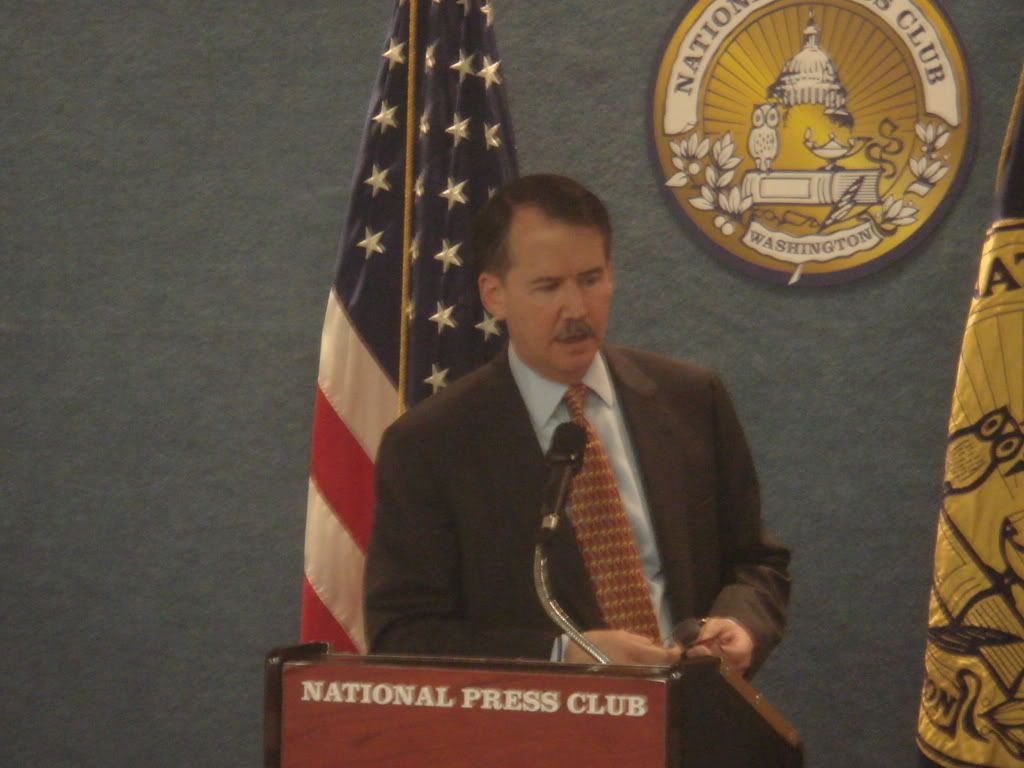
Pressure by Turkey may have played a role in his forced retirement, former U.S. Ambassador John M. Evans said at the National Press Club in Washington on April 24. Asked if he thought the Turkish government was involved, Mr. Evans said “I believe possibly so. I want to tell this story in my [upcoming] book. I do know that there were some telephone calls made.”

Last September, in a letter to the Senate Foreign Relations Committee, the State Department admitted that three of its officials were contacted by Turkish lobbyists from the Livingston Group within days of Mr. Evans’ comments in February 2005.

Mr. Evans also mentioned that he “did not write the apology” that was issued in his name following the remarks. “It was dictated to me and it was posted on the web site,” he said. That statement described his remarks as “personal” and “improper.”
Asked if there was a written State Department directive not to use the word Genocide in the reference to the Armenian experience, Mr. Evans responded “I have never seen such a piece of paper. It is more an omission that it is a commandment. It is simply a kind of a taboo.”

In April 2005, Mr. Evans was selected for the American Foreign Service Association’s Constructive Dissent Award. “That announcement was made in a State Department telegram signed by [the Secretary of State Condoleezza] Rice,” he recalled. But in June 2005 Mr. Evans was summoned to Washington and “interrogated about the fact that [he] did not decline the award.” The award was ultimately withdrawn on a technicality.

Speaking in reference to the proposed House Resolution 106 (H. Res. 106), Evans said that “I do believe this Congress should pass [the Armenian Genocide] resolution.” He argued that unless there is political pressure on Turkey on this issue, the “natural default reaction” there will prevail and no substantial steps towards Armenian-Turkish normalization would be taken.

A book by Mr. Evans about his experience and views on ways to address the Armenian Genocide issue is currently with an editor and is expected to be released in spring 2008.

State Department flip-flops on controversial passage in Human Rights report

The latest annual State Department Report on Human Rights Practices, first released on March 6, caused controversy in Armenia because of a sentence that sounded like official lingo in its suggestion that Armenia “continues to occupy the Azerbaijani territory of Nagorno-Karabakh and seven surrounding Azerbaijani territories.”

The sentence was at odds with the carefully crafted U.S. policy language on Karabakh. While the U.S. recognizes Azerbaijan’s territorial integrity in principle (as it does that of Iraq, for example), U.S. officials typical clarify that “Karabakh’s status is a matter negotiations.”

The implication is that while the U.S. does not officially recognize Karabakh’s de-facto independence from Azerbaijan, it does not side in favor of Azerbaijan’s claim on Karabakh either.

Furthermore, every known peace proposal that U.S. mediators have helped draft in the last seven years would, if implemented, open the way to international recognition of Karabakh’s secession.

Foreign Minister Vartan Oskanian took issue with the report’s wording and Armenian officials have requested that State Department correct the language. According to Mr. Oskanian, U.S. officials said it was an “obvious mistake on their part” and promised to “try to make a correction in that document.” Such corrections are rare because of the bureaucratic hurdles involved.

Last week, the text was revised to say that “Armenian forces occupy large portions of Azerbaijan territory adjacent to Nagorno-Karabakh. Armenian officials maintain that they do not "occupy" Nagorno-Karabakh itself.”

While the revised version included a strange negation of the obvious (Iraqi Kurds are not accused of “occupying” Iraqi Kurdistan, for example), and the Azerbaijan portion of the report remained unedited (another bureaucratic hurdle), the change still “caused bewilderment” in Baku, which protested by calling off a previously planned official visit to Washington.

On April 26, State Department, apparently as a result of the Azeri protest, went back to the initial language. The Mediamax news agency cited Armenia’s Foreign Ministry spokesman as saying that the second change was a reflection of “frivolous attitude” to the report.

Asked by the Reporter to clarify the issue, State Department’s Deputy Spokesman Tom Casey admitted that his agency can be “fallible,” but stressed that “the bottom line here is that U.S. policy with respect to Karabakh is long-standing and it has not changed.”

Azerbaijan imprisons journalist for [allegedly] taking a moderate line on Karabakh

The frequently persecuted Azerbaijani journalist Eynulla Fatullayev was sentenced to 2.5 years in prison on charges of “libel” on April 20, local and international news agencies reported. International organizations and media watchdogs criticized the move.

Mr. Fatullayev is the editor of the twice shut down “Realny Azerbaijan” and former deputy editor for even more frequently shut down “Monitor.” That publication finally closed after the March 2005 assassination of its chief editor Elmar Huseynov (who, Mr. Fatullayev believes, was killed with government’s involvement; perpetrators have not been found to date).

Unlike most of Azerbaijan’s media, Mr. Fatullayev, and the late Mr. Huseynov before him, allowed for relatively free discussion of issues related to the Karabakh conflict and refused to tow the government’s anti-Armenian hate-mongering. Mr. Fatullayev first earned nationalists’ ire after he visited Nagorno Karabakh in 2005, shortly before Mr. Huseynov’s murder.

The current “libel” charges arose from accusations that Mr. Fatullayev was “an Armenian agent of influence” who played down Azerbaijani civilian deaths during the Karabakh war, which he says he did not. In a sense, Mr. Fatullayev’s prosecution is similar to that of Hrant Dink, who was charged with writing what he did not and targeted for assassination as a result.

Turkish media soul-searching again, as Dink investigation appears stalled

Following the heinous murder of three Christians in the town of Malatya on April 18, the Turkish media is again full of introspective articles on the nature of nationalist violence in Turkey. The Turkish Daily News editor Yusuf Kanli wrote on April 20 that murders such as those in Malatya, that of Hrant Dink last January and others, continue to take place because “the real culprits,” those who organized the crimes are still “at large.”

Investigators have arrested 11 individuals in connection to Dink’s murder. The 11 are assorted nationalists from the Black Sea city of Trabzon and include the self-confessed assassin and the head of the local chapter of the nationalist Grand Unity Party. (For investigation details see February 24 Reporter). But none of the security officials believed to be involved have been legally sanctioned.

Asked by the Reporter on April 17, when organizers of the murder might be found, Chairman of the Turkish Parliament’s Foreign Relations Committee Mehmet Dulger produced a copy of a Turkish newspaper with a picture of crowds at Dink’s funeral and said that it showed how “Turkey is fed up with allegations concerning its behavior towards Armenians.” He said that “investigation is continuing and there may be some secrecy.”

Gul set to become Turkey’s President, French race still undecided

Turkey’s majority Justice and Development Party (AKP) selected Foreign Minister Abdullah Gul as their choice for Turkey’s next President, news media reported. Since presidents in Turkey are elected for a single seven-year term in a vote by Parliament (where AKP currently has a majority) Gul’s election is virtually assured. The nomination came about after AKP leader and Prime Minister Recep Tayyib Erdogan decided not to seek the presidency himself. The move is seen as a partial concession to the military-secular establishment, which has campaigned against Erdogan’s election. The formal parliamentary votes will be held in three rounds on May 2, 9 and 15.

In France, Nicolas Sarkozy from the ruling right-of center party and Socialist Segolene Royal advanced to the second round of elections on May 6. In the first round held on April 23, Sarkozy and Royal received 31 and 26 percent of the vote, respectively. Incidentally, both are supporters of the Armenian Genocide affirmation. Sarkozy, the current favorite, is also strongly opposed to Turkey’s membership in the European Union.