Showing posts with label Bryza. Show all posts

Friday, July 24, 2009

Bryza & Baku, anti-trafficking progress, lobbying against Gen. Res., Kyrgyz and Iran elections

This was first published in June 20, 2009 Armenian Reporter

Washington Briefing
by Emil Sanamyan


Possible pick for U.S. ambassador to Azerbaijan criticized


U.S. Deputy Assistant Secretary of State Matt Bryza, left, with Azerbaijani president Ilham Aliyev, right, during the latest Armenian-Azerbaijani summit in Russia, June 5. . Armenian president's press office

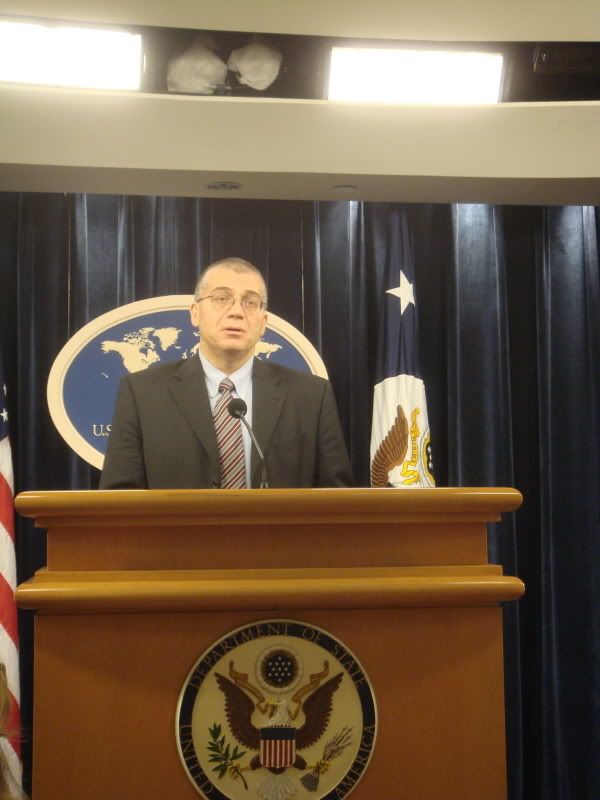
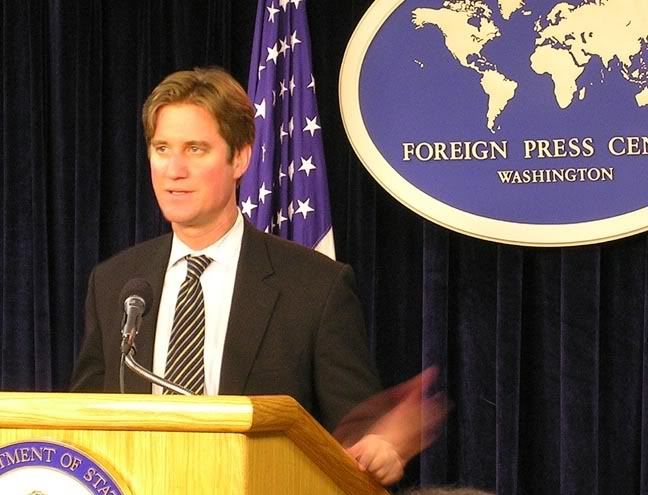
Matt Bryza, who has been the U.S. envoy for Karabakh negotiations since 2005, may be considered for a posting as U.S. ambassador to Azerbaijan, a well-connected Foreign Policy magazine blog, The Cable, reported on June 12.

Mr. Bryza declined to comment when asked about the report by the Armenian Reporter.

The Cable cited former Clinton and Bush administration officials who raised concerns that Mr. Bryza's reputed closeness to Georgia's leadership - and his handling of the Ossetia crisis last year - might irritate Moscow, thus undermining U.S. efforts to engage with Russia.

In his current capacity, Mr. Bryza was frequently a target of criticism for his contradictory and controversial remarks on Karabakh. Last February, Armenian Foreign Ministry spokesperson Tigran Balayan charged him with "hindering the negotiation process," Arminfo reported at the time.

Writing in Harper's website on June 17, Washington-based investigative journalist Ken Silverstein described Mr. Bryza as a "friend of the Azeri dictator" Ilham Aliyev.

Prior to dealing with Karabakh as an deputy assistant secretary of state, Mr. Bryza managed Caucasus and Turkey affairs at the White House in 2001-2005 and before that was the deputy U.S. envoy for Caspian energy in 1998-2001, dealing mainly with Azerbaijan.

Armenian sources familiar with Mr. Bryza's work at the State Department were harsh in their assessments of his track record.

Asked to comment, California Courier publisher Harut Sassounian told the Armenian Reporter, "everyone is tired of Bryza's antics of repeatedly saying one thing in one capital and then denying it in a second capital. He has cried wolf too many times and has lost all credibility."

Another source, who asked not to be named, predicted that "should Mr. Bryza become the president's nominee, he can expect comprehensive congressional questioning over his role" in U.S. policy in the Caucasus.

Separately, The Cable reported that Nancy McEldowney, the former deputy chief of U.S. diplomatic missions in Ankara (2004-2007) and Baku (2001-2004), will become the principal deputy assistant secretary of state for Eurasia.

State Dept. sees improvement in Armenia’s anti-trafficking policy


Armenia has been removed from the U.S. human trafficking "watch list," the State Department reported on June 16. After spending five years on the list, Armenia was credited with "significant efforts" to meet U.S. standards on fighting trafficking in persons, although it was still short of meeting them.

The U.S. Congress passed the Trafficking Victims Protection Act in 2001, mandating that the State Department issue annual reports that rate the world's efforts to counter human trafficking for the purposes of forced labor or prostitution.

Theoretically, the most egregious offenders could see a cut in U.S. aid. But no sanctions have ever been implemented under the act. See http://www.state.gov/secretary/rm/2009a/06/124872.htm for the complete report.

U.S. companies with Turkey interests lobby against Genocide resolution


Major arms producers BAE Systems Inc., Goodrich Corp., Northrop Grumman Corp., Raytheon Co., and United Technologies Corp. and energy producer Chevron Corp. lobbied against the Armenian Genocide resolution introduced in U.S. Congress earlier this year, The Associated Press reported on June 12 citing mandatory lobbying disclosures.

The companies spent a total of $14 million on lobbying for contracts and tax incentives and it was unclear how much of the amount was spent against the congressional resolution. Additional lobbying for Turkey is done by firms hired directly by the Turkish government and Turkish-American entities.

Seeking to win Ankara's favor, U.S. corporations looking to do business in Turkey have long lobbied against honoring Armenian lives lost in the Genocide.

One the resolution's main sponsors, Rep. Adam Schiff (D.-Calif.) charged the companies involved with not being ‘‘good corporate citizens.''

U.S. seeks to keep Kyrgyzstan airbase

President Obama sent a letter to Kyrgyz president Kurmanbek Bakiyev emphasizing the importance of bilateral security ties, the Kyrgyz government reported on June 11, according to news agencies.

The letter was meant as a fresh appeal for the Central Asian nation to reverse its decision to close a U.S. air base on its soil that has been used in support of Afghanistan operations. Last February, Kyrgyzstan gave the United States six months to close the base after receiving a $2 billion aid package from Russia.

During a regional summit meeting in Yekatirinburg, Russia, on June 16, Mr. Bakiyev pledged continued cooperation with the United States on Afghanistan security.

Paul Quinn-Judge, the Bishkek-based analyst for the International Crisis Group, a Brussels think tank, told Eurasianet.org on June 17 that current expectations are that the U.S. base would stay open in spite of an earlier decision to close it by August 18.

Mr. Bakiyev is seen as hedging his bets, as he faces an election contest on July 22.

World watching Iran’s post-election crisis

Street clashes and large-scale protests that followed Iran's June 12 presidential election continue to grab headlines as the United States and others try to make sense of the crisis, watching for any potential impact it might have on Iran's relations with the world.

Official figures gave the incumbent President Mahmoud Ahmadinejad more than 60 percent of the vote and a first-round victory against former prime minister Mir-Hossein Mousavi, who was credited with about half as many votes. But Mr. Mousavi's supporters and sympathizers say the vote was a sham and have held protests demanding its annulment.

While President Barack Obama said he did not want to be seen as "meddling" in Iran's politics, he implicitly criticized the handling of the vote and most of America's political class remained overtly hopeful that Mr. Ahmadinejad, known for his controversial rhetoric, could be sidelined.

Meanwhile, China and Russia were quick to recognize Mr. Ahmadinejad's victory, with Russia's President Dmitry Medvedev hosting Iran's president on June 16 for a regional summit meeting.

In Europe, France's President Nicolas Sarkozy was most outspoken. Shortly before attending the funeral of Gabon's ruler of more than 40 years and France's protégé, Mr. Sarkozy criticized Iran's election as a "fraud" and its government reaction "brutal."

In scenes reminiscent of recent election-related crises in Armenia and Georgia, angry opposition supporters filled the streets of the capital Tehran and other major cities, while pro-government groups sought to counter with demonstrations of their own. On June 15 seven protestors were killed as they tried to make their way inside the headquarters of Basij, the pro-government militia.

Observers have compared the post-election ferment to demonstrations that preceded the 1979 Islamic Revolution that overthrew Iran's Shah. But in a major difference, in addition to support in the streets, Mr. Mousavi has strong endorsements from within Iran's establishment, including two of Mr. Ahmadinejad's predecessors as president, Mohammad Khatami (1997–2005) and Ali Akbar Hashemi Rafsanjani (1989–97) – who continues to hold powerful posts – as well as many celebrities.

Iran's supreme leader for the last 20 years, Ali Khamenei, under pressure from some fellow religious leaders, has already called for a partial recount of votes.

The ongoing crisis follows an earlier setback for Iran in Lebanon, where a Tehran-backed coalition failed to unseat a ruling alliance backed by the West and Saudi Arabia in June 7 elections.

Sunday, October 26, 2008

Armenia objects to Cheney rhetoric on NK

First published in October 18, 2008 Armenian Reporter.

Armenia takes issue with Bush administration’s rhetoric on Karabakh
Recently modified language prioritizes “territorial integrity”
by Emil Sanamyan


U.S. vice president Dick Cheney with Prime Minister Tigran Sarkisian of Armenia with translators in Washington on October 10, 2008. Armenian government photo

Washington - In a meeting with Vice President Dick Cheney in Washington on October 10, Prime Minister Tigran Sarkisian raised concerns on behalf of Armenia over the recently modified rhetoric of U.S. officials on Nagorno-Karabakh, the prime minister's office reported.

It is "extremely dangerous" to emphasize the principle of territorial integrity at the expense of self-determination when it comes to Karabakh, Mr. Sarkisian told Mr. Cheney in what amounted to the first publicly reported criticism of the revised U.S. policy language by Armenia.

The prime minister was referring, in particular, to remarks delivered in Baku by Mr. Cheney that a Karabakh settlement "must proceed" from the principle of Azerbaijan's territorial integrity and only then "take into account other principles." The remarks were apparently drafted by Deputy Assistant Secretary of State Matt Bryza, the U.S. co-chair of the OSCE Minsk Group, which mediates in the Karabakh negotiations.

"If territorial integrity is prioritized, the peace process - all of the work the mediators have done - becomes meaningless," Prime Minister Sarkisian told the Armenian Reporter on October 14. "And this also provokes [Azerbaijan] toward war."

According to Mr. Sarkisian, Mr. Cheney in response reiterated U.S. support for the peace process.

Evolution of the peace process

According to sources familiar with the details of the peace process, since 1999 its focus has been on ways that would formalize Karabakh's separation from Azerbaijan and reunification with Armenia.

But with Azerbaijan increasingly belligerent, the Karabakh talks in recent years have shifted toward a "postponed status" for Karabakh, with an increasingly vague definition of a mechanism for determination of this status.

Still, while the United States has always voiced support for the principle of territorial integrity with regard to former Soviet republics, including Azerbaijan, it has also mentioned the need to reconcile that principle with other principles.

For example in an August 6, 2007, interview with Russia's Vremya Novostei newspaper, Mr. Bryza noted, "There are three main principles that influence our talks [on Karabakh]: refusal to apply force, recognition of the territorial integrity of the states, and the right for self-determination.

"A compromise should be found among these principles," he said, and added, "I represent [the United States,] a country founded by separatists."

In the case of Georgia, a close U.S. ally, the United States has spoken openly in support of Tbilisi's claims on Abkhazia and South Ossetia. But U.S. officials - up until recently - have been careful not to use language that could be deemed to be prejudging the outcome of the talks on Karabakh's status.

As Azerbaijan continues to lobby for international support for its claim on Karabakh, Azerbaijani officials have become increasingly wary about international developments.

In February, the Azerbaijani government called the U.S. recognition of Kosovo "illegal" and pulled its troops from the NATO peacekeeping mission there.

Azerbaijanis were outraged by the U.S. vote against the UN General Assembly resolution on Karabakh proposed by Azerbaijan last March. Mr. Bryza told Azerbaijani media that the decision to oppose the resolution was one he "agonized and lost sleep over."

Adding to Azerbaijan's worries is the pledge of presidential candidate Barack Obama to work toward a Karabakh settlement "based upon America's founding commitment to the principles of democracy and self determination."

The Russian-Georgian military clash in August has also made the threat of Azerbaijani attack in Karabakh - its biggest leverage in talks - less credible.

The latest upset came with the decision of Turkey's president to visit Armenia last month; a number of current and former Azerbaijani officials portrayed this move as a "betrayal" of Azerbaijan.

Azerbaijan's "endangerment" and permutations of U.S. rhetoric

President Ilham Aliyev rushed to Moscow to pledge his loyalty soon after the Georgia war and the visit of the president of Turkey to Armenia.

Intimidated by Russia's military operations in Georgia, Azerbaijani officials began to suggest that they may reroute their energy exports, particularly natural gas, via Russia.

It has been a longstanding U.S. goal to challenge Russia's dominance of gas supplies to Europe. Azerbaijan, along with Georgia, provides a key transit corridor for that effort.

"If Azerbaijan tilts to Russia there goes 15 years of U.S. energy diplomacy," a Western diplomat based in Baku told Britain's Daily Telegraph on September 2.

In response, the United States appears to have sought to encourage Azerbaijan, which, in the words of Assistant Secretary of State Dan Fried, was "endangered" in the wake of the Russian-Georgian war.

The first signs that U.S. officials were reconsidering their Karabakh policy language came on August 19. In a State Department press conference, Mr. Bryza said, "the principle of territorial integrity occupies the highest priority when we begin the process of conflict resolution, separatist conflict resolution. It simply is the fact of international law."

But, he quickly added, "If the two sides decide that they can reach a compromise that incorporates other elements of international diplomatic practice or international law like self-determination of peoples, terrific.

"That is what we want to do in the case of Karabakh: have a negotiated political settlement that takes into account both of these principles," he said.

New rhetoric unveiled

The new language was annunciated by Vice President Cheney during his visit to Baku on September 3, in which he sought to shore up Azerbaijan's confidence in Western support.

In comments during that reportedly less-than-successful trip, Mr. Cheney went beyond the usual endorsement of Azerbaijan's territorial integrity by saying that the United States is "committed to achieving a negotiated solution to the Nagorno-Karabakh conflict - a solution that starts with the principle of territorial integrity, and takes into account other international principles." Mr. Cheney and other U.S. officials since have not spelled what these other principles are.

Mr. Bryza then repeated this new language to Armenia's Mediamax news agency on September 5 and at the congressional Commission for Security and Cooperation in Europe on September 10.

In written testimony submitted for that hearing, Mr. Bryza spoke of "a just and lasting settlement of the Nagorno-Karabakh conflict that proceeds from the principle of our support for Azerbaijan's territorial integrity, and ultimately incorporates other elements of international law and diplomatic practice."

Armenian officials did not react publicly at that time. Nor did Congress. During a subsequent trip to Armenia and Nagorno-Karabakh in mid-September, Mr. Bryza encountered no public rebuke.

Then, on October 9, Mr. Bryza took an additional rhetorical step. In an interview with the BBC's Russian-language service, he went so far as to suggest that Armenia should first recognize Azerbaijan's territorial integrity before a settlement on the Karabakh conflict is finalized.

Prime Minister Sarkisian delivered a public rebuff of U.S. policy the next day.

On October 13, Mr. Bryza's latest remarks were also blasted by Ken Hachikian, chairperson of the Armenian National Committee of America (ANCA), as a "retreat from principle" in U.S. policy and "absolutely wrong."

Ross Vartian, executive director of the U.S.-Armenia Public Affairs Committee (USAPAC), told the Armenian Reporter, "United States emphasis of territorial integrity over self-determination does not serve the cause of a peaceful settlement of the Nagorno-Karabakh conflict.

"Instead of confronting Azerbaijan's war preparation and threats, the United States appeases," Mr. Vartian charged.

N.B. During his visit to Yerevan on October 17, Mr. Fried was asked about Mr. Cheney's remarks and Armenian reaction by the Armenian Reporter's Armen Hakobyan (transcript follows):

Hakobyan: During his meeting with Vice President Cheney the prime minister referred to the vice president's statement about the territorial integrity of Azerbaijan being the basic principle, and said that statement was dangerous; focusing on this principle, other principles are not taken into consideration. Having in mind that the statement had come from the American co-chair, Matthew Bryza, as a representative of a co-chair country, what are you doing about that danger and about making room for another important principle, self-determination?

Dan Fried in Yerevan on Oct. 17

Fried: Well, I'm happy to tell you that some of the media reports of what my friend and colleague Matt Bryza said were not entirely accurate. We have always believed and we believe now that territorial integrity is an important principle. We even say that we start with this principle. We have not ever said it is the only principle, and indeed it is not. Territorial integrity is a recognized principle of international law. There are other principles, such as self-determination.

Now, we all know what we're talking about here. Bringing these principles together, reconciling these principles is extremely difficult and complicated. The Minsk Group process has been working on these issues for some time. The process has made some real progress. We are going to build on that process – on that progress if we can. We will work with the governments [sic] of Azerbaijan, with the government of Armenia, and the co-chairs are prepared to work together.

It is important to actually find a settlement. Scoring debating points, one side, the other, advantage here, advantage there, well that's fine, but it doesn't take us where we need to go. We need to try to solve these regional problems and not debate them. This is serious business. We cannot continue to live with this situation of tension and occasional incidents of shooting.

The people of Azerbaijan, the people of Armenia, the people of the occupied territories, the people of Nagorno-Karabakh all deserve better. And I look forward to working with the Minsk Group and trying to push forward a solution as soon as we can.

N.B.-2 While Mr. Fried and others at the State Department have implied that Mr. Bryza's comments to BBC Russian were misconstrued, the remarks were made in Russian and their recording is available here http://news.bbc.co.uk/hi/russian/international/newsid_7661000/7661150.stm
Mr. Bryza was interviewed by BBC's Mark Grigorian whose own comment on the issue is available here: http://markgrigorian.livejournal.com/249429.html?thread=8577877#t8577877

Thursday, September 25, 2008

Briefly: U.S. on Armenian and Azerbaijani politics, Turkish ruling AKP avoids ban

Washington Briefing
by Yelena Osipova and Emil Sanamyan

U.S. wants Armenian government to succeed on democracy


“It is in the interest of the U.S.-Armenia bilateral relationship and in the interest of the Armenian people to see the new government in Yerevan succeed in deepening Armenia’s democratic development,” U.S. Assistant Secretary of State David Kramer said in a prepared statement on July 29.

Recalling his tour of the Caucasus earlier this summer (see this page and the editorial page in the June 28 issue of the Armenian Reporter), Mr. Kramer stressed the need for the Armenian authorities to take timely steps – the release of opposition activists, an independent investigation, and dialogue – “to heal the serious divisions in the country that the presidential election and its violent aftermath exacerbated.”

Overall, Mr. Kramer’s remarks on Armenia were a departure from the sharp rhetoric he employed while in Yerevan.

Similarly, Deputy Assistant Secretary of State Matt Bryza said earlier in the month that while the United States wanted to see the Armenian government do more on democracy, the United States is “seeing some positive momentum” and that “the direction has shifted and is much better.”

Referring to President Serge Sargsian, Mr. Bryza told the RFE/RL Armenian Service in a July 19 interview, “It seems that President Sarkisian understands the challenges that face the country and what issues need some work. We have seen some leadership from him on a number fronts and we appreciate that.”

Mr. Bryza also praised Prime Minister Tigran Sarkisian for “setting a good example as he takes on tough issues [such as government corruption] and is advancing a reform agenda.”

For his part, Mr. Kramer singled out Human Rights Defender Armen Harutiunian, appointed by former President Robert Kocharian, for “playing an important role on behalf of democratic reform in the country.”

Congressional human rights commission discusses Azerbaijan

Members of Congress, officials, and activists expressed various degrees of concern with Azerbaijan’s treatment of dissenters during a July 29 hearing organized by the U.S. Commission for Security and Cooperation in Europe (Helsinki Commission) and described as “biased” by an Azerbaijani presidential aide the next day.

The hearing was timed to precede Azerbaijani president Ilham Aliyev’s widely anticipated reelection on October 15 in balloting seen by most as a mere formality. Mr. Aliyev inherited the presidency after his father, Heydar Aliyev, died in 2003.

In testimony, Chris Walker of Freedom House, a human-rights advocacy group, noted that growing revenues from energy production have emboldened Azerbaijan’s government and diminished any remaining hopes for democratic changes.

Later in the hearing, Commission co-chair Rep. Alcee Hastings (D.-Fla.) quoted Mr. Aliyev as saying recently, “those who say that something is going wrong in Azerbaijan … should look in the mirror at their own country. Attempts to apply pressure will just cause tension in our relations. While several years ago we may not have reacted to this pressure or kept silent, we are not silent today.”

Indeed, speaking for Mr. Aliyev the next day, his aide Elnur Aslanov described views expressed at the hearing as “biased and provocative.”

“Azerbaijan has its own path leading to democracy which conforms to the level of development of state and society,” he told the Trend news agency.

“Senior Azeri officials have already suggested a third term [through 2018] for President Aliyev,” Mr. Walker said, adding that it appears that “the country is laying the foundations for a possible leader-for-life system,” as in most Central Asian states.

Assistant Secretary of State David Kramer expressed U.S. concerns that “political space for dissenting voices has been shrinking over the past few years,” pointing to the continued imprisonment of dozens of political prisoners. They
include journalist Eynullah Fatullayev, imprisoned after being labeled a “traitor” for his visit to Armenia and Karabakh. (See this page in the Nov. 3, 2007, issue of the Armenian Reporter.)

Mr. Kramer dismissed Azerbaijan’s efforts to link all its failings to Armenian misdeeds. “The unresolved conflict … over Nagorno- Karabakh is not a valid reason for either country to avoid respecting media freedom or engaging in other essential components of democratization,” he said.

Mr. Hastings pointed to his criticism of the Bush administration and wondered whether he could “still be walking around Baku” had he done something similar in Azerbaijan.

In a telling response, Azerbaijan’s ambassador, Yashar Aliyev, said, “I don’t know.”

“I think that is a fair answer to perhaps what was a rhetorical question,” Rep. Hastings went on amid laughter in the room. “And that is that my butt would be in jail.”

Commission members Sen. Robert Burr (R.-N.C.) and Rep. G.K. Butterfield (R.-N.C.) focused their remarks on the imprisonment of former millionaire government member Farkhad Aliyev, who fell out with the Azerbaijani president in 2005; Rep. Hilda Solis (D.-Calif.) raised concerns over prosecution of Christian minorities, and Sen. Ben Cardin (D.-Md.) made general observations about the need for reform.

No concerns over anti-Armenian hate speech in Azerbaijan were raised as part of the hearing.

Wiesenthal Center notes “confusion” over Rabbi Cooper’s Azerbaijan comments

This column last week reported on the visit by Rabbi Abraham Cooper of the Los Angeles–based Simon Wiesenthal Center to Baku during which he heard anti-Armenian hate speech from Azerbaijan’s religious leader and was reported by Azerbaijani media as praising the country for its “tolerance” and even “condemning” Armenians.

Contacted by the Armenian Reporter last week and this, Rabbi Cooper was not available for an interview. But the Center’s public relations director Avra Shapiro facilitated the following comment on behalf of Rabbi Cooper via e-mail: “My visit to Baku [was in part] to brief religious leaders who will shortly be visiting the U.S.... I read the article [from Azerbaijani media] that was written very carefully. It seems that whoever wrote the headline may have confused the comments of the [Azerbaijani] Parliamentary Chairman [condemning Armenians] with mine. For the record, what I did state was that the systematic destruction of any houses of worship would be an outrage.”

Rabbi Cooper has not so far provided comment on the Azerbaijani religious leader’s hate speech toward Armenians and how that fits into his reported praise of Azerbaijan’s tolerance.

The latter claim was this week sited by an Azerbaijani presidential aide as evidence of his country’s good behavior and in response to criticism of Azerbaijani government during the U.S. Helsinki Commission hearing on July 29.

Turkish ruling party avoids ban, gets off with “warning”

Turkey’s Constitutional Court did not endorse a proposed ban on the ruling Justice and Development Party (AKP) but decided to cut half of its state funding in a ruling made on July 30, news agencies reported.

Six judges voted in favor of banning the party, four voted for financial penalties, while one judge rejected the case, CNN reported. Seven votes were required for the court to approve the ban.

The case was filed by the country’s chief prosecutor in March, as part of the struggle between the mildly Islamist AKP and Turkey’s secular elite, which includes the military and the judiciary.

Despite the rejection of closure, the case issued “a serious warning” to the party, court chair Hasim Kilic said.

Mithat Sancar, a law professor at Ankara University, told the New York Times that the ruling does not mean the party is cleared of charges. “Cutting the party’s treasury funds means that the evidence for their anti-secular activity was there but not substantial enough to impose a ban,” he said.

More than 20 parties, mostly pro-Islamist or pro-Kurdish, have been banned by the courts for posing a threat to Kemalist secular principles. However, this was the first case against a party with a large parliamentary majority.

The court decision came just days after a heretofore unknown group set off two bombs in an Istanbul residential area, killing 17 passers- by including five children, and
wounding some 150.

The attack, on July 27, came shortly after six people – three police officers and three assailants – died in an attack near the U.S. Consulate in Istanbul on July 9.

It was the worst case of terrorism in Turkey since two synagogues, a British consulate, and a bank were bombed in November 2003, acts of terror blamed on local Islamic radicals.

Turkish officials said they suspected that the Kurdistan Workers’ Party (PKK) was responsible for July 27 attack, with the PKK itself denying any involvement.

Writing for the Jamestown Foundation, Istanbul-based journalist Gareth Jenkins noted that neither PKK nor Islamic radicals have been known for random attacks on residential areas in Turkey.

Monday, August 27, 2007

U.S.-Azerbaijani security talks in Washington

Originally published in July 14, 2007 Armenian Reporter.

U.S., Azeri officials discuss security issues
Azerbaijan’s threats over Karabakh, democratic record glossed over
By Emil Sanamyan


WASHINGTON – U.S. and Azerbaijani officials discussed security cooperation in talks held here this week. Deputy Foreign Minister Araz Azimov led a delegation that included officials from six of Azerbaijan’s seven militarized agencies to the U.S. for the “10th annual bilateral security dialogue.”

The visit was originally scheduled for April but it was postponed after Azerbaijan protested a correction to a passage pertaining to the Karabakh conflict in one of State Department’s reports that was later reversed.

While U.S. is seeking Azerbaijan’s cooperation to undermine Russian energy dominance in Eurasia and help contain Iran, Azerbaijan’s own domestic record and threatening posture towards Armenia appear to be taking a back seat.

In a July 9 press-conference, Mr. Azimov said that his government was ready for an “increased partnership with the U.S. whose commitment to Azerbaijan’s… sovereignty and total integrity remains unswerving,” a veiled reference to Azerbaijan’s claims on Karabakh.

Deputy Assistant Secretary of State Matt Bryza weighed in that while his government has a “deep commitment to Azerbaijan’s… territorial integrity,” in the matter of the Karabakh conflict it is also looking for a compromise between that principle and “people’s right to self-determination.” And, he added, “there’s no universal formula… to do that.”

Mr. Bryza did not raise Azerbaijan’s continued threats to launch a war in Karabakah. He described cooperation on security, energy and democratic reform as the three focal issues in bilateral discussions.

Asked if the matter of the recently intensified crackdown on mass media in Azerbaijan, particularly the imprisonment of Eynulla Fatullayev had been raised in talks, Mr. Bryza said that “we’re going to do it probably tomorrow.”

But Mr. Azimov retorted that such issues are not “related to the current agenda of my presence here” and that security cooperation and democratic issues should be addressed separately.

Meantime, U.S. human rights advocates argued during a July 12 congressional hearing that U.S. “could better balance human rights promotion with other strategic interests,” the Washington-based Freedom House reported the same day.

The think tank’s executive director Elizabeth Windsor said in a statement that Azerbaijan, like Cuba and Egypt “arrests journalists for practicing their profession, stifles meaningful political competition, shows a blatant disregard for internationally recognized human rights, and seeks to isolate its people from the global dialogue on freedom.”

Unlike Cuba, which is under U.S. embargo, both Egypt and Azerbaijan, including their security agencies directly implicated in human rights violations, are recipients of U.S. assistance.

When first announced last week, the hearing was titled “Is there a Human Rights Double Standard: U.S. Policy Toward Azerbaijan, Cuba and Egypt.” But earlier this week the title was changed to “Ideals vs. Reality in Human Rights and U.S. Foreign Policy.”

Monday, April 16, 2007

U.S. foreign aid, Turkey's Akhtamar ploy, looking for intelligence in Azerbaijan,

Published in April 7, 2007 Armenian Reporter

From Washington, in Brief
by Emil Sanamyan

Armenian-American organizations offer spending recommendations to Congress

The Armenian Assembly of America (AAA), the Armenian National Committee of America (ANCA), and the U.S.-Armenia Public Affairs Committee (USAPAC) submitted recommendations for the March 29 public hearing held by the House Appropriations Subcommittee on Foreign Operations about spending in Fiscal Year 2008. The subcommittee, along with its counterpart in the Senate, sets U.S. foreign assistance levels.

The three organizations’ recommendations were nearly identical on four items: (1) no less than $75 million in economic assistance for Armenia; (2) no less than $10 million in humanitarian and development aid to Nagorno-Karabakh; (3) equal amounts of Foreign Military Financing ($4.3 million) and International Military Education and Training ($1 million) to Armenia and Azerbaijan; and (4) strict monitoring of the conditions to the waiver of Section 907, which restricts U.S. assistance to Azerbaijan.

For the first time, the three organizations have also requested that the U.S. Congress take a closer look at the $100 million 8-year Caspian Security (Guard) initiative which has been underway since 2004. Under this program, the U.S. has helped upgrade sea and air bases, install radar equipment, and train special forces in Azerbaijan.

Additionally, the AAA requested U.S. support for Armenia’s energy security and Armenia’s participation in regional development projects. Both AAA and USAPAC specifically recommended congressional funding for confidence-building measures to support peace in Karabakh. For its part, ANCA requested U.S. funding for the California Trade Office in Armenia.


Rep. Watson warns colleagues of Turkey’s Akhtamar ploy

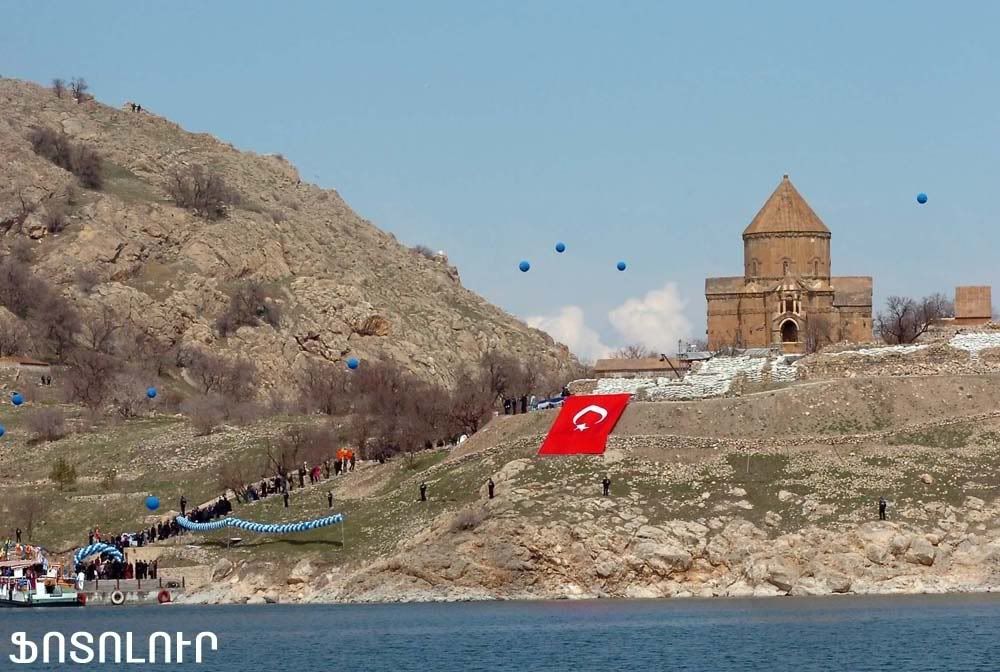
On March 29, Rep. Diane Watson (D.-Calif.) sent a letter to congressional colleagues titled, “The Truth about Armenian Churches in Turkey,” the Armenian National Committee of America reports. The letter came in response to Turkey’s efforts to advertise its renovation of the Holy Cross Church on the Aghtamar island in Lake Van.

Ms. Watson noted that while the Turkish government “is holding an event to tout the rehabilitation of an Armenian Church . . . hundreds of [such] Churches in Turkey, some dating as far back as the 4th century, have been neglected and even egregiously abused.” She added that this was part of “a desperate and malicious campaign, which began in 1915, to erase the Armenian people's physical and cultural existence in their historic homeland.” For more information about the issue, see www.teachgenocide.com/background/hist_sites.htm.

Rep. Hoekstra looking for intelligence in Azerbaijan

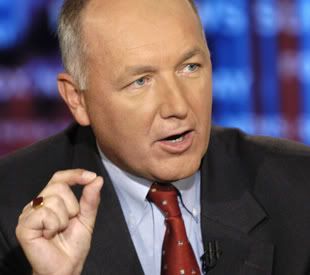
Rep. Pete Hoekstra (R.-Mich.), ranking member of the House Permanent Select Committee on Intelligence, was in Baku this week. Official reports suggested that Mr. Hoekstra’s April 3 meetings with Azerbaijani officials focused on the “development of inter-parliamentary relations,” but the representative is better known for his concerns about Azerbaijan’s southern neighbor.

In a March 4 television interview with Fox News, Mr. Hoekstra complained that "we still don't have the intelligence community overall to give us, as policy-makers, the information that we need to make good decisions in North Korea, Iran and other places." On March 27 he told the Holland Sentinels, his hometown paper, that his frequent foreign travel helped him fill in the gap.

State Dept. plays down Caucasus missile defense talk amid tensions with Iran

Deputy Assistant Secretary of State Matt Bryza was in Georgia last week. Speaking to the press in Tbilisi on March 30, he said, “the United States does not intend to deploy a missile-defense system in the Caucasus,” the Azerbaijan Press Agency (APA) reported.

Earlier this year, the United States announced plans to place parts of a European-theater missile-defense system in Poland and the Czech Republic. U.S. Missile Defense Agency Director Gen. Henry Obering added on March 1 that the United States would like to be able to deploy mobile anti-missile radar in one of the countries of the Caucasus.

Armenia, Azerbaijan, and Georgia have all denied receiving any deployment requests from the United States.

A retired U.S. Air Force planner, Col. Sam Gardiner, told the Armenian Reporter that while Iran does not yet have missiles capable of reaching Europe, U.S. missile defense plans were clearly part of an overall effort to put pressure on Iran. He added that having mobile radar units in the Caucasus might make sense to provide additional early warning to U.S. allies.

“This is a game of strategic chicken,” Mr. Gardiner said. It entails the ratcheting up of U.S. pressure, including a military buildup in the Persian Gulf and the detention of alleged Iranian operatives in Iraq. In recent months U.S. official have also expressed concerns about Iran’s policies on ethnic minorities, including Kurds, Arabs, and Azeris.

***
While in Tbilisi, Mr. Bryza noted that the United States would “want to have an opportunity” to use air bases in Azerbaijan “in emergencies,” according to APA. As part of its Caspian Security (Guard) initiative, the United States helped modernize several of Azerbaijan’s air bases.

(A day before Mr. Bryza’s statement, on March 29, the Azerbaijani government invited foreign diplomats to Haji Zeynalabdin Tagiyev [previously Nasosnaya] air base to showcase the MiG-29 fighter jets it just acquired from the Ukraine [see the March 24 edition of the Reporter for details]. On March 30, the muscle-flexing continued as Azerbaijani aircraft flew near Karabakh.)

In response to speculations that the United States would like to use Azerbaijan for strikes against Iran, the Azerbaijani Defense Ministry issued a statement on April 1 confirming Azerbaijan’s previously articulated position that it "will not create opportunities or conditions allowing foreign countries to use its territory against neighboring countries," RFE/RL reported.

Meantime, Vafa Guluzade, top advisor to at least three Azerbaijani presidents (1991–99) predicted that the United States intends to destroy and dismember Iran because it is an anti-American state that is “ignoring UN resolutions, which makes war inevitable,” day.az reported on April 3. Mr. Guluzade went on to warn that “since the U.S. is trying to weaken regional states, [in the future] Turkey might end up in the same situation as Iran today.”

Georgia’s NATO membership increasingly likely

On March 30, Mr. Bryza confirmed that the United States and Georgia share a common goal: “Georgia’s membership at a right time in NATO,” Civil Georgias reported. The “right time for Georgian membership in NATO is when Georgia has completed all of its reforms . . . and has continued what it’s been doing now for several month, which is pursuing constructive and peaceful [efforts] to resolving separatists conflicts in Abkhazia and South Ossetia within Georgia.”

NATO Secretary General Jaap de Hoop Scheffer had said on February 9 that the alliance should be "coming closer to honoring the ambitions of Ukraine and Georgia." Both chambers of the U.S. Congress have voted to support the two countries’ accession to NATO financially.

President Mikhail Saakashvili of Georgia in turn recently promised to more than double Georgia’s force in Iraq to 2,000, which would make it one of the largest contingents in the U.S.-led coalition there. Mr. Saakashvili is optimistic that Georgia could become a NATO member by 2009.

Cory Welt from the Washington-based Center for Strategic and International Studies told the Reporter that there has been more enthusiasm for Georgian membership lately. “They still have a lot to do, but the 2009 possibility is more realistic now.”

Last month, Georgia’s parliament voted 160-0 in favor of joining NATO. This policy is supported by most Georgians, but has caused lingering tensions with Russia. In apparent reference to their northern neighbor, Mr. Bryza assured Georgians last week that “no country that is not a member of NATO has any say over Georgia’s future within the alliance.”

Neither Armenia nor Azerbaijan has expressed a desire to join the alliance yet, but Mr. Welt believes that the two will likely “reassess their current position in light of Georgia’s membership.”