Showing posts with label Congress Armenian Genocide. Show all posts

Tuesday, April 7, 2009

Ian Bremmer predicts the future, an interview

Ian Bremmer: no war over NK, same challenges for Genocide resolution
Prominent political risk consultant offers Armenia, regional outlook for 2009
by Emil Sanamyan


Ian Bremmer, 2d from right with, from left, Pres. Ilham Aliyev of Azerbaijan, Prime Minister Recep Tayyip Erdogan of Turkey, Foreign Minister Edward Nalbandian of Armenia, and Foreign Minister Manouchehr Mottaki of Iran at the World Economic Forum in Davos, Switzerland, on Thursday Jan. 29. AP Photo: Michel Euler

Ian Bremmer is founder and President of Eurasia Group, one of the world's leading providers of political risk analysis for corporate clients. Self-described "intellectual entrepreneur" Mr. Bremmer, who turns 40 this year and is of Armenian and German descent, has built the consultancy from the ground up since 1998. The group is at 100 full-time staff in offices in New York, Washington and London, including former senior U.S. government planners and analysts, and hundreds more contributing experts worldwide. On February 9 Mr. Bremmer spoke with Armenian Reporter's Washington editor Emil Sanamyan about risks faced by Armenia and the world.

Nonpolar world and Russian regional dominance

AR: In a Foreign Affairs article last year, Richard Haass, the president of the Council on Foreign Relations, observed that the world order was shifting from U.S.-dominated "uni-polar" one to a "non-polar" state of affairs. And you agree with that view. What does this mean for the world and for countries like Armenia?

IB: This [nonpolar arrangement] is unlikely to be the equilibrium outcome, [i.e., the world order will continue to undergo changes]. But there is no question that America's ability and willingness to do the heavy lifting on global issues is much more limited than it was five years ago or even one year ago.

What it means for a country like Armenia is that you are dealing much more with your immediate neighborhood. At the end of the day that means countries like Russia.

Look at what happened in Georgia. The Russian government, after a number of provocations, basically goaded the [Georgian President Mikheil] Saakashvili to do something stupid and he did. And the Russians would have probably gone to Tbilisi if it was not for the U.S. and France.

The end of that story is they have got control [over the region]. You saw that the U.S. base in Kyrgyz Republic was forced out after the Russians threw a little more cash and engaged in political pressure [against the Kyrgyz government].

It is very clear that Russia believes that there is a region of the world that is in its sphere of influence, where [Russian interests] are privileged. In the same way the United States exists in Latin America. And the Russians intend to behave that way.

So if you are Armenia, a tiny landlocked country with very limited resources, it means that your relationship with Russia is going to become even more important than it has been.

AR: How significant an event was the war in Georgia last year? In terms of regional impact, was it on the scale of the September 11, 2001, attacks or perhaps even the Soviet breakup?

IB: No, because [Georgia] is a tiny little country and because, at the end of the day, you can give Russia 75 percent of the blame, but you have to give Saakashvili 25 percent [of the blame] for sheer lack of understanding of what he was getting himself into. Or lack of care.

Georgia is a small country, where the United States and Europeans are not prepared to move quickly on NATO integration or send troops to stop the Russians. It could have 9/11-type implications if Americans and Europeans decided that Georgia was an ally they could not allow to fall, but that was not the case.

When I wrote my early 2008 paper about expectant risks going forward [in 2008], I talked about Georgia. I didn't say it was going to be the number one risk, because it is not that big of a deal, but certainly the likelihood that Russians could have gone in, we could predict a while back.

AR: Do you see this sort of Russian resurgence exhibited again in 2009?

IB: We just saw that in the Kyrgyz Republic, and we saw that in a natural gas cut off to Ukraine earlier in the year that had implications for European countries.

And if people said that Russia attacked Georgia when a barrel of oil was $120 and Russians felt a lot stronger, the fact is that Russia cut off gas to Ukraine when oil was at $40 a barrel. So clearly, it is not just economic interest that is playing a role here for the Russian government.

The willingness of the Russian government to ensure that they have dominant political influence over Ukraine is significant. That may well mean that they play a more proactive role in trying to get [former prime minister Viktor] Yanukovich as the next president of Ukraine.

There is greater possibility for tensions over Crimea - both directly with local population that has a pro-Russian orientation and also in terms of the Russian naval base in [Crimea's port of] Sevastopol - and Russia continuing to leverage their energy influence over Ukraine.

I do not expect to see Russian tanks rolling into Kiev or anywhere else in the region. While there is always a possibility, if we are looking at the immediate future in 2009, there is not the same level of expectation of military confrontation that Russians could provoke that we saw with Georgia.

Aliyev's success and Karabakh stability

AR: Considering the increase in Russian influence and the fall of oil prices, which is very important to Azerbaijan, where do you see the Karabakh stand-off going?

IB: Clearly, the Armenians are showing more flexibility [in negotiations] than the Azeris are since [Armenians] recognize that they are increasingly in a weaker position than the Azeris, with all their resources and regional allies.

When I met [Azerbaijani President] Ilham Aliyev [before the panel that Mr. Bremmer moderated] in Davos, it struck me that he felt that he had more of an upper hand to play.

But Karabakh is not an area where Russians are actively playing one side against the other. Moscow's relationships with Yerevan and Baku are both pretty good.

If you do see Aliyev saying, "I am going independent, I am going to build Nabucco [a gas pipeline to Europe bypassing Russia] all by myself, I don't care about Russia and their energy interests," then you could see Russians promoting more conflict and trying to squeeze the Azeris.

Aliyev has been a comparative success story in the region. When he first became president, everyone said he was a playboy, not an intellectual, not serious. But he actually became a pretty good and articulate head of state. And he is aware of the difficulty of Azerbaijan's geopolitical position even in the context of Russia economically being a bit on the back foot.

AR: What do you make of all of Aliyev's threats to go to war over Karabakh that have been coming for many years? What do you think has held Aliyev back?

IB: First of all, they know that it's not in their interests. I think it is much more rhetoric, knowing that Armenians are in a difficult position and taking the more maximalist diplomatic line to try to improve the terms of any eventual settlement.

Secondly, the Azeris do listen to Russia; they listen to Turkey. Neither of those countries is pushing the Azeris toward a military confrontation with Armenia. And I just don't expect it.

And certainly Azerbaijan is an oil producer and oil prices being now at about a quarter of what they were at the peak, it's not the time I'd be wanting to launch military excursions. They are expensive.

Armenian-Turkish dialogue

AR: The other Davos panel that involved Turkish and Israeli leaders created quite a bit of news. Where do you see Turkey going and what does that mean for Armenia?

IB: You know that the Armenian and Turkish foreign ministers met privately three times the day before the panel that I moderated. I had been told directly that those meetings went quite well. And [Turkish prime minister Recep Tayyip] Erdogan met with Armenian president Serge Sargsian. When I asked Mr. Erdogan, he was cautiously optimistic that [the matter of] relations with Armenia is going well.

The Armenian government understands it has to play a very sensitive role. The diaspora is much more focused on the Genocide issue and is much more loath to support Armenia opening relations with Turkey. But it really behooves the leaders of the Armenian diaspora to recognize that opening diplomatic and trade relations between Armenia and Turkey would be an incredibly positive step that does not mean that Armenians should never talk about genocide again.

The genocide recognition should not be a precondition. Armenia is in the difficult position. The leaders in Yerevan and citizens of Armenia have to live in that geopolitical context. Members of the diaspora living in Watertown or Pasadena do not. And I think there needs be a level of sensitivity with the extraordinary pressure that the Armenian government is presently under.

There is a real opportunity with the Erdogan government right now. And if diplomatic relations with Armenia are opened, that creates more of an opportunity over the longer term through dialogue and through closer relations to get the Turks to move to the place where they could finally recognize and offer an historical apology for what happened between our two nations.

AR: Over the past number of years, whenever there are improved expectations of headway for Armenian Genocide recognition, especially a congressional resolution in the United States, Turkey becomes more interested in talking to Armenia on a high level. And as soon as the resolutions get shelved, dialogue on normalization gets shelved as well. Would it be too unfair to suggest that Turks are using these talks to simply try and prevent once again a congressional resolution?

IB: Certainly, pressure in Congress under the Obama Administration is something that is talked about in Turkey frequently and that plays into their calculus.

But that does not mean you do not open relations. What the Armenian diaspora does vis-à-vis Washington is separate from what the Armenian government does vis-à-vis Ankara. And these need to be recognized as dual tracks.

The diaspora telling the Obama administration and their representatives in Congress that the Genocide resolution is important to the community is very different from the diaspora telling Yerevan you can't open relations with Turkey.

AR: In your outlook for 2009, you wrote that "Turkey-U.S. relations could suffer significantly if President Obama decides to fulfill his electoral pledge to approve the Armenian genocide resolution, a step that would seriously inflame the Turkish government and public opinion." Do you think that perhaps the adoption of the resolution could be helpful in that it would no longer "threaten" U.S.-Turkish relations as it has for the past two or three decades?

IB: No, it will always threaten U.S.-Turkish relations but that does not mean it is not helpful for the Armenian diaspora. We need to recognize that the diaspora has a different view of priorities than the U.S. government does, which is perfectly reasonable for a special interest group.

The pro-Israel lobby in U.S. has interests that differ from U.S. priorities in the Middle East or even in U.S-Israel relations.

And it is appropriate for the Armenian diaspora to push for what they feel is incredibly important to them. But it is also appropriate for the Obama administration to resist that, because Turkey is an important country. And that is healthy for a democracy.

Openness, stability, and risks

AR: In your 2006 book The J Curve: A New Way to Understand Why Nations Rise and Fall, you argued that there is a peculiar relationship between a country's stability and its openness toward the flow of people, goods, and information (not necessarily being a democracy). Sometimes it seems that Armenia is just open enough to frequently find itself at the bottom of this curve, do you agree with that?

IB: No, Armenia is reasonably closed at this point and it pretty much has to be in the present environment. Armenia is a country that lost about thirty percent of its population in the 1980s and 90s, some of the most pro-globalization, pro-entrepreneurial citizens of that country, because they had opportunities outside of Armenia.

So it is not a surprise in that context that the Armenian government is focused on stability. They fought a war against Azerbaijan and their closest relationship is with authoritarian Russia. It is a very difficult geopolitical position and no surprise it finds itself on the left side of the curve.

AR: Overall, is the so-called Putin model of authoritarian leadership the best possible fit for Armenia?

IB: Not long-term. Being a small country with a very active diaspora, Armenia could open up in a relatively short time, developing ties and trade with Turkey, and move toward settlement with Azerbaijan. And if Georgia remains less stable, Armenia becomes a better option for things like pipelines. A small country like that with a relatively small amount of money gets a lot of optionality. But we are not there yet.

AR: And you have a new book coming out in the next couple of weeks, The Fat Tail: The Power of Political Knowledge for Strategic Investing. What is that about?

IB: The book tries to explain how politics increasingly affect the market. The notion of the "fat tail" is that so many of the things that affect us in the global economy today are things that we think are very, very unlikely to happen, but they actually happen much more frequently.

A lot of people say that these things cannot be predicted. And what I am saying in the book is that increasingly the biggest risks in the market are not economic but political in nature. And I am trying to help people understand what these political risks are all about.

Top 10 risks of 2009 according to Eurasia Group
(Eurasia Group's Jan. 5, 2009 release)


1. Congress: how the U.S. reacts to the economic crisis

2. South Asia security: Afghanistan, Pakistan, and India

3. Iran/Israel: Nuclear Iran to shift regional balance

4. Russia: economic problems and tension with the West

5. Iraq: reduced U.S. presence to lead to spike in violence

6. Venezuela: Chavez to fight to retain power

7. Mexico: War on drugs taking a violent turn

8. Ukraine: economic implosion and political bickering

9. Turkey: Islamists v. secularists; drift from the West

10. South Africa: elections and political instability

Red herrings:
China: no domestic unrest and resilient economy

The Persian Gulf: Petro-states to weather the oil prices

Climate change: Issue to take back seat to economic crisis

Brief description for each item inserted after colon is the Reporter's summary of Eurasia Group findings.

connect: www.eurasiagroup.net

Friday, October 10, 2008

Briefly: Bush, Obama on Armenia independence, U.S. to "Georgia and the region," State Dept. on Genocide and anti-Armenian attacks in Azerbaijan

First published in September 27, 2008 Armenian Reporter.

Washington Briefing
by Emil Sanamyan and Lusine Sarkisyan

Bush, Obama send messages on Armenian Independence Day


President George W. Bush sent a private message to congratulate President Serge Sargsian on Armenian Independence Day.

The letter was transmitted to Mr. Sargsian by Ambassador Marie Yovanovitch as she handed her letter of credence to the Armenian president on September 22, the president’s office reported without publicizing the content of the message, which is the first known direct communication from Mr. Bush to Mr. Sargsian since the latter took office in April.

Presidential candidate Senator Barack Obama issued a public message on September 21, Armenian Independence Day, noting that “throughout their long history, a spirit of independence, self-reliance, and survival defines the Armenian people... Even in the face of genocide, the pain of the past has not defeated the Armenians, either in Armenia or the far-flung diaspora.”

Pointing to the Georgia crisis, Mr. Obama said it “shows the danger that lurks when rising tensions are ignored and the United States pursues a diplomatic strategy of neglect.” At the same time, he welcomed the “hopeful step – taken by the Presidents of Turkey and Armenia – to restart dialogue.”

The full text of the statement by Mr. Obama appears at www.barackobama.com/2008/01/19/barack_obama_on_the_importance.php

Congress to appropriate $365 million in aid for “Georgia and the region”

According to the text of proposed legislation made available by Rep. David Obey (D.-Wis.), chair of the House Appropriations Committee on September 23, “$365,000,000 shall be made available for assistance for Georgia and the region for humanitarian and economic relief, reconstruction, energy-related programs and democracy activities.”

The extra aid proposed is six times the amount Georgia was slated to receive before the August war with Russia, but less than the $570 million initially requested by
the Bush administration.

The proposal would also safeguard foreign aid already earmarked, such as that to Armenia, from being “reprogrammed for assistance for Georgia.”

But the draft legislation apparently leaves it to the administration’s discretion whether assistance to “the region” actually means providing part of the $365 million to other countries in the region.

On September 19, twenty members of Congress joined Reps. Frank Pallone (D.-N.J.) and George Radanovich (R.-Calif.) in writing to Mr. Bush with a request for proportional funding to Georgia’s Armenian-populated districts as well as additional aid to Armenia to offset the losses its economy suffered as a result of Russian-Georgian fighting last month.

The issue was raised earlier by Rep. Brad Sherman (D.-Calif.), with Assistant Secretary of State Dan Fried promising to look into the concerns.

Senators question nominee for U.S. ambassador to Turkey on Armenia policy

Senators John Kerry (D.-Mass.) and Robert Menendez (D.-N.J.) questioned President Bush’s nominee to be the next U.S. ambassador to Turkey in a hearing on September 24.

Ambassador-designate James Jeffrey, who previously served in the U.S. diplomatic mission in Turkey on three separate occasions and is currently Mr. Bush’s deputy national security advisor, called Turkey a “key friend and strategic partner of the United States” on a range of issues, although he acknowledged “occasional differences” over Iraq and Iran.

Mr. Jeffrey also “strongly urge[d] Turkey to work with Armenia to reestablish diplomatic relations and to have an open and honest dialogue about the tragic events at the end of the Ottoman Empire.”

Mr. Kerry wondered if that meant the United States is “supportive of the historical commission itself” as proposed by the Turkish government.

Mr. Jeffrey responded that the United States supports “anything that the two sides agree on and as part of the process there should be a full and open review of events of that time... providing it’s mutually agreed on.”

Mr. Menendez said he was “dismayed” by Mr. Jeffrey’s remarks, arguing they were at variance with the administration’s position as expressed during Ambassador Marie Yovanovitch’s confirmation process earlier this year.

“The Administration in their letter said ‘our goal is not to open a debate whether the Ottomans have committed these horrendous acts, it is to help preserve the documentation that supports the truth of those events,’ Sen. Menendez stressed.

Mr. Jeffrey disagreed that he was diverging from the U.S. position as articulated by Assistant Secretary of State Matthew Reynolds in July 2008.

In the days prior to the hearing, the Armenian National Committee of America (ANCA) contacted committee members urging them to scrutinize the administration’s nominee on “failings in U.S.-Turkey policy” ranging from disagreements over Iraq to the Administration’s opposition to congressional legislation affirming the Armenian Genocide that was debated last year.

According to the ANCA, the “sad public spectacle” of lobbying against the Genocide resolution was accompanied by “the decision of the President to send two of his Administration’s senior officials, Under Secretary of Defense Eric Edelman and Assistant Secretary of State Dan Fried, to Ankara to
personally apologize for America for the House Foreign Affair Committee’s approval of this human rights legislation” on the Genocide in October 2007.

State Department report again ignores Azerbaijan’s anti- Armenian policies

Remnants of Baku's Armenian cemetery as of Sept. 2007“The International Religious Freedom Report 2008,” a congressionally mandated State Department report released on September 19 focused – as similar reports have done in years past – on restrictions and harassment faced by missionary groups, particularly Jehovah’s Witnesses, while ignoring continuing anti-Armenian rhetoric and actions in Azerbaijan. The reports are compiled primarily by in-country U.S. Embassy staff.

The report also listed, in minute detail, the few instances in which anti-Semitic comments were employed by pro-government media in their attacks on the opposition in the pre- and post-election period (while ignoring equally xenophobic although not anti-Semitic attacks).

The report did note that Armenia is “a country traditionally known for its welcoming attitude toward Jews.”

While reporting that “on December 17, 2007, Jewish community members discovered a small swastika drawn on the Hebrew side of the 14-month-old Joint Tragedies Memorial,” the report misses the state-organized destruction of Armenian monuments and cemeteries throughout Azerbaijan, including the widely publicized case in central
Baku (see the September 15, 2007, edition of the Armenian Reporter).

Also ignored are a slew of Armenophobic comments by Azerbaijani leaders, such as those by country’s formal Muslim leader Allahshukur Pashazade who told a visiting Jewish American rabbi that “falsehood and treason run through Armenians’ blood” (see this page in the July 26 edition of the Armenian Reporter).

In a correction, the report no longer refers to Nagorno-Karabakh as an “occupied region” (see this page in the September 22, 2007, edition of the Armenian Reporter). Instead it mentions an “unresolved conflict over Nagorno-Karabakh” and “those areas of [Azerbaijan] controlled by ethnic Armenian separatists,” while rehashing baseless claims and figures used by the Azerbaijani government.

Not much change in “corruption perception”

The Corruption Perception Index (CPI), the informal rival of the World Bank’s Doing Business report, which measures business regulation (see this page in the September 20 edition of the Armenian Reporter), was released by the Berlin-based Transparency International on September 23. Both reports count towards Armenia’s continued eligibility for the U.S. aid under Millennium Challenge program.

This year’s CPI for Armenia was 2.9 of out of 10 possible points – the same rating it had in 2005–2006, but slightly worse than 3.0 in 2007 and 3.1 in 2004. The decline placed Armenia 109th of 180 nations on par with Argentina and Moldova.

Transparency studies in Armenia are conducted by the Center for Regional Development, a Yerevan-based Transparency International affiliate (www.transparency.am).

Meanwhile, other Transparency affiliates found improvements in Georgia, placing it in 67th place, up from 79th, and regression in Azerbaijan, placed 158th, down from the 150th position in 2007.

Wednesday, September 3, 2008

Briefly: MCC cut proposed, U.S. debt forgiveness proposal, Armenia vs. Georgia at UN GA, Turkish lobby vs. Genocide resolution

First published in May 24, 2008 Armenian Reporter.

Washington Briefing
by Emil Sanamyan

Senator proposes Millennium Challenge program cut


An amendment to Fiscal Year 2008 and 2009 U.S. foreign assistance would reallocate $225 million in funds set aside for but still unspent by the Millennium Challenge Corporation (MCC) to other foreign aid programs, the amendment’s sponsor Sen. Judd Gregg (R.-N.H.) initially reported on May 15.

The amendment has since passed as part of the Senate spending bill on May 20 and will next be considered in a conference with the House appropriators.

Sen. Gregg, who is ranking member (most senior GOP senator) on the Senate Appropriations Subcommittee on Foreign Operations, proposed to spend the funds for alleviating the Burma cyclone disaster as well as food aid programs elsewhere, to address rising prices.

Last June, Sen. Gregg already succeeded in cutting MCC’s FY 2008 budget to $1.2 billion from $1.4 billion, reallocating the difference to military aid for Jordan. That came on top of the Senate Democrats’ cut of the original Bush Administration request of $3 billion for MCC.

It is so far unclear whether MCC’s Armenia program, valued at $236 million over five years, will be in any way affected. Armenia’s eligibility for the program has received additional scrutiny following the recent post-election crisis.

Since its establishment earlier in the Bush Administration, MCC has consistently received larger congressional allocation than it has been able to expend, because it employed a stricter eligibility criteria for qualification than have other U.S. aid programs in the past.

Armenia left out of new debt relief program

Because of its improved economic performance, Armenia was left out of the new congressional proposal to forgive the debt of lower-income countries.

The Jubilee Act for Responsible Lending and Expanded Debt Cancellation of 2007 (H.R. 2634/S. 2166) would make several dozen countries in the lower and lowermiddle income category, including Georgia, Moldova, Kyrgyzstan, and Tajikistan, eligible for partial or full foreign debt cancellation.

The act has passed the House of Representatives and is expected to be considered by the Senate Foreign Relations Committee this month. The country qualifications are based on the World Bank’s lending category criteria.

Although Armenia and 14 other countries (including Azerbaijan, India, and Pakistan, among others) are also in the lower-middle income category, because of their somewhat higher incomes they receive World Bank assistance through both the International Development Agency (IDA) and other programs (the so-called “Blend”
category), making them ineligible for debt relief under this legislation.

According to sources familiar with the developments, last month a leading member of the congressional Armenian Caucus sought to amend the criteria to include Armenia, but since the change would make large debtors like India and Pakistan also eligible, the amendment did not succeed.

Armenia’s foreign debt amounted to $1.45 billion at the end of 2007.

UN General Assembly passes pro-Georgia resolution on Abkhazia

The General Assembly of the United Nations on May 16 voted 14-11 to pass a Georgia-sponsored nonbinding resolution affirming its claims on the breakaway and de facto independent republic of Abkhazia. Fully 105 countries abstained, and the rest did not vote.

The vote came two months after the General Assembly passed an Azerbaijan-sponsored resolution on Karabakh. In that vote Georgia sided with Azerbaijan, even though the three leading mediators in the Karabakh peace process, France, Russia and the United States, voted against the resolution.

In the May 16 vote, Armenia in turn sided with Russia, voting against the Georgian proposal.

Georgia was backed by the United States, Sweden, 10 eastern European states, as well as Azerbaijan. Most Western European states, as well as Turkey, abstained.

According to the UN news release, Armenia’s representative argued against the draft, saying that it focused on consequences of the conflict rather than addressing the core issues and was thus counterproductive to the conflict-resolution process.

A spokesperson for the Georgian Embassy in Armenia, Georgi Saganelidze, revealed on May 6 that Georgia had actively lobbied Armenia not to vote against the resolution. According to the Mediamax news agency, Mr. Saganelidze defended Georgia’s vote in favor of Azerbaijan, but still expected Armenia to continue to take a more neutral position on the Abkhazia issue, suggesting that a “no” vote could have consequences for bilateral relations.

Turkish lobby continues to target Genocide resolution

Pro-Turkey lobby groups remain focused on the congressional proposal affirming the U.S. record on the Armenian Genocide. In a Washington conference on U.S.-Turkey relations held on May 16, the Turkish Industrialists’ and Businessmen’s Association (TUSIAD), an influential business lobby, released an analysis it funded challenging the substance of the congressional resolution, Turkish media reported.

House Resolution 106, backed House Speaker Nancy Pelosi (D.-Calif.) and Majority Leader Steny Hoyer (D.-Md.) passed the Foreign Affairs Committee last October but has remained stalled in the House because of opposition from the Bush Administration and from several key Democrats in Congress.

The TUSIAD-sponsored analysis was prepared by David Saltzman of the Washington-based
Saltzman and Evinch LLP, the Turkish government’s veteran legal aides.

Also on May 19, Turkey’s ambassador to the U.S., Nabi Sensoy, discussed U.S.-Turkish cooperation at a session held on Capitol Hill. In recent months, events on U.S.-Turkish relations have taken place on nearly a weekly basis, suggesting a concerted public relations campaign by Turkey.

Monday, September 1, 2008

Congressional leadership marks April 24

First published in April 26, 2008 Armenian Reporter

House Speaker, Majority Leader stress importance of Genocide affirmation

WASHINGTON – Speaker of the House Nancy Pelosi (D.-Calif.) and Majority Leader Steny Hoyer (D.-Md.) addressed the annual congressional commemoration of the Armenian Genocide hosted by Congressional Armenian Caucus co-chairs Reps. Frank Pallone (D.-N.J.) and Joe Knollenberg (R.-Mich.) on the Capitol Hill on April 23.

Ms. Pelosi spoke of the urgency of addressing the Genocide “as long as genocides happen now – in Rwanda, Darfur, we must speak with one voice.”

“I carry in my briefcase the front page of the New York Times from the day the resolution was passed because it shows the survivors,” Ms. Pelosi said in a reference to the House Foreign Affairs Committee approval last October of House Resolution 106 affirming the Armenian Genocide.

Ms. Pelosi described the committee vote as “a human rights statement [that] almost 100 years ago something happened to the Armenians, and we are prepared to call it Genocide.”

Strong pressure from the Bush administration on behalf of the Turkish government has since stalled passage of the resolution by the full House of Representatives. Rep. Hoyer in turn stressed that “repetition [of genocide] is the child of denial: it’s not about what happened in 1915, it’s about what happens today. When you speak out for this resolution, you speak out for all the people today” who are suffering genocide.

The Armenian National Committee of America (ANCA), U.S.–Armenia Public Affairs Committee (USAPAC), and other Armenian groups helped organize the event attended by hundreds of supporters of Armenian Genocide affirmation. The commemoration featured speeches from more than a dozen lawmakers, as well as keynote addresses by Dr. Gregory Stanton of the International Association of Genocide Scholars, Armenia’s Ambassador to the U.S. Tatoul Markarian, NKR Representative Vardan Barseghian, and prayers led by Archbishops Oshagan Choloyan and Vicken Aykazian.

Thursday, July 31, 2008

Briefly: Nuclear power; Nick Burns; “Genocide Prevention Task Force;” EU on Caucasus and Saakashvili's inauguration


This was originally published in January 26, 2008 Armenian Reporter.

by Emil Sanamyan

American nuclear energy official visits Armenia
U.S. Nuclear Regulatory Commissioner Peter Lyons was in Armenia January 21–22 to discuss the Armenian government’s plans to build a new nuclear power plant to replace the existing one at Metsamor before 2016.

The U.S. Embassy in Yerevan reported that Mr. Lyons’ talks focused on how the Nuclear Regulatory Commission “can help Armenia to develop the regulatory infrastructure needed in order to license a new nuclear power plant.”

Last November, the United States agreed to fund a $2 million environmental impact and technical feasibility study that would help the Armenian government choose the best technical solutions and project logistics.

During a visit to Armenia last April, Russia’s chief nuclear energy regulator Sergei Kirienko offered assistance with both construction and funding for the new nuclear power plant. (See this page in the December 15, 2007, edition of the Armenian Reporter .) Russia has been the sole nuclear fuel supplier to Armenia and its electricity monopoly RAO UES currently manages Metsamor.

The Armenian energy minister, Armen Movsisian, has said that he anticipates involvement by several countries in what is variously estimated to be a $1 to $2 billion project.

Top U.S. diplomat to retire “for personal reasons”
Undersecretary of State for Political Affairs Nick Burns intends to retire this March “to go back to family concerns,” the State Department announced on January 18. The administration intends to nominate the current ambassador to Russia, Bill Burns (not related), to replace him.

Since 2005 the outgoing undersecretary has been the U.S. diplomat in charge of negotiating international sanctions against Iran, the future status of Kosovo, mending of U.S.-Turkish relations, as well as a U.S.-India agreement on nuclear energy. Mr. Burns, 51, is due to continue to deal with the India issue after his retirement, when he intends “to pursue other ventures outside the government.”

The Los Angeles Times noted on January 19 that the move came “amid signs that U.S. efforts on key issues have been losing momentum.” As undersecretary, Mr. Burns was the public face of the department, frequently announcing and articulating U.S. foreign policy initiatives.

Last September, shortly before taking a trip to Ankara, he acknowledged difficulties in U.S.-Turkish relations since 2002 and spoke on the need to “restore” bilateral ties, particularly through “mechanisms” to clamp down on anti-Turkey Kurdish forces in northern Iraq.

He said at the time that while the Bush Administration has repeatedly acknowledged and condemned the “mass killings and forced deportations” in Ottoman Turkey, it opposes “the passage of the U.S. House of Representative’s Resolution 106, which would make a political determination that the tragedy of 1915 constituted genocide.”

That pronouncement was followed by aggressive administration lobbying against the Armenian Genocide resolution in October, a Turkish prime minister’s visit to Washington in November, and provision of U.S. intelligence to help Turkish military operations in northern Iraq since last December.

Members of Congress urge “Genocide prevention task force” to learn from Armenian experience
Four lead co-sponsors of the congressional resolution on the Armenian Genocide wrote to the co-chairs of the recently launched anti-genocide initiative on January 17 “to ensure that the lessons of the Armenian Genocide are used to help prevent future genocides.”

The letter, co-signed by Reps. Frank Pallone (D.-N.J.), Joe Knollenberg (R.-Mich.), Adam Schiff (D.-Calif.), and George Radanovich (R.-Calif.), was made available to the Armenian Reporter by Mr. Pallone’s staff.

“When addressing U.S. policy on genocide,” the representatives argued, “no serious discussion can take place that does not cover the extensive U.S. record documenting the American response to the Armenian Genocide, as well as the modern-day impact of the ongoing denial of this crime,” it read.

The “Genocide prevention task force” is co-chaired by Madeleine Albright and Bill Cohen, former Clinton Administration secretaries of state and defense, respectively. They intend to issue a report on the subject by December of this year.

As former secretaries launched the “task force” last November, they repeatedly heard questions, including from this newspaper, about their credibility on the issue. (See this page in the November 17, 2007, edition of the Armenian Reporter .) Ms. Albright and Mr. Cohen have advocated against congressional affirmation of the Armenian Genocide while both in and out of government.

European Parliament wants “more effective” Caucasus policy
The European Union (EU) was urged to “develop a clear profile and stronger presence” in the Caucasus in a resolution passed by the European Parliament on January 17, the European Armenian Federation (EAF) reported.

The resolution expressed support for “an inbuilt differentiation in the application of the [EU] policy towards the countries concerned . . . according to their individual merits”. The resolution particularly welcomes “internal political and institutional reforms undertaken by Armenia” since 2005 and urges further progress; it is also generally supportive of Georgia, although expressing concern over its government’s crackdown on opposition last November; and it is critical “of the deterioration of the human rights situation and media freedom in Azerbaijan.”

The EAF criticized the resolution for avoiding a mention of the Armenian Genocide, instead referring to “past events,” and failing to clearly condemn Azerbaijan’s anti-Armenian policies and rhetoric. Moreover, the original text prepared by MEP from Luxemburg (and its former foreign minister) Lydie Polfer also included a line endorsing “internationally recognized borders of Azerbaijan.”

The final version retained that reference while also expressing support for “the right to self-determination, in accordance with UN Charter and the Helsinki Final Act” and claiming “that the contradiction between the principles of self-determination and territorial integrity contributes to the perpetuation of the unresolved conflicts in the South Caucasus region,” Armenpress reported.

President inaugurated in Georgia as opposition protests
Mikhail Saakashvili was inaugurated for a second term as Georgian president on January 20, local media reported.

The inauguration was attended by presidents of the three Baltic States, Poland, and Romania, as well as ministerial delegations from the U.S., Russia, Armenia, and elsewhere. The inauguration went ahead while many thousands of opposition supporters rallied in Tbilisi to protest it as illegitimate.

In his inaugural address, Mr. Saakashvili pledged to focus on overcoming poverty in Georgia’s provinces and improving relations with Russia and the political opposition, which accuses him of rigging the vote to avoid a runoff. Mr. Saakashvili was certified the winner of January 5 election with over 53% of the vote, roughly 70,000 votes above the fifty percent plus one vote threshold.

In Washington, long-time Georgia analyst Dr. Charles Fairbanks of the Hudson Institute argued on January 16 that at least 80,000 votes were added to Mr. Saakashvili’s total and his re-election in the first round was therefore invalid. The opposition claimed days after the election that as many as 110,000 votes were stolen. (See this page in the January 12 edition of the Armenian Reporter .)

But Deputy Assistant Secretary of State Matt Bryza told RFE/RL earlier this week that the U.S. Embassy in Tbilisi concluded that while “there were irregularities of concern, there was no systematic attempt we saw to use massive fraud to change the result of the election.”

President Bush called to congratulate Mr. Saakashvili on January 14. Mr. Bryza urged the opposition to “move forward . . . accept the results and prepare for parliamentary elections,” which he said should be conducted “better.”

Briefly: Lantos retires, Gül to visit U.S., Russia supplies Iran with nuclear fuel and Putin “Person of the Year.”


This was originally published in January 5, 2008 Armenian Reporter.

by Emil Sanamyan

Congressman Lantos announces retirement
Foreign Affairs Committee chair Rep. Tom Lantos (D.-Calif.) said on January 2 that he will retire from Congress at the end of 2008. “Routine medical tests have revealed that I have cancer of the esophagus,” Rep. Lantos said in a statement. “In view of this development and the treatment it will require, I will not seek re-election.”

Rep. Lantos, together with Speaker Nancy Pelosi, played a key role in assuring the passage of the Armenian Genocide resolution in the Foreign Affairs Committee last October. Rep. Lantos described that vote to PBS as “a significant step in restoring the moral authority of U.S. foreign policy.”

Until 2005, Mr. Lantos – the only Holocaust survivor in Congress – opposed similar resolutions, citing Turkey’s importance to the U.S. and Israel. Rep. Lantos, who will turn 80 next month, has represented a San Francisco-area congressional district since 1980 and for over a decade has been one of the most influential congressional voices on foreign affairs.

Should Democrats retain their congressional majority next year, Rep. Lantos is likely to be replaced as committee chair by Rep. Howard Berman (D.-Calif.), a member of the Armenian Caucus and a supporter of Armenian-American issues.

On January 3, Rep. Lantos’ hometown newspaper, the San Mateo Daily News, reported that former California State Senator Jackie Speier (D.-San Mateo), who is of Armenian descent, had been planning a run for Rep. Lantos’ seat even before his retirement announcement. At this time, Rep. Anna Eshoo (D.-Calif.) is the only member of Congress of Armenian descent.

Turkish president to visit United States
President Abdullah Gül of Turkey has been invited to visit the United States next week. He will meet President George W. Bush at the White House on January 8 and will then travel to New York for a meeting with the United Nations’ Secretary General Ban Ki-Moon.

Turkish media report that talks in Washington will focus on Turkey’s concerns over Kurds and in New York – over Cyprus. Gül’s will be the first visit by Turkish president to the United States since 1996.

“Obviously President Gül’s visit to the White House will reconfirm the importance attached to our bilateral ties,” the Turkish Daily News cited an anonymous Turkish diplomat as saying on January 2. “We are satisfied with the new intelligence sharing system and looking forward to deepening our cooperation,” he said in reference to assistance the U.S. has begun to provide Turkey since an early November meeting between President Bush and visiting Turkish Prime Minister Recep Tayyip Erdogan.

The visit also comes shortly after Iraqi Kurdish leaders said they would postpone by six months a referendum on the status of the oil-rich city of Kirkuk in northern Iraq. Turkey has long objected to making that majority Kurdish-populated (and de facto controlled) city part of Iraqi Kurdistan.

Russia resumes nuclear fuel shipments to Iran
With international pressure at least temporarily off Iran over its nuclear program, following the publication of the most recent U.S. intelligence assessment (see this page in the Dec. 8, 2007 Armenian Reporter), Russia at the end of December resumed supplying nuclear fuel to an Iranian nuclear power plant in Bushehr.

Senior officials in Tehran also suggested that Russia would supply the Iranian armed forces advanced air defense systems, news agencies reported. But Russian officials would not confirm that the deal to supply the S-300 surface-to-air missile systems was currently on the agenda.

Last fall, Russia suspended the fuel supplies, as the U.S. prodded the international community to take a tougher stand against the Tehran government, which it accuses of seeking to develop nuclear weapons. But the U.S.’s own intelligence estimate released a month ago determined that Iran stopped its nuclear weapons program in 2003.


Time names Putin “Person of the Year”
In its annual selection, Time picked Russian President Vladimir Putin as its “Person of the Year 2007.” The magazine said that the Russian president was chosen because he performed an extraordinary feat of leadership in imposing stability on a nation that has rarely known it and brought Russia back to the table of world power.”

Mr. Putin, who was chosen over former U.S. vice president and Nobel laureate Al Gore, became the fourth Russian leader to be selected since Time began the selections in 1927. The others chosen included Joseph Stalin (1939 and 1942), Nikita Khrushchev (1957), and Mikhail Gorbachev (1989).

Monday, July 21, 2008

Briefly: Congress approves military aid to Turkey, GUAM reps visit U.S., Western embassies in Baku threatened, Georgia to sell its railroad


This was originally published in November 3, 2007 Armenian Reporter.

From Washington, in brief
by Emil Sanamyan


Members of Congress speak of Genocide affirmation;
Committee approves military aid to Turkey


Reps. Frank Pallone (D.-N.J.) and Joe Knollenberg (R.-Mich.), co-chairs of the 155-member Congressional Caucus on Armenian Issues, confirmed on October 29 their determination to bring the House resolution affirming the U.S. record on the Armenian Genocide to a vote before the end of 2008. Last week, the resolution’s co-sponsors decided to ask the Speaker not to bring it up this month because of the erosion of support for the resolution as a result of strong opposition from the Bush Administration.

In a letter to fellow members of Congress, the co-chairs noted that “although the events of the resolution took place more than ninety years ago, denial of its historical fact remains. And until this denial is removed, we must stand up to injustice and refuse to allow another country to impede our efforts to speak out against inhumanity.”

During a House Foreign Affairs Committee hearing with Secretary of State Condoleezza Rice on October 24, Rep. Dana Rohrabacher (R.-Calif.) said that the committee’s approval of the resolution on October 10, strongly opposed by the administration, was “a human rights vote and recognition of a violation of human rights.” In response, Secretary Rice said that she “recognize[s] that it was a difficult vote for some who supported the administration’s position,” but that the administration would continue to oppose passage.

A day earlier, on October 23, the committee approved a transfer of decommissioned U.S. military ships worth nearly half a billion dollars to Turkey, Reuters reported same day. The legislators denied that the bill – drafted by committee chair Tom Lantos (D.-Calif.), who supported the Armenian Genocide resolution – was intended to placate Turkey.

Committee member Rep. Brad Sherman (D.-Calif.), who led the fight for the Genocide resolution’s passage in the committee, wondered how the vessels would help in Turkey’s fight against Kurdish rebels, which Ankara identifies as a top priority. “In dealing with the defense concerns on its Iraqi and Iranian border, where will Turkey deploy these naval vessels? The last time oceangoing ships were seen in Eastern Anatolia, it was Noah’s Ark,” Rep. Sherman was quoted as saying.

More talks held on Turkish-Kurdish conflict The U.S. military began providing “actionable intelligence” to help Turkish forces attack Kurdish rebel positions, BBC News and others reported this week.

While the Turkish military continued operations in the country’s southeast region and just across the border with Iraq, a major invasion of Iraqi Kurdistan appeared less likely, as Turkish media reported that no action would be taken before Prime Minister Recep Tayyip Erdogan’s visit to Washington for talks with President George W. Bush on November 5.

In a recent speech, Mr. Erdogan said that future U.S. steps on the Kurdish issue “will determine the nature of our relationship.” About 50 Turkish soldiers were killed and eight captured in clashes over the past month, and the Turkish public has pressured the government to retaliate. But Iraqi Kurdish leaders said they would fight a Turkish invasion, and U.S. and regional governments cautioned against it.

Secretary of State Rice, who was in Turkey on November 2, again promised a joint struggle against the forces of the Kurdistan Workers’ Party (PKK). While Turkish leaders demanded immediate U.S. action against the PKK, Ms. Rice cautioned that the struggle against the PKK “is going to take persistence, it is going to take commitment. This is a very difficult problem.”

The Jamestown Foundation reported on October 31 that amid fears of intercommunal violence between Turks and Kurds, the liberal Democratic Society Party (DTP) represented in the Turkish parliament called for giving Kurdish-populated regions more autonomy as a way to end the conflict. Following that statement, DTP leaders were charged with “supporting a terrorist organization.”

U.S. interest in GUAM said to be reviving

Officials from Georgia, Ukraine, Azerbaijan, and Moldova (GUAM) visited the U.S. earlier this week to discuss efforts to strengthen the grouping first established in 1997 on Azerbaijan’s initiative.

While GUAM is often perceived as an anti-Russia initiative in the former Soviet space, members’ interests have since diverged, with Azerbaijan and Russia enjoying warmer relations, just as Georgia appeared near an open confrontation with Moscow.

Speaking at the Center for Strategic and International Studies (CSIS) at a workshop on October 31, Tofig Musayev of the Azerbaijani Foreign Ministry recalled that the four countries were brought together by shared concerns over “aggressive separatism” and conflicts “accompanied by . . . genocide.”

GUAM members have tried to jointly lobby larger international organizations, including the United Nations, to adopt a more favorable attitude to the states’ interests. But the U.S. and the European Union have avoided taking a uniform approach to conflicts affecting GUAM states.

A former U.S. State Department official, Steven Pifer, said at CSIS that the U.S.’s interest in GUAM reached a low point five years ago, but has since revived, with former
Deputy Secretary of State Richard Armitage playing a key role. (Prior to joining the Bush Administration, Mr. Armitage was on the board of the U.S.-Azerbaijan Chamber of Commerce, a lobbying group.)

Amb. Thomas Adams, the State Department’s assistance coordinator for Europe and Eurasia, also recalled Mr. Armitage’s desire to make GUAM a successful organization and welcomed the organization’s focus on specific projects, funded in part by the United States.

While in Washington this week, the officials from GUAM countries met Assistant Secretary of State Dan Fried and gave a briefing on Capitol Hill organized by the offices of the Azerbaijani Caucus co-chairs, Reps. Solomon Ortiz (D.-Tex.) and Bill Shuster (R.-Pa.).

In addition to Rep. Shuster, the briefing was attended by the Turkish Caucus co-chair Ed Whitfield (R.-Ky.); two Armenian Caucus members, Rep. Marcy Kaptur (D.-Ohio) and Joe Wilson (R.-S.C.); and former House Speaker Bob Livingston – currently the main congressional lobbyist for the Turkish and Azerbaijani governments.

Western embassies reportedly threatened in Baku

The U.S. and British embassies in Azerbaijan limited their operations earlier this week after the Azerbaijani government claimed there was a “credible threat” that Islamic “radicals” planned to attack Western interests in Baku, the State Department’s spokesperson Sean McCormack confirmed on October 29.

According to official claims carried by Azerbaijani media, the “plotters” included about a dozen army officers who espouse radical Islamic beliefs. One suspect was killed and several dozen were detained. The crackdown reportedly included the police shaving and burning the beards of pious-looking individuals in rural areas.

As of November 2, police were still looking for more plotters, including an officer who is said to have left his unit weeks ago with a weapons cache. While mutinies in the Azerbaijani armed forces have occurred in the past, this is the first reported case of religiously motivated insubordination.

Meanwhile, on October 30, in what Human Rights Watch described as an “unrelenting crackdown on media,” dissident Azerbaijani editor Eynulla Fatullayev was sentenced to an additional eight and a half years in prison.

Earlier this year, Mr. Fatullayev was sentenced to two and a half years in prison for an article he wrote questioning the nationalist government narrative of the war in Karabakh. (See this page in the May 26 Armenian Reporter .) New charges stemmed from Mr. Fatullayev’s article about the potential impact of a U.S.-Iranian confrontation on Azerbaijan.

In comments reported by kavkaz.memo.ru, the imprisoned editor described the Azerbaijani court system as “worse than in Nazi Germany,” but also “thanked” the government for not murdering him outright. The March 2005 murder of Fatullayev’s colleague Elmar Huseynov remains unresolved.

Georgian railroad up for sale

The Georgian government has put the national railroad up for sale, after a long-term management deal with an anonymous offshore investment company fell through, www.civil.ge reported. The rail line is a key part of the transit infrastructure for goods transported to and from Armenia.

According to an ad in the October 28 Economist, the Georgian Economics Ministry is inviting investment proposals by January 25, 2008, for a general tender, but “reserves the right to withdraw from the purchasing procedures at any time; or suspend or change procedure, or exclude any interested party from the purchasing procedure.”

In the same issue, Georgia also invited bids for the construction of the highway between Tbilisi and Armenian-populated Javakheti, to be funded through a U.S. grant. A deal with offshore firm Parkfield Investment to manage the Georgian railway for 99 years, agreed in August (see this page in the August 25 Armenian Reporter ), has been reportedly annulled, with officials offering no explanation for the cancellation.

Georgian media speculated that businesspeople linked to Russian interests may have been behind the August deal. It also came shortly after Azerbaijan transferred the first tranche of a $220 million low-interest loan to Georgia to build a railroad to Turkey bypassing Armenia.

Nareg Seferian contributed to this week’s column.

Monday, June 23, 2008

Genocide resolution at "crunch point," U.S.' Iraq policy

This was originally published in August 4, 2007 Armenian Reporter.

From Washington, in brief
by Emil Sanamyan

Genocide resolution seen approaching “crunch point”

With elections in Turkey wrapping up, the House Resolution on the Armenian Genocide (H. Res. 106) will approach a “crunch point quite soon,” according to Alan Makovsky, a senior staff member on the House Foreign Relations Committee. But he anticipated no action until the August recess was over.

Mr. Makovsky said this in his personal capacity in response to a question from former Congressman and long-time Turkish lobbyist Stephen Solarz during a July 23 discussion at the Washington Institute for Near East Policy (WINEP), an audio of which is available on its web site.

Prior to his congressional appointment, Mr. Makovsky headed WINEP’s Turkey program and in that capacity he publicly opposed the 2000 House Genocide resolution, according to reports in the Turkish media at the time.

Both Speaker Nancy Pelosi and Democratic Majority leader Steny Hoyer have had a “long-time personal commitment on this issue,” Mr. Makovsky noted, and “if they had their way [H. Res. 106] would pass.” At the same time, the Bush Administration has been intensively lobbying against the measure. The senior congressional official recalled that two types of arguments have been made against the resolution. The first argument is “strategic,” in terms of potential consequences for U.S.-Turkish relations, and, the second one is that of timing linked to elections in Turkey.

“We [the U.S.] don’t want to become a factor in the elections,” Mr. Makovsky said, and “that point resonated with a lot of people [in Congress].” Now that the Turkish electoral process is about to wrap up (the general election was held on July 22 and a parliamentary vote for president is expected in the next several weeks), that second argument is about to become irrelevant.

Also participating in the WINEP discussion, Deputy Assistant Secretary of State Matt Bryza thanked Mr. Makovsky for referring to the Administration’s work in opposing the resolution and promised that it “will continue that approach.” Mr. Bryza reiterated the State Department’s position that it “do[es] not deny anything one way or another” but believes that “those horrible events” should be addressed through dialogue between Armenians and Turks. “How do you do that, I don’t know,” he said but added that that is the approach favored by the Administration.

Referring to “somewhat ominous” comments by Mr. Makovsky that “things are going move” on the resolution, Mr. Bryza argued that “we really need something from the Turkish government that… moves towards normalization of relations with Armenia, it is time for that to happen.”

As of this week, 224 of 435 members of Congress have officially endorsed H. Res. 106. Mr. Makovsky said that the fact that more than half of the House members back the measure was “psychologically significant, but in itself does not mean anything operationally.”

Still, former U.S. Ambassador to Turkey Morton Abramowitz said that the resolution was very likely to pass in the House after Congress’ August recess, the Turkish Daily News reported on July 26.

A vote on the resolution depends on a decision by the Democratic leadership of the House of Representatives.

Be watching…

Our readers in the Washington area take note that this Sunday, August 5 at 8 p.m. the local PBS affiliate WETA channel 26 will be re-airing Andrew Goldberg’s film The Armenian Genocide. This documentary first aired on PBS nationally last year, when it received critical acclaim both in the United States and abroad. For more information connect at www.weta.com.

Reputed plans for U.S.-Turkish “secret operation” against Kurds leaked

Speaking at the Washington Institute for the Near East Policy on July 23, U.S. Deputy Assistant Secretary of State Matt Bryza hinted that in the immediate future the U.S. is likely to take action against anti-Turkey Kurdish groups in northern Iraq. Mr. Bryza agreed with Turkey’s claims that the U.S. has not done enough to clamp down on forces in Iraqi Kurdistan, usually identified as the Kurdistan Workers’ Party (PKK), who Ankara has accused of fueling a growing anti-government insurgency within Turkey.

Both the military and the government in Turkey have threatened to invade Iraqi Kurdistan unless the U.S. takes measures of its own. “The attitude has shifted here in
Washington,” Mr. Bryza revealed. “We have to produce concrete results and I’m confident we are going to soon… in the next few weeks or months.”

In his July 30 Washington Post column Bob Novak offered details of one potential such action. According to Novak’s sources, during the previous week Undersecretary of Defense Eric Edelman gave select members of Congress a confidential briefing on plans, in Novak’s words, “for a covert operation of U.S. Special Forces to help the Turks neutralize the PKK. They would behead the guerilla organization by helping Turkey get rid of PKK leaders that they have targeted for years.”

But, according to the Post columnist, the idea was not well received by at least some in Congress. Its opponents believe that any such U.S. action would undermine progress made in Iraqi Kurdistan, the only stable part of the country. Predictably, U.S. and Turkish officials declined to comment on Novak’s claim.

Most commentators suggested that the leak intended to scuttle any such operation. The
Administration-friendly Washington Times, in its editorial on July 31 blasted the unidentified congressional sources that leaked the contents of Mr. Edelman’s briefing. The Times concluded: “now that it has been made public, the operation has been severely compromised – if it hasn’t been forced off the table altogether.”

But mindful of the Administration’s penchant for secrecy and tendency not to share information with Congress, Blake Hounshell, web editor for the Foreign Policy magazine, wondered on his blog if Mr. Edelman’s briefing to Congress was made with an intention for its details to be leaked. “So perhaps the plan was simply being floated in order to buy more time with the Turks, and Congress was used in order to kill it,” Mr.
Hounshell speculated.

Whatever the case may be, senior Turkish officials continue to threaten to invade Iraqi Kurdistan, although Prime Minister Recep Tayyib Erdogan acknowledged earlier this summer (see this page in Jue 16 Reporter) that the Kurdish resistance is based mostly in Turkey rather than in Iraq. Turkey’s real concern appears to be with the existence of a defacto Kurdish state on its border.

A referendum on the status of the Kurdish-populated and oil-rich city of Kirkuk, expected to result in its unification with Iraqi Kurdistan and opposed by Turkey, may yet lead to a fresh escalation in tensions if it takes place as is currently planned before the end of this year.

Think tank study argues for Iraq partition

Frustration over continuing sectarian violence in U.S.-occupied Iraq has sent Washington policy-makers scrambling for policy ideas that could provide for a long-term stability in Iraq. In recent years, a view that Iraq can no longer function as a centralized state has increasingly gained ground.

Last month, a prominent national security scholar and an experienced conflict-management practitioner issued “The Case for Soft Partition of Iraq,” a policy paper in which its authors Michael O’Hanlon and Edward Joseph argue that such an approach “would involve the Iraqis, with the assistance of the international community, dividing their country into three main regions. Each would assume primary responsibility for its own security and governance, as Iraqi Kurdistan already does.”

The paper was published by the Brookings Institution – one of the more respected and less partisan think tanks in Washington – and received considerable attention both in Congress and in the media.

Nonetheless, the plan has also been criticized because it would entail continued U.S. occupation of Iraq at the current levels for at least another two years, as well as major population relocation within Iraq, certain to cause additional humanitarian crises.

U.S. policy initiatives are frequently vetted through think tank studies, although only few of them become blueprints for government action. A policy paper prepared last year by the pro-Administration American Enterprise Institute, which argued for a “surge” in U.S. troop presence in Iraq as a way to contain the sectarian violence in the country, was one such example. The “surge” policy has been in effect from early this year and has received mixed reviews so far.

This September, the U.S. military commander in charge of the plan is expected to report on whether the approach is working and based on the outcome of that report whether it should be modified or abandoned in favor of troop withdrawal. Mr. O’Hanlon, of the partition study has been supportive of the Iraq invasion as well as the most recent “surge” policy, and may expect to have the Administration’s ear.

U.S. to begin major arms infusion into Middle East

Secretaries of State and Defense Condoleezza Rice and Robert Gates this week traveled to the Middle East, bringing along an aid package that includes many billions of dollars worth of U.S. military hardware for its Arab allies like Egypt, Saudi Arabia and smaller Persian Gulf states, as well as Israel. “The United States is determined to assure our allies that we are going to be reliable in helping them to meet their security needs,” Ms. Rice was reported as saying on July 31 by news agencies.

Israel, which is already the biggest recipient of U.S. military assistance to the tune of $2.4 billion a year, is expected to receive $30 billion over ten years (a 25 percent increase from the current level). Arab states are due to jointly get an additional $33 billion over the same period, with aid to Egypt doubled from $1.3 billion a year. The aid, including naval vessels and missile defense systems, is intended to check the perceived increase in Iran’s regional power following the devastation of Iraq and amid Tehran’s continued progress over its nuclear program, in spite of U.S.-championed international sanctions.

The U.S. Congress would need to approve the aid. That, despite some reservations over aiding countries like Saudi Arabia, seems likely since the plan has Israel’s support. As part of its efforts to contain Iran, U.S. also poured arms into Lebanon in the effort to limit the influence of Iran-backed Hezbollah there. The U.S. is also supporting one of the two main factions in Palestine; aiding Azerbaijan through the multi-year $100 million Caspian security program and funding opposition groups within Iran itself.

Iran’s reaction came from its Defense Minister Mostafa Mohammad Najar. “[The U.S.] are engaging in psychological warfare in the region in an effort to save the American military industry,” he was quoted as saying by news agencies. “U.S. plans are designed to create a security belt around Israel,” Mr. Najar said. “We have no problem with neighboring or Muslim countries, and should any of these countries acquire weapons. This would only make the Islamic world more powerful,” he suggested.

Saturday, February 3, 2007

U.S. Congress on Armenian Genocide


Congressmen Introduce Resolution Affirming U.S. Record on Genocide
Amid General Optimism for Passage a Tough Fight is Likely
By Emil Sanamyan (Special to the Armenian Reporter)

WASHINGTON, DC – Lawmakers have launched a new effort to have the U.S. Congress affirm the Armenian Genocide. The proposed House Resolution 106 (H. Res. 106), “Calling upon the President to ensure that the foreign policy of the United States reflects... the United States record relating to the Armenian Genocide,” was officially entered into the Congressional Record on January 31, 2007.

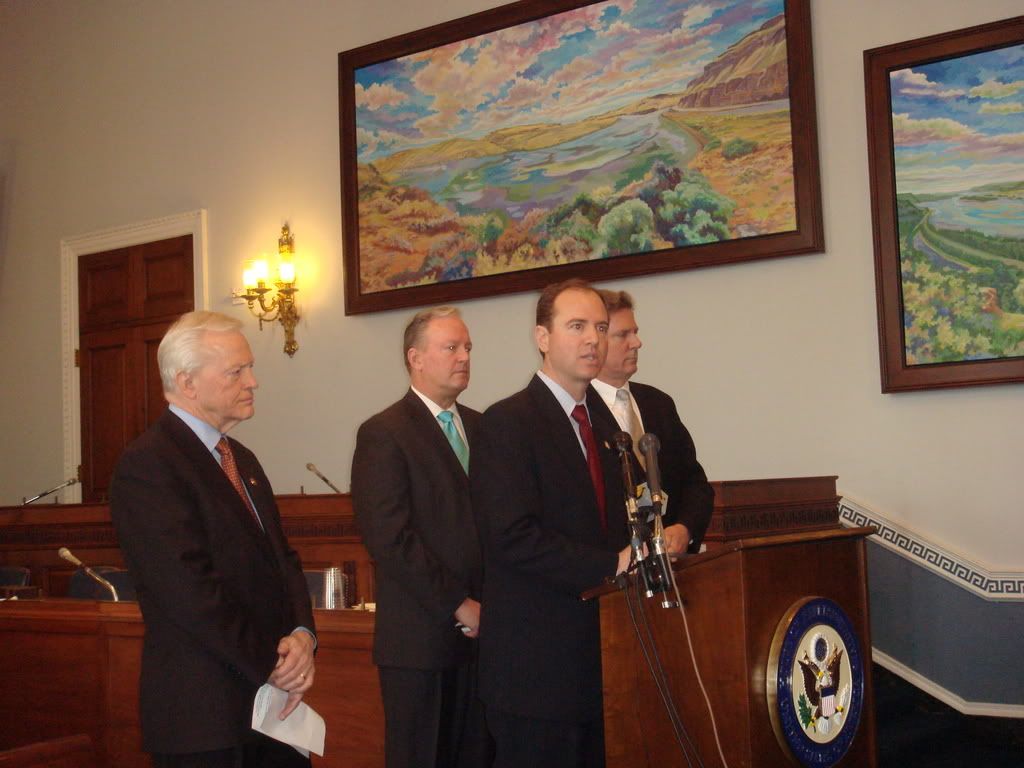
The House measure is championed by Congressmen Adam Schiff (D-CA), Frank Pallone, Jr. (D-NJ), George Radanovich (R-CA), and Joe Knollenberg (R-MI), who announced the effort at a January 30 press conference.

As in the past, the Bush Administration is expected to oppose the resolution, which both its supporters and opponents agree has its best chance of passage in years.

H. Res. 106 has received an early endorsement from over 160 congressmen of the 435-member House of Representatives. These early co-signers comprise more than half of the Democratic majority and over one-fifth of the Republican minority in the House.

The Democrats’ victory last November has led to the election of Congresswoman Nancy Pelosi (D-CA) as the House Speaker, the first time a member of the Congressional Armenian Caucus and long-time supporter of Genocide affirmation has been chosen for the position.

“We feel very strongly that this year is the year we’re going to get [the resolution] passed,” Rep. Pallone said at the press conference.

Asked by the Reporter how soon the passage is expected, Rep. Knollenberg suggested that the resolution would come up in the “next 90 days,” around the time of April 24 commemoration.

But before it can be considered by the full House, H. Res. 106 will be taken up by the House Foreign Affairs Committee, whose members and legislation’s two other original co-sponsors Congressmen Brad Sherman (D-CA) and Thaddeus McCotter (R-MI) will play an important role in securing a prompt Committee consideration.

Twenty-one of the 48 Committee members are among the early co-signers of the resolution. The Committee is chaired by Congressman Tom Lantos (D-CA), who has a mixed record on affirmation.

A Holocaust survivor, Rep. Lantos nevertheless opposed similar affirmation measures in the past, citing Turkey’s importance to the United States. But in 2005, the last time a resolution on the Armenian Genocide received Committee consideration, Rep. Lantos voted for affirmation, citing Turkey’s obstructionism of U.S. policies. In January, Rep. Lantos co-signed a congressional letter to the Turkish government condemning the assassination of Hrant Dink and urging reform in Turkey.

Should the legislation clear the Committee, as similar measures have in the past, it will be up to the Speaker to bring the resolution to the House floor, something that Pelosi’s predecessors repeatedly refused to do, citing opposition from both the Bush and Clinton administrations.

The resolution’s original co-sponsors cautioned that passage would not be easy. “Make no mistake, the speaker will get a call from the president asking for [a vote not be scheduled] on the grounds of national security,” said Rep. Radanovich.

U.S. Ambassador to Turkey Ross Wilson has already expressed the Administration’s opposition to the resolution. And the Turkish government is likely to use its paid lobbyists in Washington in combination with blackmail tactics, such as threatening trade embargoes and suspending military cooperation, to provide a rationale for the Administration’s opposition.

Turkey may also take steps to tighten its blockade against Armenia, as it did in 2000, when a Genocide resolution was pulled from congressional consideration at the last moment.

But even the resolution’s opponents have acknowledged that it has good chances of passage. U.S. Undersecretary of State Nicholas Burns agreed that there is a “lot of momentum behind” the effort to pass the resolution.

Burns made the comment while answering a question from one of Turkey’s leading journalists, Mehmet Ali Birand, who suggested that “there is an overall belief that the Bush Administration will not be able to block” the resolution.

This view was also shared by Turkey’s former President (1993-2000) Suleyman Demirel, who was quoted on January 23 by the Azeri daily Zerkalo as saying that, “this time around this legislation is expected to be adopted.”

During his visit to Turkey in January, Burns was repeatedly asked by major local media whether the murder of Hrant Dink would affect the chances for the resolution’s passage. While Burns dismissed such linkages as “inappropriate,” it appears that while strongly condemning the assassination the Turkish establishment also had in mind the imminent introduction of the resolution.

Former U.S. Ambassador to Turkey Mark Parris (1997-2000) was quoted by the Turkish Daily News as saying that “the resolution is likely to pass in both the House of Representatives and the Senate” in spite of Administration’s opposition.

At this week’s press conference, the resolution’s co-sponsors argued that the opponents of affirmation were misguided, and that passage is in best interest of both U.S. and Turkey.

Rep. Schiff asked: “How can we demonstrate the kind of moral leadership we need to condemn the genocide in Darfur, if we do not have the courage to recognize the murder of a million and a-half people in the first genocide of the last century?”

(Published in February 3, 2007 Armenian Reporter)