Emil Sanamyan's articles on Armenian-Americans, Armenia and its neighborhood.

Friday, July 24, 2009

"Armenian issue is at core of Turkish identity"

Nigar Goksel discusses Armenia and Turkey
by Emil Sanamyan
Published: Thursday June 25, 2009


Nigar Goksel in Yerevan

Washington - Diba Nigar Goksel is an Istanbul-based senior analyst for the European Stability Initiative (ESI), a Berlin think tank. For the past several years, Ms. Goksel's work has focused on Armenia and has included a report, "Noah's Dove Returns: Armenia, Turkey and the Debate on Genocide," released last April. Last week she was in the United States to begin a research project on the Armenian diaspora's role in Armenia. She was interviewed by the Armenian Reporter's Washington editor Emil Sanamyan on June 17.

Welcomed in Armenia as "normal person"

Armenian Reporter: When you first began working in Armenia, were you apprehensive about it or, perhaps, excited about the opportunity, or both?

Nigar Goksel: I was excited. I was a little bit concerned that as a Turk I wouldn't be spoken to about issues in Armenia openly and that would influence the quality of research I would do.

Like in Georgia and Azerbaijan, our research in Armenia is about trying to understand how Armenia is changing, where Armenia is headed. How the state-building process and economic development, and a debate about the future of Armenia is progressing. A lot of our research in Armenia entailed travel outside of Yerevan, talking to ordinary people, opinion leaders, and business people.

So I was concerned that because I was a Turk, answers would be adjusted accordingly and there would be a perception that I was looking for problems to display [to the outside world] or something like that.

It ended up not being the case and I was positively surprised.

I was received and welcomed wholeheartedly, especially in the villages of Armenia. In Yerevan, it was more complex: some would be more positive, others more negative. And it was in small towns where I received the most challenging questions and borderline accusations.

So it ended up being research / bilateral dialogue effort, because I was also asked a lot of questions by Armenians about Turkey. One amazing thing is how high the level of interest is in Armenia about what is happening in Turkey and how few Turks Armenians actually meet.

AR: The warm reception you describe particularly in the rural areas, did you feel like you were given special treatment because, perhaps, you were breaking existing stereotypes? Or was it more just out of a sense of general neglect and an appreciation of an outsider's attention?

NG: At least in some places, my Turkishness was not important or not initially an important issue. People would talk about their local problems. Say, how budget of this village is sufficient or not for reconstruction of a particular sewage system or whatnot.

And it could be an hour into a conversation when someone would ask where I was from. And upon hearing I was from Turkey, they would say, "Oh, why didn't you tell us?" and start bringing fruits and vodka to the table and start talking about the past.

In part, I think it was a stereotype issue. I was not a classical Turk that people envisioned – a stern man with a mustache. And it was an opportunity for [Armenians] to talk to one of those people that they had heard so much about but never had an opportunity to confront.

Sometimes, when my Turkishness would be first revealed, the conversation would turn more confrontational. [I would be often asked] if from my perspective there was genocide. And after hearing me say yes [there was], and that Turkey is changing profoundly in this sense but that there are still problems- as soon as it seemed that I talked as a normal person, the atmosphere [would relax.]

And in villages, sure, there is a sense of not being paid attention to by other Armenians first of all. So, someone coming from an international organization and caring about what their daily life looked like certainly got a positive reaction.

Rural similarities and differences

AR: You have also done field research in rural parts of Turkey; how similar are problems in Armenia's rural areas to those in Turkey?

NG: There are similarities with Turkey, but frankly problems in Armenia are more similar to Azerbaijan's or Georgia's by virtue of the Soviet heritage and the breakdown of the Soviet system.

In Armenia, in some rural areas, people used to work in industry and had to readjust to working on land, but are still trying to hold on to some degree of their education.

That is different from eastern Turkey where industrialization has not yet reached. And people in Turkish villages were always there and education-wise they are not where the villagers of Armenia are.

And of course in eastern Turkey there is the conflict with the Kurdish insurgency which taps into identity issues and relations with the Turkish state.

Other than that, in terms of underdevelopment, the lack of amenities and limited opportunities, they are similar.

Armenian-Turkish engagement and where it could lead

AR: Having focused on Armenia for several years now, what is your sense of Armenia's main challenges?

NG: When we began working in Armenia, our focus was not on Armenia-Turkey relations. But we soon saw that the debate on the political scene, what politicians are accused of, is usually about concessions they are [ostensibly] ready to make to Turkey. Or the debate on the economy, why Armenia's economy is in a state it is in: Oh, it is because Turkey has closed the border.

So, we realized we could not avoid the Turkey issue if we were to discuss Armenia's challenges. Frankly, I think more and more people realize in Armenia that the source of Armenia's problems today is not necessarily Turkey. Yes, Turkey's border being closed does create some challenges, but were it to open tomorrow it would create other obstacles to recovery of the economy as well.

But Armenia's challenges certainly go beyond the border issue.

AR: On the issue of the border opening: Today, with the border closed, certainly that keeps people apart but not just from cooperating; it also limits conflict. In your sense, would a potential border opening be necessarily a step toward normalization, or just toward a different form of confrontation?

NG: I have thought about this question. Results of the Armenian-Turkish dialogue so far have been positive. Many more Turks come to Armenia, and many more Armenians go to Turkey. That is all very positive and contributes to a positive change in how people perceive each other.

Strong feelings in Armenia


On the other hand, there are issues that we are sweeping under the rug that might come to the surface more should there be [more direct contact via] an open border.

For example, in Turkey there is this perception that diaspora Armenians are the ones who insist on recognition of genocide internationally, and talk about lands and compensation. And that Armenian-Armenians are brotherly neighbors who don't share those views necessarily.

Ironically, this view has been promoted by Turkish liberals, including some liberal columnists, in an attempt [to make the Turkish public] more comfortable about relations with Armenia and so that negative feelings about genocide recognition are not transferred to Armenia in Turkish minds.

But I think there would be a rude awakening when the border does open, and more Turkish nationalists get a chance to meet with Armenians from Armenia, who actually feel quite strongly about genocide recognition.

The Turkish public needs to be ready for that and prepare to hear that.

[Having said all that,] there is really no other way forward, and many Armenians and Turks would have to agree to disagree on certain issues, and that might be the case for some time. And I think if we have some tolerance toward different opinions on both sides, there will be many opportunities to find common ground and similarities.

Many Turks who come to Armenia are astounded at how similar the cuisines, the dances are, the way people look and carry themselves.

Why Turks should care about Armenians

AR: What do you think should or could happen between Armenians and Turks, for them to become nations with historical, but not necessarily present-day problems?

NG: I could speak from the Turkish perspective on this.

Strong political leadership in Turkey is important. A sincere attitude in terms of remorse – I don't know if it is the right word – for the past needs to be emanating from Ankara. And that can be in the form of words, but beyond that having a memorial that is dedicated to the Armenians that were in Anatolia – right now, as you know, we have a memorial to Turks who died in that period.

Definitely, [another thing to do is] owning up to the cultural heritage of Armenians. Having one Holy Cross Church on Aghtamar restored should not be the end. There are other Armenian churches and monasteries that need to be approached with respect and acknowledgement of their Armenianness.

There can be a multitude of steps that could demonstrate a new attitude of Ankara and the past treated with more openness and more regret.

The current government has been inconsistent about its rhetoric on Armenia. There are positive developments, such as more open debate. But on the other hand, while suggesting a historical commission, [Turkish leaders] claim with certainty that there was no genocide. If you are proposing a free and independent study, you can't be making a judgment like that before the study is realized.

AR: Regarding the historical commission, do you see it as purely an element of the public-relations effort – to deflect genocide recognition – or could there be an opportunity there as well?

NG: I don't think [a commission], a state-driven initiative, would change the hearts and minds of Turks and Armenians, nor that it should.

It depends on how it is designed, what its mandate is. I think a commission to facilitate research on this issue can only help, if it is going to involve opening of archives, a meeting of minds, independent scholars from around the world, a platform for discussion that is open and constructive, then fine.

But we have to adjust our expectations. I don't think anybody really expects that [a commission] would work and solve the differences. I think we should be used to different opinions that can come closer together over time, but not necessarily be resolved all together.

I think when there is a critical mass in [Turkish] society leaning in a particular way, the government will follow that lead.

AR: Why should a critical mass of Turks care about Armenia or the Armenian issue?

NG: Because the Armenian issue is a core issue when it comes to Turkish identity, and the state's relationship [with the public]. When you see liberal intellectuals confronting the state in Turkey, the Armenian issue is one of the issues at hand.

It symbolizes the Turkish state's monopoly over history learning for many years. The Armenian issue is not the only issue that the Turkish education system has selectively opposed; there are many others.

As Taner Akcam noted, the issue is not Armenia; the issue is the Turkish state and its relationship with its citizens. And as Turkish society evolves and becomes more democratic, there will be more questions about what else we have been misled about or not allowed to speak of freely.

In the end, what it means to be a Turk is very intertwined with the Armenian issue.

Going from words to deeds

AR: Do you think Turkey will ever come to a point when it would be ready to offer some sort of compensation – financial or even physical – for the Armenian Genocide?

NG: There has been very positive progress in recent years in terms of allowing for a more open debate in Turkey about Ottoman Armenians, giving more space to challenging views. And considerable progress on minority issues in Turkey. On culture, too, there have been important strides forward: restoration of a church in Diyarbakir is now underway, for example, due partly to changes in foundations law recently.

In terms of compensation [pauses]. I don't think there is a way to hold Turkey legally liable in the foreseeable future. Turkey might be interested in making some gestures toward the Armenians who are descendants of Anatolia families. There is a discussion among intellectuals in Turkey as to what kind of gestures these could be. From benefits in acquiring lands to inviting members of the diaspora to help them find their roots, it is a wide range of possibilities.

Would Turkey actually be sitting down to try to determine financial compensation? We have not found legal ground for that. In foreseeable future, I think gestures will be of different nature.

There is, I think, genuine desire in Ankara to right some wrongs of the past, but there is also a risk of moving too fast and generating a political backlash.

Considering the defensive tone that has dominated in Turkey – you just can't go from that [to paying compensation]. More time is needed.

AR: From an Armenian perspective, of course, plenty of time has elapsed – more than 90 years.

NG: Definitely. But if you look at how much Turkey changed on this issue in the last nine years – it is much more than any change that had occurred from 1915 to 2000. Since 2000 there has been dramatic change. So don't look at the last 90 years, look at the last nine years.

Karabakh linkage and purpose of the "road map"

AR: What about the conflict in Karabakh? Do you see Turkey continuing to side with Azerbaijan on that to the degree it has until now, or do you see a debate and possible evolution there?

NG: The Karabakh issue is difficult. Most people in Turkey see a grave injustice committed to detriment of Azeris and that also no one in the world acknowledges that.

For Turks that is seen as "classical" example of Turkish people being wronged by the international community. Believe it or not, there is a complex of victimization psychology in Turkey as well and in that sense [Azerbaijan] is seen as an extension of Turkey.

But the perception of Turkey and Azerbaijan being "ethnic" brethren is stronger than the reality of it.

Secondly, there is also a feeling for many in Ankara that a Karabakh resolution is not that difficult and can even be done this year, and that is where there is a lack of realism.

But if you ask, who in this region has taken land and given it back, it is hard to find example of that. So, there is not a simplified view of Karabakh [in Turkey]; there is not a very good understanding of it.

There is also a fear of "losing" Azerbaijan to Russia, grounded or not. And the sentiment is that there is more vested economic interest of Turkey in Azerbaijan than there could be in Armenia.

Those in the Turkish press who argued that Turkey should take the Azerbaijani side – who are a minority right now – [tend to] engage in very simple economic calculations, comparing populations and energy resources.

AR: So where do you see Turkey going on this issue?

NG: The Turkish prime minister [Recep Tayyip Erdogan] has said over and over again in April and in May that there would be no normalization with Armenia until there is resolution in Karabakh. He said that so many times in so many different environments that it is difficult to conceive that he could do something that would be totally detached.

What he could do is spin some kind of development on Karabakh – that may not necessarily be a major development – as one more important than it really is and say, OK, this justifies a step toward Armenia. And there could be more steps like that, starting with establishment of diplomatic relations.

But it would be politically very difficult to disconnect [Armenia-Turkey relations] from Karabakh.

AR: What was then the purpose of the April 22 declaration by Armenia, Switzerland, and Turkey? Was it just a kind of "cease-fire" agreement to try to preempt "bad" resolutions in foreign parliaments?

NG: Turkey might hope that the "road map" would serve as a disincentive for some countries to pass genocide resolutions. Some people in Turkey might think that that might serve that purpose.

But whoever signs that paper on behalf of Armenia, be it president or foreign minister, does not have the authority to prevent the diaspora in the rest of the world from acting.

So, if that is the intention, then it is not realistic. But I don't think that is the only intention either. I would like to think that there is more to it than that.

Bryza & Baku, anti-trafficking progress, lobbying against Gen. Res., Kyrgyz and Iran elections

This was first published in June 20, 2009 Armenian Reporter

Washington Briefing
by Emil Sanamyan


Possible pick for U.S. ambassador to Azerbaijan criticized


U.S. Deputy Assistant Secretary of State Matt Bryza, left, with Azerbaijani president Ilham Aliyev, right, during the latest Armenian-Azerbaijani summit in Russia, June 5. . Armenian president's press office

Matt Bryza, who has been the U.S. envoy for Karabakh negotiations since 2005, may be considered for a posting as U.S. ambassador to Azerbaijan, a well-connected Foreign Policy magazine blog, The Cable, reported on June 12.

Mr. Bryza declined to comment when asked about the report by the Armenian Reporter.

The Cable cited former Clinton and Bush administration officials who raised concerns that Mr. Bryza's reputed closeness to Georgia's leadership - and his handling of the Ossetia crisis last year - might irritate Moscow, thus undermining U.S. efforts to engage with Russia.

In his current capacity, Mr. Bryza was frequently a target of criticism for his contradictory and controversial remarks on Karabakh. Last February, Armenian Foreign Ministry spokesperson Tigran Balayan charged him with "hindering the negotiation process," Arminfo reported at the time.

Writing in Harper's website on June 17, Washington-based investigative journalist Ken Silverstein described Mr. Bryza as a "friend of the Azeri dictator" Ilham Aliyev.

Prior to dealing with Karabakh as an deputy assistant secretary of state, Mr. Bryza managed Caucasus and Turkey affairs at the White House in 2001-2005 and before that was the deputy U.S. envoy for Caspian energy in 1998-2001, dealing mainly with Azerbaijan.

Armenian sources familiar with Mr. Bryza's work at the State Department were harsh in their assessments of his track record.

Asked to comment, California Courier publisher Harut Sassounian told the Armenian Reporter, "everyone is tired of Bryza's antics of repeatedly saying one thing in one capital and then denying it in a second capital. He has cried wolf too many times and has lost all credibility."

Another source, who asked not to be named, predicted that "should Mr. Bryza become the president's nominee, he can expect comprehensive congressional questioning over his role" in U.S. policy in the Caucasus.

Separately, The Cable reported that Nancy McEldowney, the former deputy chief of U.S. diplomatic missions in Ankara (2004-2007) and Baku (2001-2004), will become the principal deputy assistant secretary of state for Eurasia.

State Dept. sees improvement in Armenia’s anti-trafficking policy


Armenia has been removed from the U.S. human trafficking "watch list," the State Department reported on June 16. After spending five years on the list, Armenia was credited with "significant efforts" to meet U.S. standards on fighting trafficking in persons, although it was still short of meeting them.

The U.S. Congress passed the Trafficking Victims Protection Act in 2001, mandating that the State Department issue annual reports that rate the world's efforts to counter human trafficking for the purposes of forced labor or prostitution.

Theoretically, the most egregious offenders could see a cut in U.S. aid. But no sanctions have ever been implemented under the act. See http://www.state.gov/secretary/rm/2009a/06/124872.htm for the complete report.

U.S. companies with Turkey interests lobby against Genocide resolution


Major arms producers BAE Systems Inc., Goodrich Corp., Northrop Grumman Corp., Raytheon Co., and United Technologies Corp. and energy producer Chevron Corp. lobbied against the Armenian Genocide resolution introduced in U.S. Congress earlier this year, The Associated Press reported on June 12 citing mandatory lobbying disclosures.

The companies spent a total of $14 million on lobbying for contracts and tax incentives and it was unclear how much of the amount was spent against the congressional resolution. Additional lobbying for Turkey is done by firms hired directly by the Turkish government and Turkish-American entities.

Seeking to win Ankara's favor, U.S. corporations looking to do business in Turkey have long lobbied against honoring Armenian lives lost in the Genocide.

One the resolution's main sponsors, Rep. Adam Schiff (D.-Calif.) charged the companies involved with not being ‘‘good corporate citizens.''

U.S. seeks to keep Kyrgyzstan airbase

President Obama sent a letter to Kyrgyz president Kurmanbek Bakiyev emphasizing the importance of bilateral security ties, the Kyrgyz government reported on June 11, according to news agencies.

The letter was meant as a fresh appeal for the Central Asian nation to reverse its decision to close a U.S. air base on its soil that has been used in support of Afghanistan operations. Last February, Kyrgyzstan gave the United States six months to close the base after receiving a $2 billion aid package from Russia.

During a regional summit meeting in Yekatirinburg, Russia, on June 16, Mr. Bakiyev pledged continued cooperation with the United States on Afghanistan security.

Paul Quinn-Judge, the Bishkek-based analyst for the International Crisis Group, a Brussels think tank, told Eurasianet.org on June 17 that current expectations are that the U.S. base would stay open in spite of an earlier decision to close it by August 18.

Mr. Bakiyev is seen as hedging his bets, as he faces an election contest on July 22.

World watching Iran’s post-election crisis

Street clashes and large-scale protests that followed Iran's June 12 presidential election continue to grab headlines as the United States and others try to make sense of the crisis, watching for any potential impact it might have on Iran's relations with the world.

Official figures gave the incumbent President Mahmoud Ahmadinejad more than 60 percent of the vote and a first-round victory against former prime minister Mir-Hossein Mousavi, who was credited with about half as many votes. But Mr. Mousavi's supporters and sympathizers say the vote was a sham and have held protests demanding its annulment.

While President Barack Obama said he did not want to be seen as "meddling" in Iran's politics, he implicitly criticized the handling of the vote and most of America's political class remained overtly hopeful that Mr. Ahmadinejad, known for his controversial rhetoric, could be sidelined.

Meanwhile, China and Russia were quick to recognize Mr. Ahmadinejad's victory, with Russia's President Dmitry Medvedev hosting Iran's president on June 16 for a regional summit meeting.

In Europe, France's President Nicolas Sarkozy was most outspoken. Shortly before attending the funeral of Gabon's ruler of more than 40 years and France's protégé, Mr. Sarkozy criticized Iran's election as a "fraud" and its government reaction "brutal."

In scenes reminiscent of recent election-related crises in Armenia and Georgia, angry opposition supporters filled the streets of the capital Tehran and other major cities, while pro-government groups sought to counter with demonstrations of their own. On June 15 seven protestors were killed as they tried to make their way inside the headquarters of Basij, the pro-government militia.

Observers have compared the post-election ferment to demonstrations that preceded the 1979 Islamic Revolution that overthrew Iran's Shah. But in a major difference, in addition to support in the streets, Mr. Mousavi has strong endorsements from within Iran's establishment, including two of Mr. Ahmadinejad's predecessors as president, Mohammad Khatami (1997–2005) and Ali Akbar Hashemi Rafsanjani (1989–97) – who continues to hold powerful posts – as well as many celebrities.

Iran's supreme leader for the last 20 years, Ali Khamenei, under pressure from some fellow religious leaders, has already called for a partial recount of votes.

The ongoing crisis follows an earlier setback for Iran in Lebanon, where a Tehran-backed coalition failed to unseat a ruling alliance backed by the West and Saudi Arabia in June 7 elections.

House Subcommittee on aid to Armenia

House panel ups Armenia, Karabakh aid levels, insists on military aid parity
Subcommittee chair Lowey lauded for “fixing” President Obama’s aid request
by Emil Sanamyan
Published: Friday June 19, 2009

Washington
- A key congressional subcommittee responsible for U.S. foreign aid spending agreed this week to allocate $48 million in aid to Armenia and $10 million to Nagorno-Karabakh in Fiscal Year 2010. The June 17 decision by the House Appropriations Subcommittee on State, Foreign Operations, and Related Programs chaired by Rep. Nita Lowey (D.-N.Y.) set Armenia aid to the same level as it is in the current fiscal year and increased the allocation to Karabakh by $2 million.

The move was welcomed by Armenian-American organizations, which praised Rep. Lowey and subcommittee members for taking a step towards "fixing" the budget request submitted by the Obama administration last month.

The congressional panel also set military aid to Armenia and Azerbaijan at $3.45 million each and introduced requirements for closer scrutiny for a presidential waiver of Section 907, which restricts U.S. aid to Azerbaijan, according to sources cited by the Armenian National Committee of America (ANCA).

The administration had requested $30 million for aid to Armenia, and had requested no funds for Nagorno-Karabakh. It had also asked for more military aid to Azerbaijan than to Armenia.

Last week the Millennium Challenge Corporation chaired by the secretary of state cancelled a separated $67 million aid program intended to rehabilitate Armenia's rural roads.

According to comments by Assistant Secretary of State Philip Gordon during his recent visit to Yerevan, the congressional revision of the aid request was anticipated by the State Department.

In a letter to the subcommittee leadership earlier this year, the co-chairs of the Armenian Caucus, Rep. Frank Pallone, Jr. (D.-N.J.), and Mark Kirk (R.-Ill.) recommended $70 million in economic and $5 million in military aid to Armenia and $10 million for Nagorno-Karabakh.

In addition to Rep. Kirk, the subcommittee includes Rep. Adam Schiff (D.-Calif.) and several other key supporters of Armenian issues.

Rep. Schiff issued a statement welcoming the subcommittee decision, saying it "will help ensure peace and greater economic stability in the Caucasus."

"As the Armenian Government prepares to send troops to join the NATO mission in Afghanistan, our Committee worked in a bipartisan fashion to provide robust economic and security assistance to this strong U.S. ally," Rep. Kirk was quoted by the ANCA as saying.

"Our Committee sent a strong message to the Government of Azerbaijan to keep its commitment to the OSCE peace process, end its bellicose rhetoric and stop meddling in the U.S.-backed Armenian-Turkish reconciliation process," Mr. Kirk added.

"Quedah Merchant was no ordinary vessel"

Dr. Sebouh Aslanian puts legendary ship’s story in historical context
by Emil Sanamyan
Published: Thursday June 18, 2009


Earlier this month, Armenian Reporter's Washington Editor Emil Sanamyan wrote about the recent discovery of a 17th-century Armenian ship, the Quedagh Merchant, off the coast of the Dominican Republic. The rare find, which has excited archeologists and historians, has also highlighted the lesser-studied periods in Armenian diaspora history in Iran, India, and elsewhere in the 17th and 18th centuries.

One of few experts on this subject is Sebouh Aslanian, a historian of the early modern Indian Ocean who will be teaching at Cornell University next year as a Mellon Foundation post-doctoral fellow in world history. Dr. Aslanian's book, From the Indian Ocean to the Mediterranean: Circulation and the Global Trade Networks of Armenian Merchants from New Julfa, Isfahan, 1605–1747, is coming out next year from the University of California Press. He is writing a second book, "The Santa Catharina: Voyages from a Ship's Floating Archives to the 18th Century History of the Indian Ocean," as well as an essay on the Quedah Merchant (Quedagh Merchant).

On June 16 Dr. Aslanian responded to Mr. Sanamyan's questions by e-mail.

Armenian Reporter: How did Armenians become involved in maritime trade?

Sebouh Aslanian: The earliest references to Armenian maritime trade can be traced back to Cilician Armenia, a kingdom on the Mediterranean. After the fall of Cilicia in 1375, Armenians ceased being a maritime people and were largely landlocked until the Safavid ruler, Shah Abbas I, forcibly resettled the population of Julfa on the Aras River (Araks in Armenian) to his imperial capital of Isfahan in 1605.

Julfan merchants work with the English

Shortly after their relocation to Iran, the Julfans, with Safavid backing, became important merchants in the Indian Ocean arena. Roughly until the second half of the 17th century most of their trade was dependent on overland caravan routes both to the commercial centers near the Mediterranean where they sold Iranian raw silk to European merchants, as well as east toward India where they traveled to engage in the textile trade of the subcontinent.

In 1622 the strategic gateway of the Indian Ocean from the Persian Gulf at Hormuz passed from Portuguese control to Iranian rule, thus allowing a greater number of Julfans to fan out into the Indian Ocean basin.

In 1688 another event paved the way for Julfan-Armenian participation in Indian Ocean maritime trade. On June 22 of that year, an eminent Julfan merchant residing in London, Coja Panous Calendar (khwaja Panos Ghalandarian), acting on behalf of the larger Julfan community of merchants, signed an agreement with the English East India Company in London, whereby the Julfans agreed to transport their silk and other merchandise using English company shipping and were granted a number of privileges, such as equal rights with "Englishmen freeborn" in residing in the company's settlements in such places as Madras, Bombay, and later Calcutta.

Thus, soon after signing the 1688 agreement, many Julfan Armenians began using English company ships to transport their goods and themselves across the Indian Ocean.

Armenian ships on the Indian Ocean

AR: Did Armenians own and operate their ships?

SA: Around the same time, some wealthy Armenians became ship owners in their own right and began to operate their trade using their own ships. In most cases, the nakhudas, Persian for pilot or captain of a ship, were Europeans or Indians. In a number of cases, however, we see Julfans who were also nakhudas. There are several famous Julfan nakhudas that we know of.

Some Julfan merchants, such as Khwaja Minas of Surat, were famous shipping tycoons and operated a merchant fleet that plied the waters of the Indian Ocean and traded as far a field as the Red Sea, Southeast Asia, and Manila as early as the 1680s. Much of the shipping between India and Spanish-controlled Manila [in the present-day Philippines] was done on Armenian ships.

So there are about a dozen cases of Armenian-owned ships sailing the Indian Ocean in the late 17th and early 18th centuries.

Another common practice among Julfan merchants was to freight ships from other merchants in order to load their cargo on board and participate in what was known as the "country trade" (or intra-Asian port-to-port trade) in the Indian Ocean.

This was the case with a Julfan-freighted ship called the Santa Catharina carrying merchandise (including about 2,000 pieces of family and mercantile correspondence that later ended up in a British archive where I discovered them) on a return trip between Bengal and Basra when it was intercepted by the British navy in 1748 on the pretext that it was a French vessel and could therefore be legally confiscated as a wartime prize (Britain and France were at war at the time and both sides were engaged in taking the enemy's ships as prizes).

I am now in the process of writing my second book where I will attempt to write the history of the Indian Ocean during the 18th century using the Julfan documents stored in Santa Catharina's hold.

Cannons and European dominance

AR: What were relations like between Armenian and European merchants on sea?

SA: The Europeans, including the Portuguese, English, and Dutch, were dominant on water from the first arrival in Calicut of Vasco Da Gama in 1498.

Some Asian merchants (including the Julfan Armenians) also had a share of the maritime trade but they were progressively edged out as the European East India Companies came to dominate the trade of the Indian Ocean and impose their state-chartered monopolies there.

Asian merchants had to be careful of European power. European ships dominated the sea lanes of the Indian Ocean because they had better guns and sails. Cannon on ships was a European innovation and among the principal reasons for European dominance.

Before the arrival of the Portuguese, trade in the Indian Ocean was mostly peaceful and merchants were unaccustomed to seeing ships armed with cannons, as no Asian power had thought about controlling and monopolizing an entire body of water as the Portuguese and, following them, the Dutch and English did.

Enter Captain Kidd

AR: How did the encounter between Quedagh Merchant and Captain Kidd in 1698 come about?

SA: Captain William Kidd began his career as a privateer and was hired by the British Crown in the 1690s to capture pirates. Kidd arrived in the Indian Ocean traveling from New York in 1696 and had little luck in capturing any pirates. It was then that he turned his sights on capturing merchant vessels, plundering several small vessels but without significant cargo.

Then, on January 31, 1698, Kidd came across his greatest prize. A 400-ton vessel much of whose freight belonged to Julfan-Armenian merchants residing in Surat, the Quedah Merchant was on its return voyage from Bengal where it had sold its cargo and was returning with large quantities of raw silk, cotton, muslins, calico, opium, saltpeter, iron, and many chests filled with silver.

According to a court deposition given in London on 17 July 1701 by Coji Babba, one of the Julfans invested in the ship's cargo, the Julfan stakeholders of the Quedah owned "1200 Bayles of Muslins raw silk and Callicoes of all sorts fourteen hundred baggs of brown Sugars 84 Bayles of raw silke and eighty Chests of Opium besides iron and other goods," including diamonds, rubies, gold bars, and so on.

The vessel had just rounded the southern tip of India and was sailing north, with its Armenian colors, when two of Kidd's ships, The Adventure Galley and November, both flying French colors (a typical ploy used by pirates to deceive their unsuspecting prey) intercepted it near Cochin.

Off to Madagascar

Upon seeing the Adventure's flag, the Quedah's English captain, John Wright, hoisted his French flag and sent over one of his French officers who showed Kidd the Quedah's French pass. Kidd then boarded the vessel and, showing the Captain his English letter of marque authorizing him to seize French ships, confiscated the vessel.

At this point, Coji Babba Sulthanoom, one of about seven Julfans traveling on the ship, confronted the English pirate and offered him 20,000 rupees to set the ship free, but Kidd spurned the offer. He took the Quedah to the nearby port of Quillon where he sold some of its cargo at an estimated price of 7,000 to 8,000 pounds. He then sailed the Quedah to Madagascar, a famous pirate outpost in the Indian Ocean.

As Kidd's flagship vessel, the Adventure, was badly leaking and unable to make the long journey back to North America, Kidd refitted the Quedah, renamed the Adventure Prize.

In the fall of 1699, Kidd's crew sailed to the Caribbean island of Hispaniola with The Adventure Prize, whence Kidd sailed on another vessel to New York harbor, where he was hoping to get a pardon from the Earl of Bellomont, his erstwhile friend and business partner and the governor of New York and Massachusetts, who had influential friends in London.

But instead Kidd was arrested and shipped to London (along with some of the Quedah's cargo that had not yet been sold) to face trial on charges of piracy and murder.

AR: Why was there such a tough verdict against Kidd in a British court?

SA: Part of the reason for this sea change in English policy with regard to piracy has to do with events unfolding in Surat, one of the most important port cities in Mughal India.

Three ships plundered

The 1690s brought in a rich harvest of booty for pirates and privateers preying on Mughal shipping along the Red Sea–Surat corridor frequented by pilgrim and merchant ships alike. It was also the most taxing decade for the East India Company's factory (colony – Ed.) in Surat.

Three important ships belonging to Surat-based merchants were plundered in quick succession during that period. Genj-i-Sawai (known in European sources as the Gunnesway), the Fatehi Mohammed (The Great Mohhamed), and the Quedah Merchant were all ships with significantly rich cargos.

The first appears to have belonged to Mughal Emperor Aurangzeb (who ruled in 1658–1707) and was returning with pilgrims from Mecca when it was plundered by Captain Avery. The Fatehi Mohammed, also plundered by pirates on its return voyage from the Red Sea with a cargo of pilgrims and silver, was owned by the "merchant prince" Mulla Abdul Ghafur, the most influential Muslim merchant of Surat.

The plunder of these ships sent shock waves in Surat's mercantile community and even provoked the ire of the Mughal court. The British factory in Surat came under intense pressure from the Muslim Governor of the city to compensate for losses and provide secure convoys for Surati shipping.

The price of English business

Of these, however, the capture of the Quedah seems to have been the event that finally tipped the scale against the East India Company. The Quedah was no ordinary vessel. Mukhlis Khan, an eminent Mughal nobleman and a leading member of Emperor Aurangzeb's court, appears to have been heavily invested in the ship's cargo.

When news of the Quedah's capture reached Surat, an Armenian merchant who had a stake in the Quedah's cargo had immediately gone to Delhi to complain to the emperor. He had informed Mukhlis Khan of the events and the fact that he had seen the English pirate's letter of marque from the English Crown. This revelation further reinforced the Mughal Court's convictions that all pirates were Englishmen (so-called "hatmen") and that, moreover, they were operating with the blessing of the English government and the East India Company.

The news soon spread through the streets of Surat. The city's Muslim governor took strong measures to isolate the English factory. The mobs outside the compound began to whip up anti-European sentiment (already on the rise after rumors that pirates had violated Indian Muslim women aboard the Fatih Mohammed, returning from their hajj to Mecca). Faced with mounting opposition and violence to its presence in India, Company officials in Surat appealed to the Court of Directors in London to increase pressure on Parliament to pass strict legislation outlawing piracy.

It was in this context that the High Court of Admiralty in London issued an arrest warrant for Kidd. Though the Court had offered a general pardon for pirates that same year, Kidd was exempted from this amnesty since he had become notoriously implicated in the fate of the company's trade in India.

In a sense, he had come to symbolize English piracy in the Indian Ocean and as such was a liability for the continued success of the company's trade in India. His punishment was therefore a price the company was forced to pay to resume its profitable activities on the subcontinent.

Piracy or spoils of war?


AR: According to the French pass issued to the Quedah Merchant, the merchants involved in the ship's voyage were Khoja Owaness and Khoja Jakob, as well as Agapiris Parsi Kalendar and Cohergy Nannabye Parsi. What is the background of these individuals?

SA: During his trial, Kidd had vociferously claimed that the Quedah's capture (the principal charge for which he was hanged) did not constitute piracy in the technical sense, since the ship was traveling with a French pass or letter of safe conduct, and Kidd was empowered to take French vessels at a time when England and France were on opposing sides of a war.

The court had dismissed the existence of the pass in question and Kidd's inability to produce the pass before the court was a major factor in his guilty verdict.

Historians of piracy had also cast doubt on the existence of the pass until in 1910 an American researcher stumbled across the pass in the Public Records Office (PRO, now the National Archives of Great Britain) where it had been misfiled.

Who were the Armenian merchants?

As for the names mentioned in the pass and the actual ownership of the vessel itself, the present state of scholarly research on the Quedah Merchant, and the paucity of reliable archival documents regarding the ship do not permit us to have definitive views.

The few documents in our possession (including one from the PRO collection and another one from the manuscript collection from the Bodleian Library of Oxford University) suggest that a group of Julfan merchants including "Cogi Babba Sulthanum, Augau peree Callendar, Ovaness Sarkes[,] Fasali di Maruta, Cachig di Jodgar, Marcus di pocus [Poghos?], Marcus di Ovaness, Maranta Tasseler [?] Ovaness petros, Bagdasar Avetich Malin Bogoz, Gregore Agazar, Aga Perry Assator Comondore [?] Aga Mal Mirsa Mahomet, Hagi Mirsa Beg de Bagon, and others Armenian merchants Subjects of the King of Persia... did hire upon freight of one Coergi an inhabitant of Suratt the ship Quidah also Kary Merchant of which Ship he was then owner and John Wright was master to go from Surrat to Bengall and so back to Suratt." (see HCA 24/127 "High Court of Admiralty: Instance and Prize Courts." PRO)

So it seems that the ship itself belonged to a wealthy merchant in Surat and was leased or freighted by the Julfan merchants mentioned both in the French pass as well as in the above-cited document from the PRO containing Coji Babba's deposition to the court claiming some of the goods from the Quedah Merchant that had been brought back to London with Kidd.

We know next to nothing about the ship's owner ("Coergi" or "Cohergy Nannabye Parsi"), though his name suggests that he was a wealthy member of the Parsi community of merchants active in Surat at the time.

As to the "Augau peree Callendar" mentioned in the PRO document as well as a similar document preserved in a manuscript at Oxford there is no doubt in my mind that he was Aghapiri Calendar (Ghalandarian), a reputable Julfan merchant operating from Surat with solid connections with both the Mughal court and the East India Company, whose father Khwaja Panos Calendar of London had signed the famous "Agreement" of 1688 with the English East India Company.

In fact, both Aghapiri and Coji Babba (Khwaja Babba Sulthanumian) had been present at Kidd's trial in London and had pressed charges against him.

Flying Armenian colors

AR: What is the story of the Armenian merchant marine flag?

SA: The official court proceedings of Kidd's trial mention that the Quedah Merchant was indeed "flying Armenian colours" just before Kidd's ships had intercepted her.

This seems to have been a rather common practice with Armenian ships engaged in maritime commerce. In this connection, it is interesting to note that in the maritime trade between India and Manila, East India Company officials during the late 17th century occasionally used Armenian-owned ships flying Armenian colors as a cover for their trade with the Philippines. It was forbidden for the English to trade with Manila whereas no such restrictions existed for Armenian ships.

As for the Armenian flag itself, it is reported to have had three horizontal stripes (red, yellow, red) with the Lamb of God in the middle yellow stripe. That is the extent of our knowledge on this flag. Most of our evidence on the flag is scattered in Armenian and European sources and none of it sheds light on the history of how and when Julfans began to use it.

Armchair scholars and Armenian history

AR: From state-centric perspective, Armenian history of 16th to 17th centuries is sort of the "dark ages" after the fall of Armenian kingdoms and principalities and before the rise of the national movement for independence. How did you come to study this period?

SA: That is indeed true. Armenian history during the early modern period (roughly extending from the beginning of the 16th to the late 18th century) is one of the most understudied periods in Armenian studies.

It is sometimes referred to as the "black hole" of Armenian history on the grounds that we do not have sufficient primary-source documentation. This, of course, is far from the truth, and is probably a reflection of the unfortunate lethargic state of mind of many Armenian scholars who are more armchair scholars than historians who get their hands and feet dirty in archives.

I first became interested in this period at the beginning stages of working on my Columbia University dissertation in 2003. While conducting archival research in London at the time, I stumbled across 2,000 Julfa-dialect letters and other commercial documents stored at the PRO in London that had been confiscated by the British Navy from the Julfan freighted ship, the Santa Catharina. This discovery prompted me to study the obscure dialect of the Julfans and to conduct further research in quest of discovering more Julfa-dialect documents.

Since my initial discovery in London, I have traveled and worked in about 30 archives across 13 countries (including archives in New Julfa, over 15 archives across Europe, and even in the State Archives in Mexico City). The result has been the collection of digitized archives of about 15,000 or so pieces of Julfa-dialect documentation (amounting to over 100,000 pages of documentation when fully transcribed) that are not only important in shedding light on Julfan and Armenian history during the early modern period, but also important for the study of world or global history during this crucial period of history.

Many of these documents are mercantile in nature and as such are primarily useful for economic historians. But there are also other documents in my collection that include priceless travel accounts or itineraries written by Armenian merchants and travelers as well as various historical tracts whose value for scholars goes beyond the confines of the field of economic history.

A global Armenian network

AR: How did the Julfan merchant network stretching from Amsterdam to Manila come about? Other than business interests, did it project a kind of sense of common, national mission?

SA: I have dealt extensively with the expansion of the Julfan network in my various publications and in my forthcoming book, so I won't go into it in detail now.

Suffice to say here that shortly after their forced resettlement in the suburbs of the Safavid imperial capital of Isfahan, Julfan merchants came to preside over one of the greatest trade networks of the early modern period, with settlements stretching from London, Amsterdam, and Cadiz in the west to Mughal India, Canton in China, and Manila in the Philippines in the east.

There is also evidence that some intrepid Julfans were not content with reaching Manila and had ventured further by crossing the Pacific Ocean using the Spanish fleets known as the Manila Galleon to travel and trade in New Spain (Mexico). Documents from the archives of Mexico City that I discovered testify that several globetrotting Julfans were trading with Acapulco in the 1720s and at least one merchant (a certain "Don Pedro di Zarrate" Agha Petros vordi Sarhati?) was a resident of Mexico City for about ten years in the 1720s.

The flow of information

Many of the Julfan settlements across their far-flung network where traveling merchants resided were connected to each other and to the center of the network in New Julfa through the circulation of various subjects and objects including merchants (all of whom were young men working for wealthy merchants known as Khwajas in New Julfa), capital, women, information (in the form of family and mercantile correspondence), and priests. The circulation of these objects and subjects and especially that of information glued the network together and was responsible for maintaining the structural integrity of the network for over a century.

As for your question relating to the "sense of common, national mission" above and beyond the projection of "business interests," it is difficult to say one way or another. Talking about a "national" mission in the absence of the nation-state is a complicated and difficult issue.

In the absence of a state of their own, Julfans relied on various "techniques of survival and prosperity" some of which can be seen as forms of "stateless power." One technique was for these merchants to rely on the state institutions of their "host societies" to achieve ends that were in the interest of the larger Julfan network.

The case of the Quedah Merchant is illustrative of this form of stateless power, since the Julfans who had lost significant property on the ship relied on the Mughal state to apply pressure on the East India Company to restitute the Julfan owners of the ship's cargo.

The Julfans invested in the Quedah also appealed to the Safavid state to intervene on their behalf. A letter from the last Safavid ruler Shah Sultan Husayn (ruled 1694–1722) addressed to King William III of England asking the English Crown to render justice to the Shah's Armenian subjects has been preserved both in the British Library as well as the PRO.

Similarly when the Santa Catharina was confiscated by the British navy in 1748, the ship's Armenian merchants appealed to the court of Bengal's governor, Aliverdi Khan (r. 1740–1755) who went so far as to wage a small war against the East India Company in Bengal in order to have the property of his Armenian and other merchants restored.

Imagining a larger Armenian nation

In all these cases what Julfan merchants did to retaliate against their more powerful state-backed rivals was in some ways similar to what we would today call "diaspora lobbying." The cases mentioned above illustrate that when push came to shove, Julfans were indeed resourceful at finding ways to defend the larger collective interests of the Julfan network and its Julfan members. This is not the same thing as pursuing a "national interest," since the latter would have to involve the interests of other Armenians who were not members of the Julfan network and its community of merchants.

We should keep in mind that Julfan identity was place- and culture-specific. It was defined by one's family and cultural ties to the suburb of New Julfa in Iran. There was a strong tendency among Julfans to define themselves as a "diaspora within a diaspora" and this meant that the identity in question was more specific and regional than a larger collective Armenian "national identity."

To be sure, the Julfans came to radically "re-imagine" and re-invent themselves not only as Julfans but as members of the larger Armenian nation mostly in the late 18th century when a small group of Julfan neo-intellectuals in Madras (India) including Shahamir Shahamirian began to formulate republican ideas and wrote constitutional treatises for a future republic of Armenia that would not exist on the map for another 140 years or so.

But this shift from a strictly regional Julfan identity to a national Armenian one did not occur until the Julfan network along with the hayrenik (homeland/patria) of the Julfans in New Julfa had collapsed in the second half of the 18th century, compelling the Julfans to re-invent themselves as members of a larger and modern Armenian nation.

Thursday, July 23, 2009

Biden in Tbilisi, adds heroic flair to night at restaurant

In address to the Georgian Parliament earlier today, Vice President Joe Biden recalled that last August he “sat on a rooftop of a restaurant with President Saakashvili, as sound of artillery fire and fighter aircraft punctuated the night.”

U.S. Embassy in Georgia photo.

Biden in fact visited Tbilisi on August 17, 2008 almost a week after military operations were over. He is pictured with Georgian president and his wife at the time (and apparently on same rooftop).

Monday, July 6, 2009

Sirusho, wikipedia and cataphracts

Reporter.web.review 1.0
by Emil Sanamyan
Published: Friday June 12, 2009


Washington - Before launching what I hope will become a new regular Armenian Reporter feature, just a few general thoughts on the subject of the Internet.

It has become a cliché to say that the popularization of online technologies has fundamentally altered our lives. This change over the last 20 years has affected the way individuals worldwide communicate with one another, entertain themselves, consume news, and, increasingly, trade goods and do work.

The generation gap is slowly disappearing. There are some weeks when I exchange more e-mails than phone calls (regular or over the Internet) even with my parents, who are relatively new Internet users. My family is more likely to see photos or videos of their grandchildren online rather than in print or on disc. And you are more likely to read these words on your computer screen than on a printed page.

From 2000 to 2008, the number of Internet users more than quadrupled from 361 million to 1.6 billion out of an estimated global population of 6.7 billion people. This is nearly every fourth person in the world. With ready Internet access on most new telephones and improved and inexpensive cellular connections, it is likely that world's entire population will have online access in the next decade.

This new organization of humanity into personal e-mails, websites, blogs, and Facebook, Tweeter, and YouTube accounts can seem cacophonous, dizzying, and often distracting. Certainly, this new array of media is becoming an evermore significant challenge for traditional media, whose readers, listeners, and viewers have migrated to the web in droves.

But it has also provided mass media with unique new opportunities. One is to study people's preferences and attitudes with an ease and accuracy that is unprecedented. By simply checking Internet monitoring traffic sites, one can learn how this newspaper's readership changes month-to-month and even how popular this article is compared to others.

This web.review is intended to cast a look on what we and our readers believe are the more important trends in human relations as reflected online.

Since our newspaper's determined focus is on things Armenian, this inaugural review will take advantage of the aforementioned measuring tools to look at what the world's most popular Internet gateways - places where most of humanity find what they are looking for on nearly every subject - have to offer on the subject of Armenians. Or, in effect, what it means to be Armenian in the world today.

According to the regularly updated Alexa.com, the five most popular websites worldwide are Google, Yahoo, YouTube (also owned by Google), Facebook, and Microsoft's Live (most recently branded as Bing).

When searching for "Armenian" (or most other terms) on Google, Yahoo, or Live one is invariably directed to relevant entries in Wikipedia, a collaborative user-created encyclopedia that anyone can edit and which itself is the seventh-most-visited website in the world.

In recent years, Wikipedia has trumped all other established reference sources. Today, having a well-written and updated reference page on Wikipedia is often more important than having one's own website.

Wikipedia's "Armenia" page is "semi-protected," meaning that only registered users can edit its content which - a result of more than five years of updates by volunteers - on first glance appears comprehensive and accurate.

On YouTube, entertainment videos rule. And it is Sirusho who continues to represent Armenians after performing in the Eurovision song contest last year. Three separate videos of Sirusho's "Qele, qele" have been viewed more than a million times each. No other video on an Armenian subject comes close.

This year's Eurovision contestants Inga & Anush with "Jan, jan," a video that has been online only three months (as opposed to Sirusho's more than a year), are a distant second with over half a million views.

Oddly enough, when sorted by "Relevance" the most popular Armenian-themed video is a re-play from a computer game "Total war" pitting forces of Rome, Armenia and other ancient states. As it turns out, Armenia is the foe to beat in that game with an especially tough armored cavalry known as cataphract.

Even stranger are the second and third "relevant" entries. They are, respectively, a talking parrot and a Chinese student from Beijing University practicing their Armenian-language skills.

Finally, what do Armenians concern themselves with on Facebook? If one is to judge by most popular groups, it is seeking to "Recognize the Armenian Genocide." A group by that name launched by several Armenian-American students had more than 32,000 members as of this week.

An apparently rival "Armenian genocide? Bull****!!" group created by a lone Turkish activist has grown to more than 23,000 members. Meantime, a group set up by several dozen individuals affiliated with a number of Turkish universities "Armenian genocide? Bull****!" (note just one exclamation sign) has 8,300 members (with at least some overlap in membership likely).

The second most popular Armenian group "Armenia," also started in the United States, has just over 3,800 members and it too seeks to highlight the Armenian Genocide recognition campaign.

To sum up, Armenia's Eurovision contestants, echoes of the campaign for and against Armenian-Genocide recognition, and little-known volunteers behind Wikipedia's Armenian entries are the three most influential elements shaping the Armenian image online.

-Emil.Sanamyan@reporter.am

Clinton on Armenia-Turkey; MCC aid cut; Azerbaijan PNTR; new DoD manager for Eurasia

Washington Briefing
by Emil Sanamyan

Secretary Clinton remains upbeat on Armenia-Turkey talks


There has been "no flagging of commitment" to the normalization of relations between Turkey and Armenia, Secretary of State Hillary Clinton said on June 5. She was speaking at a joint press conference with visiting Turkish foreign minister Ahmet Davutoglu.

Asked whether she remained hopeful about a resolution of Armenian-Turkish relations on a bilateral track or in the Karabakh conflict since the statement by Armenia, Switzerland, and Turkey was issued on April 22, Mrs. Clinton said she remained "very encouraged by progress that has been made and commitment by governments involved."

Mrs. Clinton emphasized that Armenia and Turkey "have committed themselves to a process of normalization"; although she also counseled there was a need for "patience and perseverance" to achieve results in what she said was a "difficult undertaking" addressing longstanding issues.

She also pointed to this week's Armenia-Azerbaijan presidential summit in Saint Petersburg as evidence of progress in the Karabakh peace process.

Although immediately after the April 22 statement, the United States emphasized the need for the normalization of Armenia-Turkey relations to take place "without preconditions and within a reasonable timeframe," U.S. officials have since linked progress in these talks to the Karabakh negotiations, describing the two processes as parallel.

Armenian officials insist there should be "no parallelism" or any other linkages between the two processes.

The United States also has not defined what it would consider to be "a reasonable timeframe," with Mrs. Clinton again saying that it was up to Armenia and Turkey to continue "on the path they themselves have set," and that the United States was only acting in a supporting role.

For his part, Mr. Davutoglu reiterated that Turkey "is fully committed to normalization with Armenia and resolution of Armenian-Azeri issues."

U.S. agency cuts $67 million in Armenia funding

The Millennium Challenge Corporation (MCC) board met on June 10 and decided that it "will not resume funding for any further road construction and rehabilitation" in Armenia, the agency said in a press release.

The MCC's five-year $235 million Armenia compact originally included $67 million for road construction and repair and $146 million for agriculture projects. The latter projects have continued.

"MCC regrets that it cannot move forward with funding road construction in Armenia," the corporation's acting CEO, Rodney Bent, said in a statement. "The responsibility for this outcome remains with the government of Armenia, whose actions have been inconsistent with the eligibility criteria that are at the heart of the MCC program. I do not anticipate that the Board will revisit this issue in the future."

The agency first introduced a hold on road projects after U.S. officials blamed the Armenian government for the violence that followed last year's presidential elections.

The latest ruling comes after the May 31 election for the Yerevan city council, the conduct of which received a mixed review from observers, including criticism from the U.S. Embassy.

The MCC is chaired by the secretary of state and its decisions are influenced by State Department determinations on whether a country is making progress toward meetings eligibility criteria.

[Asked by the Armenian Reporter for comment late on June 11, the head of media relations for Armenia's Foreign Ministry, Tigran Balayan, said the ministry had been focused on a visit from the Estonian foreign minister and had no immediate comment.]

Proposed removal of U.S. trade restrictions for Azerbaijan questioned

Armenian organizations are questioning the rationale and timing for the efforts to remove Soviet-era trade sanctions against Azerbaijan – commonly referred to as the Jackson-Vanik amendment.

On June 4 Reps. Robert Wexler (D.-Fla.) and Bill Shuster (R.-Pa.), who co-chair the Turkey and Azerbaijan caucuses, respectively, introduced House Resolution 2742 "to authorize the extension of nondiscriminatory treatment (normal trade relations treatment) to the products of Azerbaijan," which would terminate the restriction vis-à-vis Azerbaijan. The bill has since been referred to the House Ways and Means Committee.

Azerbaijan and all other former Soviet republics and satellite states inherited the restriction in the aftermath of the Soviet breakup. It was originally intended to promote human rights, particularly freedom of emigration. Rarely enforced, it has been a symbolic measure and successive U.S. presidents have annually waived the restriction.

Jackson-Vanik restrictions had been previously removed for former Soviet republics that joined or were about to join the World Trade Organization (WTO). Although Azerbaijan first applied for WTO membership in 1997, it has until now showed little interest in joining the group.

"The consideration of this ill-timed legislation would afford Members of Congress a valuable opportunity to review Azerbaijan's unacceptable behavior on a range of issues – from its arms build-up and its threats of renewed aggression against Armenia to its authoritarian political system and systematic destruction of Christian Armenian cultural heritage," Aram Hamparian of the Armenian National Committee of America (ANCA) told the Armenian Reporter.

Ross Vartian of the U.S.-Armenia Public Affairs Committee (USAPAC) added, "The United States cannot grant Permanent Normal Trade Relations (PNTR) to a nation like Azerbaijan that blockades another nation, Armenia, in violation of U.S. law."

The Obama administration has not yet taken a public position on the proposed legislation.

Meanwhile, the State Department's incoming assistant secretary for political-military affairs, Andrew Shapiro, praised Azerbaijan for "cooperating in good faith" in the Karabakh peace process and indicated that the United States would continue security assistance to Azerbaijan, the ANCA reported on June 10.

The comment came as part of Mr. Shapiro's confirmation process and was in response to questions from Sen. Barbara Boxer (D.-Calif.) who raised the issue of Azerbaijani war threats against Armenia and continued U.S. security assistance to Azerbaijan.

Pentagon’s Eurasia manager appointed

American University professor Celeste Wallander was appointed deputy assistant secretary of defense for Russia, Ukraine, and Eurasia policy, the Department of Defense reported on June 9.

The new appointee is an expert on Russia and has also written on U.S. policy toward Iran. In her analyses, Ms. Wallander has sought to counter the frequently alarmist descriptions of Russia's intentions, portraying Moscow leaders as primarily pragmatic and their policies as seeking to manage rather than confront America's dominance in world affairs.

Prior to her appointment, Ms. Wallander led the Program on New Approaches to Research and Security (PONARS) that focused on the former Soviet space, particularly the Caucasus, and was first housed at the Center for Strategic and International Studies (CSIS) and since 2007 at Georgetown University.

Discussing last year's Russian-Georgian war, Ms. Wallander told PBS NewsHour that "in traditional security terms, the Caucasus is in a geostrategically important part of the world."

"The Caucasus is just north of Iraq and Iran," she elaborated. "It's just west of Central Asia, which involves Afghanistan. So all these regions are areas in which the United States is militarily engaged because these are where the security challenges of the 21st century are."

17th cent. Armenia vessel discovered in Caribbean

Long-lost Armenian ship, the stuff of legend, to become a “living museum” in the Caribbean
Explorers unravel mystery of the “Quedagh Merchant” hijacked in 1698
by Emil Sanamyan
Published: Friday June 05, 2009


Indiana University’s Charles Beeker (l.) and Fritz Hanselmann collect a sample from what is believed to be the wooden keel of the Quedagh Merchant under a pile of coral-shrouded cannons on June 2. Eleanor Seagle / Published with permission

Near Catalina Island, Dominican Republic - This has been a mystery three centuries in the making.

Burned and scuttled off the coast of this former Spanish colony, an Armenian merchant ship captured by British privateer Captain William Kidd has since become the stuff of legend and an elusive prize for treasure hunters.

Since it was accidentally found in December 2007, the researchers involved have called Quedagh Merchant an unprecedented discovery of its kind in recent history. They are now working on ascertaining the vessel's identity and on the creation of a unique museum.

An international mystery

According to British records, Kidd captured the Quedagh Merchant (also known as Cara Merchant) in January 1698 from Armenian traders near the coast of India and then sailed on it to the Caribbean.

In 1701, after a two-year public trial in London, Kidd was hanged to his death on charges of murder and piracy - charges based in main part on testimony from the Armenian vessel's owners.

Seeking to bury the evidence after looting much of its precious cargo, Kidd's associates set the ship on fire and sunk it in 1699. Subsequent efforts sanctioned by the British Crown to find the vessel and its cargo and compensate the Armenians proved fruitless.

The story of the missing ship became an obsession for numerous historians and explorers in the West. Among Armenians, however, the Quedagh Merchant - like much of the Armenian maritime heritage - has remained virtually unknown.

To this day, few Armenian studies of the subject have been attempted. One of these few was a Russian-language paper by Yuri Barsegov, a Moscow professor with expertise in maritime law, published in an obscure academic journal in 1984.

"When I first heard of this Armenian ship in early 2007, I thought to myself: right, this is just another fable that Armenians like to brag about among themselves," recalled Pavel Galoumian, who together with his wife Isabella Agad, was recognized at the U.S. Embassy in Santo Domingo on June 1 at an event dedicated to the discovery of the shipwreck.

But after checking British sources, Mr. Galoumian learned that the Armenian provenance of the vessel was well-documented. Having since gone through a mountain of literature on the Quedagh Merchant, he argues that its significance goes far beyond public excitement about pirates and treasures.

"Much sought-after internationally, this vessel represents a highly significant but little-studied chapter of Armenian history," Mr. Galoumian told the Armenian Reporter.

In fact, from the 17th century and well into the 18th, at the dawn of the modern era, Armenian diaspora communities in Iran and India dominated commerce between Asia and Europe that, in its significance for the world economy, can be compared to trade between the United States and China today. (See an interview on the subject in the Armenian Reporter.)

A search for Armenian treasure

Passion for Armenian history and adventure turned the Galoumians - he a physicist who had worked at the European Center for Nuclear Research (CERN) in Geneva and she a professional translator - into born-again sea explorers.

Natives of landlocked Armenia and Switzerland, respectively, Mr. and Mrs. Galoumian purchased a yacht and decided to embark on a fresh search for the elusive Quedagh Merchant.

They joined with sea enthusiasts from Yerevan's Ayas Nautical Research Club led by Karen Balayan, who in 2004-6 had sailed around Europe in a replica of the 13th-century Armenian vessel Kilikia.

In a sketch, "The Quest for the Armenian vessel: Quedagh Merchant," prepared in March 2007, Ayas members said that beginning that December they would undertake an expedition to the Caribbean Sea aboard a 46-foot yacht, Anahit, sailing under the flag of the Republic of Armenia.

Mr. Galoumian admits that the chances that their four-person team could find the three-century-old relic underwater were slim.

"But we thought we would ask the local population, focusing primarily on the area between Puerto Rico and the Dominican Republic, specifically the uninhabited islet of Mona, where Quedagh Merchant was known to have been hiding at one point, and see what we could find," Mr. Galoumian remembered.

But just days after the Anahit sailed from the United States came the stunning news reports.

Researchers from University of Indiana (IU), acting on a tip to Dominican officials from a local resident, found what appeared to be the long-lost Quedagh Merchant. (By then, the IU team had been doing archeological work in the waters of the Dominican Republic for 15 years.)

"We felt shock." Mr. Galoumian was candid about his first reaction. "I felt like a dog that lost a bone he didn't know he could have."

But when the Anahit crew made contact with the American team, they began to collaborate. The Armenian Nautical Association has since become one of the main sponsors of the research effort.

Examining the discovery

In the past 18 months, the IU team, led by Professor Charles Beeker, has been examining the wreck. They have identified at least 26 cannons and what may be the vessel's wooden keel. One cannon has since been removed from the water for lab examination.

Evidence gathered so far, the general location of the wreck, and the location of the cannons - which were piled together to force the burning vessel underwater - are consistent with contemporary descriptions of the Quedagh Merchant's last sighting off the coast of the present-day Dominican Republic.

Researchers are also looking to see whether the ship is made of teak, a hardwood common to parts of India near the port of Surat, where the vessel was reportedly built.

"Additionally, Captain Kidd testified that Cara Merchant had fully rebidded seams - that means tongue and groove joining. So that's another thing we are looking for," noted John Foster, a senior archeologist from California State Parks Administration and also a senior member of the IU team.

Much of the wreck remains buried and it is so far unclear whether any of the ship's original cargo - such as rock sugar - was left on it and has, in some form, survived the fire and water.

Prof. Beeker says that mounting evidence is pointing toward a strong probability that the shipwreck they found is the Armenian merchant vessel captured by Kidd.

Also underway is historical research.

Fritz Hanselmann, an IU graduate student and a member of the research team, noted the need for additional research from Armenian sources.

"We have conducted archival research in the British Library and Public Records Office in the [British] National Archives," Mr. Hanselmann told the Armenian Reporter. "What we are lacking is information from Armenian sources pertaining to the owner of the ship and his dealings with other merchants and the British East India Company" before it was captured by Kidd.

Establishing a "living museum"

A memorial plaque to be installed underwater.

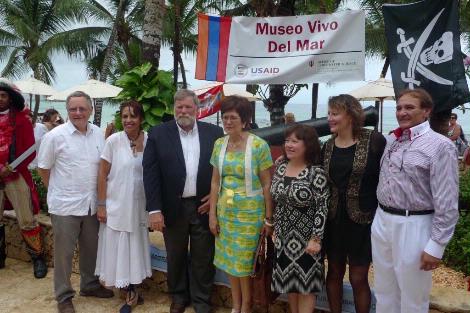
Last year, the IU team received a $200,000 grant from the U.S. Agency for International Development (USAID) with a mandate to work with the Dominican government and others and turn the shipwreck into a "living museum" - living remnants of the Armenian ship in its final resting place.

When completed, the museum would be open to snorkelers and divers. Considering the existing tourist flow to the Dominican Republic and the unique attractions of a pirate shipwreck, the new museum is likely to become a major attraction.

The June 1 event at the U.S. Embassy in Santo Domingo highlighted progress on the project so far and brought together senior members of the Dominican government and the local diplomatic corps.

One of the most enthusiastic participants was British ambassador to the Dominican Republic Ian Worthington, himself a diver who had already visited the underwater site.

"This is a marvelous discovery and the efforts to bring an international quality [should contribute] to the project's longevity," Mr. Worthington told the Armenian Reporter.

"This is Dominican patrimony, but there is also a link to my country, because Kidd was Scottish; there is an obvious link to Armenia and to India; and overall this is a unique project," he added.

At the event, Mr. Galoumian shared a similar vision of "a cross-cultural center" on Catalina Island near the find that would highlight the history of all nations involved in the Quedagh Merchant.

See the National Geographic Channel's program about the discovery.

Obama in Cairo, Davutoglu at UN, Russia/Georgia talks, Iran elections

First published in June 6, 2009 Armenian Reporter

Washington Briefing
by Emil Sanamyan

Barack Obama urges fresh start with Muslim world


In a much-anticipated address, President Barack Obama acknowledged on June 4 misunderstandings between the United States and many Muslims, and also stressed that "America and Islam are not exclusive, and need not be in competition."

The almost-one-hour-long speech was delivered at Cairo University in Egypt before an audience of 3,000; it was also carried live worldwide. Among other things, the president sought to emphasize shared values between Christians, Jews, and Muslims, frequently quoting from holy books.

Mr. Obama also promised a more evenhanded approach to the Israeli-Palestinian conflict rather than simply supporting Israel's actions unconditionally, as was the case under George W. Bush.

Earlier this year, Mr. Obama had already addressed Muslims via the Saudi-owned Al Arabiya TV, in a Nowrooz message to Iranians, and during a visit to Turkey.

Separately, on June 1, the United States' Caspian energy envoy Richard Morningstar delivered a letter from Mr. Obama to Azerbaijani president Ilham Aliyev.

According to reports in the Azerbaijani press, Mr. Obama stressed the importance of exporting energy products in and near Azerbaijan, and pledged to offer America's "partnership" and "friendship" for continued progress on energy issues.

FM: Turkey wants new emphasis on U.S. ties, continued Armenia talks

U.S.-Turkey relations should be forward-looking and "make contributions to humanity" rather than excessively focus, as they have, on military cooperation, Foreign Minister Ahmet Davutoglu told the American-Turkish Council (ATC) conference in a keynote address on June 2, Zaman reported.

The annual ATC conference is primarily funded by major U.S. weapons producers with a long history of selling their products to the Turkish military. It featured appearances by top military officers from both countries - Admiral Mike Mullen and General Ilker Basbug - who, Mr. Davutoglu noted, have known one another for 30 years.

Drawing a parallel between the United States and Roman Empire, Mr. Davutoglu urged the United States to take the more thoughtful, multilateral foreign-policy approach of Marcus Aurelius, rather than the unilateral approach of Julius Caesar.

Asked at a press conference the following day about Armenia-Turkey talks, Mr. Davutoglu sought to portray the process as continuing, albeit slowly. He also reiterated the linkage of Armenia-Turkey talks and the Karabakh dispute as "processes that positively support each other." He warned, however, that "moving frozen conflicts is a painful process which necessitates patience."

Mr. Davutoglu also acknowledged the link between Armenia-Turkey talks and Armenian-American efforts to pass a congressional resolution on the Armenian Genocide.

He argued that a "positive pace" in Armenia-Turkey talks will have to be maintained so that "the Armenian issue [is] no longer an issue blocking Turkish-American relations."

During a weeklong U.S. trip, the Turkish foreign minister also visited the United Nations headquarters in New York, as Turkey assumed the Security Council's rotating presidency.

Russia, Georgia may discuss opening of border crossing

While the rhetoric between Moscow and Tbilisi remains acrimonious, the Russian Foreign Ministry has proposed to hold talks with Georgian diplomats on reopening the main highway linking the two countries at the Lars checkpoint. A formal request was reportedly made on May 24, and Georgian officials have said they agreed to begin talks.

Before being closed by Russia in 2006, formally for repairs but also as a form of pressure on Georgia, the road served as a key ground-transportation link for Armenia, which has since had to rely on Black Sea ferry links that bypassed the Russian-Georgian border.

Meanwhile in Tbilisi, the Georgian opposition campaign against incumbent President Mikheil Saakashvili began to unravel, after failing to win substantial public support. One of the main opposition leaders, Irakly Alasania, has effectively split from others in the opposition coalition, most notably Nino Bourjanadze and Levan Gachechiladze, by calling for dialogue with Mr. Saakashvili.

Iran’s president faces strong electoral challenge

Early expectations that Iran's President Mahmoud Ahmadinejad would easily win reelection in voting on June 12 have now been replaced with those of a close race with a former prime minister, Mir-Hossein Mousavi, with the outcome likely to be decided in a runoff election.

According to media reports, the two candidates launched into personal attacks as they debated one another on live television on June 3. The debate became so heated that Iran's Supreme Leader, Ali Khamenei, reportedly intervened to halt it.

Mr. Mousavi was prime minister between 1981 and 1989, during the years of war with Iraq. He has criticized Mr. Ahmadinejad for doing a disservice to Iran as president. Mr. Mousavi is backed by Mr. Ahmadinejad's predecessor Mohammad Khatami, who was president between 1997 and 2005.

Coming up: Sarkozy, Gordon, and Peres in the Caucasus, Obama in Russia


Recently appointed Assistant Secretary of State Philip Gordon will be in the Caucasus the week of June 8, visiting Armenia on June 9.

On June 25–26, French president Nicolas Sarkozy will visit Kazakhstan and the three Caucasus states. France is one of the lead mediators in Karabakh negotiations.

On June 28, Israeli president Shimon Peres will be in Baku, as part of a trip to Central Asia.

And between July 6 and 8, President Barack Obama will visit Russia for talks that are likely to focus on Afghanistan, Iran, and North Korea, but might also include discussion of Caucasus concerns.