Showing posts with label Iraq war. Show all posts

Sunday, December 21, 2008

Iraq coalition; Erdogan, Medvedev in DC; EU restores Russia ties

First published in November 15, 2008 Armenian Reporter.

Washington Briefing
by Emil Sanamyan

U.S.-led coalition members pull troops out of Iraq


Multi-National Force-Iraq insignia.The 7-pointed star represents Iraq's largest communities- Sunnis, Shias, Kurds, Turkomans, Assyrians, Yazidis, and Armenians. Source U.S. Dept. of Defense.

With the twilight of the George W. Bush administration and with President-elect Barack Obama having pledged a gradual withdrawal of U.S. forces from Iraq within 16 months of taking office, most of the remaining members of the so-called Coalition of the Willing are no longer willing to stay in Iraq.

Since 2003 the coalition had included troops from the three former Soviet republics in the Caucasus, as well as Kazakhstan, Moldova, Ukraine, and the three Baltic states - Estonia, Latvia and Lithuania, which are now members of NATO. Most of these troops have already withdrawn, with 37 Estonians and 20 Moldovans due out by the end of the year.

Azerbaijan became the latest former Soviet republic to announce a pullout, with its president issuing instructions to that effect shortly after the U.S. election. Initially at 150, the Azerbaijani unit currently ­numbers 88 personnel that have served as security guards at a hydroelectric plant.

Although Azerbaijani forces were not reported to have taken part in operations outside the dam perimeter, they did suffer at least one soldier killed last June in apparent fratricide.

Armenia pulled its 46-person unit from near the town of Kut, on the Iraqi-Iranian border, last month. The pullout was timed to the withdrawal of the Polish forces, under whose command Armenians served.

(Poland participated in the 2003 invasion of Iraq and in five years Polish forces lost 21 soldiers, with 70 others wounded, according to U.S. military records cited by AFP.)

The Armenian unit was involved in demining, medical rescue, and logistics operations, suffering one officer seriously wounded in combat. That officer, Sr. Lt. Georgi Nalbandian, has since recovered and returned to active duty with the Armenian armed forces.

Georgia, which earlier this year increased its presence in Iraq to nearly 2,000 soldiers, pulled most of them out during the war with Russia in August with the remainder returning home since then.

Georgians had served in Baghdad and northern Iraq and were due to take over the Polish-led division before their deployment was cut short. Through June 2008, five Georgian soldiers died (three from hostile action, one in an accident, and one in an apparent suicide) and 18 others were wounded.

Ukraine, which in 2003 deployed more than 1,600 of its soldiers in Iraq, pulled out in 2005 after losing 18 soldiers in various incidents. Several dozen Ukrainian officers remain in Iraq as part of NATO advisory mission to the Iraqi government.

And finally Kazakhstan, another former Soviet republic, also withdrew its 29-person unit of de­miners and medics last month.

Kazakhstan, like Armenia, is a member of the Collective Security Treaty Organization led by Russia, which openly opposed the U.S. invasion of Iraq.

But subsequently, Russia dropped objections to U.S. military presence in Iraq. Foreign Minister Sergei Lavrov said this week that Russia would support a renewed United Nations mandate for the American military presence in Iraq.

The current five-year mandate is about to expire and the Bush administration is now negotiating a status of forces agreement with the Iraqi government that would keep U.S. forces in the country via bilateral agreement.

World leaders to gather in Washington for economic summit

Russia's President Dmitry Medvedev and Turkey's Prime Minister Recep Tayyib Erdogan will be among heads of state and government and senior officials from the world's 20 biggest economies who are arriving in Washington on November 14 for a summit called by President Bush.

The summit was called with a stated intention of addressing the global financial crisis, but for some visiting foreign leaders this would also be the first opportunity to meet with key aides of U.S. President-elect Barack Obama. Mr. Obama said he would not attend the summit and would not be meeting with any of the summit participants, according to the Washington Post.

Mr. Erdogan reportedly sought a meeting with Mr. Obama to offer mediation between the United States and Iran, while also urging him not to change the U.S. policy on the Armenian Genocide. According to Hurriyet, it is unclear if Mr. Erdogan would agree to meet with Mr. Obama's advisors.

According to Referans, Mr. Erdogan also wants to meet with the chair of U.S. Federal Reserve to ask for U.S. financial aid on more preferential terms than are offered by the International Monetary Fund.

The summit will be the first opportunity for a meeting between U.S. and Russian leaders since the war in Georgia last August. Mr. Medvedev told Le Figaro that he already had a "very good conversation" with President-elect Obama, RIA Novosti reported on November 13, and they would "meet will meet without delay and obstruction," although apparently not this week.

Europeans resume talks with Russia over Georgian objections

The European Union (EU) will resume talks with Russia on a "strategic partnership" agreement, which it suspended on September 1 as a punishment for Russian military operations in Georgia.

French President Nicolas Sarkozy, who holds the rotating EU chair and had negotiated the Russian-Georgian cease-fire, announced the decision on November 11. Poland and Lithuania expressed public opposition to the decision.

Georgian officials protested and EU officials acknowledged that Russian forces had not returned to positions they held before the Georgian attack against South Ossetia on August 7-8, saying that the EU's talks with Russia in "no way legitimize the status quo in Georgia," with the EU continuing to protest Russian recognition of Abkhazia and South Ossetia, which broke away from Georgia in early 1990s.

But in an interview with Le Figaro, Russian President Dmitry Medvedev said his country's decisions "are no joking matters" and could not be revised. Mr. Medvedev added that future Russian military presence in both Abkhazia and South Ossetia would be regulated on a bilateral basis.

Speaking at the Brookings Institution in Washington on November 12, Foreign Minister Bernard Kouchner of France said Russia represented a "challenge" to the West, but he added that "there is no solution to most of today's [global] problems without [Russia], let alone against [Russia]."?

Wednesday, November 12, 2008

On Armenians for Obama, Iraqi Christians, Turkey's UN and nuclear plans

First published in October 18, 2008 Armenian Reporter.

Washington Briefing
by Emil Sanamyan

Armenian activists meet Barack Obama’s advisor, confidante


Nora Keomurjian and Karine Birazian with Barack Obama's senior campaign advisor Valerie Jarrett, in Philadelphia on October 13, 2008. ANCA

"Armenians for Obama" activists Nora Keomurjian and Karine Birazian met with Sen. Barack Obama's senior campaign advisor Valerie Jarrett to update her on the group's activities on behalf of the presidential campaign.

During a "Pennsylvania Women for Obama" event held in Philadelphia on October 13, Ms. Jarrett expressed "deep interest in [the Armenian] community's efforts to elect Senator Obama our next president," according to Ms. Keomurjian.

Described as Mr. Obama's "big sister" and "fixer" by the New Republic, Ms. Jarrett is a Chicago lawyer and businessperson. The Wall Street Journal described her as an "insider widely tipped for a top position in an Obama administration."

Ms. Birazian is Eastern U.S. director for the Armenian National Committee of America (ANCA) and Ms. Keomurjian is also an activist for ANCA, which endorsed Mr. Obama.

"Armenians for Obama" is a nationwide Los Angeles-based voter registration, education, and mobilization effort dedicated to electing Barack Obama president. connect: www.ArmeniansforObama.com

Iraqi Armenians killed, wounded in attacks

An ethnic Armenian music-store owner, Farques Batool, was killed, and his nephew was wounded in attacks in Iraq's northern city of Mosul on October 13, news agencies reported. The attacks were apparently religiously motivated.

Since the surge in violence, ethnic Armenians and other Christians who had remained in Mosul, one of Iraq's largest cities, more than 4,000 people in all, have fled, most for the relative safety of Iraqi Kurdistan.

In all, at least ten people have been killed in fresh attacks blamed on Sunni radicals linked with Al-Qaeda in Iraq. The Associated Press linked the attacks to calls by Iraqi Christians for restoration of Saddam Hussein-era quotas that would give them seats in provincial councils. The Shiite-dominated Iraqi government sent police reinforcements to try to stabilize the situation in Mosul.

"Thousands of people fled virtually overnight, many with only the clothes on their back," said Jamil Abdul-Ahad, the head of an interfaith Christian council in Mosul that has been distributing aid to the displaced, The AP reported.

"Our situation needs active work, not just media propaganda from government officials," Mr. Abdul-Ahad said. "The government should protect Christians in Mosul and safeguard their rights."

Sunni extremists have regularly targeted Iraqi Christians since the U.S. invasion and occupation of Iraq in 2003. In addition to Armenians, Iraqi Christians include Syrian Orthodox and Catholics.

Turkey poised to win UN Security Council seat

After years of lobbying and courting countries worldwide, Turkey appeared poised to win a nonpermanent seat on the United Nations Security Council, in an election set for October 17.

All 192 UN member states were to participate in a vote in which Turkey, Austria, and Iceland would compete for two seats reserved for the Western European group of countries. In the absence of progress in its European Union bid, the Turkish government has made winning the Security Council seat a foreign policy priority.

Turkey has raised its international profile in recent years, distancing itself from U.S. policies in Iraq and Iran, mediating talks between Syria and Israel, and most recently suggesting a Caucasus regional pact with Russia. Turkey has also offered financial support to island nations and pledged to open embassies in a number of remote countries. Turkey was previously a Security Council member twice, in the 1950s and in 1961.

According to an October 16 report in Zaman newspaper, Turkey's bid for the 2009-10 Security Council term is backed by most Muslim countries, as well as a number of countries in Africa, Asia, the Caribbean, and Latin America. In all, Turkey needs support from 128 countries to win the seat.

In addition to five veto-holding permanent members - France, China, Russia, the United Kingdom, and the United States, ten other states are elected for two-year terms.

Three of the ten come from the Africa group; two each from Latin America/Caribbean, Asia-Pacific, and Western Europe; and one from Eastern Europe. One of the members is an Arab country, alternately from the Asia or Africa bloc.

In the contest for the Asia seat, Iran is expected to lose to Japan; Iran had previously served on the Security Council in 1955-56. Mexico and Uganda are expected to be elected without opposition in their respective groups. Libya, Burkina Faso, Costa Rica, Croatia, and Vietnam will continue to serve out their terms, which end next year.

The Security Council is authorized to approve military action, peacekeeping operations, and international sanctions.

Turkey still weighing nuclear power plans

The Turkish government is seeking to build two nuclear power plants - a long-delayed one at Akkuyu near the Mediterranean port of Mersin, and another near the Black Sea port of Sinop, the Jamestown Foundation's Eurasia Daily Monitor (EDM) reported on October 10, citing Turkish media.

Although 13 consortia expressed interest in Akkuyu as the tender was announced earlier this year, only one - a joint venture between the Russian state-owned Atomstroyexport and the Turkish Ciner Group - submitted a formal bid before the deadline last month. Other companies have expressed reservations about the project's conditions, which the Turkish government has declined to renegotiate.

The Turkish government will decide whether to accept the sole Russian bid before the end of October. Russia currently supplies two-thirds of the natural gas and one-third of the oil consumed by Turkey.

According to EDM, "the general consensus in Turkey is that the AKP will eventually have to cancel the nuclear power tender" in part over concerns that the United States will perceive the project's award to Russia as another sign of Turkey distancing from the West. AKP is the abbreviation by which Turkey's governing party is known.

Turkish officials have for now pledged to continue with the tender process. Energy Minister Hilmi Guler conceded, however, that "the global financial crisis will affect large investments," including possibly nuclear plant plans.

Ilham Aliyev claims less than 90 percent of vote in re-election

Azerbaijan's incumbent president Ilham Aliyev won just over 89 percent of the votes cast on October 15 and will remain president at least until 2013; his "main rival," Milli Majlis member Iqbal Agazade was second, with 2.78 percent, according to official returns cited by RFE/RL.

Officials also claimed a voter turnout of 75 percent in an election that saw very little public interest or campaigning; the turnout in the significantly more competitive 2003 election was put at 71 percent.

Kenan Aliyev, the director of RFE/RL's Azerbaijani Service, said "a lot of voters were basically forced to go to the polling stations."

Western observers working under the Organization for Security and Cooperation in Europe umbrella released a statement on October 16 saying Azerbaijan's presidential elections showed "considerable progress" compared to previous votes but did not meet all international commitments on democracy.

The poll "was characterized by a lack of robust competition and vibrant political discourse" and "did not reflect all the principles of a meaningful, pluralistic, democratic election," they said.

RFE/RL reported that government celebrations in Baku began before results were announced.

Tuesday, July 22, 2008

Aided by U.S. intelligence, Turkish military raids Iraqi Kurdistan


This was originally published in December 22, 2007 Armenian Reporter.

by Emil Sanamyan and Nareg Seferian


Iraq condemns attack, Europeans issue warning

WASHINGTON – Dozens of Turkish aircraft dropped bombs and hundreds of ground soldiers pushed more than 11 miles into Iraqi Kurdish territory early on December 18 before pulling back 15 hours later, international news agencies reported.

The raid was on a larger scale than previous incursions and was intended to target the infrastructure of anti-Turkey Kurdish rebels in northern Iraq. Turkish officials said their military was aided by U.S. intelligence on the forces of the Kurdistan Workers’ Party (PKK).

President George W. Bush pledged to provide such information to Turkey in talks with Turkish Prime Minister Recep Tayyip Erdogan in Washington in early November (see the front page story in the November 10 Armenian Reporter).

Iraqi officials in Baghdad condemned the Turkish raid, claiming that it targeted civilian infrastructure. Turkey has been threatening action against Kurdish rebels for many months and in recent weeks has also stepped up pressure on pro-Kurdish Democratic Society Party, which has more than 20 seats in the Turkish parliament.

To allay tensions Secretary of State Condoleezza Rice made an unscheduled visit to northern Iraq late on December 18, where Iraqi Kurdish leaders refused to meet with her. The BBC quoted Iraqi Kurdish leader Massoud Barzani calling U.S. permission for the attack “unacceptable,” the BBC reported.

Deadlock with EU continues

The European Union (EU) issued a statement calling on “Turkish authorities [to] refrain from taking any military action that could undermine regional peace and stability,” Reuters reported. But Turkish officials said the country reserved the right to conduct more attacks within Iraq.

This week’s incursion came just days after EU renamed its upcoming annual talks with Turkey an “intergovernmental conference” instead of “accession conference” as in the past. The move reportedly came on behest of French President Nicolas Sarkozy who remains opposed to Turkey’s membership in the EU, the Jamestown Foundation’s Eurasia Daily Monitor reported on December 17.

EU-Turkey membership talks have deadlocked over Turkey’s refusal to establish relations with Cyprus, an EU member, and lack of progress in democratic reforms, accompanied by a rise of xenophobic attacks with Turkey.

On December 16 yet another priest was stabbed and wounded in an apparently nationalist-motivated attack in the city of Izmir, Reuters reported.

Friday, July 18, 2008

PM Serge Sargsian begins U.S. visit

First published in October 20, 2007 Armenian Reporter

Prime Minister Serge Sargsian begins visit to the United States
Meets Vice President Cheney, Defense Secretary Gates
Thanks members of Congress for supporting Genocide resolution
by Emil Sanamyan

WASHINGTON – Prime Minister Serge Sargsian of Armenia, who arrived here on October 18, expressed his country’s gratitude to congressional leaders for their support for the Armenian Genocide resolution.

“We are thankful to those members of Congress who voted in favor of the resolution’s passage” in the House Foreign Affairs Committee, Mr. Sargsian told the Armenian Reporter. He said the issue had not come up in his meeting with Defense Secretary Bob Gates. Their talks on October 18 were focused on U.S.–Armenia military cooperation.

Last week, Mr. Gates along with other Bush administration officials spoke out against the resolution, arguing that its passage may result in the suspension, by Turkey, of military cooperation with the United States, and interfere with logistical supplies to U.S.–led forces in Iraq.

The forces include a small contingent from the Republic of Armenia. According to the Armenian Embassy in Washington, Mr. Gates thanked Mr. Sargsian for Armenia’s contribution to the U.S. effort in Iraq, and the sides discussed a possible peacekeeping deployment by Armenia in Afghanistan.

On October 18 Mr. Sargsyan also visited with Vice President Dick Cheney and the executive director of the U.S. Millennium Challenge Corporation (MCC) Ambassador
John Danilovich. Speaking to the press following his meeting with Armenia’s prime minister, Mr. Danilovich said that the MCC is “very happy” about how the five-year $235 million program is being implemented in Armenia. [See page A5 for a story on the implementation of the program.]

“We are pleased with the progress Armenia is making in all respects,” Mr. Danilovich said. He added that the MCC looks forward to seeing Armenia’s presidential elections in early 2008 being conducted “in a positive way.” Funding for the program is contingent on Armenia’s continuing compliance with MCC eligibility criteria, which include ongoing improvements in the conduct of elections.

The program began last year and is designed to reduce poverty by developing Armenia’s rural areas.

Armenia qualified for the program because of its government’s relatively liberal democratic and economic policies and its efforts to improve health and education. Among former Soviet republics Georgia, Ukraine, and Moldova have also been found eligible to sign MCC assistance compacts with the U.S. government.

On October 19 and 20, Mr. Sargsian will be in Los Angeles, where he will meet members of the Armenian community. He will then return to Washington on October 21 to attend the annual meetings of the World Bank and the International Monetary Fund (IMF) and the biannual session of the U.S.–Armenia Task Force on economic cooperation. He will also hold talks with congressional leaders and senior State Department officials.

The bank and IMF have provided developmental and fiscal support to Armenia with programs totaling over $1 billion over the past decade. The organizations’ low-interest loans account for the lion’s share of Armenia’s $1.2 billion foreign debt.
U.S. government aid programs to Armenia have totaled $1.7 billion over fifteen years. Last year, U.S.–Armenia trade amounted to $127 million out of Armenia’s total $3.2 billion foreign-trade turnover. That put the United States fifth among Armenia’s largest trading partners, behind Russia, Germany, Belgium, and the Netherlands.

Wednesday, July 9, 2008

Briefly: U.S.' Iraq policy, anti-Americanism in Turkey, Georgia and U.S., Armenia’s nuclear neighborhood, Russia’s new PM


First published in the September 15, 2007 Armenian Reporter

From Washington, in brief
by Emil Sanamyan

Bush Administration resists calls for withdrawal from Iraq

Speaking in Congress this week, the U.S. commander in Iraq made the Bush Administration’s case for maintaining the American military presence in the country at about the current level, at least until next summer. Democratic leaders continued to call for a substantial withdrawal sooner rather than later.

On September 10 and 11, Gen. David Petraeus pointed to some progress made in establishing security in central Iraq since the U.S. began its “surge” earlier this year to the current troop level of over 160,000. But the pressure has been building from both Democrats and Republicans to begin to pull troops out of the increasingly unpopular conflict in Iraq, particularly ahead of November 2008 presidential and congressional elections.

The war launched by the United States in March 2003 and the subsequent insurgency and civil war in Iraq have so far resulted in the deaths of more than 4,000 U.S. and coalition military personnel, and well over 70,000 Iraqi civilians, displacing about two million more.

According to the latest ABC News/Washington Post poll, 55 percent of Americans want U.S. troops out of Iraq by early 2008. Gen. Petraeus could only see up to 30,000 U.S. personnel possibly withdrawn by summer of 2008 – something that would reverse this year’s “surge,” but would also almost certainly leave the Iraq conflict for the next American president to sort out.

A small Armenian contingent is set to remain in Iraq until the end of 2007, when the Armenian government may seek another extension for the deployment. It is based near the town of Al Kut, in the same area near the Iraq-Iran border where the U.S. is planning to build a large military based, according to the September 10 report in the Wall Street Journal.

Poll: Anti-American sentiments in Turkey not limited to U.S. government

Turks continue to have some of the strongest anti-American sentiments in the world, according to a study by the Pew Global Attitudes Project conducted earlier this year. The findings, circulated by www.worldpublicopinion.org on September 5, show that more than 83 percent of Turks hold an unfavorable view of the United States, and 77 percent dislike Americans.

The Pew study also confirmed findings of a Bilgi University study (see this column in the June 16 Armenian Reporter ) according to which Turks view the United States, their country’s longtime NATO ally, as the greatest threat to their security; 64 percent in the Pew study said the U.S. was a threat to Turkey, and 35 percent in the Bilgi study said the U.S. posed the biggest threat (more than any other source).

Commentators see the U.S. invasion and occupation of Iraq as the main reason for the increase in anti-American attitudes. Turks are particularly unhappy with the strengthening of a de facto Kurdish state in northern Iraq and simultaneous intensification of insurgent attacks in majority Kurdish southeastern Turkey. The intermittent clashes so far this year are believed to have killed 300 Kurds and about 100 Turkish security forces, the Washington-based Jamestown Foundation reported on September 5.

Turkish dislikes of America are spilling into apolitical spheres as well. Thus, 81 percent “dislike American ideas about democracy,” 83 percent dislike “American ways of doing business,” 68 percent dislike “American music, movies and television,” and up to 51 percent say they do not admire the United States for its “technological and scientific advances.”

Georgian foreign minister works to retain U.S. support

The U.S. secretaries of state and defense offered continued support for Georgia’s Euro-Atlantic integration (also known as NATO membership), the Georgian Foreign Ministry reported on September 11, after Minister Gela Bezhuashvili met with Condoleezza Rice and Robert Gates.

Mr. Bezhuashvili told the Associated Press that Georgia hopes for a formal invitation to join the alliance in April 2008. “This is the highest priority of our foreign policy,” he told AP.

The U.S. supports Georgia’s membership, but it is unclear whether the country would be able to win unanimous backing from alliance members wary of expansion and Georgia’s volatility (see this column in the September 8 Armenian Reporter).

Speaking at the Brookings Institution in Washington on September 10, Mr. Bezhuashvili sought to play down continued tensions with Russia and said Georgia would respond “moderately” to future “provocations.” He also argued that Georgia’s increased military spending was needed to fund its armed forces’ reform and missions abroad – particularly in Iraq, where it is in the process of increasing its presence to 2,000 service members.

Mr. Bezhuashvili’s talk focused on improvements in Georgia’s business climate, noting the growth in foreign investments from $400 million in 2005 to $1.5 billion in 2006, which he said had resulted from reduced corruption and increased transparency.

Asked by the Armenian Reporter why the investors who last month secured the rights to manage Georgia’s railroad (see this column in August 25 Armenian Reporter ) have not been named, Mr. Bezhuashvili claimed that he was not familiar with the deal since he had been traveling for weeks.

A Georgian business tycoon, Badri Patarkatsishvili, denied media speculation that he had taken control of the railroad in exchange for his TV holding, www.civil.ge reported on September 10. Mr. Patarkatsishvili recently relocated to London after he claimed his Imedi television station came under pressure from the Georgian government.

The Georgian Messenger daily reported on September 7 that the railroad’s formal owner, the Britishregistered Parkfield Investments, was a shell company backed by two other offshore groups registered respectively in the Bahamas and Cyprus.

Armenia’s neighbors are also interested in nuclear energy

According to preliminary estimates, a new nuclear power plant will take four-and-a-half years to build and cost $2 billion, Armenian news agencies cited Energy Minister Armen Movsisian as telling the National Assembly on September 7. A project feasibility study, currently being developed together with Russia, the U.S., and the International Agency for Atomic Energy (IAEA), is to be ready by next year, Mr. Movsisian said.

Despite the steep price tag, Mr. Movsisian said that “only a new nuclear plant can become an alternative for the existing power plant” at Metsamor, which is slated to be decommissioned in the next decade, PanArmenian.net reported.

He added that due to the efforts of the Armenian government, key international players “now realize that Armenia must have an atomic power plant.” In addition to Iran’s widely publicized nuclear efforts, Armenia’s three other neighbors are also looking to benefit from nuclear technology. The Turkish government still plans to have nuclear energy by 2020, although construction plans for a plant were scrapped during the economic crisis in 2000.

Last month, the Georgian government established a state commission headed by its energy minister to look into the possibility of constructing a nuclear reactor in Georgia, Prime News reported on August 16 (also see this column in
the June 23 Armenian Reporter ). And on August 24, the Azeri Trend news agency reported that, with help from IAEA, the Azerbaijani government is planning to begin building a nuclear reactor near Baku in 2009. Azerbaijan is reportedly looking to build a nuclear power plant later this century, when its oil and gas resources are expected to run out.

Around the world, there are 31 nuclear reactors now under construction, with 439 reactors currently working, the Economist reported on September 8. In the U.S., the Nuclear Regulatory Commission is expected to receive a total of 27 applications in 2007–8 for building new nuclear reactors.

Russian President appoints new Prime Minister

With just six months left before the Russian presidential elections, President Vladimir Putin replaced his prime minister on September 12, international news agencies reported. But instead of naming his likely successor to the post, Mr. Putin appointed a largely unknown bureaucrat, Viktor Zubkov, to take over from another political lightweight, Mikhail Fradkov.

After more than seven years in office, Mr. Putin remains popular in Russia, but he will not stand in elections when his second term runs out in March 2008. Speculations have focused on three influential deputy Prime ministers – Sergei Ivanov, Sergei Naryshkin, and Dmitri Medvedev – as his most likely successors.

On the day of the reshuffle, Vedomosti, a leading Russian business daily, cited a source close to the Kremlin as saying that Mr. Ivanov would be named prime minister. But instead Mr. Zubkov – a 66-year-old, longtime colleague of Mr. Putin, who until now had headed a state committee combating money laundering – was appointed.

Most Russia watchers have ruled out Mr. Zubkov as a potential successor, and still see Mr. Ivanov as the most likely next president of Russia.

Monday, June 23, 2008

Genocide resolution at "crunch point," U.S.' Iraq policy

This was originally published in August 4, 2007 Armenian Reporter.

From Washington, in brief
by Emil Sanamyan

Genocide resolution seen approaching “crunch point”

With elections in Turkey wrapping up, the House Resolution on the Armenian Genocide (H. Res. 106) will approach a “crunch point quite soon,” according to Alan Makovsky, a senior staff member on the House Foreign Relations Committee. But he anticipated no action until the August recess was over.

Mr. Makovsky said this in his personal capacity in response to a question from former Congressman and long-time Turkish lobbyist Stephen Solarz during a July 23 discussion at the Washington Institute for Near East Policy (WINEP), an audio of which is available on its web site.

Prior to his congressional appointment, Mr. Makovsky headed WINEP’s Turkey program and in that capacity he publicly opposed the 2000 House Genocide resolution, according to reports in the Turkish media at the time.

Both Speaker Nancy Pelosi and Democratic Majority leader Steny Hoyer have had a “long-time personal commitment on this issue,” Mr. Makovsky noted, and “if they had their way [H. Res. 106] would pass.” At the same time, the Bush Administration has been intensively lobbying against the measure. The senior congressional official recalled that two types of arguments have been made against the resolution. The first argument is “strategic,” in terms of potential consequences for U.S.-Turkish relations, and, the second one is that of timing linked to elections in Turkey.

“We [the U.S.] don’t want to become a factor in the elections,” Mr. Makovsky said, and “that point resonated with a lot of people [in Congress].” Now that the Turkish electoral process is about to wrap up (the general election was held on July 22 and a parliamentary vote for president is expected in the next several weeks), that second argument is about to become irrelevant.

Also participating in the WINEP discussion, Deputy Assistant Secretary of State Matt Bryza thanked Mr. Makovsky for referring to the Administration’s work in opposing the resolution and promised that it “will continue that approach.” Mr. Bryza reiterated the State Department’s position that it “do[es] not deny anything one way or another” but believes that “those horrible events” should be addressed through dialogue between Armenians and Turks. “How do you do that, I don’t know,” he said but added that that is the approach favored by the Administration.

Referring to “somewhat ominous” comments by Mr. Makovsky that “things are going move” on the resolution, Mr. Bryza argued that “we really need something from the Turkish government that… moves towards normalization of relations with Armenia, it is time for that to happen.”

As of this week, 224 of 435 members of Congress have officially endorsed H. Res. 106. Mr. Makovsky said that the fact that more than half of the House members back the measure was “psychologically significant, but in itself does not mean anything operationally.”

Still, former U.S. Ambassador to Turkey Morton Abramowitz said that the resolution was very likely to pass in the House after Congress’ August recess, the Turkish Daily News reported on July 26.

A vote on the resolution depends on a decision by the Democratic leadership of the House of Representatives.

Be watching…

Our readers in the Washington area take note that this Sunday, August 5 at 8 p.m. the local PBS affiliate WETA channel 26 will be re-airing Andrew Goldberg’s film The Armenian Genocide. This documentary first aired on PBS nationally last year, when it received critical acclaim both in the United States and abroad. For more information connect at www.weta.com.

Reputed plans for U.S.-Turkish “secret operation” against Kurds leaked

Speaking at the Washington Institute for the Near East Policy on July 23, U.S. Deputy Assistant Secretary of State Matt Bryza hinted that in the immediate future the U.S. is likely to take action against anti-Turkey Kurdish groups in northern Iraq. Mr. Bryza agreed with Turkey’s claims that the U.S. has not done enough to clamp down on forces in Iraqi Kurdistan, usually identified as the Kurdistan Workers’ Party (PKK), who Ankara has accused of fueling a growing anti-government insurgency within Turkey.

Both the military and the government in Turkey have threatened to invade Iraqi Kurdistan unless the U.S. takes measures of its own. “The attitude has shifted here in
Washington,” Mr. Bryza revealed. “We have to produce concrete results and I’m confident we are going to soon… in the next few weeks or months.”

In his July 30 Washington Post column Bob Novak offered details of one potential such action. According to Novak’s sources, during the previous week Undersecretary of Defense Eric Edelman gave select members of Congress a confidential briefing on plans, in Novak’s words, “for a covert operation of U.S. Special Forces to help the Turks neutralize the PKK. They would behead the guerilla organization by helping Turkey get rid of PKK leaders that they have targeted for years.”

But, according to the Post columnist, the idea was not well received by at least some in Congress. Its opponents believe that any such U.S. action would undermine progress made in Iraqi Kurdistan, the only stable part of the country. Predictably, U.S. and Turkish officials declined to comment on Novak’s claim.

Most commentators suggested that the leak intended to scuttle any such operation. The
Administration-friendly Washington Times, in its editorial on July 31 blasted the unidentified congressional sources that leaked the contents of Mr. Edelman’s briefing. The Times concluded: “now that it has been made public, the operation has been severely compromised – if it hasn’t been forced off the table altogether.”

But mindful of the Administration’s penchant for secrecy and tendency not to share information with Congress, Blake Hounshell, web editor for the Foreign Policy magazine, wondered on his blog if Mr. Edelman’s briefing to Congress was made with an intention for its details to be leaked. “So perhaps the plan was simply being floated in order to buy more time with the Turks, and Congress was used in order to kill it,” Mr.
Hounshell speculated.

Whatever the case may be, senior Turkish officials continue to threaten to invade Iraqi Kurdistan, although Prime Minister Recep Tayyib Erdogan acknowledged earlier this summer (see this page in Jue 16 Reporter) that the Kurdish resistance is based mostly in Turkey rather than in Iraq. Turkey’s real concern appears to be with the existence of a defacto Kurdish state on its border.

A referendum on the status of the Kurdish-populated and oil-rich city of Kirkuk, expected to result in its unification with Iraqi Kurdistan and opposed by Turkey, may yet lead to a fresh escalation in tensions if it takes place as is currently planned before the end of this year.

Think tank study argues for Iraq partition

Frustration over continuing sectarian violence in U.S.-occupied Iraq has sent Washington policy-makers scrambling for policy ideas that could provide for a long-term stability in Iraq. In recent years, a view that Iraq can no longer function as a centralized state has increasingly gained ground.

Last month, a prominent national security scholar and an experienced conflict-management practitioner issued “The Case for Soft Partition of Iraq,” a policy paper in which its authors Michael O’Hanlon and Edward Joseph argue that such an approach “would involve the Iraqis, with the assistance of the international community, dividing their country into three main regions. Each would assume primary responsibility for its own security and governance, as Iraqi Kurdistan already does.”

The paper was published by the Brookings Institution – one of the more respected and less partisan think tanks in Washington – and received considerable attention both in Congress and in the media.

Nonetheless, the plan has also been criticized because it would entail continued U.S. occupation of Iraq at the current levels for at least another two years, as well as major population relocation within Iraq, certain to cause additional humanitarian crises.

U.S. policy initiatives are frequently vetted through think tank studies, although only few of them become blueprints for government action. A policy paper prepared last year by the pro-Administration American Enterprise Institute, which argued for a “surge” in U.S. troop presence in Iraq as a way to contain the sectarian violence in the country, was one such example. The “surge” policy has been in effect from early this year and has received mixed reviews so far.

This September, the U.S. military commander in charge of the plan is expected to report on whether the approach is working and based on the outcome of that report whether it should be modified or abandoned in favor of troop withdrawal. Mr. O’Hanlon, of the partition study has been supportive of the Iraq invasion as well as the most recent “surge” policy, and may expect to have the Administration’s ear.

U.S. to begin major arms infusion into Middle East

Secretaries of State and Defense Condoleezza Rice and Robert Gates this week traveled to the Middle East, bringing along an aid package that includes many billions of dollars worth of U.S. military hardware for its Arab allies like Egypt, Saudi Arabia and smaller Persian Gulf states, as well as Israel. “The United States is determined to assure our allies that we are going to be reliable in helping them to meet their security needs,” Ms. Rice was reported as saying on July 31 by news agencies.

Israel, which is already the biggest recipient of U.S. military assistance to the tune of $2.4 billion a year, is expected to receive $30 billion over ten years (a 25 percent increase from the current level). Arab states are due to jointly get an additional $33 billion over the same period, with aid to Egypt doubled from $1.3 billion a year. The aid, including naval vessels and missile defense systems, is intended to check the perceived increase in Iran’s regional power following the devastation of Iraq and amid Tehran’s continued progress over its nuclear program, in spite of U.S.-championed international sanctions.

The U.S. Congress would need to approve the aid. That, despite some reservations over aiding countries like Saudi Arabia, seems likely since the plan has Israel’s support. As part of its efforts to contain Iran, U.S. also poured arms into Lebanon in the effort to limit the influence of Iran-backed Hezbollah there. The U.S. is also supporting one of the two main factions in Palestine; aiding Azerbaijan through the multi-year $100 million Caspian security program and funding opposition groups within Iran itself.

Iran’s reaction came from its Defense Minister Mostafa Mohammad Najar. “[The U.S.] are engaging in psychological warfare in the region in an effort to save the American military industry,” he was quoted as saying by news agencies. “U.S. plans are designed to create a security belt around Israel,” Mr. Najar said. “We have no problem with neighboring or Muslim countries, and should any of these countries acquire weapons. This would only make the Islamic world more powerful,” he suggested.

Monday, April 16, 2007

Armenian officer wounded in Iraq recalls his experience

Published in April 14, 2007 Armenian Reporter

Armenian officer wounded in Iraq recalls his experience
* Senior Lieutenant Georgi Nalbandian looking to return to army service


For about a month 25-year-old Senior Lieutenant (Sr. Lt.) Georgi Nalbandian of the Armenian Army has been at the Walter Reed Medical Center in Washington. He was seriously wounded in action in Iraq on November 11, 2006. Our Washington Editor Emil Sanamyan sat down with the officer on April 11 to write down his story. “From everything I’ll say, you’ll see that I am both lucky and unlucky,” he said.

“I am from the town of Ararat originally. There I finished school in 1998 and enrolled in the Military Engineering Academy in Moscow. That September I began my first year. After graduating from the Academy with only A’s and B’s I was commissioned a lieutenant in the Armenian Army in 2003.

From then on and until November 2005, I served in the Vayk-based regiment of the 4th Army Corps – this is a forward deployed combat unit [on the border with Azerbaijan-controlled Nakhichevan]. I was then transferred to the Military De-Mining Center in Echmiadzin. After nine months there I on my own initiative volunteered to serve in Iraq as a commander of a de-mining team. We were the fourth rotation going to Iraq in July 2006 for a six-month period.”

First Armenian servicemen arrived in Iraq in January 2005, where they continue to serve under Polish command in the multi-national division in central and southern Iraq.
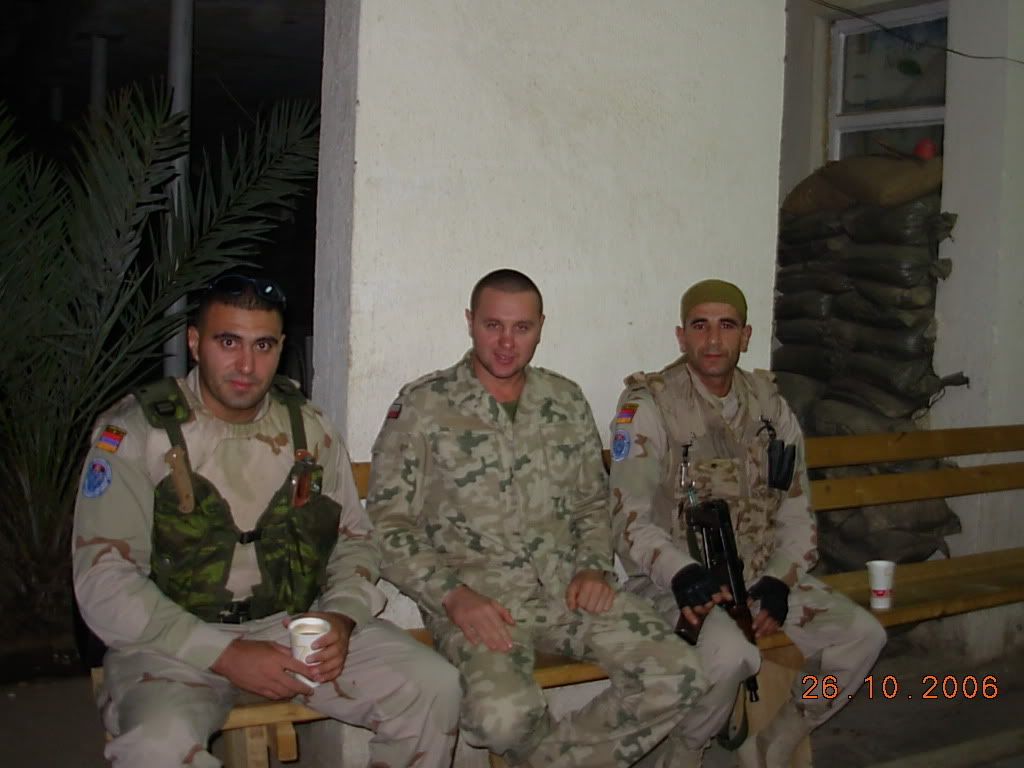
"We arrived in the town of al-Kut. There was not anything special going on at the time. But we did get decent combat assignments. We dealt primarily with unexploded ordinance that all over the place there. We found and destroyed that ammunition.

Along with soldiers from El Salvador we helped secure the coalition military base in al-Kut, to make sure none of the improvised explosive devices (IED’s) got inside the base perimeter.

And together with Polish soldiers we drove out on field reconnaissance missions in the area. My job was to make sure key bridges were not rigged and again to find the unexploded ordinance. We got attacked once at the time, but the explosion was in the front of the vehicle and we did not take casualties. That was the first time.”

What about that day?

“No, that happened at night. I remember it all. All the way to the hospital’s operating room. We had an assignment to check out this area of an ammunition dump. Previously we reconnoitered that area with the Poles. As we realized, what we found was the Iraqi army ammunition storage. Much of it was destroyed in the [U.S.] aerial bombing. But there was still a lot of stuff still unexploded lying around, including mines, 155-mm missiles, artillery shells, grenades, anything you can imagine, I can’t really list it all. It was a large area of about 300 by 400 meters, with stuff lying around quite densely.

We needed to clean that area up since there was evidence that terrorists were coming in, taking some of that ammunition out to presumably use it either directly or make it into IED’s. We could see the tracks from their digging. It was clear there were not looking for lost treasures there.

So that morning of November 10, at about eight in the morning, I guided a group of Slovak soldiers on five Humvees and several Czechoslovak-made Tatra armored vehicles with a de-mining machine in tow to that area, to tell them what is where, so that they could begin with the clean up. The place was about three kilometers off the main road. You needed to take one of several gravel paths that had been cleared previously.

We got in safely and they proceeded to destroy some of the anti-personnel mines there and were generally assessing what could be done with that place. There was no system of any kind, with various ordinance lying everywhere, so they were trying to find a way to organize their work.

The plan was to go in for half a day, so we did not really bring along much in the way of water or food. Just days earlier Saddam was sentenced to death and there was apprehension there might be an increase in attacks. So by 2 p.m. we began to move out. We could not turn the convoy around and had to take another road. But as we started moving those big Tatras began to sink into the gravel that in some places became really powdery from all the explosions. As we tried to pull out some of the vehicles, others would sink in. It was a comic situation really.

By 6 or 7 it gets dark there and dangerous. We called in reinforcements from the base. Salvadoran soldiers on four more Humvees arrived along with a crane. Salvadorans secured the perimeter around the convoy. But that crane too got stuck. Then U.S. and Iraqi special forces arrived with even a bigger crane – that was a really powerful machine that pulled almost all of the vehicles out, but then itself got stuck. So it got even funnier.

In the end, it was already past 1 a.m., we got the order that those that had been at that dump since the morning, and we were really dead tired by then, could go back to the base. The others would stay until the remaining vehicles are pulled out.

I got into the back seat of one of the Polish vehicles together with a Slovak. A full moon was out, so we turned off the headlights not to draw attention to the convoy. We talked a little, but I remember I was falling asleep. I was asleep.

It was a miracle or what, I don’t know, but it was as if someone pushed me a second or two before the explosion – as if I sensed it was coming. Instinctively, I drew my hands to cover my face and the next thing to happen is explosion ripping us apart.

I would typically have gloves on my hands, but I took the left one off to hold up the MRE (the U.S. Army-issued Meal Ready to Eat) that we just had, and forgot to put it back on. So I lost the skin on this hand.”

Nalbandian points to the burn covering much of his left hand.

“I saw that flame – on sunny days I still can’t go outside without sunglasses – heard the screams, felt the heat. So I realized I was OK, I was not dead.

(The Polish driver and Slovak sitting next to me were killed in the explosion. The other Pole sitting next to the driver was hit in the knee and has since had trouble walking.)

I moved my legs – the left one was heavy, the right one also felt like it was there. I looked up and saw bullet traces coming in and realized we were being ambushed. I heard the shooting, the Humvee kept moving, but the heat was getting worse and I couldn’t breath. I started feeling around trying to find my machine gun. I would always keep it next to my left leg, but I couldn’t find it. I started to suffocate, opened the door and tried to jump out, pushing with my right leg and that’s when I saw I had no right leg left and blood was gushing out of where it used to be.

I fell on the ground, with my right leg left under the driver’s seat. I was in shock and for a moment began to think that was all a dream and nothing had happened. But then the pain began and I realized my other leg was on fire. I put it out and took cover.

The Humvee stopped a few meters away. By then our large caliber machine guns opened up, and it sounded like the enemy began to disperse, at least they could not fire at us anymore. I waived my hand, calling out that I was still alive and needed help.

They ran up to me with a stretcher. The medevac vehicle was right behind me, so they quickly took me in and brought me to al-Kut. Our base doctor Major Vigen Tatentsian met us at the gate and began to stick me with needles with painkillers, IV and whatever else I don’t know. They took my clothes off. I was losing a lot of blood and couldn’t breath so they stuck a tube into my throat.

In just ten minutes or so, an American helicopter arrived to take me to the hospital in Baghdad. By then I was heavily medicated, so it felt like the normally 45-minute flight from al-Kut only took a few minutes. I was losing consciousness, they were bringing me back out. I was really thirsty, but they could only give me a wet cloth – it was not even a drop of water.

As soon as we reached the Baghdad hospital they operated. I remember those three round medical lamps above me. They gave me another incision and everything I ate that day came out of me. I was high on morphine and wondered what these ten people in white were doing around me. They kept sticking me with needles. And after one incision I felt completely paralyzed. I couldn’t even move my eyes. It really felt like death. Then I either fell asleep or lost consciousness, I don’t know.

When I came to, Captain David Gyozalian, who is our liaison officer in Baghdad, was next to me. I was still high on morphine, so I was laughing and smiling. He told me that they cleaned the wound and would be taking me to a hospital in Germany in the next three hours.”

All coalition soldiers wounded in Iraq, after receiving first aid and emergency surgery, are evacuated to the U.S. military bases in Germany for further treatment.

“The pain kept coming back, so I asked for morphine and sleeping pills, and I really already woke up in Germany after a six-hour flight. Then there was a second surgery and four more surgeries soon after. Those three weeks I could hardly move even in the bed. Pain continued, including the phantom pain - that was really bad. By the end of that third week I for the first time got into a wheelchair and got tired really quickly.

Our officers based at NATO in Brussels, Colonel David Tonoyan and Major Mher Israelian, would visit me almost every week. Special thanks to them, make sure you write about them, they helped bring me back to life. Talking to the doctors, everything. They were constantly there and brought me anything I needed.

The Defense Minister, who is now Prime Minister Serge Sargsian, called two days after I arrived in Germany. His Deputies have been calling since then. General Seyran Ohanian, the commander of the Karabakh army, who had a similar wound during the war, and has a prosthetic and gets around fine, also called.

My brother came to visit for three days. (I did not want my mom to come see me in that condition, so I asked for my brother to come.) He is also an officer with the Defense Ministry. My cousin who is a professional soccer player for one of the clubs in Finland also came to visit.

Then doctors began talking about moving me to U.S. for rehabilitation treatment. And as I was about to go it got postponed and then the chief doctor said that I would stay in Germany, at the U.S. military medical center in Landstuhl. There were probably some financial reasons or something, so they first decided to keep me in Germany. All other wounded coalition soldiers, Romanians, Latvians, others were treated there and fitted with prosthetics. I got my first prosthetic leg before the New Year. There were some problems with it, but nothing that could not be resolved.

But then all of a sudden they told me they would put me on the plane to U.S. for further treatment and rehabilitation. It was just as the news about Walter Reed was all over television. I finally arrived here at Walter Reed on March 9.”
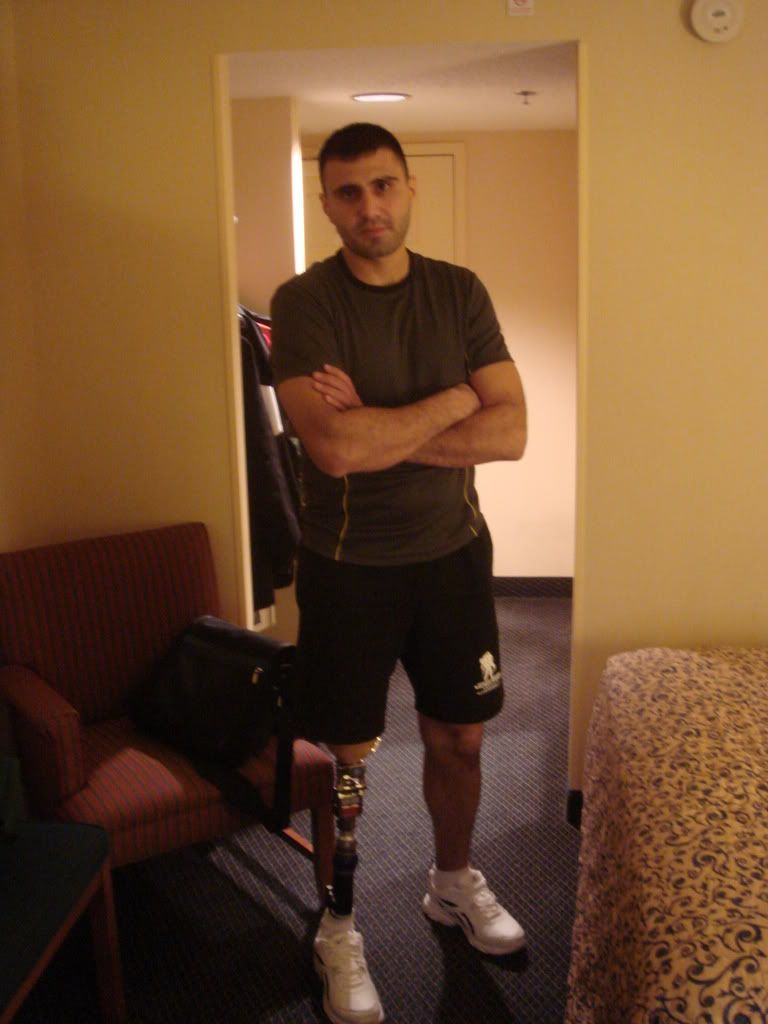
Sr. Lt. Nalbandian is very happy with the treatment at Walter Reed, where he is the only non-American servicemen that he knows of at this time. What about the recent scandal around Walter Reed?

“I didn’t personally sense any of that. I spent a week in the hospital ward for amputees – there were no problems and the care was excellent. I didn’t even see any evidence of recent repairs or anything. So, I don’t really know what the whole issue was about. I heard that one or two doctors were not doing their work and were disciplined. But that was before my arrival.

They are now fitting me with a new prosthetic. With the one I have now, I can walk quite well and even run. But I can’t walk up the stairs. The new prosthetic would give me more agility. They also said they would give me additional prosthetics for running, for swimming and also one as a replacement.

They are treating me as one of their own.”

There are Armenian doctors here at the hospital, one is a surgeon, another psychologist, Sr. Lt. Nalbandian said.

“They invited me over to their homes, including for Easter. Other local Armenians came to visit me and took me to the local Armenian Church the other week. So, I don’t have to stay in the room and watch TV on weekends. I use Skype to call my brother in Armenia – we talk almost every day.

And of course, the Embassy here, Ambassador Tatoul Markarian and Defense Attache Colonel Armen Sargsian met me as I arrived here, and they and others from the Embassy continue to visit and helping me out.”

And what will he do after the treatment?

“I want to go back into the service. I always tell everyone, what happened to me is nothing. Things are fine – I can walk, run, swim, drive a car. What’s the difference? I am a fully functioning person, it’s not like I am missing both legs.

I want to go back on active duty. If I see that I can’t handle the physical aspect of the service in the field, I’ll request a transfer to headquarters – there is enough work there too. There are plenty of combat officers in Armenia with prosthetics who serve both in the field and in the headquarters.”