Showing posts with label Russia-U.S.. Show all posts

Friday, April 10, 2009

Obama hears from Ankara, CIA on Caucasus, NRC on Armenia, Turkish President visits Moscow

This was first published in February 21, 2009 Armenian Reporter

Washington Briefing
by Emil Sanamyan

Obama hears about Armenia from Turkish leaders


President Barack Obama had "wide-ranging" phone discussions with Turkey's president and prime minister, the White House reported on February 16. President Obama initiated the calls to "emphasize his desire to strengthen U.S.-Turkish relations" and to discuss specific U.S. concerns related to its Middle East priorities.

According to Turkish media, President Abdullah Gül and Prime Minister Recep Tayyip Erdogan both raised Turkey's opposition to U.S. affirmation of the Armenian Genocide. During the election campaign, Mr. Obama pledged that as president, he would recognize the Armenian Genocide.

Turkish media claimed that in response Mr. Obama welcomed the recently intensified dialogue between Armenia and Turkey. According to Mr. Erdogan's office, Mr. Obama added that "America always understands Turkey's sensitivities."

The White House read out of the conversation made no mention of Armenian concerns and, as of press time, the White House had not responded to the Armenian Reporter's request for clarification.

Meanwhile, Mr. Erdogan again lashed out at Israel, questioning Prime Minister Ehud Olmert's credibility. His remarks came after the outgoing head of the Israeli government attempted to explain why, during a visit to Turkey just days before launching the Gaza operation, he did not tell Mr. Erdogan about Israel's military plans, Zaman newspaper reported on February 19.

National intelligence director notes Caucasus problems

"Fundamental differences between Azerbaijan and Armenia over Nagorno-Karabakh will keep tensions high in the Caucasus," National Intelligence Director Dennis Blair told the Senate Select Committee on Intelligence in testimony on February 12.

The testimony summarized recent developments around the standoff: "Azerbaijan fears isolation in the wake of Kosovo's independence, Russia's recognition of South Ossetia and Abkhazia, and signs of improved Armenian-Turkish relations. Armenia is concerned about Baku's military buildup and does not want to become dependent on Russia. Both countries face the dual challenges of overcoming inertia in democratic reforms and battling endemic corruption in the face of an economic downturn."

In the aftermath of the Georgia war, the U.S. intelligence community's "Eurasia/Caucasus/Central Asia" concerns occupied a full page of the total 44 pages of testimony.

Admiral Blair noted that despite its many problems, "the Russian military defeated the Georgian military last August." He also referred to Russia's persistent line that Georgia's and Ukraine's membership in NATO would put U.S.-Russia cooperation on international security issues in jeopardy.

In their recent comments, Obama administration officials have stepped back from the Bush administration's outright support for the two countries' NATO membership.

In a possibly related development, Russia this week indicated it would continue to hold up supplies of sophisticated air defense missile systems to Iran.

U.S. nuclear regulator ready to help Armenia

"We have had a good bilateral agreement with Armenia," sharing technology and training, chairperson of the U.S. Nuclear Regulatory Commission (NRC) Dale Klein told the Armenian Reporter on February 13.

Asked if the United States would continue to have a role in Armenia's efforts to replace its existing nuclear power plant with a new one in coming years, Mr. Klein said he and his counterparts in Armenia enjoyed a "very good relationship" and, "if asked for help, [the NRC] will try to help to the extent that [it] can."

The NRC oversees safety and security of U.S. plants and provides expertise around the world. An NRC commissioner, Peter Lyons, visited Armenia last year and the United States had funded a feasibility study looking at options for building a new reactor.

Mr. Klein noted that for the United States to take part in the Armenian nuclear energy sector, privately owned U.S. companies would have to be attracted to the project. In general, he said, it made sense for Armenia to have a "diversified portfolio" in terms of energy supplies.

In remarks at the Council on the Foreign Relations, Mr. Klein said that 50 new nuclear power plants were being built around the world, 21 of them in China and 12 in India.

In the United States, in addition to 104 functioning power plants, 17 applications for 26 more reactors are currently being considered by the NRC.

But there are concerns that fewer reactors may end up being built, considering the economic slowdown and the Obama administration's reservations about the long-term impact of nuclear waste.

Russia, Turkey tout friendly relations

Turkey's President Abdullah Gül visited with his Russian counterpart Dmitry Medvedev in the Kremlin on February 13, with the two presidents signing a joint declaration "on new stage of relations" and "deepening of friendship and wide-ranging cooperation," according to the Kremlin website. Mr. Gül made a four-day state visit to Russia between February 12 and 15.

The declaration, mirroring the document signed during then President Vladimir Putin's visit to Turkey in 2004, emphasized cooperation on energy and trade issues.

Russia is seeking to build four nuclear reactors in Turkey worth $20 billion and supply electricity to Turkey on a long-term basis, Russia's energy minister said the same day. Turkey already relies on Russia for natural-gas supplies, and overall bilateral trade topped $32 billion in 2008.

The document also briefly referred to the need to settle Caucasus conflicts. Last year, Turkey in effect backed Russia's military action against Georgia, although Ankara has declined to recognize Abkhazia or South Ossetia.

Tuesday, April 7, 2009

Obama, Islam, Turkey, Jews, Eurogas, etc.

This was first published in January 31, 2009 Armenian Reporter.

Washington Briefing
by Emil Sanamyan


Obama seeks dialogue with Iran, Muslim world

"As I said during my inauguration speech, if countries like Iran are willing to unclench their fist, they will find an extended hand from us," President Barack Obama said in his first White House interview, granted to Saudi-owned Al-Arabiya television on January 27.

In response, President Mahmoud Ahmadinejad said Iran would "welcome" a change in U.S. policy. But, as BBC News reported, that statement came after the Iranian president, who is facing re-election this June, issued a tirade of grievances against the United States.

Earlier, in an unusual gesture, Mr. Ahmadinejad sent a letter congratulating Mr. Obama on his election. The White House is reported to be currently drafting a letter to Iran. According to the Daily Telegraph "diplomatic drafts [of the letter] give assurances that Washington does not want to overthrow the Islamic regime, but merely seek a change in its behavior."

In the interview this week, Mr. Obama stressed the importance of dialogue. "It [is] important for us to be willing to talk to Iran, to express very clearly where our differences are, but where there are potential avenues for progress," he said.

By contrast, the former president, George W. Bush, refused to talk to Iran and pushed for tougher sanctions over Iran's enrichment of uranium.

In October 2007, both President Bush and Vice President Dick Cheney issued dire warnings. Mr. Cheney said that the United States "will not allow" Iran to have a nuclear weapon, while Mr. Bush spoke of possible "World War III" should Iran acquire a nuclear weapon.

But in December 2007, a U.S. intelligence assessment determined that Iran suspended its nuclear weapons program in 2003. Although members of the U.S. and Israeli political establishments disagreed with the assessment, the Bush Administration began to tone down its Iran rhetoric.

Notwithstanding the Obama administration's emphasis on dialogue, Secretary of State Hillary Clinton hinted recently that a military option remains on the table. In her January 13 Senate testimony, she said the new administration was "not taking any option off the table at all . . . to try to prevent" Iran from acquiring nuclear weapons.

(As a candidate for the Democratic presidential nomination, Mrs. Clinton had threatened to "obliterate" Iran if it used nuclear weapons against Israel and had criticized her ultimately victorious rival's readiness to talk to Iran without preconditions.)

Mr. Obama, while reiterating the importance of Israel's security to the United States, said he wanted to convince the Muslims "that Americans are not your enemy."

Among steps designed to reach that goal, the Obama Administration is closing the Guantánamo Bay detention center, making preparations for pulling out of Iraq, and pledging a renewed focus on settling the Israeli-Palestinian conflict in the wake of Israel's devastating attack on Gaza.

U.S. envoy George Mitchell will be visiting Israel, Jordan, Saudi Arabia, and Turkey. The Turkish media noted that the visit will be the first high-level U.S.-Turkish contact since the new president's inauguration.

Separately, Turkish Prime Minister Recep Tayyip Erdogan sent a message to the president inviting to him to attend the summit dubbed the Alliance of Civilizations planned for April 6-7 in Istanbul.

That initiative was first launched by Turkey and Spain under the United Nations umbrella in 2007. Its first forum in January 2008 did not include U.S. officials.

World optimistic about Obama presidency

A majority of more than 17,000 respondents queried in 17 countries around the world believe that their nations will enjoy better ties with the United States under President Barack Obama, according to a BBC World Service study released on January 20.

Fifty-one percent of Turks and 47 percent of Russians - groups that have in recent years been especially suspicious of U.S. intentions - were optimistic about positive change under President Obama.

Respondents were also asked about what they thought should be the top priority of the new U.S. administration, with most identifying "dealing with global financial crisis." See www.worldpublicopinion.org.

Jewish Americans “gravely distressed” with Turkey

Leaders of five Jewish-American organizations expressed profound concern over what they described as "the current wave of anti-Semitic manifestations in Turkey."

In a January 21 letter addressed to Turkish Prime Minister Recep Tayyip Erdogan and made available to the Armenian Reporter, the letter's co-signers said their "Jewish friends in Turkey feel besieged and threatened" and called on Turkey to address "these disturbing developments."

They also disagreed with Turkey's harsh criticism of Israel's recent campaign in Gaza.

Mr. Erdogan called the Israeli operation a "crime against humanity" and an "evil" deed and went so far as to suggest that Israel should be barred from the United Nations. There have been numerous public demonstrations in Turkey in solidarity with Gaza.

On January 29, Mr. Erdogan joined Israel's President Shimon Peres at the Global Economic Forum in Switzerland and accused Israel of "barbarism" in Gaza, BBC News reported. The Turkish premier left the panel after the moderator, David Ignatius of the Washington Post, tried to cut off his microphone.

"We're not convinced that Turkey has earned the right to lecture Israelis about human rights," the Jerusalem Post had written in an editorial on January 5, citing Turkey's decades-long campaign against Kurdish rebels that has left tens of thousands of people dead.

The five co-signers of the letter are senior executives from the American Jewish Committee, the Anti-Defamation League (ADL), B'nai B'rith International, Conference of Presidents of Major Jewish American Organizations, and Jewish Institute for National Security Affairs.

The organizations have in the past supported Turkey's agenda in Washington, including opposition to congressional resolutions on the Armenian Genocide. But following recent exchanges, Turkish daily Milliyet cited Jewish-American leaders as saying they are not inclined do so any more.

U.S. study: China, India, Russia to dominate headlines in next decade

U.S. global influence will diminish and that of China and India will increase in the next decade and half, according to a study prepared by the National Intelligence Council, an in-house think tank of the U.S. intelligence community.

Predictions made in the report, "Global Trends 2025: A Transformed World," released last November, see the world moving away from post-Cold War dominance by the United States to what political scientists have described as a multipolar or nonpolar world.

The report also underscores importance of Russia and Iran as major exporters of fossil energy, particularly natural gas, and in case of Russia also coal.

While none of the Caucasus states was mentioned individually, the Caucasus region was mentioned four times (three times as a source of conflicts and once as an energy corridor) and Caspian energy was mentioned twice.

Below is a table showing the number of times sixteen select countries are mentioned in the report, along with size of their economies.

Country Number of mentions 2007 GDP (in bn. USD)

China 190 3280

India 138 1100

Russia 138 1290

Iran 84 285

Japan 57 4381

Pakistan 25 144

Afghanistan 22 10

Iraq 20 55

Korea (N. & S.) 20 1000+

Israel 15 164

Turkey 15 659

Saudi Arabia 8 382

United Kingdom 6 2804

Germany 6 3320

France 4 2594

Ukraine 4 142

See report at http://www.dni.gov/nic/PDF_2025/2025_Global_Trends_Final_Report.pdf

European Union promises funding for Russia gas bypass

The European Commission has proposed $330 million in initial funding for what is known as the Nabucco gas pipeline. The proposal unveiled at a European Union (EU) conference held in Hungary on January 28 would need member-states' approval to go ahead. It comes shortly after the Russian-Ukrainian spat over gas supplies that left several Balkan countries without heating earlier this month.

In theory, the Nabucco pipeline would bring natural gas from Central Asia to Turkey and then on to Europe, substantially eroding Russia's current dominance in Europe's natural gas market. (The pipeline's unusual name is short for Nebuchadnezzar, the Babylonian king who according to the Old Testament freed the Jews and rebuilt their temple; there is also an opera of the same name.)

The pipeline, with an estimated price tag of more than $10 billion, has been slow to take off since it is still unclear where the gas would come from.

The United States and some of its European allies legally restrict energy cooperation with Iran, which is the second-largest gas producer after Russia and is the only real alternative.

Turkmenistan and Azerbaijan, which have signed off as the only suppliers so far, are unlikely to be able to supply the needed 30 billion cubic meters of gas a year; Iraq and Egypt have also been courted as potential suppliers.

At the same time, Germany and Turkey and others are supporting the North and South stream pipelines that would bring Russian gas to them via the Baltic and Black Seas, respectively.

Officials seeking to reduce Europe's reliance on Russia have called the twin pipelines a "direct threat to Nabucco project," according to RFE/RL.

Russia expands Georgia sanctions

Russian government could slap sanctions on countries and companies supplying the Georgian military, according to President Dmitry Medvedev's executive order issued on January 19.

The order "On measures banning supplies of military and dual use technology to Georgia" threatens curtailment of military cooperation between Russia and countries providing Georgia with military support and would be in effect through the end of 2011.

Prior to the war in South Ossetia last August, Ukraine, Israel, Turkey, and the United States were the largest suppliers of weapons systems to Georgia. Israel reportedly halted military cooperation with Georgia shortly before the war.

In Turkey: Dink murder trial, apology petition, and curriculum changes

The trial of the accused assassins of Turkish-Armenian journalist Hrant Dink rambled on in Istanbul this week, as his friends marked the second anniversary of his death.

The Paris-based Reporters without Borders issued a statement on January 28 urging the court to keep trial proceedings "dignified," noting that one of the accused and his lawyer had repeatedly used ethnic slurs against the late Mr. Dink and his family members in attendance.

The Economist meanwhile reported that prosecutors were probing a connection between the Dink murder and the so-called Ergenekon case of alleged coup plotters. Dozens more arrests were made in the Ergenekon case on January 22.

Prosecutors refused to file "insulting Turkishness" charges against intellectuals who initiated a public apology to Armenians over the Turkey's "insensitivity" to the memory of the "Great Catastrophe," The Associated Press reported on January 26.

More than 28,000 individuals signed on to the online petition launched last December on a web site, www.ozurdiliyoruz.com, which repeatedly has been hacked, presumably by its opponents. Meanwhile, a rival site "I do not apologize" popped up and claimed the support of more than 65,000 Turks.

A state entity known as "Coordination Board to Fight Baseless Genocide Claims" decided to amend the Turkish school curriculum to remove terms like "baseless" and "so-called Armenian genocide" from eighth-grade textbooks. (The board's own name was not reported to have been changed.)

According to the newspaper Milliyet, Turkish children will now study "Turkish-Armenian relations, 1915 events, and related Armenian allegations."

Similarly in July 2007, the Turkish government reportedly instructed state officials not to refer to the term "so called Armenian genocide allegations," UlulasKanal.com reported at the time. The recommended usage was "1915 incidents" or "Armenian allegations regarding incidents in 1915," shifting official rhetoric from straightforward denial to a more ambiguous wording.

Sunday, December 21, 2008

Iraq coalition; Erdogan, Medvedev in DC; EU restores Russia ties

First published in November 15, 2008 Armenian Reporter.

Washington Briefing
by Emil Sanamyan

U.S.-led coalition members pull troops out of Iraq


Multi-National Force-Iraq insignia.The 7-pointed star represents Iraq's largest communities- Sunnis, Shias, Kurds, Turkomans, Assyrians, Yazidis, and Armenians. Source U.S. Dept. of Defense.

With the twilight of the George W. Bush administration and with President-elect Barack Obama having pledged a gradual withdrawal of U.S. forces from Iraq within 16 months of taking office, most of the remaining members of the so-called Coalition of the Willing are no longer willing to stay in Iraq.

Since 2003 the coalition had included troops from the three former Soviet republics in the Caucasus, as well as Kazakhstan, Moldova, Ukraine, and the three Baltic states - Estonia, Latvia and Lithuania, which are now members of NATO. Most of these troops have already withdrawn, with 37 Estonians and 20 Moldovans due out by the end of the year.

Azerbaijan became the latest former Soviet republic to announce a pullout, with its president issuing instructions to that effect shortly after the U.S. election. Initially at 150, the Azerbaijani unit currently ­numbers 88 personnel that have served as security guards at a hydroelectric plant.

Although Azerbaijani forces were not reported to have taken part in operations outside the dam perimeter, they did suffer at least one soldier killed last June in apparent fratricide.

Armenia pulled its 46-person unit from near the town of Kut, on the Iraqi-Iranian border, last month. The pullout was timed to the withdrawal of the Polish forces, under whose command Armenians served.

(Poland participated in the 2003 invasion of Iraq and in five years Polish forces lost 21 soldiers, with 70 others wounded, according to U.S. military records cited by AFP.)

The Armenian unit was involved in demining, medical rescue, and logistics operations, suffering one officer seriously wounded in combat. That officer, Sr. Lt. Georgi Nalbandian, has since recovered and returned to active duty with the Armenian armed forces.

Georgia, which earlier this year increased its presence in Iraq to nearly 2,000 soldiers, pulled most of them out during the war with Russia in August with the remainder returning home since then.

Georgians had served in Baghdad and northern Iraq and were due to take over the Polish-led division before their deployment was cut short. Through June 2008, five Georgian soldiers died (three from hostile action, one in an accident, and one in an apparent suicide) and 18 others were wounded.

Ukraine, which in 2003 deployed more than 1,600 of its soldiers in Iraq, pulled out in 2005 after losing 18 soldiers in various incidents. Several dozen Ukrainian officers remain in Iraq as part of NATO advisory mission to the Iraqi government.

And finally Kazakhstan, another former Soviet republic, also withdrew its 29-person unit of de­miners and medics last month.

Kazakhstan, like Armenia, is a member of the Collective Security Treaty Organization led by Russia, which openly opposed the U.S. invasion of Iraq.

But subsequently, Russia dropped objections to U.S. military presence in Iraq. Foreign Minister Sergei Lavrov said this week that Russia would support a renewed United Nations mandate for the American military presence in Iraq.

The current five-year mandate is about to expire and the Bush administration is now negotiating a status of forces agreement with the Iraqi government that would keep U.S. forces in the country via bilateral agreement.

World leaders to gather in Washington for economic summit

Russia's President Dmitry Medvedev and Turkey's Prime Minister Recep Tayyib Erdogan will be among heads of state and government and senior officials from the world's 20 biggest economies who are arriving in Washington on November 14 for a summit called by President Bush.

The summit was called with a stated intention of addressing the global financial crisis, but for some visiting foreign leaders this would also be the first opportunity to meet with key aides of U.S. President-elect Barack Obama. Mr. Obama said he would not attend the summit and would not be meeting with any of the summit participants, according to the Washington Post.

Mr. Erdogan reportedly sought a meeting with Mr. Obama to offer mediation between the United States and Iran, while also urging him not to change the U.S. policy on the Armenian Genocide. According to Hurriyet, it is unclear if Mr. Erdogan would agree to meet with Mr. Obama's advisors.

According to Referans, Mr. Erdogan also wants to meet with the chair of U.S. Federal Reserve to ask for U.S. financial aid on more preferential terms than are offered by the International Monetary Fund.

The summit will be the first opportunity for a meeting between U.S. and Russian leaders since the war in Georgia last August. Mr. Medvedev told Le Figaro that he already had a "very good conversation" with President-elect Obama, RIA Novosti reported on November 13, and they would "meet will meet without delay and obstruction," although apparently not this week.

Europeans resume talks with Russia over Georgian objections

The European Union (EU) will resume talks with Russia on a "strategic partnership" agreement, which it suspended on September 1 as a punishment for Russian military operations in Georgia.

French President Nicolas Sarkozy, who holds the rotating EU chair and had negotiated the Russian-Georgian cease-fire, announced the decision on November 11. Poland and Lithuania expressed public opposition to the decision.

Georgian officials protested and EU officials acknowledged that Russian forces had not returned to positions they held before the Georgian attack against South Ossetia on August 7-8, saying that the EU's talks with Russia in "no way legitimize the status quo in Georgia," with the EU continuing to protest Russian recognition of Abkhazia and South Ossetia, which broke away from Georgia in early 1990s.

But in an interview with Le Figaro, Russian President Dmitry Medvedev said his country's decisions "are no joking matters" and could not be revised. Mr. Medvedev added that future Russian military presence in both Abkhazia and South Ossetia would be regulated on a bilateral basis.

Speaking at the Brookings Institution in Washington on November 12, Foreign Minister Bernard Kouchner of France said Russia represented a "challenge" to the West, but he added that "there is no solution to most of today's [global] problems without [Russia], let alone against [Russia]."?

Friday, September 26, 2008

Russia, West in stare-down over Caucasus

First published in August 30, 2008 Armenian Reporter.

Russia, West mull options in stare-down over Caucasus
Citing Kosovo, Moscow recognizes Abkhaz, Ossetian independence
by Emil Sanamyan

Russian navy cruiser Moskva (seen in earlier photo) dropped anchor in Abkhazia this week.

WASHINGTON
– Moscow on August 26 recognized the independence of Republics of Abkhazia and South Ossetia, which broke away from Georgia’s rule in the early 1990s.

The bold move came just two weeks after the end of Russia’s military campaign in Georgia in defense of the two republics. It aroused a new round of condemnation from the United States and most Western states.

But it remained unclear what exactly Georgia’s Western backers could do to enhance that state’s security without undermining their own priorities.

Most observers suggested that U.S. efforts to contain Iran and continue operations in Afghanistan may immediately suffer from a cool-down in relations with Russia.

Moscow has also threatened to reciprocate with an embargo on American goods should there be any U.S. sanctions. (Both General Motors and Ford now have plants in Russia.)

For major European powers like Germany and Italy, Russian energy supplies clearly take priority over Georgia.

So far, U.S. officials have employed tough rhetoric, with some arguing that the United States should help re-arm the decimated Georgian military.

Vice President Dick Cheney will be touring Azerbaijan, Georgia, and Ukraine during the first week of September in a visit apparently intended to shore
up shaken U.S. influence. His visit will almost certainly feature more harsh talk.

The steady stream of U.S. visitors has in recent weeks included the wife of Republican presidential hopeful Sen. John McCain and three U.S. senators, including Foreign Relations Committee Chair Sen. Joe Biden, who this week became the Democratic Party’s nominee for vice president of the United States.

In addition, two U.S. vessels arrived in the Black Sea for an earlier scheduled exercise and delivered humanitarian aid to Georgia in a show of mostly symbolic support.

Turkey’s refusal to allow larger U.S. vessels into the Black Sea prevented a more impressive show of symbolism.

Meantime, the flagship of Russia’s Black Sea fleet arrived in Abkhazia, where Russia will soon be establishing a permanent base. Russians have also promised to raise their naval presence in the Mediterranean Sea.

U.S. Coast Guard cutter Dallas (seen in earlier photo) reached the coast of Georgia this week.

Diplomatic maneuvers

President Dmitry Medvedev of Russia said his nation was “not afraid of anything, including the prospect of a Cold War,” although adding that Russia would prefer to avoid one.

Mr. Medvedev also recalled the United States’ unilateral recognition of Kosovo earlier this year and argued that the recognition of Abkhazia and South Ossetia was the only sure way to safeguard peoples’ lives there.

Russia’s ambassador to the United Nations, Vitaly Churkin, suggested that Russia decided to take the step to recognize the two republics after France – apparently under insistent U.S. pressure – withdrew references to future talks on the status of Abkhazia and South Ossetia from a draft United Nations Security Council resolution, in effect supporting Georgia’s claims on the two republics.

“So, they were the ones who immediately started walking away from this diplomatic opportunity,” forcing Russia to take the “Kosovo route,” the Russian diplomat suggested.

Kosovo, however, has been recognized by 40 countries worldwide, including three of the five permanent members of the UN Security Council. No such support for Russian recognition is currently anticipated.

In fact, as Armenian expert Aleksandr Iskandarian pointed out this week, Russia’s move is more akin to Ankara’s recognition of the Turkish Republic of Northern Cyprus rather than the U.S.–initiated recognition of Kosovo, which was a long drawn-out process.

The only exceptions, in terms of open support for Russia’s position in Georgia, may come from states closely tied to Russia, such as Belarus and Tajikistan, or openly hostile to the United States, such as Cuba, Iran, Syria, and Venezuela.

Eurasian fence-sitting

A majority of Eurasian states, including the fifth permanent member of the Security Council, China, and two regional powers bordering on the Caucasus – Iran and Turkey – have taken a neutral position on the conflict.

Following a meeting between Russian and Chinese leaders at a regional summit in Central Asia, China issued a statement on August 27 that referred to “the complicated history and reality of the South Ossetia and Abkhazia issues” calling for resolution of issues through “dialogue and consultation.”

Importantly, the statement did not refer to anyone’s territorial integrity – something that for China remains the cornerstone of its foreign policy. Chinese leaders may have also taken personally the fact that Georgia launched its attack on South Ossetia on the day of opening of the Olympic Games in Beijing.

Turkey, a NATO member that recognized Kosovo, has not criticized Russia’s actions in Georgia and appeared to welcome signs of a decline of U.S. influence in the Caucasus.

Iran and Israel, both keen on courting Russia, have taken similar positions calling for a peaceful settlement without concrete assessments of the conflict.

On September 1, European Union states will meet in Paris for an emergency session on relations with Russia, but as Moreau Defarges of the French Institute for International Relations (IFRI) suggests, EU members will prioritize a unified message of criticism along with continued dialogue with Russia rather than any concrete sanctions.

“The West is not going to go to war for Georgia,” Mr. Defarges asserted to Radio Liberty.

Georgian leader Mikhail Saakashvili who was expected to attend the European summit no longer plans to; although he explained his decision with reference to a fear that he might somehow be prevented from returning to Georgia.

Chronology: Georgian-Ossetian conflict

First published in August 23, 2008 Armenian Reporter and since slightly updated.

Chronology: Georgian-Ossetian conflict

Early history

(1918–21)


As the Czarist Empire collapses, Ossetians – who are ethnic cousins of Persians and are mostly Orthodox Christians – rise up against Georgian rule. Thousands are killed in clashes before Georgia is occupied by the Red Army in 1921.

1920s–80s

Most majority-Ossetian areas south of the Greater Caucasus Mountains become the South Ossetian Autonomous Oblast (Province) within Soviet Georgia. Dissent, including
ethnic grievances, are kept tightly in check.

1990–92

As Soviet Union collapses, Ossetians demand greater rights. Georgia’s newly elected nationalist leadership of Zviad Gamsakhurdia instead abolishes the autonomy altogether and sends armed Georgian units into the South Ossetian capital of Tskhinvali, resulting in atrocities. Georgian forces are eventually forced out of Tskhinvali and Georgia agrees to a Russian-mediated cease-fire, acquiescing to de-facto loss of control over much of South Ossetia.

1992–2004

With the cease-fire patrolled by a small Russian peacekeeping contingent and the Georgian government bankrupt, relative normalcy returns to Ossetian-Georgian relations.

In the mid-1990s, Georgian president Eduard Shevardnadze meets his South Ossetian counterpart and negotiates a partial return of refugees. Ethnic Ossetians return to live and work in Georgian towns and Georgians return to live and work Tskhinvali. A large black market springs up at a Georgian village near Tskhinvali.

2004–2008

Mikhail Saakashvili is elected president of Georgia after overthrowing Mr. Shevardnadze through street protests and pledges to return control over South Ossetia and another breakaway former Georgian autonomy, Abkhazia.

With help from the U.S. and Europe, Mr. Saakashvili begins to build up the Georgian army – with the country’s military budget reaching $1 billion in 2007 – and increases pressure on both Abkhazia and South Ossetia, including fighting around Tskhinvali in summer 2004 involving mortars that claimed dozens of lives.

At the same time, Georgia seeks Western support and makes joining NATO one of its major foreign policy goals and provides one of the largest contingents in support of U.S. forces in Iraq.

Meanwhile, Russia raises its profile in the long-neglected breakaway republics, extending Russian citizenship to their residents, and serving as their only conduit to the outside world. Russian leaders say they view NATO expansion into Georgia and, another former Soviet republic, Ukraine, as a hostile act.

Through spring 2008, a number of incidents take place in Abkhazia, where Georgia launched unmanned spy planes, which Abkhaz begin to shoot down with Russian help.

By summer 2008, Georgia switches its attention back to South Ossetia.

Run-up to war

June 14 – For the first time in four years, Georgian forces launch mortar fire on Tskhinvali. One person is killed and several are wounded. Russian and European mediators are unable to determine who was to blame for the incident.

June 24 – The Georgian parliament approves the government’s decision to reverse an earlier military spending cut and increases its military budget back to near the
2007 level of about $1 billion.

July 3–4 – More bombings and exchanges of fire occur, including with the use of mortars and grenade launchers, with several more people reported killed in and around Tskhinvali. The sides blame each other. Georgians force Russian peacekeepers from one of the heights near Tskhinvali. Ossetians lambast Russian peacekeepers for failing to maintain peace and begin to mobilize forces and establish defense fortifications.

July 9 – Russia acknowledges its combat plane flew over Georgia, as U.S. Secretary of State Condoleezza Rice visits Tbilisi and tells Georgians that the United States “always fights for [its] friends.”

August 1–2 – More Georgian mortar shelling of Tskhinvali leaves 6 dead and 21 wounded; the Georgian government member in charge of South Ossetia / Abkhazia policy
arrives in Tskhinvali on August 2 for a meeting with South Ossetian leader Eduard Kokoity. Following that meeting, Ossetians begin largescale evacuation of women and children from Tskhinvali to Russia.

August 7 – Georgia’s artillery, including large-caliber howitzers and multiple-launch rocket systems, begin to take combat positions around Tskhinvali. After intense shelling throughout the day, Mr. Saakashvili in an evening televised addresses promises to cease fire as Georgian armored and mechanized units begin to move towards South Ossetia.

How the “4-day” Ossetian war unfolded
Some of the main developments


Friday, August 8

00:00 – Shortly before midnight Georgia’s Gen. Mamuka Kurashvili calls commander of 500 Russian peacekeepers in South Ossetia Gen. Marat Kulahmetov to tell him that Tbilisi is about to begin an operation to “restore constitutional order” in South Ossetia and urges his forces to stay out of fighting.

At this time, Georgian artillery opens massive fire on the town of Tskhinvali and other areas of South Ossetia; howitzers acquired in Ukraine and Czech Repubic, and Lar-160Multiple-Launch Rocket Systems made in Israel continue shelling Tskhinvali through the morning.


01:00 – Georgian forces advance north of Tskhinvali through South Ossetia’s ethnic Georgian enclaves in an effort to interdict the Roki tunnel – the area’s only land connection with Russia. The move is anticipated by Ossetians, who deploy the bulk of their force to protect the Roki tunnel and adjacent Java district, leaving their capital of Tskhinvali sparsely defended.

[By August 9–10 this Georgian force was surrounded and largely destroyed by Russian and Ossetian forces; days later Georgian leaders admitted they were “too late” in reaching the Roki tunnel and that they underestimated Ossetian and Russian deployments in that area.]

02:00 – Georgian police spokesperson tells journalists that “Georgian [ground] attack is underway, clashes are taking place outside Tskhinvali”; Ossetians confirm engaging Georgian forces, who are using dozens of tanks and armored vehicles supplied by Ukraine and Turkey and equipped with nightvision equipment supplied by the U.S., Israel, and Ukraine. The Georgians begin to overwhelm a smaller and lightly armed Ossetian self-defense.

02:30 – Assistant Secretary of State Dan Fried tells journalists in Washington: “We’re urging the Georgians to exercise restraint, but it seems the South Ossetians are the provocative party.” Mr. Fried adds that he sees no Russian involvement so far.

03:15 – In televised remarks, the Georgian government’s main war spokesperson Timur Yakobashvili urges Ossetians to surrender: “Tskhinvali is surrounded…. Illegal armed formations need to surrender.” He reports that Georgian forces have taken five Ossetian villages.

03:30 – The Ossetian leadership appeals for immediate Russian military help. Around this time, first Russian forces begin to enter South Ossetia through the Roki tunnel and build up near Java. By mid-day August 8, there were up to 2,000 Russian mechanized infantry on the ground in support of several thousand Ossetian self-defense who were facing up to 10,000 Georgian forces.

05:00 – Russia calls for an emergency United Nations Security Council meeting to protest Georgia’s actions, which Russia’s Foreign Ministry calls a “massive and treacherous attack.” The council convenes by 07:00 (11 p.m. eST), but amid disagreements between Russia and the U.S., the Security Council remains deadlocked and after days of arguments takes no position on the conflict.

06:00 – Georgian forces enter the Tskhinvali town center, after bypassing Russian peacekeeping forces. Georgia’s Israeli-upgraded aircraft attacks targets in South Ossetia, including in and near Java.

10:00 – Shortly after attending the opening of the Olympic Games in Beijing, Russia’s Prime Minister Vladimir Putin tells media that Georgia’s actions “will have a response.” At about the same time, the first Russian bombing raid is reported on Georgian military targets around Gori and Kareli just south
of Tskhinvali; Russian helicopters and aircraft begin to attack Georgian forces in South Ossetia.

Ossetian leader Eduard Kokoity and security detail in Java.

13:00 – The Russian Defense Ministry in a statement pledges to “protect Russian citizens” in South Ossetia. Soon after, Russia launches tactical missile strikes against Georgian army command and control center near Borjomi, as well as military targets in Gori and Black Sea port of Poti.

15:00 – A Russian tank and artillery unit breaks through a Georgian enclave and arrives north of Tskhinvali. By then Georgians claim to control “70 percent” of the town and call for a cease-fire. About the same time NATO Secretary General also calls for cease-fire.

15:10 – At a press conference in the Kremlin, Russian President Dmitry Medvedev declares that “those who attack Russian citizens [in South Ossetia] will be punished. Russian officials soon brand their military action a “peace-enforcement operation” in Georgia and add that Georgia’s “territorial integrity has suffered a mortal blow,” as far as Tbilisi’s claims on South Ossetia and Abkhazia are concerned.

Georgian forces near Tskhinval. The jeep shown was later captured by an ethnic Chechen unit of the Russian army (see below).

16:00 – Russian artillery fires on Georgian forces in Tskhinvali center forcing them to retreat. The Russian Air Force attacks military targets across Georgia. Georgian President Mikheil Saakashvili appears on CNN, denies he launched the war, and calls for U.S. help against Russian attacks.

21:00 – Mr. Saakashvili tells Georgians that their army scored a “complete victory” in South Ossetia, while losing “30” service members; Russian TV channels that report continued fighting across South Ossetia and accuse Georgia of an attempted genocide against Ossetians, are taken off the air in Georgia.

Saturday, August 9

Overnight and throughout the day fighting and shelling takes place throughout South Ossetia, with the Russian army engaging and pushing back Georgian forces north of Tskhinvali and the Russian Air Force attacking military targets from the Black Sea to suburbs of Tbilisi.

Georgia's Czech-made Dana howitzers near Tskhinvali on August 9.

Georgian efforts to push through Tskhinvali to relieve Georgian units surrounded in Tamarasheni-Kurta enclave in the north are stalled by Ossetian forces. U.S. aircraft begin to airlift some 1,800 Georgian soldiers deployed in Iraq back to Tbilisi airport.

Later in the day, Georgians shell a Russian army column as it enters Tskhinvali, wounding the Russian commanding officer, Gen. Anatoly Khrulev, along with several Russian journalists, and destroying two Russian tanks and several armored vehicles.

Russia also confirms losing two aircraft that day, with two more lost in subsequent days, including one reportedly to “friendly fire.”

Georgia is believed to have lost most of its fleet of 12 combat aircraft.

19:00 – Mr. Saakashvili says in a televised address that the Georgian military is “sweeping out gangs, who have re-infiltrated in the north of Tskhinvali” and calls for a cease-fire with Russia. Shortly after, police spokesperson Shota Utiashvili claims that Georgians retain control of Tskhinvali and that Java and the Roki tunnel were the Georgian army’s “next target.”

Sunday, August 10

Overnight, Georgian forces begin to pull out of Tskhinvali. The Russian Air Force continues to bomb military targets throughout Georgia, including a military facility near Tbilisi airport, which causes panic and suspension of all flights into Tbilisi. Foreigners in Tbilisi begin to flee to Yerevan to take flights out. Russia begins naval blockade of Georgia and sinks a Georgian patrol boat.

10:00 – Georgia’s president’s national security advisor Kakha Lomaia says that Georgian forces are “regrouping” south of Tskhinvali. Throughout the day Ossetian and Russian units, including the special forces’ Vostok battalion comprised of ethnic Chechens, clear remaining Georgian units out of Tskhinvali.


In the evening, the Russian Air Force continues to attack targets around Georgia. Russian and Abkhaz forces begin to bombard Georgian positions in Abkhazia’s Kodori gorge.

Monday, August 11

Overnight, the Russian Air Force continues bombing raids across Georgia, including one 5 km from downtown Tbilisi. In the morning, Georgian artillery and, reportedly, one surviving aircraft fire on Tskhinvali.


In late morning, Mr. Saakashvili and visiting French Foreign Minister Bernard Kouchner arrive in the town of Gori, just south of Tskhinvali, to observe collateral damage sustained from Russian attacks on military targets in the town. Just after Mr. Kouchner departs from Gori, Mr. Saakashvili observes an aircraft in the sky and is shown to be running away and then hurriedly whisked away by security guards in a car convoy.

In the afternoon, Russian and Ossetian forces move out of Tskhinvali and begin to reclaim Ossetian villages to the west of town and capture Georgian positions north, east, and south of Tskhinvali.

Destruction in Tskhinval.

Meanwhile, Russian forces from Abkhazia are accompanied by Georgian police as they begin to destroy military bases in Western Georgia, citing violations of the Abkhazia peace agreements.

Czech-made howitzers abandoned by Georgian army (Aug. 12 photo by Artem Drabkin)

17:00 – British journalists on the Gori-to-Tbilisi road observe the Georgian army retreating in panic toward the capital, leaving behind dozens of tanks, artillery, and other military equipment along with civilians. It is unclear what caused the panic, as Russian forces had not yet approached Gori.

Georgian soldiers fleeing Gori.

Later in the evening, Georgian media cites Mr. Saakashvili as claiming that “Russian tanks have taken positions on approaches to Tbilisi”; the Georgian president goes on CNN to declare that Russian tanks are “surrounding” Tbilisi and “we are ready to defend Tbilisi to the last drop of blood.”

Minutes later, Mr. Saakashvili acknowledges that tanks observed near Tbilisi were those of the retreating Georgian army and not of the Russian army. He promises Tbilisi residents a “12-hour warning” before Russian forces come; this causes panic in Tbilisi. Russians deny they intend to enter Tbilisi.

In late evening and subsequent days, Russian forces begin to come into Gori and other Georgian towns without resistance to take over abandoned military equipment and
destroy military bases. Russians also sink the Georgian navy in the port of Poti and force a Georgian retreat from Abkhazia’s Kodori gorge.

Russian soldiers taking a break near Gori.

At the same time, all sides agree to a cease-fire that necessitates a Russian pullout in exchange for the creation of a “security zone” around South Ossetia and international discussions of South Ossetia’s and Abkhazia’s status. Russia promises to pull out from Georgian into the “security zone” by August 22.

Casualties

As of August 19, the Georgian government has confirmed 146 military and 69 civilian deaths, as well as 1,199 military and 270 civilians wounded; 70 persons are reported “missing.” The death toll is expected to rise, since the Georgian army suffered a bulk of casualties in an area now outside its control.

As of August 20, Ossetian officials have confirmed the death of 133 of their residents, both civilians and self-defense fighters. The death toll is expected to rise, but few expect it to reach "more than 2,000 dead” claimed by Ossetian officials at the height of fighting.

Russian forces have confirmed 64 servicem members killed and 323 wounded.

— Compiled by Emil Sanamyan from media sources. All times shown are local Moscow-Ossetia-Georgia time which is eight hours ahead of EST.

Tuesday, July 22, 2008

Briefly: Minsk Group in a new proposal, U.S. & Russia clash on security & elections, Rep. Hyde dies, Armenia tops neighbors in Human Development


This was originally published in December 1, 2007 Armenian Reporter.
by Emil Sanamyan

U.S., Russia, and France offer “joint proposal” on basic principles of Karabakh settlement
On November 29, the three countries that have for over a decade jointly led the international efforts to address the Armenian-Azerbaijani conflict made what amounts to a new proposal on its settlement.

The office of the State Department spokesperson in Washington reported on the same day that during the annual ministerial meeting of the Organization for Security and Cooperation in Europe (OSCE) held this week in Madrid, U.S. Undersecretary of State Nick Burns along with the Russian and French foreign ministers met foreign ministers from Armenia and Azerbaijan “to demonstrate political-level support for the OSCE Minsk Group Co-Chair countries’ effort to forge a just and lasting settlement of the Nagorno-Karabakh conflict.”

In that meeting, the three co-chairs transmitted a “joint proposal” that “offered just and constructive solutions” to address the existing disagreements over basic principles of settlement of the Karabakh conflict.

The Armenian and Azerbaijani governments with the help of the co-chairs have been engaged in what has been termed as the Prague process for the past three years, but have not fully agreed on basic principles of settlement that would precede a development of the full-scale peace agreement.

The most recent proposal is the fifth settlement option proposed by international mediators since 1996. The three proposals made up to 1998 sought to put Karabakh inside Azerbaijani borders or did not address its status. The two latest proposals focused on ways to formalize Karabakh’s 1991 secession.

Speaking in Madrid, Foreign Minister Vartan Oskanian broadly welcomed the proposal “as a working document that can serve as the basis for a preliminary agreement.” He said that the “document addresses the core issue – the security of the people of Nagorno-Karabakh, through self-determination.”

But Mr. Oskanian also noted the continued efforts by Azerbaijan to undermine the peace process, most recently by obstructing OSCE’s monthly monitoring of the ceasefire along the Line of Contact.

Azerbaijan’s reaction to the proposal was not immediately available.

U.S., Russia clash on security policies, elections
Talks between Secretary of State Condoleezza Rice and visiting Russian Foreign Minister Sergei Lavrov here this week again highlighted the long list of disagreements between the two countries. Mr. Lavrov was in the U.S. to participate in the Middle East peace conference held in Annapolis, MD.

In addition to now long-standing Russian opposition to a new U.S. missile defense system in central Europe, as well as tougher sanctions against Iran and support for Kosovo independence, Moscow this week accused the U.S. of seeking to undermine the international legitimacy of Russia’s parliamentary elections on December 2.

The Organization for Security and Cooperation in Europe (OSCE) decided not to send observers to a vote in which Russia’s pro-government party is expected to win an overwhelming majority. Russian President Vladimir Putin blamed the decision on the U.S. But U.S. and OSCE officials said the decision was a result of the Russian government’s efforts to restrict the size and the mandate of the observers.

On November 26, the State Department went on to describe the Russian government’s efforts to “impede freedom of speech and peaceful assembly” ahead of the elections as “troubling.” Days before, the Russian police detained the former world chess champion turned political activist Garry Kasparov on charges of conducting an “unlawful march” through Moscow; he has since been released.

Studies by one of Russia’s main polling groups (www.wciom.ru ) put support for the pro-Putin “United Russia” party at over 55 percent of the voters. The next most popular party, the Communists, polled less than six percent. The Kasparov-led coalition, “The Other Russia,” which has so far enjoyed marginal public support, has been refused official registration and is not running for parliament.


Retired Illinois Rep. Henry Hyde dies
A former senior Republican member of Congress who in 2005 came around to support a resolution affirming the U.S. record on the Armenian Genocide passed away on November 29, U.S. media reported the same day.

Rep. Henry Hyde (R.-Ill.) served in Congress for 32 years. He chaired the House International Relations Committee (2001–6 ) and prior to that the House Judiciary Committee (1995–2001). He retired early this year.

Family members told the New York Times that Mr. Hyde, 83, died from complications following heart surgery.

During the September 2005 committee deliberations over the Genocide resolution, then-chairman Hyde, despite opposition from the Bush Administration and the House Republican majority, decided to vote in favor; the resolution subsequently passed overwhelmingly.

“I have thought long and hard about these resolutions and have decided to vote in favor,” Mr. Hyde said following the committee debate. “The overriding purpose in all of my work in Congress has been to promote the interests of the United States.

“I believe it is in the interests of the United States and of Turkey and Armenia both that we take the lead in dealing with this paralyzing legacy,” he went on to say. “And we must start with a recognition of the truth. For there is no possibility that this problem can ever be overcome if we seek to ground any solution on silence and forgetting.”

Hyde’s successor at the House Foreign Affairs Committee, Rep. Tom Lantos (D.-Calif.), who also voted for the resolution in 2005 and again this past October, called Rep. Hyde a “giant,” who “transcended partisan political considerations.”


UN study: Armenia tops neighbors in “human development”
An annual United Nations study of the world’s development released on November 27 placed Armenia ahead of its neighbors and in the middle of the 175 countries ranked. The Human Development Index, which takes into account life expectancy, education levels, and per capita economic activity, ranked Armenia 83rd worldwide, followed by Turkey (84), Iran (94), Georgia (96), and Azerbaijan (98).

In the former Soviet territory, the three Baltic republics were ranked most developed, occupying places from 43rd to 45th; Belarus was ranked 64th, and Russia 67th. The HDI list was topped by Iceland, Norway, and Australia, while Yemen, Uganda, and Gambia were ranked at bottom.

The HDI report focused on the dangers of worldwide climate change, which it said was threatening “unprecedented human development reversals.” The UNDP administrator Kemal Dervis (a career World Bank economist who was Turkish economics minister in
2001–2) said that “fighting climate change is about our commitment to human development today and about creating a world that will provide ecological security for our children and their grandchildren.”

Connect at http://hdr.undp.org.

Nareg Seferian contributed to this week’s column.

Monday, August 27, 2007

In Brief: RFERL in Armenia; U.S. aid to Armenia; Russia seeks U.S. ties

Originally published in the Armenian Reporter on July 7, 2007

From Washington, In Brief
By Emil Sanamyan


State Department criticizes proposed curbs on U.S.-funded radio in Armenia

“We would be deeply concerned about any legislation that would restrict the abilities of Radio Liberty to broadcast in Armenia,” the U.S. State Department said in response to a media query on July 2, a day before the Armenian government initiative banning foreign broadcasters from the national Public Radio failed to pass Armenia’s National Assembly.

The Armenian service of the U.S.-funded Radio Liberty, which is frequently critical of the Armenian government, currently has that government’s permission to broadcast through the Public Radio (www.armradio.am). The Armenian government’s proposal would have likely stripped it of that right and also impose steep penalties on private TV and radio stations that carry foreign-funded broadcasters.

“We fail to see how any such proposed legislation would further the Armenian Government’s stated desire for continued democratization, particularly in the wake of the May parliamentary elections that marked a step forward even as they reflected the need for further improvements toward democratic standards,” said the spokesman’s statement.

Following the parliament’s failure to pass the legislation on July 3, the U.S. Embassy in Armenia spokesman Tom Mittnacht said his government was “happy that Radio Liberty will be able to continue broadcasting” and added that there should be more opportunity to discuss the proposal before the Parliament may take up the issue again. "We appreciate the substantive and active dialogue we have had with the speaker of the assembly,” said Mr. Mittnacht.

Senate bill proposes $39 million in 2008 Armenia aid The Senate Appropriations Committee approved its version of the Fiscal Year 2008 foreign aid bill on June 28, setting aside $39 million in assistance to Armenia, according to sources familiar with the committee’s report language. There were specific allocations for military assistance to Armenia or aid to Nagorno Karabakh.

Following anticipated passage by the full Senate, the bill will next need to be reconciled with the House of Representatives’ version, which proposed $68 million in assistance to Armenia, $6 million to Karabakh, and additional $3.3 million in military aid to Armenia (and the same amount to Azerbaijan, see this page in the June 9 Reporter). Typically, final figures are a compromise between the House and Senate versions.

On March 29, Armenian-American groups urged Congress to provide “not less than” $75 million in economic aid to Armenia, $10 million to Karabakh and maintain parity in security assistance to Armenia and Azerbaijan.

The lower Senate allocation for Armenia came despite the overall increase in assistance to the former Soviet Union (FSU) from $350 to $401 million, as reported by the Senate Committee press office on June 28. The committee also lowered the allocation for the Millennium Challenge Corporation (MCC) to $1.2 billion, citing $2.1 billion in unobligated funds. Armenia is set to receive $235 million over five years in development aid through the MCC.

The Senate proposal also offered for a broader half a billion dollar cut in the U.S. bilateral economic assistance worldwide from $17.8 billion requested by the Bush Administration and a similar increase in development assistance to total $1.5 billion. Israel remains the largest U.S. foreign aid recipient, with the House of Representatives approving $2.4 billion in mostly security assistance.
President Bush may yet veto the entire bill if it retains funding for contraception and overseas clinics that provide abortions.

Key House sponsors welcome growing support for Genocide resolution

With 219 of 435 members of the House of Representatives now supporting the Armenian Genocide resolution (H. Res. 109), its key sponsors urged its prompt passage.

Rep. George Radanovich (R-CA) called the current level of support “a tremendous milestone [that] demonstrates unequivocal support to recognize the Armenian genocide." In a comment sent to the Reporter by his staff on June 29, he added that "Speaker [Nancy] Pelosi has been supportive of our efforts in the past, and the responsibility rests on her shoulders to bring this resolution up for a vote on the House floor. For her to not bring this up for a vote, now that there are enough cosponsors to guarantee passage, raises questions of her commitment to the issue."

Meantime, Co-chair of the Armenian Congressional Caucasus Rep. Frank Pallone, Jr. (D-N.J.) told the U.S-Armenia Public Affairs Committee that he is “very proud that this overwhelming number of U.S. Representatives now understands that our nation cannot effectively work to end current crimes against humanity without recognizing those that have previously occurred."

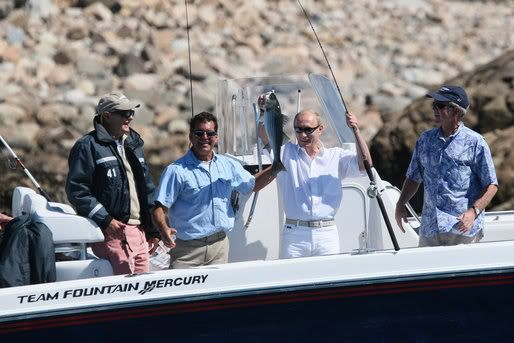
Russia seeks strategic ties with U.S. The Bush family hosted Russia’s President Vladimir Putin at their home in Kennebunkport, Maine on July 1-2, with the two presidents focusing on Iran and strategic missile defense, and finalizing a new nuclear energy agreement.
The visit was arranged amid vocal bilateral disagreements on the range of issues - from status of Kosovo to energy security to U.S. plans to install radars and missile interceptors in central Europe.

At their joint press conference on July 2, President George W. Bush noted that his Russian counterpart proposed a “regional approach to missile defense.” Pres. Bush said he was in “strong agreement with that concept” and that work on it should continue.

Several weeks ago, Pres. Putin offered U.S. joint use of Russia’s early warning radar near Gabala, Azerbaijan instead of building new radars in Europe, a proposal Mr. Bush termed “interesting,” but several experts argued was not technically feasible. (See this column in the June 16, 2007 Reporter).

This week Mr. Putin expanded on that proposal. “We are prepared to involve in this work, not only the Gabala radar,” he said, but also “the newly built radar, early warning system in the south of Russia,” which is currently under construction and is expected to replace one at Gabala by 2012.

Mr. Putin said that cooperation on missile defense would raise the relations “to an entirely new level” and “lead to a gradual development of strategic partnership in the area of security.” But U.S. sees Russian facilities as potentially complementing and not replacing those in central Europe.

Mr. Bush also said that he was “counting on the Russians’ support to send a clear message to the Iranians” through new, tougher United Nations sanctions. But the two presidents did not appear to agree on the exact nature of the sanctions.

But the former U.S. Ambassador to Russia James Collins told RFE/RL on July 3 that the summit marked another key development in bilateral relations – the signing of a key cooperation agreement on civilian nuclear energy. “To have this agreement means that we now have open the opportunity for our whole civilian nuclear communities in both countries to work together,” said Amb. Collins. “And that has not been the case up till now.”

The Russian President’s stopover at Kennebunkport was on his way to the International Olympic Committee meeting in Guatemala, which on July 4 selected Russia’s Sochi over Korean and Austrian alternatives as the location for the 2014 Winter Olympics.

An Armenian appointed British Minister of Health

The Great Britain’s new cabinet will have an ethnic Armenian as Health Minister. Sir Ara Darzi, a prominent surgeon, was on June 27 appointed to the cabinet of Prime Minister Gordon Brown who took over from Tony Blair last week.

Prior to the appointment, the 47-year-old Dr. Darzi was chair of surgery at Imperial College London and National Advisor on surgery. Dr. Darzi was born in Baghdad and raised in Dublin, where his father Vartkes Darzi (Terzian) moved after receiving an engineering degree in California.

The Guardian newspaper op-ed on July 5 described the new minister as “one of the world's leading surgeons, a charismatic Renaissance man who operates at 6am, pioneers robotic non-invasive technology, and still finds time to be a formidable committee man.”

In a 2003 interview with David Zenian, then with AGBU News, the elder Mr. Darzi, himself a son of Genocide survivors, took pride in his son “as first Armenian to become an honorary Knight Commander of the Most Excellent Order of the British Empire (KBE).”

Dr. Darzi himself said at the time that he would “really like to take my knowledge to Armenia… I have not had the chance until now, but I hope to get more involved in the coming years. I want to go to my roots. I have served in many countries around the world. Why not also Armenia?” he said.

OSCE to monitor Turkish elections, sort of

The Organization for Security and Cooperation in Europe (OSCE) will dispatch a monitoring mission to “assess” Turkey’s general elections this July 22, it said in a statement on June 25. “The mission, led by Julian Peel Yates from the United Kingdom, includes experts from 14 OSCE countries.”

But the team, the release said, “does not intend to carry out systematic or comprehensive observation of the voting, counting, or tabulation.” The OSCE will issue a report of findings two months after the completion of the election process.