Emil Sanamyan's articles on Armenian-Americans, Armenia and its neighborhood.

Monday, April 16, 2007

Armenian officer wounded in Iraq recalls his experience

Published in April 14, 2007 Armenian Reporter

Armenian officer wounded in Iraq recalls his experience
* Senior Lieutenant Georgi Nalbandian looking to return to army service


For about a month 25-year-old Senior Lieutenant (Sr. Lt.) Georgi Nalbandian of the Armenian Army has been at the Walter Reed Medical Center in Washington. He was seriously wounded in action in Iraq on November 11, 2006. Our Washington Editor Emil Sanamyan sat down with the officer on April 11 to write down his story. “From everything I’ll say, you’ll see that I am both lucky and unlucky,” he said.

“I am from the town of Ararat originally. There I finished school in 1998 and enrolled in the Military Engineering Academy in Moscow. That September I began my first year. After graduating from the Academy with only A’s and B’s I was commissioned a lieutenant in the Armenian Army in 2003.

From then on and until November 2005, I served in the Vayk-based regiment of the 4th Army Corps – this is a forward deployed combat unit [on the border with Azerbaijan-controlled Nakhichevan]. I was then transferred to the Military De-Mining Center in Echmiadzin. After nine months there I on my own initiative volunteered to serve in Iraq as a commander of a de-mining team. We were the fourth rotation going to Iraq in July 2006 for a six-month period.”

First Armenian servicemen arrived in Iraq in January 2005, where they continue to serve under Polish command in the multi-national division in central and southern Iraq.
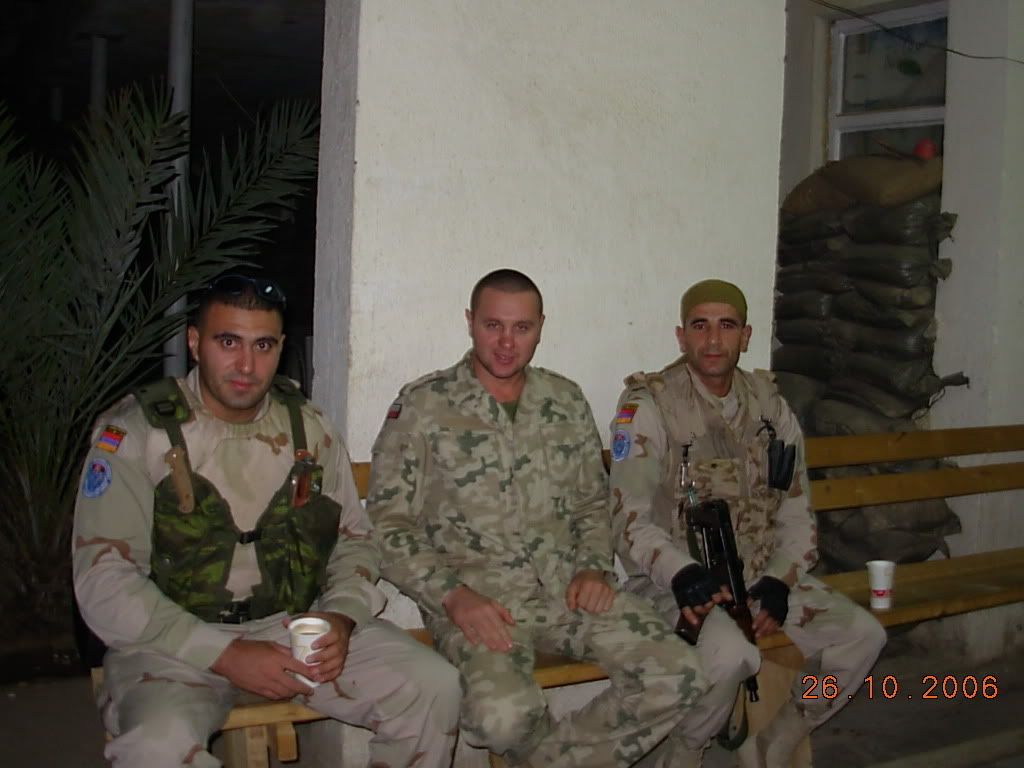
"We arrived in the town of al-Kut. There was not anything special going on at the time. But we did get decent combat assignments. We dealt primarily with unexploded ordinance that all over the place there. We found and destroyed that ammunition.

Along with soldiers from El Salvador we helped secure the coalition military base in al-Kut, to make sure none of the improvised explosive devices (IED’s) got inside the base perimeter.

And together with Polish soldiers we drove out on field reconnaissance missions in the area. My job was to make sure key bridges were not rigged and again to find the unexploded ordinance. We got attacked once at the time, but the explosion was in the front of the vehicle and we did not take casualties. That was the first time.”

What about that day?

“No, that happened at night. I remember it all. All the way to the hospital’s operating room. We had an assignment to check out this area of an ammunition dump. Previously we reconnoitered that area with the Poles. As we realized, what we found was the Iraqi army ammunition storage. Much of it was destroyed in the [U.S.] aerial bombing. But there was still a lot of stuff still unexploded lying around, including mines, 155-mm missiles, artillery shells, grenades, anything you can imagine, I can’t really list it all. It was a large area of about 300 by 400 meters, with stuff lying around quite densely.

We needed to clean that area up since there was evidence that terrorists were coming in, taking some of that ammunition out to presumably use it either directly or make it into IED’s. We could see the tracks from their digging. It was clear there were not looking for lost treasures there.

So that morning of November 10, at about eight in the morning, I guided a group of Slovak soldiers on five Humvees and several Czechoslovak-made Tatra armored vehicles with a de-mining machine in tow to that area, to tell them what is where, so that they could begin with the clean up. The place was about three kilometers off the main road. You needed to take one of several gravel paths that had been cleared previously.

We got in safely and they proceeded to destroy some of the anti-personnel mines there and were generally assessing what could be done with that place. There was no system of any kind, with various ordinance lying everywhere, so they were trying to find a way to organize their work.

The plan was to go in for half a day, so we did not really bring along much in the way of water or food. Just days earlier Saddam was sentenced to death and there was apprehension there might be an increase in attacks. So by 2 p.m. we began to move out. We could not turn the convoy around and had to take another road. But as we started moving those big Tatras began to sink into the gravel that in some places became really powdery from all the explosions. As we tried to pull out some of the vehicles, others would sink in. It was a comic situation really.

By 6 or 7 it gets dark there and dangerous. We called in reinforcements from the base. Salvadoran soldiers on four more Humvees arrived along with a crane. Salvadorans secured the perimeter around the convoy. But that crane too got stuck. Then U.S. and Iraqi special forces arrived with even a bigger crane – that was a really powerful machine that pulled almost all of the vehicles out, but then itself got stuck. So it got even funnier.

In the end, it was already past 1 a.m., we got the order that those that had been at that dump since the morning, and we were really dead tired by then, could go back to the base. The others would stay until the remaining vehicles are pulled out.

I got into the back seat of one of the Polish vehicles together with a Slovak. A full moon was out, so we turned off the headlights not to draw attention to the convoy. We talked a little, but I remember I was falling asleep. I was asleep.

It was a miracle or what, I don’t know, but it was as if someone pushed me a second or two before the explosion – as if I sensed it was coming. Instinctively, I drew my hands to cover my face and the next thing to happen is explosion ripping us apart.

I would typically have gloves on my hands, but I took the left one off to hold up the MRE (the U.S. Army-issued Meal Ready to Eat) that we just had, and forgot to put it back on. So I lost the skin on this hand.”

Nalbandian points to the burn covering much of his left hand.

“I saw that flame – on sunny days I still can’t go outside without sunglasses – heard the screams, felt the heat. So I realized I was OK, I was not dead.

(The Polish driver and Slovak sitting next to me were killed in the explosion. The other Pole sitting next to the driver was hit in the knee and has since had trouble walking.)

I moved my legs – the left one was heavy, the right one also felt like it was there. I looked up and saw bullet traces coming in and realized we were being ambushed. I heard the shooting, the Humvee kept moving, but the heat was getting worse and I couldn’t breath. I started feeling around trying to find my machine gun. I would always keep it next to my left leg, but I couldn’t find it. I started to suffocate, opened the door and tried to jump out, pushing with my right leg and that’s when I saw I had no right leg left and blood was gushing out of where it used to be.

I fell on the ground, with my right leg left under the driver’s seat. I was in shock and for a moment began to think that was all a dream and nothing had happened. But then the pain began and I realized my other leg was on fire. I put it out and took cover.

The Humvee stopped a few meters away. By then our large caliber machine guns opened up, and it sounded like the enemy began to disperse, at least they could not fire at us anymore. I waived my hand, calling out that I was still alive and needed help.

They ran up to me with a stretcher. The medevac vehicle was right behind me, so they quickly took me in and brought me to al-Kut. Our base doctor Major Vigen Tatentsian met us at the gate and began to stick me with needles with painkillers, IV and whatever else I don’t know. They took my clothes off. I was losing a lot of blood and couldn’t breath so they stuck a tube into my throat.

In just ten minutes or so, an American helicopter arrived to take me to the hospital in Baghdad. By then I was heavily medicated, so it felt like the normally 45-minute flight from al-Kut only took a few minutes. I was losing consciousness, they were bringing me back out. I was really thirsty, but they could only give me a wet cloth – it was not even a drop of water.

As soon as we reached the Baghdad hospital they operated. I remember those three round medical lamps above me. They gave me another incision and everything I ate that day came out of me. I was high on morphine and wondered what these ten people in white were doing around me. They kept sticking me with needles. And after one incision I felt completely paralyzed. I couldn’t even move my eyes. It really felt like death. Then I either fell asleep or lost consciousness, I don’t know.

When I came to, Captain David Gyozalian, who is our liaison officer in Baghdad, was next to me. I was still high on morphine, so I was laughing and smiling. He told me that they cleaned the wound and would be taking me to a hospital in Germany in the next three hours.”

All coalition soldiers wounded in Iraq, after receiving first aid and emergency surgery, are evacuated to the U.S. military bases in Germany for further treatment.

“The pain kept coming back, so I asked for morphine and sleeping pills, and I really already woke up in Germany after a six-hour flight. Then there was a second surgery and four more surgeries soon after. Those three weeks I could hardly move even in the bed. Pain continued, including the phantom pain - that was really bad. By the end of that third week I for the first time got into a wheelchair and got tired really quickly.

Our officers based at NATO in Brussels, Colonel David Tonoyan and Major Mher Israelian, would visit me almost every week. Special thanks to them, make sure you write about them, they helped bring me back to life. Talking to the doctors, everything. They were constantly there and brought me anything I needed.

The Defense Minister, who is now Prime Minister Serge Sargsian, called two days after I arrived in Germany. His Deputies have been calling since then. General Seyran Ohanian, the commander of the Karabakh army, who had a similar wound during the war, and has a prosthetic and gets around fine, also called.

My brother came to visit for three days. (I did not want my mom to come see me in that condition, so I asked for my brother to come.) He is also an officer with the Defense Ministry. My cousin who is a professional soccer player for one of the clubs in Finland also came to visit.

Then doctors began talking about moving me to U.S. for rehabilitation treatment. And as I was about to go it got postponed and then the chief doctor said that I would stay in Germany, at the U.S. military medical center in Landstuhl. There were probably some financial reasons or something, so they first decided to keep me in Germany. All other wounded coalition soldiers, Romanians, Latvians, others were treated there and fitted with prosthetics. I got my first prosthetic leg before the New Year. There were some problems with it, but nothing that could not be resolved.

But then all of a sudden they told me they would put me on the plane to U.S. for further treatment and rehabilitation. It was just as the news about Walter Reed was all over television. I finally arrived here at Walter Reed on March 9.”
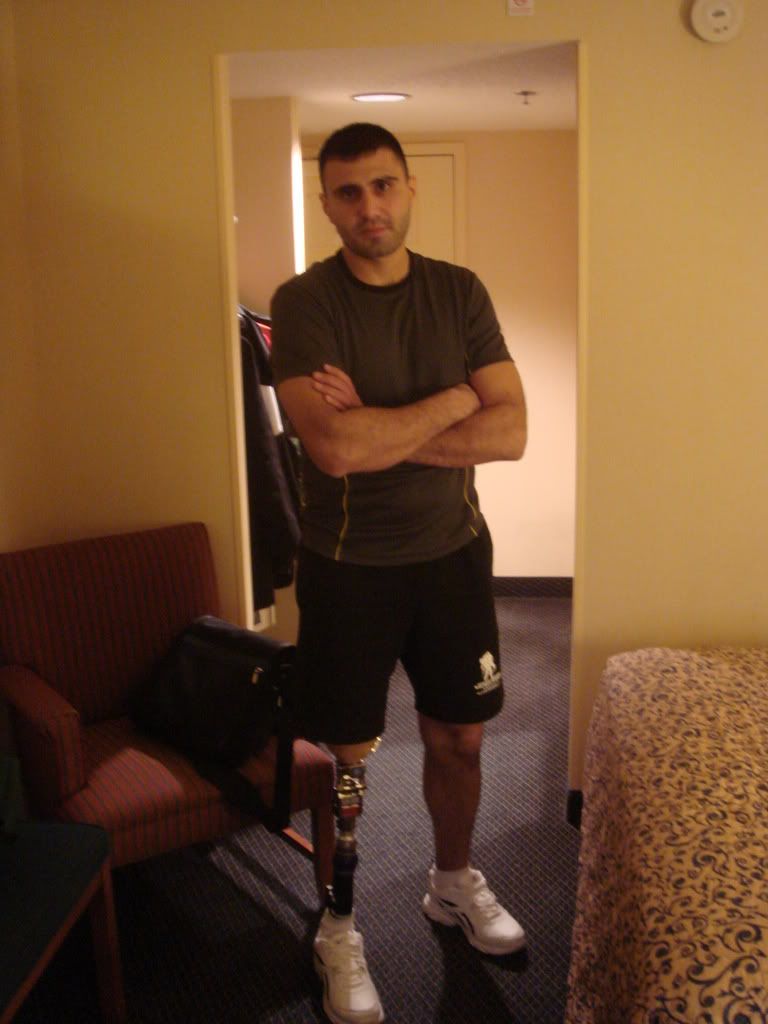
Sr. Lt. Nalbandian is very happy with the treatment at Walter Reed, where he is the only non-American servicemen that he knows of at this time. What about the recent scandal around Walter Reed?

“I didn’t personally sense any of that. I spent a week in the hospital ward for amputees – there were no problems and the care was excellent. I didn’t even see any evidence of recent repairs or anything. So, I don’t really know what the whole issue was about. I heard that one or two doctors were not doing their work and were disciplined. But that was before my arrival.

They are now fitting me with a new prosthetic. With the one I have now, I can walk quite well and even run. But I can’t walk up the stairs. The new prosthetic would give me more agility. They also said they would give me additional prosthetics for running, for swimming and also one as a replacement.

They are treating me as one of their own.”

There are Armenian doctors here at the hospital, one is a surgeon, another psychologist, Sr. Lt. Nalbandian said.

“They invited me over to their homes, including for Easter. Other local Armenians came to visit me and took me to the local Armenian Church the other week. So, I don’t have to stay in the room and watch TV on weekends. I use Skype to call my brother in Armenia – we talk almost every day.

And of course, the Embassy here, Ambassador Tatoul Markarian and Defense Attache Colonel Armen Sargsian met me as I arrived here, and they and others from the Embassy continue to visit and helping me out.”

And what will he do after the treatment?

“I want to go back into the service. I always tell everyone, what happened to me is nothing. Things are fine – I can walk, run, swim, drive a car. What’s the difference? I am a fully functioning person, it’s not like I am missing both legs.

I want to go back on active duty. If I see that I can’t handle the physical aspect of the service in the field, I’ll request a transfer to headquarters – there is enough work there too. There are plenty of combat officers in Armenia with prosthetics who serve both in the field and in the headquarters.”

UN dismantles a Rwandan genocide exhibit after Turkey protests

Published in April 14, 2007 Armenian Reporter

UN dismantles a Rwandan genocide exhibit after Turkey protests
* Armenia's Foreign Ministry calls the decision "shameful"
by Emil Sanamyan

WASHINGTON – A photo exhibition on genocide titled “Lessons from the Rwanda Genocide,” scheduled to open on April 9, has been dismantled and postponed because Turkey took issue with one of its sections that referred to the Armenian experience. UN Secretary General Ban Ki-moon was scheduled to offer opening remarks.

The event was planned by the U.K.-based Aegis Trust, which seeks to prevent genocide worldwide. After receiving approval from the UN Secretariat, it began to install the exhibit on April 5. The Turkish mission intervened after one of its diplomats noticed the reference, which read: “Following World War I, during which one million Armenians were murdered in Turkey.”

The Armenian mission sought to prevent the postponement by negotiating a compromise language that would remove the words “in Turkey” while maintaining the reference to Armenians.

Ambassador Armen Martirossian, Armenia’s Permanent Representative to the United Nations, told the Reporter that in a meeting last week with the Undersecretary-General for Public Information, Kiyotaka Akasaka, Martirossian wanted to make sure the Rwanda exhibit goes ahead.

“We take the Rwandan Genocide, the anniversary of which is also marked in April, as our own pain. As a nation that survived the Genocide, we understand the importance of honoring the memory of the victims," Ambassador Martirossian said.

But according to Aegis chief executive Dr. James Smith, officials from the U.N Secretariat told him over the weekend that “the sentence [referring to Armenians] would have to be eliminated or the exhibition would be struck.”

“We felt as a matter of principle you can't just go around striking things out," Mr. Smith told The Associated Press. "It is a form of denial, and as an organization that deals with genocide issues, we couldn't do that on any genocide, and we can't do this."

Armenia's Foreign Ministry issued a strongly worded statement on the matter on April 10: "It is unacceptable that a UN member-state, committed to world peace, dares to export such intolerance to the United Nations. Armenia cannot accept that the history of the world, the current experiences of suffering of the people of Rwanda, of Darfur, and Armenians’ memories of injustice are subjected to such callous, cynical dismissal.”

"It is ironic and shameful that this Turkish-led postponement should befall an event which was to provide lessons on how to respect human rights and prevent genocides. Instead, the lesson here is one of total disrespect for history and memory," the Foreign Ministry statement concluded.

Ambassador Joseph Nsengimana, Rwanda’s Permanent Representative to the UN, wrote to the UN Secretary-General to express “profound regret” that the exhibit was postponed over “reasons unrelated” to the UN mandate on the Rwanda Genocide reported on April 9 (see www.InnerCityPress.com for details).

"If we can't get this right, it undermines all the values of the UN," Mr. Smith of Aegis said. "It undermines everything the UN is meant to stand for in terms of preventing'' genocide.

He continued: ''You can't learn the lessons from history if you're going to sweep all of that history under the carpet. And what about accountability? What about ending impunity if you're going to hide part of the truth? It makes a mockery of all of this.''

Top Democrats "concerned" about Resolution; Turkey vs. Gaz de France; New York Times; and Nobel Laureates' letter

Published in April 14, 2007 Armenian Reporter

From Washington, in Brief
by Emil Sanamyan


* Key Congressmen “extremely concerned” about House resolution on Genocide

Three key members of Congress co-signed a March 28 “Dear Colleague” letter that communicated the Bush Administration’s opposition to the House Genocide resolution (H. Res. 106) and was made available to the Reporter by the U.S.-Armenia Public Affairs Committee.

Reps. Ike Skelton (D-Mo.), John Murtha (D-Pa.), Roy Blunt (R-Mo.) and Dan Burton (R-Ind.) joined the Congressional Turkey Caucus co-chairs Robert Wexler (D-Fla.), Kay Granger (R-TX) and Ed Whitfield (R-Ky.) in urging their colleagues “to take into account all factors” as they are described in the March 7 letter from the Secretaries of State and Defense opposing the resolution’s consideration on the grounds that it might hurt relations with Turkey.

The member of Congress wrote that “While we do not seek to minimize the historical significance of the atrocities and murders perpetrated against Armenians from 1915 to 1923 as described in H. Res. 106, we are extremely concerned about the ramifications of passing this resolution and its effect on U.S.-Turkish relations.” H. Res. 106 is currently backed by 185 Congressmen.

Rep. Skelton chairs the Armed Services Committee, Rep. Murtha is chair of the Defense Appropriations Subcommittee (both are also members of the Turkish caucus) and Rep. Blunt is the Minority Whip (number two in the House Republican leadership). Rep. Murtha, who opposed U.S. affirmation of the Genocide in the past, is known as a close ally of the House Speaker Nancy Pelosi, who has been a consistent support of affirmation.

Meantime, the Armenian National Committee of America (ANCA) issued a release on April 10 highlighting the support for the House resolution by 24 members seating on the Foreign Affairs Committee; 18 members on the Homeland Security Committee; 16 on the Armed Service Committee; 9 on the House Intelligence Committee; and 9 on the House Appropriations Subcommittee, which has jurisdiction over the State Department.

* More companies deny they oppose the resolution

Xerox, American Express, Altria, and FedEx have joined Microsoft, Johnson and Johnson, and Cargill in distancing themselves from the letter sent by the American Business Forum in Turkey (ABFT) in opposition to the resolution, the ANCA reported on April 4 after inquiring with some 70 ABFT members about their position on the issue.

Altria includes the tobacco giant Philip Morris International (PMI), which is also a member of the American Turkish Council (ATC). ATC president Jim Holmes told Roll Call, the congressional news daily, that ATC member companies are working to stop the resolution. But Atria claimed in a letter to ANCA that “neither PMI nor Altria have taken a position – and neither company plans to take a position – on the proposed Resolution."

* Turkey issues “threat” against French company, then withdraws it

"Turkey sends blunt message to France. Ankara angered by Armenia bill, halts pipeline talks," said the April 6 headline in the International Herald Tribune, published by the New York Times. A senior Turkish energy official told Reuters that Turkey, unhappy with a French “bill” on the Armenian Genocide, would suspend talks with Gaz de France (GDF) over building a gas pipeline through Turkey to Europe.

But there were a couple of problems with the story.

First, there is no active proposal on the Genocide in the French Parliament at this time. France, including its president, senate, and the National Assembly, formally recognized the Armenian Genocide in 2001. Since then, the trade between France and Turkey has grown by 131 percent. Last year, the National Assembly voted for a proposal to punish Genocide denial, but it did not become law over opposition from the French government – and did not result in the threatened suspension of French-Turkish military cooperation.

Second, GDF is not a part of the Austrian OMV company-led gas pipeline consortium that includes the Turkish state-owned Botas company. An OMV spokeswoman would not confirm that any talks with GDF were underway to be suspended. And on April 7, Zaman cited Turkish Foreign Ministry officials as saying “There is no suspension decision yet.”

Almost lost in the coverage was a comment from an unnamed European Union diplomat, cited by Reuters. The diplomat suggested that the “threat” may have been an indirect message to the U.S. Congress over H. Res. 106. Indeed, opponents of the resolution who claim that the Genocide resolution would “damage” U.S.-Turkish relations are hard-pressed to find evidence that any such “damage” has occurred when other countries’ parliaments have passed similar resolutions.

* New York Times confirms editorial policy on the Genocide

In a “correction” published on April 5, the New York Times editors noted that “A headline on Friday [March 30] about a planned vote in Congress over the widespread killing of Armenians by the Ottoman Turkish government early in the 20th century incorrectly described the killings, in which 1.5 million Armenians died. It was genocide, not a ‘massacre.’”

The correction came after a number of readers wrote to complain about the story’s headline, “Planned House Vote on Armenian Massacre Angers Turks.”

* Nobel Laureates send a letter to Turks and Armenians

Fifty-three Nobel Prize winners co-signed a letter that called for “tolerance, contact and cooperation between Turks and Armenians,” the Elie Wiesel Foundation for Humanity reported in an April 9 release. The Foundation’s executive director David Phillips told the Reporter that he drafted the letter on the initiative from Mr. Wiesel.

The letter urged “Armenians and Turks [to] encourage their governments to: open the Turkish-Armenian border; generate confidence through civil society cooperation; improve official contacts; and allow basic freedoms.”

While a senior fellow at the Council on Foreign Relations, Mr. Phillips moderated the U.S.-sponsored Turkish-Armenian Reconciliation Commission (TARC) that created much controversy in the Armenian community, but did not bring about a breakthrough in relations.

Although Nobel laureates regularly sign joint letters on a variety of subjects, they are typically in their general area of expertise. For example, in February 2001, 80 laureates in the sciences urged President Bush to fund stem cell research; and in October 2006, 15 Nobel Peace Prize Laureates called on the United Nations to initiate a treaty restricting arms trade.

In the case of the Turkish-Armenian initiative, co-signers were a diverse group, including laureates in physics (14), chemistry (14), medicine (12), economics (6), peace (5, including Wiesel), and literature (2). The signers did not include Orhan Pamuk, who won the latest prize for literature and two months ago left Turkey fearing for his safety, in the wake of the murder of Hrant Dink.

U.S. foreign aid, Turkey's Akhtamar ploy, looking for intelligence in Azerbaijan,

Published in April 7, 2007 Armenian Reporter

From Washington, in Brief
by Emil Sanamyan

Armenian-American organizations offer spending recommendations to Congress

The Armenian Assembly of America (AAA), the Armenian National Committee of America (ANCA), and the U.S.-Armenia Public Affairs Committee (USAPAC) submitted recommendations for the March 29 public hearing held by the House Appropriations Subcommittee on Foreign Operations about spending in Fiscal Year 2008. The subcommittee, along with its counterpart in the Senate, sets U.S. foreign assistance levels.

The three organizations’ recommendations were nearly identical on four items: (1) no less than $75 million in economic assistance for Armenia; (2) no less than $10 million in humanitarian and development aid to Nagorno-Karabakh; (3) equal amounts of Foreign Military Financing ($4.3 million) and International Military Education and Training ($1 million) to Armenia and Azerbaijan; and (4) strict monitoring of the conditions to the waiver of Section 907, which restricts U.S. assistance to Azerbaijan.

For the first time, the three organizations have also requested that the U.S. Congress take a closer look at the $100 million 8-year Caspian Security (Guard) initiative which has been underway since 2004. Under this program, the U.S. has helped upgrade sea and air bases, install radar equipment, and train special forces in Azerbaijan.

Additionally, the AAA requested U.S. support for Armenia’s energy security and Armenia’s participation in regional development projects. Both AAA and USAPAC specifically recommended congressional funding for confidence-building measures to support peace in Karabakh. For its part, ANCA requested U.S. funding for the California Trade Office in Armenia.


Rep. Watson warns colleagues of Turkey’s Akhtamar ploy

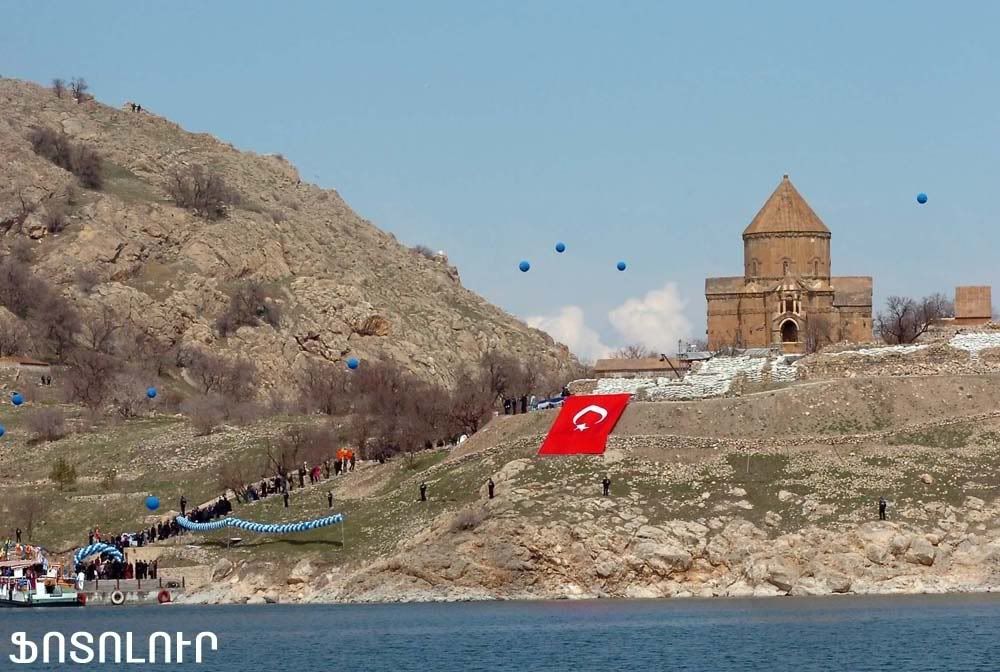
On March 29, Rep. Diane Watson (D.-Calif.) sent a letter to congressional colleagues titled, “The Truth about Armenian Churches in Turkey,” the Armenian National Committee of America reports. The letter came in response to Turkey’s efforts to advertise its renovation of the Holy Cross Church on the Aghtamar island in Lake Van.

Ms. Watson noted that while the Turkish government “is holding an event to tout the rehabilitation of an Armenian Church . . . hundreds of [such] Churches in Turkey, some dating as far back as the 4th century, have been neglected and even egregiously abused.” She added that this was part of “a desperate and malicious campaign, which began in 1915, to erase the Armenian people's physical and cultural existence in their historic homeland.” For more information about the issue, see www.teachgenocide.com/background/hist_sites.htm.

Rep. Hoekstra looking for intelligence in Azerbaijan

Rep. Pete Hoekstra (R.-Mich.), ranking member of the House Permanent Select Committee on Intelligence, was in Baku this week. Official reports suggested that Mr. Hoekstra’s April 3 meetings with Azerbaijani officials focused on the “development of inter-parliamentary relations,” but the representative is better known for his concerns about Azerbaijan’s southern neighbor.

In a March 4 television interview with Fox News, Mr. Hoekstra complained that "we still don't have the intelligence community overall to give us, as policy-makers, the information that we need to make good decisions in North Korea, Iran and other places." On March 27 he told the Holland Sentinels, his hometown paper, that his frequent foreign travel helped him fill in the gap.

State Dept. plays down Caucasus missile defense talk amid tensions with Iran

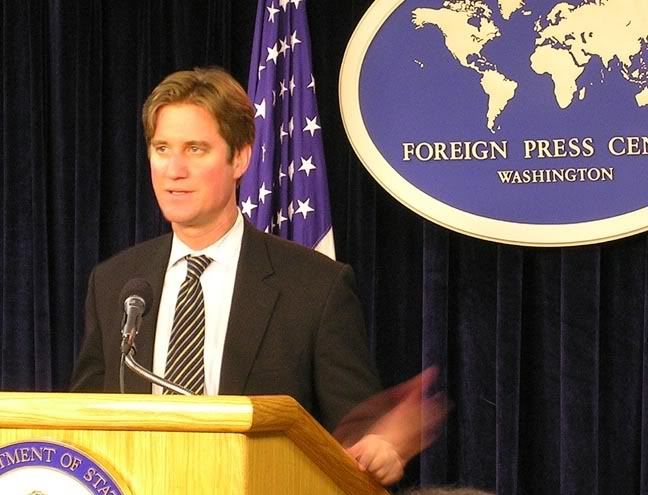
Deputy Assistant Secretary of State Matt Bryza was in Georgia last week. Speaking to the press in Tbilisi on March 30, he said, “the United States does not intend to deploy a missile-defense system in the Caucasus,” the Azerbaijan Press Agency (APA) reported.

Earlier this year, the United States announced plans to place parts of a European-theater missile-defense system in Poland and the Czech Republic. U.S. Missile Defense Agency Director Gen. Henry Obering added on March 1 that the United States would like to be able to deploy mobile anti-missile radar in one of the countries of the Caucasus.

Armenia, Azerbaijan, and Georgia have all denied receiving any deployment requests from the United States.

A retired U.S. Air Force planner, Col. Sam Gardiner, told the Armenian Reporter that while Iran does not yet have missiles capable of reaching Europe, U.S. missile defense plans were clearly part of an overall effort to put pressure on Iran. He added that having mobile radar units in the Caucasus might make sense to provide additional early warning to U.S. allies.

“This is a game of strategic chicken,” Mr. Gardiner said. It entails the ratcheting up of U.S. pressure, including a military buildup in the Persian Gulf and the detention of alleged Iranian operatives in Iraq. In recent months U.S. official have also expressed concerns about Iran’s policies on ethnic minorities, including Kurds, Arabs, and Azeris.

***
While in Tbilisi, Mr. Bryza noted that the United States would “want to have an opportunity” to use air bases in Azerbaijan “in emergencies,” according to APA. As part of its Caspian Security (Guard) initiative, the United States helped modernize several of Azerbaijan’s air bases.

(A day before Mr. Bryza’s statement, on March 29, the Azerbaijani government invited foreign diplomats to Haji Zeynalabdin Tagiyev [previously Nasosnaya] air base to showcase the MiG-29 fighter jets it just acquired from the Ukraine [see the March 24 edition of the Reporter for details]. On March 30, the muscle-flexing continued as Azerbaijani aircraft flew near Karabakh.)

In response to speculations that the United States would like to use Azerbaijan for strikes against Iran, the Azerbaijani Defense Ministry issued a statement on April 1 confirming Azerbaijan’s previously articulated position that it "will not create opportunities or conditions allowing foreign countries to use its territory against neighboring countries," RFE/RL reported.

Meantime, Vafa Guluzade, top advisor to at least three Azerbaijani presidents (1991–99) predicted that the United States intends to destroy and dismember Iran because it is an anti-American state that is “ignoring UN resolutions, which makes war inevitable,” day.az reported on April 3. Mr. Guluzade went on to warn that “since the U.S. is trying to weaken regional states, [in the future] Turkey might end up in the same situation as Iran today.”

Georgia’s NATO membership increasingly likely

On March 30, Mr. Bryza confirmed that the United States and Georgia share a common goal: “Georgia’s membership at a right time in NATO,” Civil Georgias reported. The “right time for Georgian membership in NATO is when Georgia has completed all of its reforms . . . and has continued what it’s been doing now for several month, which is pursuing constructive and peaceful [efforts] to resolving separatists conflicts in Abkhazia and South Ossetia within Georgia.”

NATO Secretary General Jaap de Hoop Scheffer had said on February 9 that the alliance should be "coming closer to honoring the ambitions of Ukraine and Georgia." Both chambers of the U.S. Congress have voted to support the two countries’ accession to NATO financially.

President Mikhail Saakashvili of Georgia in turn recently promised to more than double Georgia’s force in Iraq to 2,000, which would make it one of the largest contingents in the U.S.-led coalition there. Mr. Saakashvili is optimistic that Georgia could become a NATO member by 2009.

Cory Welt from the Washington-based Center for Strategic and International Studies told the Reporter that there has been more enthusiasm for Georgian membership lately. “They still have a lot to do, but the 2009 possibility is more realistic now.”

Last month, Georgia’s parliament voted 160-0 in favor of joining NATO. This policy is supported by most Georgians, but has caused lingering tensions with Russia. In apparent reference to their northern neighbor, Mr. Bryza assured Georgians last week that “no country that is not a member of NATO has any say over Georgia’s future within the alliance.”

Neither Armenia nor Azerbaijan has expressed a desire to join the alliance yet, but Mr. Welt believes that the two will likely “reassess their current position in light of Georgia’s membership.”

Interview with Rep. Schiff: On Genocide Resolution and Karabakh

Article published in the March 31, 2007 Armenian Reporter

CONGRESSMAN SCHIFF IS STAYING POSITIVE ON THE GENOCIDE RESOLUTION
And U.S. support for Karabakh’s self-determination


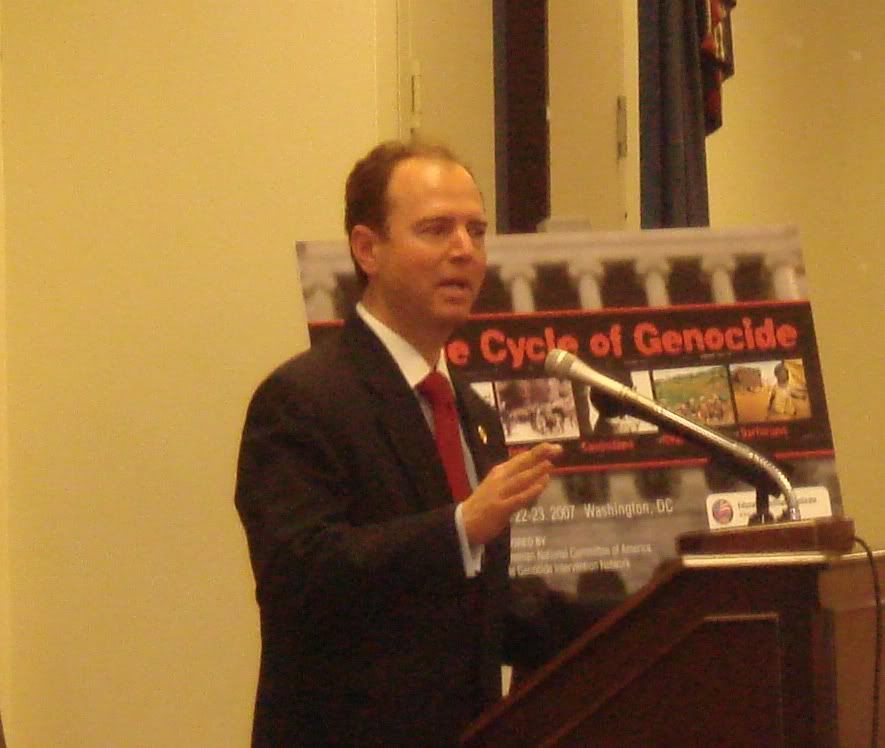
Editor’s note: On March 22 and again on March 28, our Washington Editor Emil Sanamyan spoke with Rep. Adam Schiff (D-CA) (see the fact box for information about the Congressman). Below is the transcript of those interviews.


Reporter: What is the stumbling block for H. Res. 106 [the proposed House resolution affirming the Armenian Genocide introduced on January 30] going forward?

Rep. Schiff: I hope there is no stumbling block. Right now we are still gathering supporters for the resolution. We are stronger than we have ever been with more than 180 co-sponsors. It’s a very good start and I like to think positive and I am very hopeful. I think the biggest challenge is overcoming the power of the Turkish lobby, which is very considerable.

Reporter: There has been hope expressed previously that there would be congressional action on H. Res. 106 before April 24. Now the connection seems to be made to the upcoming elections in Turkey. Do you see any such connections in terms of timing?

Rep. Schiff: Right now the only timing consideration is that Congress is focused first and foremost, as we need to be, on Iraq. So every foreign policy is going to have to wait until we resolve at least the immediate issues we are grappling with in Iraq. That’s the more pressing timetable. Beyond that, I don’t know what the timing is. I am much more concerned about having [H. Res. 106] taken up and having it taken up successfully than whether it is on this or that day.

Reporter: The Iraq issue is likely to stay on top of the agenda for the foreseeable future. Do you see a possibility that the resolution may not come up in this Congress (2007-2008)?

Rep. Schiff: I am keeping positive and pushing forward until I have a reason to believe otherwise and I am going to assume the best.

Support for Karabakh

Reporter: What do you think of the current U.S. policy on Karabakh?

Rep. Schiff: I think it is enormously important that we maintain parity funding between Armenia and Azerbaijan. I am concerned that the Administration is making an effort to get away from that. Armenia has been a steadfast ally [of the United States] and I think that should be rewarded not penalized. I also don’t think we should be emboldening Azerbaijan at the time that it is acting increasingly belligerently vis-a-vis Karabakh.

I was hopeful some time ago when it looked like Armenia and Azerbaijan and Karabakh were making progress in talks. But unfortunately the Azeri President [Ilham Aliyev] has not followed through with his father’s efforts in that direction. I think that the process has stalemated.

I certainly feel confident that U.S. will continue to support the right for self-determination for the people of Karabakh. I had a chance to visit Karabakh some years ago and I was enormously impressed with the pioneering spirit of the people who live there and who formed the government there. And I am determined to do all I can to support their efforts.

Reporter: U.S., however, does not recognize the Nagorno Karabakh Republic and says that Karabakh’s future status would be resolved through negotiations. Are you satisfied with the status quo in this U.S. position or do you see the need or room for change in this policy?

Rep. Schiff: Some years ago I worked to free up to $20 million in funds for Karabakh. And I am determined to continue to advocate for the right of self-determination for the people of Karabakh. I think that facts on the ground speak for themselves – today this is largely an Armenian community that chose to express its self-determination and I think they should be supported in that. And I will continue to keep our Administration’s feet to the fire in support of that right for self-determination and make sure that in our funding decisions vis-a-vis Armenia and Azerbaijan we are not sending mixed signals in terms of the rights of the people of Karabakh.

Reporter: Other than supporting funding, do you see any congressional role in developing closer relations between Nagorno Karabakh and the United States?

Rep. Schiff: I would certainly like to see closer relations. There are many efforts where we can work collaboratively. One of the issues that I am pursuing now vis-a-vis Armenia, but I think would have application in Karabakh as well, is efforts to strengthen the rule of law, democratic process, increase transparency to let people know that if they invest in Armenia, in Karabakh that those investments are good, sound investments that would be protected and rewarded.

Reporter: Armenian American organizations have called for increasing the overall volume of annual U.S. assistance to Karabakh and expand such assistance to include pro-democracy programs as well as economic development. Is that something you will be championing as a member of the Foreign Operations Subcommittee?

Rep. Schiff: I will be championing strong economic support to Armenia and continued support to Karabakh. We are just at the beginning of the appropriations process for Fiscal Year 2008, but my top priority is that there is at least parity in funding between Armenia and Azerbaijan. I am also working to secure funding for the California trade office in Armenia, which is an effort that I initiated while I was a state senator and I hope will continue.

Reporter: In terms of security assistance parity, when that’s discussed the issue of a separate multi-year $100 million U.S. security program [the so-called Caspian Guard initiative] which has focused on upgrading Azerbaijan’s airbases and training its special forces is generally not made part of that equation. Should Congress take a closer look at that program to see how that’s impacting the balance in Karabakh?

Rep. Schiff: Certainly, Congress has a very important role to play in making sure that any assistance in whatever form doesn’t negatively affect the balance of power in a region that is very important to the United States or disadvantage our ally. There are often competing goals as to where we need to make investment in the war on terror or in support of economic development of our allies. So, all of these things need to be examined and appropriate action taken.

Millennium Challenge Compact

Reporter: During a recent hearing in the House Foreign Operations Subcommittee you raised concerns with the Administration about the Millennium Challenge Account funding essentially supplanting the FREEDOM Support funds that are being reduced to Armenia and other states. Has that issue been addressed to your satisfaction or is that still is an ongoing process?

Rep. Schiff: Yes, that is still an ongoing concern. When we initiated the Millennium Challenge assistance we never contemplated that we would take funds from existing efforts in order to fund that – to rob Peter to pay Paul, so to speak. So I am concerned that this may be what the Administration is contemplating in Armenia and elsewhere; that funds that would have ordinarily gone to these countries anyway are cut back in order to fund Millennium Challenge efforts. I am not sure that advances the [overall] cause. I have not got a satisfactory answer yet and we are still going to be pursuing this.

Reporter: What’s your sense of the elections coming up in Armenia, how that might impact the Millennium Challenge assistance?

Rep. Schiff: The important thing is that the elections are held in a credible way, that they are transparent to a degree that outside election monitors are able to come in and verify that the elections are conducted well. I think this would be a very positive development for Armenia. A lot of folks will be watching the elections carefully to make sure they are held appropriately. None of us, of course, are in the position to say what the result should be, we just think that the process needs to be sound and people have an opportunity to express what their choice is in a free and unfettered way. The world will be watching and it will be very important for us in Congress that the rule of law is observed and democratic institutions are given a chance to prosper.

Representing Glendale

Reporter: How does it feel being a Congressman from Glendale, representing such a dynamic Armenian community?

Rep. Schiff: Well, it is wonderful to represent Glendale, Pasadena and Burbank, cities with large and vibrant Armenian communities. I would tease one of Glendale city council members Rafi Manoukian, after he and I went to Yerevan some years ago and had a great many people stop us in the streets [recognizing and greeting us], that we developed an international reputation. Rafi, who was then [Glendale] mayor said: “Don’t let this go to your head, Congressman. These are our Glendale constituents.” Of course, these were our constituents on vacation in Armenia. The Armenian community has added so much to the quality of life in my district. To the arts, to medicine, to law, to humanities and I have really benefited from the rich Armenian cultural heritage that my district has.

* * *
Facts about Congressman Schiff (D-CA)

Constituency: Represents 29-th district, located in northeastern suburbs of Los Angeles that include Glendale, Pasadena, and Burbank.

Role in the 110-th Congress: Member, House Appropriations Subcommittee on Foreign Operations; original co-sponsor, House Resolution 106 affirming U.S. record on the Armenian Genocide.

Personal details: Born in 1960, Framingham, MA; Jewish; JD Harvard University, 1985; Attorney, Educator; married to Eve Sanderson.

FWIB: Margarian's death, Biden's resolution on Dink, U.S.-Turkish defense lobby, Iraqi Armenians

From Washington, in Brief
by Emil Sanamyan


Prime Minister Margarian remembered in Washington

A steady stream of officials from the federal and Washington city governments, a number of U.S.-accredited ambassadors and diplomats, and Armenian-Americans came to the Armenian Embassy on March 28 to honor the memory of Prime Minister Andranik Margarian who died of heart failure on March 24.

Deputy Assistant Secretary of State Matt Bryza flew to Yerevan to attend the funeral on March 28 and deliver a letter of condolences from President George W. Bush. Co-chairs of the Congressional Armenian Caucus Reps. Frank Pallone (D.-N.J.) and Joe Knollenberg (R.-Mich.) issued a statement mourning Margarian’s passing. Heads of several U.S. federal agencies and non-governmental organizations sent letters of condolences.


Senate Committee approves amended resolution honoring Hrant Dink

On March 28, the Senate Foreign Relations Committee chair, Sen. Joe Biden (D.-Del.), secured committee passage of S. Res. 65 “Condemning the murder of Hrant Dink,” after amending several passages in the resolution’s text. Armenian-American organizations, including the Armenian Assembly, the Armenian National Committee, and USAPAC welcomed Sen. Biden’s effort.

The original text said, “Mr. Dink was prosecuted under Article 301 of the Turkish Penal Code for speaking out about the Armenian Genocide.” The State Department and the Turkish government opposed that statement. (See the March 17 edition of the Reporter for the original resolution’s full text.)

“Ankara fears that a Senate approval of the original text may act as a precedent for future congressional action,” the Turkish Daily News reported on March 26. The amended version, which passed the committee and was made available to the Reporter, said, “Mr. Dink was subjected to legal action under Article 301 of the Turkish Penal Code for referring to the 1915 massacre of Armenians as genocide.”

A State Department reaction to the final text was not available at press time.

Another amendment was made to the part of the text that called on Turkey to normalize relations with Armenia. The text that passed the committee called on both “the Government of Turkey and the Government of Armenia to act in the interest of regional security and prosperity and reestablish full diplomatic, political and economic relations.” Unlike Turkey, Armenia has been ready to establish relations without preconditions.

At this time it is unclear whether and when S. Res. 65 might come to the Senate floor.

Major U.S.-Turkish military deal suspended (no relation to Genocide resolution reported)

Turkey suspended plans to purchase 30 F-16 fighter jets and associated equipment from Maryland-based Lockheed Martin. The parties have apparently not agreed on the price, variously estimated between $1.65 and $2.9 billion. There may be political reasons too.

Defense News on March 19 cited sources in the Undersecretariat for Defense Industries, Turkey’s procurement agency, as saying that the reason for suspension is Lockheed Martin’s inability to start delivering the planes by 2010.

In the period 2014 to 2034, Turkey also plans to spend $10.7 billion to buy 100 of the U.S.-made F-35 Joint Strike Fighters (JSF), also co-produced by Lockheed Martin. Defense News’ sources said that Turkey views the modernized F-16 purchase as a stopgap solution to fill Turkey’s need for more modern jets before F-35 production begins. It would be “meaningless” for Turkey to begin taking delivery of the F-16s in 2014, as has been proposed.

But on March 26, www.F-16.net blamed the suspension on a passage inserted as part of congressional approval of the sale. The passage specifies that the sale should “not adversely affect either the military balance in the region or U.S. efforts to encourage a negotiated settlement of the Cyprus question." It provides no clear benchmarks or enforcement mechanisms.

This passage is similar to the restrictions on U.S. military aid to Azerbaijan that it not "be used for offensive purposes against Armenia or the Armenian communities in the South Caucasus." But Azerbaijani special forces and air bases modernized by the U.S. are under the control of a government that is overtly planning to use them for exactly these “offensive purposes.”

Meanwhile Turkey's Zaman cited a military source as saying, “Rather than the Armenian genocide bill, the [Kurdish] issue has the potential to turn upside down Turkish-U.S. strategic relations…. If the U.S. does not take action against the [Kurds] in northern Iraq or allow the Turkish military to stage a cross-border operation, [Turkey] may even [drop plans to buy] 100 JSF fighters from the U.S.”

Turkish lobby in the U.S. is upbeat on chances of stopping congressional resolutions


Lockheed Martin, Raytheon, and Philip Morris were “silver sponsors” of the 26th annual conference of the American-Turkish Council (ATC), held in Washington March 25-27. Other ATC members include BAE Systems, Boeing, Chevron, Citigroup, and Sikorsky.

According to the Turkish media, Ankara’s concerns with congressional affirmation of the Armenian Genocide dominated conversations at the conference.

The ATC conference featured a special message from President George W. Bush. Secretary of Defense Robert Gates was the keynote speaker. Mr. Gates was quoted by The Associated Press as saying, "Our two nations should oppose measures and rhetoric that needlessly and destructively antagonize each other. That includes symbolic resolutions by the United States Congress as well as the type of anti-American and extremist rhetoric that sometimes finds a home in Turkish political discourse."

Turkish NTV cited Economy Minister Ali Babacan of Turkey as saying, "things looked extremely dark two months ago, but thanks to the efforts exerted by the Turkish Foreign Ministry and the staff at our Washington Embassy, as well as our lawmakers and non-governmental organizations, I see better chances that the resolution would not be submitted to Congress."

ATC president Jim Holmes, a retired U.S. ambassador, told the Turkish Daily News on March 22 that following intense lobbying by ATC, he is "hopeful … that the leadership of Congress will not bring either in the Senate or in the House of Representatives this legislation to the floor for vote."

Mr. Holmes said in an interview with Roll Call, a congressional news daily, that ATC member companies (including those listed above) are working to stop the resolution. Roll Call’s sources in the companies’ Washington lobbies confirmed that such efforts were underway.

"At the end of the day, the U.S. policy will not change regardless of what Congress does on this," U.S. ambassador to Ankara Ross Wilson said during the ATC reception, according to the Turkish Daily News. "We would like to see the resolution not pass."

Mr. Holmes served as deputy chief of mission in Ankara from 1992 to 1995. The ATC board is chaired by Gen. Brent Scowcroft (ret.), national security advisor to the first President Bush. (For more information, see www.the-atc.org)

Business giants deny opposing resolutions

At the urging of the Turkish government, the American Business Forum in Turkey (ABFT) – an entity separate from the ATC – sent a letter to Congress opposing congressional resolutions on behalf of American companies with business interests in Turkey.

The Armenian National Committee of America inquired with some 70 ABFT members, asking them to clarify their position on the issue. Three companies that responded so far – Microsoft, Cargill, and Johnson and Johnson – denied they were involved in Turkey’s efforts to stop the resolutions.

U.S., United Nations aiding “special populations” displaced from Iraq


According to the United Nations High Commissioner for Refugees (UNHCR), several million Iraqis have been displaced since the war in Iraq began in 2003. U.S. Assistant Secretary of State Ellen Sauerbrey furnished this estimate during the March 26 hearing called by the House Foreign Affairs Subcommittee on Middle East.

Discussing U.S. and international assistance efforts, she referred to “special populations,” including “religious minorities such as Christians” – that in Iraq include Arabs, Assyrians, and Armenians. “We intend to ensure that these special populations receive the same consideration and access to the U.S. resettlement program as others and we are encouraging them to contact UNHCR to make their needs known,” Ms. Sauerbrey said.

On March 24, PanArmenian.net carried an interview with Baruyr Hagopian, chair of the Armenian National Committee of Iraq, who estimated that the number of Armenians in Iraq declined from 18,000 to 15,000 as a result of the war. Of those who left, most are now in Syria, Armenia, and Jordan.

Since 2003, 28 Iraqi Armenians have died, and as many have been kidnapped for ransom. Increasingly, Armenians and others from central Iraq are moving to the relative safety of the Iraqi Kurdistan. (See our story on page B1 about the new Armenian church is the area.)

Mr. Hagopian was also quoted as saying that “a significant part of Armenians living in Iraq are not satisfied with their situation and isolation from their historical motherland” and would like to become Armenian dual citizens.

FWIB: Rice-Gates letter, Azeri FM in DC

Published in March 24, Armenian Reporter

From Washington, in Brief
by Emil Sanamyan

* Bush Administration relays Turkey’s threats in a letter and testimonies to Congress


A joint letter sent to the Congressional leadership on March 7 and signed by Secretaries of State and Defense Condoleezza Rice and Robert Gates expressed the administration’s opposition to the passage of the proposed resolution affirming the Armenia Genocide. The House Resolution 106 (H. Res. 106) is currently backed by 182 congressmen.

In identical letters addressed to House Speaker Nancy Pelosi (D-CA) and Republican Minority leader John Boehner (R-OH), and made public last week, the secretaries argued that passage would “harm … U.S. efforts to promote reconciliation between Turkey and Armenia and to advance recognition by Turkey of the tragic events that occurred to ethnic Armenians under the Ottoman Empire. It would also significantly endanger U.S. national security interests…”

Ross Vartian of the U.S.-Armenia Public Affairs Committee described this position as “capitulation to Turkish threats. The United States should instead reject such threats, call upon Turkey to face history, and re-affirm Armenian and American history.… We are confident that the Speaker Pelosi will schedule a vote on H. Res. 106 despite Turkish threats and the Bush Administration’s objections.”

“The Bush Administration is today loudly and aggressively seeking, on behalf of the Turkish government, to prevent members of the U.S. Congress from exercising their constitutional right to cast their votes on the Armenian Genocide Resolution,” said Aram Hamparian of the Armenian National Committee of America. “In this unfortunate situation, it is left to us, as Armenian-Americans, to defend America’s core values.”

The Armenian Assembly of America repeated in a March 21 press release that it has “a fundamental policy disagreement with the administration” but would not qualify its position.

During March 21 House Foreign Operations Subcommittee hearing, Rep. Adam Schiff (D-CA), the principal sponsor of H. Res. 106, grilled Secretary Rice about the administration’s reluctance to talk straight about the Genocide. Schiff asked if Rice, as an academic, had any doubts that the Ottoman Armenian experience constituted Genocide. Rice, as Secretary of State, dodged the question, saying that the issue is for Armenians and Turks, not the U.S., to deal with.

According to those in the room, the hearing ended with a bit of a ruckus created by activists from the pro-peace group CODEPINK (www.codepink4peace.org ), who shouted against the war in Iraq, and that “Rice lies about the Armenian Holocaust!”

* * *
Little has changed since a similar letter was sent by the Clinton Administration to former House Speaker Dennis Hastert (R-IL) in October 2000, the last time Congress came close to voting on a measure affirming the Genocide. At the time, Secretaries of State and Defense Madeleine Albright and William Cohen also focused on Turkey’s threats to cut off cooperation with the U.S. against Iraq and terrorist threats as reason for Congress “not to go forward.”

In these intervening seven years, the only appreciable difference in the U.S. position is greater rhetorical “sensitivity” to the event of the Genocide itself. The Yerevan-based Mediamax news agency noted that the State Department began to stress this “non-denial” of the Genocide after forcing its Ambassador in Armenia John Evans to retract his by now well-known statements of two years ago.

But affirmation’s opponents in and outside the administration continue to legitimize Turkey’s arguments against the congressional resolution that essentially amount to threats of retaliation against the U.S., Armenia, and Turkish Armenians.

* * *
On March 15, Assistant Secretary of State Dan Fried, Deputy Assistant Secretary of Defense Dan Fata and Special Envoy to Turkey Gen. (ret.) Joe Ralston aired the administration’s opposition before the House Foreign Affairs Subcommittee on Europe.

(Incidentally Ralston is also a vice chair of a Washington-based consultancy, the Cohen Group (www.cohengroup.net), chaired by none other than ex-Secretary Cohen. Another vice chair is former Undersecretary of State and former Ambassador to Turkey Mark Grossman. The Cohen Group has a longstanding business alliance with the law and lobby group DLA Piper, which is currently in talks with the Turkish government about representing its interests in Washington.)

Fried introduced somewhat of a novelty into his testimony, referring to the Armenian Genocide as “ethnic cleansing” – a new term in the administration’s vocabulary that has just about exhausted alternatives as it seeks to avoid the term “genocide,” which is opposed by the Turkish government. A colleague also noted a stark difference between Secretary Fried’s prepared remarks, as posted on the Subcommittee website, and the remarks as they were actually delivered.

The prepared testimony claimed that according to unnamed Turkish Armenians, the resolution’s passage would “threaten their personal security.” But in his testimony as delivered, Fried claimed much more innocuously that the resolution “would stifle the dialogue [Turkish Armenians] seek and would … threaten the progress they have made in Turkey.”

A spokesperson for the State Department said that the change was merely editorial.

There were other oddities in Fried’s speech. Strained to find examples of Turkish-Armenian “dialogue” that could be “undermined” by the resolution, the State Department pointed to the fact that Armenia’s Deputy Foreign Minister was invited to Hrant Dink’s funeral and that USAID funded a conference on the potential benefits of border-opening, held in Yerevan last January. (The Reporter carried two stories on the conference, in its Jan. 20 and Feb. 10, 2007 editions.)

The hearing, broadly titled “U.S.-Turkish Relations and the Challenges Ahead,” was co-chaired by two long-time opponents of affirmation Representatives Robert Wexler (D-FL) and Dan Burton (R-IN).

None of the 23 House Foreign Affairs Committee members that have co-sponsored H. Res. 106 were available to speak in favor of the resolution, but several congressional offices said they have or will submit written questions to Secretary Fried.

* * *
Meanwhile, on March 14, the Associated Press referred to an unidentified Democratic congressional aide as saying that Speaker “Pelosi, who controls the House agenda, has no plan to bring the proposal before the House soon.” It added, however, that “final plans have not been approved.”

The AP also referred to a congressional staff aide who related that “it is understood that [Foreign Affairs Committee Chairman Tom] Lantos, whose committee would deal with the resolution, was awaiting word from Pelosi.”

* Azeri official complains of Armenian diaspora on U.S. visit


Azerbaijan’s Foreign Minister Elmar Mamedyarov was in New York and Washington this week to call on the United Nations, the Organization of American States, and the U.S. government.

Speaking at Johns Hopkins University on March 21, he touted Azerbaijan’s growing “role in the region and the world” based on moneys generated from peaking hydrocarbon production. The event was moderated by Svante Cornell, the honorary doctor of Azerbaijan’s National Academy of Sciences, and the research director of the DC-based university’s Central Asia and Caucasus Institute.

Speaking of Azerbaijan’s decade-long efforts to achieve unilateral Armenian compromises over Karabakh, Mamedyarov said that this has been his overarching priority. He conceded that the parties are currently not close to an agreement.

“There are a few elements which [are] unfortunately playing a negative role – one of which is the Armenian diaspora,” Mamedyarov said without listing others. The remarks echoed those by his President Ilham Aliyev who has, incredibly, identified the diaspora as Azerbaijan’s main opponent in the conflict. The recent high-level Azeri-Turkish forum held in Baku (see the Reporter’s Mar. 17 edition) focused on ways to deal with the “powerful Armenian lobby.”

Asked by the Reporter to provide an estimate on the amount of money Azerbaijan is spending on countering the Armenian diaspora, Mamedyarov would not give a figure, but suggested that Azerbaijan’s efforts to “promote” itself will grow. Mamedyarov went on to encourage Armenians in the U.S. to be “more responsible” and not [sic!] help Armenian causes financially.

Later in the discussion one of Azerbaijan’s paid lobbyists in the audience, Bob Lawrence (www.bl-a.com/clients.htm), complained that Azerbaijan’s spending was small compared to that of Armenian-American advocacy groups. Lawrence, however, is possibly the least paid lobbyist on Azerbaijan’s employ at this time.

A Look at the Azerbaijani Military: A dangerous shopping spree

Published on March 24, 2007 in the Armenian Reporter.

A Look at the Azerbaijani Military: A dangerous shopping spree
by Emil Sanamyan

EDITOR’S NOTE: This is the Reporter’s third article on developments in the Azerbaijan’s military. The first (in the Feb. 14 edition) focused on Azerbaijan’s growing oil production and military spending; the second (Mar. 3) discussed the persistent readiness problems in Azerbaijan’s armed forces. Future articles will focus on the current configuration of these forces, and the impact of foreign security assistance.


WASHINGTON – Buoyed by oil revenue, Azerbaijan is spending an increasing amount of money on large-scale weapons purchases. While its military budget is expected to surpass $1 billion this year, Azerbaijan has traditionally made major arms acquisitions from non-budget accounts.

In recent years, such acquisitions have included combat aircraft, rocket artillery, and main battle tanks.

The expressed purpose of this build-up is to outmatch the combined military force of Armenia and Nagorno-Karabakh, which so far continue to enjoy superiority both in readiness and quality of military equipment.

* Soviet heritage

As the Soviet Union collapsed in late 1991 and the Karabakh conflict escalated into a full-blown war, both Armenians and Azeris began to acquire heavy military equipment mostly from Soviet forces deployed in the region.

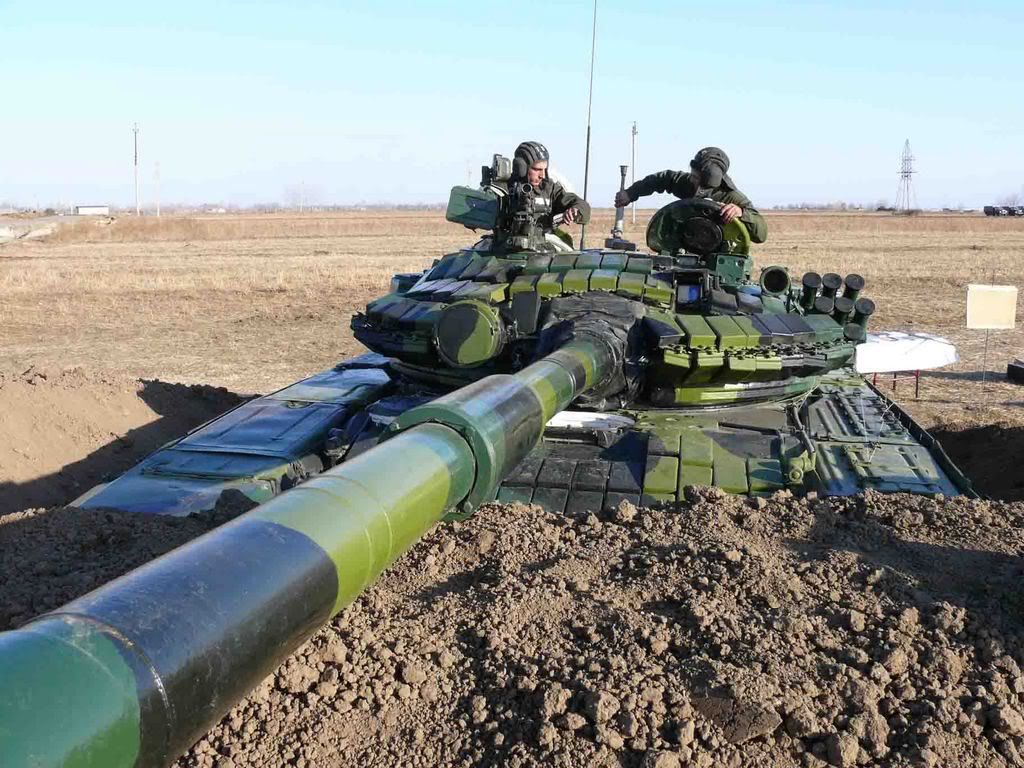
Since there was much more such equipment based in Azerbaijan, that country was able to gain control, through formal transfers and by bribing Soviet officers, of twice as much heavy ground equipment (such as tanks, armored vehicles, and artillery pieces) and more than 25 times as many combat jets, as did Armenia. Azerbaijan also received part of the Baku-based Caspian fleet, removing some of its heavy artillery to be used during the war.

According to an official mandatory filing made by Azerbaijan’s Foreign Ministry on November 6, 1993 to international organizations, Azerbaijan formally received from Russia 286 tanks, 947 armored vehicles, 388 large-caliber artillery pieces, 53 combat jets and 8 combat helicopters.

(By comparison, during the war [1992-94], Armenia received only two combat jets from Russia. One was misidentified and shot down by Karabakh Armenian forces. But an additional jet was gained when an Azeri air force pilot defected to the Armenian side.)

More equipment and much more ammunition were acquired by bribing former Soviet army officers serving at the time in Azerbaijan. And, according to Armenian sources, while the war was ongoing additional large-scale purchases of equipment were made abroad, giving Azerbaijan a theoretically significant edge in war-fighting ability.

But due to mismanagement and Armenian military successes, Azerbaijan lost nearly 200 tanks and at least 10 combat jets. Karabakh Armenians captured and subsequently repaired at least several dozen of the tanks.

* Post-war re-armament

Following the May 1994 cease-fire and conclusion of a Russia-Armenia military treaty, Armenia was able to convince the Russian leadership to make up for the initial disparity in weapons supplies.

Starting in the mid-1990s, Armenia received or purchased from Russia significant amounts of heavy ground equipment and associated upgrades. Russia also deployed modern MiG-29 jets and S-300 missiles at its military base in Armenia, giving Armenians some protection from Turkey’s significantly superior military capability.

Although Turkey has been Azerbaijan’s closest political ally, it is the former Soviet republics, particularly the Ukraine, which have been the main source for weapons, parts, and associated training for the Azeri military.

Last month, Ukrainian media confirmed earlier reports from Armenian officials that Azerbaijan is in the process of acquiring 14 MiG-29 aircraft from the Ukraine. This is a relatively modern Soviet-made air superiority fighter jet, which first entered service in the 1980s. Its primary purpose is to shoot down other planes, but it also has limited precision-bombing capability.

While the purchase price has not been made public, based on the past MiG-29 sales and associated upgrade and training needs, the cost of the transaction is likely to be anywhere from $200 million to over $300 million, making it the most expensive single acquisition for Azerbaijan to date.

In the past several years, Azerbaijan also reported purchasing half a dozen Su-25 fighter jets from Georgia, and hundreds of tanks, mostly from the Ukraine but also from Belarus, as well as artillery pieces including modern multiple-rocket launchers from the Ukraine.

* Current balance

Karabakh’s Army is not under international obligation to report on its holdings, and the Azeris are believed to be hiding much of their equipment to avoid accusations of violating the Conventional Forces in Europe Treaty. In terms of ground-based weapons, Azerbaijan and the combined forces of Armenia and Nagorno-Karabakh are believed to be about evenly matched. Total numbers disguise, however, the fact that Armenian equipment, with some exceptions, is more modern, better upgraded, and better maintained.

At the same time, Azerbaijan’s increasing oil revenue is giving it an opportunity to continue expanding its military build-up, thereby maintaining its superiority in the air and giving it a better and longer-range firepower capability that, together, may theoretically give its leaders enough confidence to launch a new military campaign.

As Armenia’s Defense Minister Serge Sargsian told Defense News last month, with more modest financial means Armenia is focusing on less expensive weapons to counter the build-up: better air defense to counter the aircraft, and anti-armor systems to counter tanks.

But the huge amount of equipment and some military-industrial capacity inherited from the Soviet Union by countries like the Ukraine, and associated economic pressures to sell as much of it as possible, means that Azerbaijan’s thirst for weapons will be met for years to come.

International mediators dealing with the conflict have so far failed to put in place an effective mechanism that could hinder the ongoing arms race. In fact, since 2001 the United States has lifted its arms embargo on Azerbaijan, following the waiver of Section 907 that banned U.S. military assistance to Azerbaijan. Moreover, as part of its policy to contain Iran, the U.S. is continuing a $100-plus million program to improve Azerbaijan’s military capability.

Azerbaijani-Turkish Forum plotting against Armenia; anti-denial case in Switzerland

Published on March 17, 2007

An Azeri-Turkish forum hatches anti-Armenian plots, as one Genocide denier is found guilty in a Swiss court
By Emil Sanamyan


WASHINGTON – Turkish Prime Minister Recep Tayyip Erdogan and Turkish Cypriot leader Mehmet Ali Talat on March 9 joined Azeri President Ilham Aliyev and hundreds of Turkish and Azeri nationalists to plot strategies against Armenians, according to reports in the Turkish and Azeri media.

The “First Forum of World Azerbaijani and Turkish Diaspora Organizations” included 513 delegates from 48 countries, including 173 Azeris, 140 Turks, 23 Iraqi [Turkoman], 14 Meskhetian Turks, and five Cypriot Turks, the Day.az news service reported. The largest delegations came from Turkey, Germany, the U.S., Russia, the Ukraine, Sweden, the Netherlands, Romania, Norway, and Lithuania.

“The world feels jealous of Azerbaijan’s and Turkey’s sharing both the grief and the happiness,” Erdogan was reported to say by the New Anatolian. “One of the architects of these relations, the great leader Heydar Aliyev, said Azerbaijan and Turkey are one nation in two independent states. This slogan came true,” Erdogan added.

Aliyev stressed the importance of the forum: “The world does not have full information about us. The powerful Armenian lobby is working against us,” Day.az reported. He promised continued state support to make the Azeri and Turkish diasporas stronger, in order to “undermine the work of the Armenian lobby.”

Contacted by the Reporter, Executive Director of the U.S.-Armenia Public Affairs Committee Ross Vartian predicted: “This effort will fail because it is based on hatred of Armenians, as opposed to promotion of either Turkey or Azerbaijan.”

Among a number of Turkish and Azeri officials who spoke at the forum, there were also several representatives from third-party countries. Day.az reported that the latter included the Lithuanian Parliament’s Deputy Speaker Gintaras Steponavicius, and parliamentarians from Latvia, Estonia, Ukraine, and Luxembourg, as well as officials from the Baltic States, Kazakhstan, Kyrgyzstan, Uzbekistan, and Bulgaria.

The forum adopted a joint strategy for the Azeri and Turkish diasporas. It also issued statements condemning Armenia, denying the Armenian Genocide, protesting countries that have recognized the Genocide, and appealing for Pan-Turkic unity on those and other issues (including Cyprus and northern Iraq).

Rovshan Mustafayev, who heads the state-funded Institute on Human Rights at Azerbaijan’s National Academy of Sciences, has long argued that Armenians should be treated “not as a nation, but as an organization.”

In an interview with Day.az, Mustafayev described the forum as the “beginning of a quite serious political assault in terms of propaganda of ideas and mobilization of forces in the struggle with Armenian terrorism.” He went on to say that “this enemy [i.e. Armenians] has become an ethnic corporation and is developing as a political network.”

Meanwhile, in Switzerland


At least a few dozen activists could not make it to the March 9 forum, as they flew to Lausanne, Switzerland, where veteran Turkish politician Dogu Perincek was tried and found guilty over his comments dismissing the Armenian Genocide as an “international lie.”

According to the California Courier, Perincek was joined by a planeload of supporters from Turkey, which also included deniers Justin McCarthy, Norman Stone, Jean-Michel Thibaux (a.k.a. Atakan Turk), and Paul Leidinger. Perincek also brought along what he described as 90 kilos (200 pounds) of materials denying the Armenian Genocide. In response, the Swiss prosecutor told the court that “90 kilos of paper do not wipe out 90 years of history; and one million pages cannot get rid of one million victims.”

In the end, Judge Pierre-Henri Winzap ordered Perincek to pay a fine of $2,450 to the court and to the Swiss-Armenian Association as “moral injury.” He was also given a suspended 90-day jail term and an additional fine of $7,360, under a 1995 Swiss law which bans denying, belittling, or justifying any genocide, Swiss and international news agencies reported.

Judge Winzap described the defendant as an “arrogant instigator” and “racist,” and the Armenian Genocide as an accepted historical fact. The publicity-conscious Perincek said that he would appeal.

Switzerland’s anti-racism legislation has previously been applied to Holocaust denial. According to the BBC, 12 Turks prosecuted in Switzerland on similar charges in 2001 were acquitted. The Swiss Parliament formally recognized the Armenian Genocide in 2003.

Sarkis Shahinian, co-president of the Swiss-Armenian Association, told SwissInfo there was “great relief” in the community. “The tribunal’s decision today confirmed the opinion expressed during parliamentary debates that the article of the criminal code in question does not only apply to the Shoah (Jewish Holocaust),” the association said in a statement.

In a release to the press, the Brussels-based European Armenian Federation said that the “Swiss legal victory paves the way for the Europe-wide legislation criminalizing Genocide denial.”

FWIB: Caucus Co-Chairs, U.S. AID and MCC in Armenia, USSD - human rights, FDA - Armenian water

Published in March 17, 2007

From Washington, in brief
By Emil Sanamyan


Armenian Congressional Caucus co-chairs weigh in on Armenia elections

In a letter sent to Armenia’s President Robert Kocharian dated February 23, and made available to the Reporter, Congressmen Joe Knollenberg (R-MI) and Frank Pallone (D-NJ) related U.S. officials’ concerns that “needed improvement [in upcoming elections] may not be achieved without a change in pre-election pace and emphasis by relevant Armenian authorities.”

The Armenian Caucus co-chairs acknowledged President Kocharian’s pledge to conduct free and fair elections, and offered to assist in achieving this outcome. At the same time, the congressmen warned that unless substantial progress is registered, the $235 million aid program to Armenia, under Millennium Challenge Account (MCA), could be suspended.

On the same day, Congressmen Knollenberg and Pallone sent a letter to Secretary of State Condoleezza Rice requesting a briefing on the U.S. pre-election assistance program in Armenia. Congressional sources familiar with the exchange told the Reporter on March 13 that while no formal response has been received, the State Department is “drafting a response” and promised to brief the congressmen “in the next several weeks.”

U.S. Aid administrator sees “great progress” in Armenia


Rep. Knollenberg reiterated his election-related concerns during the March 8 House Appropriations Subcommittee on Foreign Operations hearing with the director of U.S. Foreign Assistance, Amb. Randall Tobias. Rep. Knollenberg raised the issue of U.S. pre-election assistance to Armenia and asked if “the Armenian government could do more to ensure a free and fair election,” in part to guarantee the continuation of performance-based MCA assistance.

Amb. Tobias responded: “from everything I know about the [U.S. pre-election assistance] program it has been very successful. Armenia is a place that reflects significant progress in terms of the indicators measured by the Millennium Challenge Corporation.” While noting that more could certainly be done, Tobias stressed that “great progress has been made in Armenia.”

Another Subcommittee member, Rep. Adam Schiff (D-CA) questioned the Administration’s Fiscal Year 2008 budget request, which reduced Armenia’s allocation under the FREEDOM Support Act (FSA) to $35 million (a nearly 50 percent decline from the FY07 FSA allocation). Tobias countered that taking into account the $60 million that Armenia is due to receive under MCA in FY08, U.S. aid to Armenia, under both MCA and FSA, would “increase by 34 percent.”

Armenian-American organizations, however, do not find this rationale plausible. USAPAC Executive Director Ross Vartian stressed last month his opposition to the proposed FSA aid cut, arguing that the Administration should not be “counting the MCA grant against [other aid to] Armenia.”

State Department assesses Armenia’s human rights practices

The annual congressionally-mandated State Department report on the world’s Human Rights Practices was released on March 6. The report – accessible at www.state.gov/g/drl/rls/hrrpt – lists events involving potential human rights violations throughout 2006. While the report continues to describe Armenia’s overall record on human rights as “poor,” it also found that “implementation of constitutional reforms ratified in 2005 led to some increase in judicial independence.”

During his March 9 press conference in Yerevan, Armenia’s Foreign Minister Vartan Oskanian said in reference to the report’s Armenia chapter that “there is both recognition of the improvement of the situation on many issues, and serious, grounded criticism. At the same time, there are also factual mistakes in the report and subjective approaches to some issues, to which we will certainly draw the attention of the U.S. side,” Mediamax news agency reported.

Armenian water in America: One banned, another awarded

On March 7, the Food and Drug Administration (FDA) recalled the “Jermuk” brand mineral waters bottled by Armenia’s Jermuk Mayr Gortsaran, ARPI Plant and Jermuk Group, and warned consumers not to drink it. “FDA testing of this water revealed 500-600 micrograms of arsenic per liter,” the FDA release said, about 50 to 60 times the FDA’s “standard of quality bottled water.”

But according to Sean Carmody, the U.S. Department of Agriculture project director in Armenia, Jermuk is not dangerous, RFE/RL reports. “You have to drink around 20 liters of water a day [for the arsenic to have any impact]. It’s either a testing issue or a labeling issue,” he said.

Contacted by the Reporter, FDA spokesman Michael Herndon agreed that the product posed limited health risks. “In fact we modified our press release to reflect that ‘there is little chance that someone would become gravely ill if they consumed this product over a brief period of time,’” he said. Herndon said he would check if the ban could be rescinded after appropriate labeling changes are made.

Spokesmen for the companies involved stood by the water’s quality. But the director of Armenia’s National Institute of Standards, Yerem Chakhoyan, acknowledged to RFE/RL that Jermuk has higher than usual concentrations of arsenic. “The labels on Jermuk bottles make clear [that it is] medical water,” he said, meant to be consumed by individuals with intestinal problems.

* * *


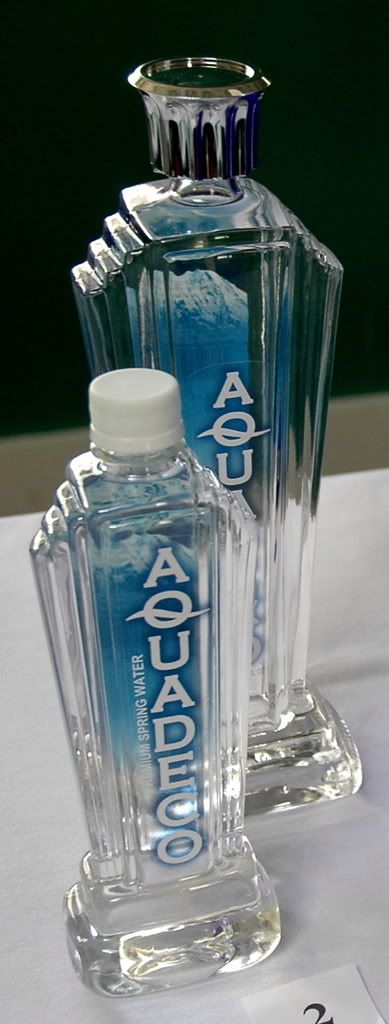
Meanwhile, the prestigious water-testing event held at Berkeley Springs, West Virginia gave one of its top prizes to water imported from Armenia. The “Aquadeco” brand received the gold medal for packaging. Aquadeco Vice-President Evan Cooper told the Reporter that the water comes from Aparan in Armenia’s Aragatsotn province (Jermuk comes from Vayots Dzor province).

“The bottle is made in Slovenia, the decorative caps are made in China, and the labels are printed in the U.S.,” Cooper explained. “All components are sent to Yerevan, where [the company] Waterlok’s plant is located,” and where the Aparan water is bottled.

“Our original plans called for the distribution of our product across the U.S., but getting regulatory approval in many of the states is very difficult, time-consuming, and costly,” Cooper said. “We still need to make some major modifications to the spring site in Aparan before we can start selling in the U.S.”