Emil Sanamyan's articles on Armenian-Americans, Armenia and its neighborhood.

Saturday, July 7, 2007

Nagorno Karabakh hosts an official Azerbaijani delegation

First published on June 30, 2007 in the Armenian Reporter

News Analysis:
Independent Karabakh hosts first-ever visit by Azerbaijani official
Will trip herald a departure from existing Armenian-Azerbaijani tensions?
By Emil Sanamyan


WASHINGTON – In a major departure from long-standing policy Azerbaijan sent a delegation to Nagorno Karabakh on June 28, where it was received by President Arkady Ghoukasian. The visit became a sensation in Azerbaijan, where the public has long been banned from visits to Karabakh and discouraged from any contacts with ethnic Armenians in general.

The group, comprising Azerbaijan’s Ambassador to Russia Polad Bul-Bul-ogly and heads of major state institutions then proceeded to Yerevan for a meeting with the President of Armenia, and later on the same day a similarly composed Armenian delegation went to Baku to meet the President of Azerbaijan.

At a press conference on June 29, Armenia’s Foreign Minister Vartan Oskanian said that the visit was agreed upon during the most recent meeting between Presidents Robert Kocharian and Ilham Aliyev in Saint Petersburg on June 10.

But both Armenian and Azerbaijani governments kept the plan secret until after the Azerbaijani delegation departed Stepanakert.

President Ghoukasian welcomed the visitors. Arminfo news agency quoted him as saying “How can we settle a conflict without speaking [with each other]? When we are told [by Azerbaijan] ‘You must do this, or we will go to war with you,’ this does contribute to mutual trust, but in fact has the opposite effect. We should proceed from international standards of settling problems."

Amb. Bul-Bul-ogly told journalists that the visit aimed at building that missing trust. "Our generation lived together, at least in the Soviet Union, and not everything was so bad, as is presented today,” the Regnum news agency quoted him as saying. “Our generation knows one another, and while we are still around we need to develop a dialogue, contacts, openly express our opinions, find ways out, compromises."

Bul-bul-ogly added that there is a need for more contacts between journalists, parliament members and other representatives. "We need to pick people, who can communicate with each other in a tolerant way, express their views, and look for mutual interests, those opportunities that serve to resolve the crisis."

To date, no Azerbaijani official has ever made a public visit to NKR and Azerbaijan has refused to engage in confidence-building measures with either Armenia or NKR.

As a matter of policy, ethnic Armenians, no matter their citizenship or political views, are still barred from entering Azerbaijan. One Aze4ri official recently suggested legally banning all Azerbaijani citizens from visiting Armenia or Karabakh.

Even individual Azerbaijanis who went to Karabakh were harassed as “traitors.” An Azerbaijani journalist Eynullah Fatullayev who visited Karabakh in early 2005 was imprisoned earlier this year on charges related to an article he wrote after his visit.

Dispatching an official delegation to “build bridges” in Karabakh is a significant diversion from this policy, although it is yet unclear if it will lead to a more positive tone in the Armenian-Azerbaijani dispute.

Significantly, in addition to being his country’s Ambassador to Russia, Bul-bul-ogly is a widely recognized name in Azerbaijan. He is a son of a locally reknowned Azeri folkloric singer (whose grave in Shushi Bul-bul-ogly reportedly visited during the trip), and himself achieved celebrity status as a singer and actor in the 1970s and 80s. From 1988 to 2006 he was Minister of Culture.

The visit was met with incredulity in Azeri media, with Zerkalo, one of the better known local newspapers, leading with a headline “Shock!” the next day.

Vafa Gulizade, a top advisor to the late President Heydar Aliyev, condemned the visit as “an unacceptable step.”

Other commentators see President Aliyev following the example of Georgia’s President Mikhail Saakashvili who has adopted a more conciliatory rhetoric towards breakaway provinces of South Ossetia and Abkhazia. They see the visit as an effort to placate international mediators long annoyed with Mr. Aliyev’s war-mongering, while making Armenians more willing to discuss unilateral compromises.

Yet other Azerbaijani commentators suggested that President Aliyev’s war threats have always been hollow. With official talks essentially stalled, these commentators believe that Mr. Aliyev is looking for a new policy that would provide an excuse both not to deliver on the threats and not commit to unpopular compromises.

Whatever the original intention, this visit can have a positive impact on the mutual climate and lead to more dialogue and possibly even some mutual confidence-building.

Amb. Perina to become Charge in Armenia

First published on June 30, 2007 in the Armenian Reporter

Retired diplomat is to take temporary charge of the U.S. Embassy in Yerevan
by Emil Sanamyan


WASHINGTON – The State Department has dispatched a veteran U.S. diplomat to lead the Embassy in Yerevan for the next few months as the acting chief of mission is preparing to depart.

Ambassador Rudolf Perina will be in Armenia not as ambassador but as chargé d’affaires ad interim. Amb. Perina’s arrival, which is expected on July 10, was welcomed by former ambassador to Armenia John Evans, who told the Armenian Reporter that Mr. Perina was “a good friend” for whom he had “highest respect.”

“The U.S. Embassy will be in good hands,” added Mr. Evans, who was forced to leave Yerevan on September 10, 2006, and retire from the Foreign Service because of remarks he made in 2005 affirming the Armenian Genocide.

Ambassador Richard Hoagland remains the formal ambassador-designate for Armenia, even though his candidacy has been blocked in the Senate since last September. A chargé d’affaires leads a diplomatic mission in the absence of a confirmed ambassador.

Sources familiar with details of the appointment suggested that Mr. Perina will remain in Yerevan for six and 10 weeks. For Mr. Perina, this would become a second such assignment. From May to September 2006, he led the U.S. Embassy in Moldova until the arrival of a permanent ambassador.

Mr. Perina’s appointment is intended to ensure the smooth handover of responsibilities from outgoing chargé d’affaires Anthony Godfrey to Joseph Pennington, a State Department official who will be arriving in Armenia later this summer. Mr. Pennington, like Mr. Godfrey, would be deputy chief of mission if an ambassador were present.

Mr. Perina has been called back from retirement after a 32-year career with the Foreign Service. Mr. Perina served as the State Department’s deputy director for policy planning (2004–2006), U.S. special negotiator for Karabakh (2001–2004), and ambassador to Moldova (1998–2001).

“By appointing Ambassador Perina as chargé d’affaires, the State Department took into account his rich experience and knowledge of Armenia as well as his personal and business ties with top Armenian leaders, which will contribute to continuity in our bilateral relations with Armenia,” a U.S. Embassy spokesperson told RFE/RL.


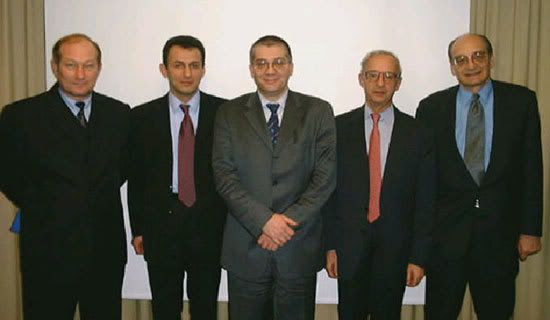
Caption: Amb. Perina on right with fellow Minsk Group co-chairs Nikolay Gribkov (1st from left) and Henry Jacolin (2nd from right) and then–Armenian and Azerbaijani deputy foreign ministers Tatul Markarian (2nd from left) and Araz Azimov (center). Mr. Markarian has since been appointed to lead the Armenian Embassy in the U.S. November 26, 2002. Photo: Geneva Center for Security Policy.

Majority of House members support Armenian Genocide resolution

First published in the Armenian Reporter on June 30, 2007

A majority in the House backs Armenian Genocide resolution
An unprecedented level of support
by Emil Sanamyan


WASHINGTON – As of June 29, 219 of 435 members of the House of Representatives support House Resolution 106, which affirms the U.S. record on the Armenian Genocide, according to the official record maintained by the Library of Congress. A simple majority of the members of the House is 218.

More than 20 co-sponsors signed on to the resolution in the last two weeks, bringing the resolution this unprecedented level of support.

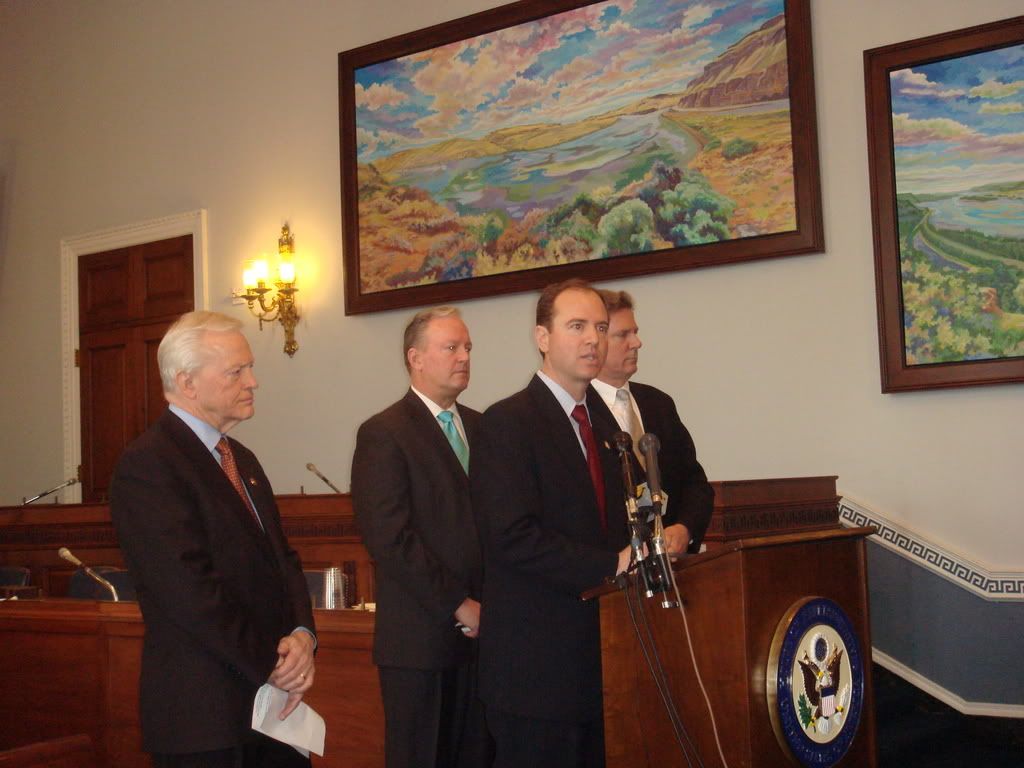
The resolution was introduced in late January by Representatives Adam Schiff (D.-Calif.), George Radanovich (R.-Calif.), Frank Pallone (D.-N.J.), and Joe Knollenberg
(R.-Mich.). It was referred to the House Foreign Affairs Committee, but the committee’s chair, Rep. Tom Lantos (D.-Calif.) has yet to bring it up for committee consideration.

Congressional supporters and Armenian-American organizations, including the Armenian National Committee of America (ANCA), the Armenian Assembly, and the U.S.-Armenia Public Affairs Committee, have been working to gain supporters for the resolution. If a majority of members sign onto the bill, supporters believe, Speaker Nancy Pelosi and Majority Leader Steny Hoyer may bring the resolution directly to the House floor, where it seems assured of passage.

Some of the Armenian community’s ardent supporters in the House have been stepping up efforts in recent weeks. Among the many examples, Reps. Schiff, Radanovich, Pallone, and Knollenberg have been enlisting additional co-sponsors among their colleagues. Reps. Donald M. Payne (D.-N.J.) and Frank R. Wolf (R.-Va.) sent around a “Dear Colleague” letter urging members to sign on.

USAPAC has been working closely with Rep. Tim Walz (D.-Minn.), vice-president of the Freshman Class in the House, who has been recruiting fellow freshmen as cosponsors.

“I am thrilled that the resolution recognizing the Armenian Genocide reached a critical mass of 218 co-sponsors today,” Mr. Walz said. “As someone who taught genocide studies, I know that we must acknowledge genocide whenever and wherever it
happens, regardless of international politics. We must work to curtail future genocides by not only addressing the cultural, economic, and religious factors that
often contribute to these atrocities, but also by learning from past genocides. To learn from our past requires at a bare minimum that we acknowledge the past, which is what this long overdue resolution will do in the case of the Armenian genocide.”

The ANCA reported on June 28 that thousands of people participated in a call-in campaign it organized in a push this week to reach the majority.

When the number of co-sponsors tipped into a majority, Rep. Schiff said: “In gaining 218 cosponsors, we have demonstrated that a majority of the House strongly supports recognizing the facts of the Armenian Genocide. While there are still survivors left, we feel a great sense of urgency in calling attention to the attempted murder of an entire people. Our failure to acknowledge these dark chapters of history prevents us from taking more effective action against ongoing genocides, like Darfur.”

Earlier, at the 200 co-sponsors mark, Rep. Schiff had also called recognition of the Genocide “a moral imperative.

In Brief: U.S.-Armenia military talks; film about Karabakh war; Genocide affirmation in Canada, Swirtzerland

First published in the Armenian Reporter on June 30, 2007

From Washington, in brief
by Emil Sanamyan

U.S.-Armenia military consultations held in Washington


On June 27-28, an Armenian Defense Ministry delegation visited with counterparts in the Pentagon for annual talks on security issues. Delegation head Gen. Mikael Melkonian, who directs the ministry’s international cooperation division, told the Armenian Reporter, “the bilateral defense consultations are intended to review the cooperation of the last two years and discuss projects for following years.”

The delegation held talks with the deputy assistant secretary of defense for Europe and NATO, Dan Fata, and other U.S. officials. They also went to the Walter Reed hospital to talk with Capt. Georgi Nalbandian, who is completing his rehabilitation treatment there after being seriously wounded in Iraq.

After that visit, Gen. Melkonian thanked the hospital staff for the care provided to Capt. Nalbandian and expressed certainty that the officer will soon return to active duty in the Armenian army.

Before arriving in Washington, the delegation visited the U.S. Defense Language Institute in San Antonio, Tex., where sixteen Armenian officers now study.

PBS program previews Karabakh war film

A Story of People in War and Peace, a documentary by Yerevan film director and war correspondent Vardan Hovannisian, was previewed on a public television (PBS) program on June 17. “Foreign Exchange with Fareed Zakaria” (http://foreignexchange.tv) aired a five-minute cut of the hour-long film about the conflict it described as “an unsolved remnant of Soviet Union’s demise.”

To accompany the film excerpt, Zakaria’s show editors misquoted a factually flawed CIA fact book, describing the war as stemming from Armenia’s “territorial claims” and resulting in a “land grab.” Zakaria is an editor of Newsweek International and a prominent Washington commentator.

Hovannisian’s documentary has won awards at European and U.S. film festivals and is due to be shown in full by Documentary Television, available via U.S. Dish Network, Channel 197.

Canadian government, Swiss court stand ground on affirmation

Prime Minister Stephen Harper of Canada reaffirmed his country’s policy on the Armenian Genocide. In comments delivered at the National Ethnic Press and Media Council of Canada (NEPMCC) on June 15, Mr. Harper said, “Canada’s recognition of the Armenian Genocide . . . is the position of the Government of Canada,” the Armenian National Committee of Canada reported on June 19.

Mr. Harper also called “unacceptable” any foreign government’s efforts to pressure the Canadian government and media not to affirm the Genocide.

A Swiss appeals court upheld on June 20 the conviction against the leader of the Turkish Workers’ Party Dogu Perincek, The Associated Press reported the same day.
On March 9 a Lausanne court sentenced the veteran Turkish politician to a fine under Swiss anti-racism laws for denying the Armenian Genocide, a ruling protested by the Turkish Foreign Ministry. Mr. Perincek’s lawyer said he would continue the appeals process.

Conversation with former Iraq relief worker Danny Dedeyan

First published in the Armenian Reporter on June 23, 2007


Interview: Former Iraq relief worker Danny Dedeyan urges U.S. not to abandon the country

From Washington editor Emil Sanamyan: Danny Dedeyan and I first met one rainy night holding vigil outside the Turkish Embassy in Washington in April 2005. It wasn’t until two years later when we met again and Danny told me that he just came back from working in Iraq – that country that has been on the minds of many Americans for the past five years.

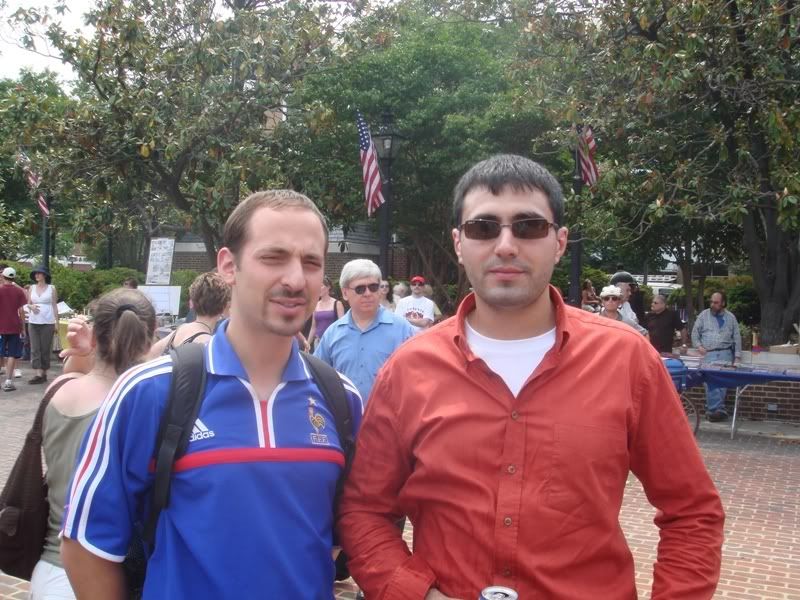
Danny Dedeyan (l.) with Armenian Iraq war veteran Georgi Nalbandian

Danny Dedeyan
Born in 1978 in France, Danny is from a family of Armenian Evangelicals. He has Bachelor’s degree in history and Spanish from the University of Texas in Austin (2001) and Master’s degree in international affairs from the George Washington University in Washington, DC (2005). Since first arriving in Washington Danny interned at the Embassy of Bolivia and the Center for Strategic and International Studies (CSIS) and worked on the staff of Sen. Kay Bailey Hutchison (R-Tex.). After several months as a humanitarian assistance advisor for the U.S. Marine Corps in Quantico, Va., Danny joined one of the large U.S. government contractors dealing with humanitarian issues in Iraq.


When we talked again on June 8, 2007, I asked him: How did you end up going to Iraq? Part of the reason, Danny said, was that he received a U.S. government fellowship towards his master’s degree.

Dedeyan: I had a requirement to work for the federal government at some point in six years after graduating. But being as methodic as I am, I wanted to fulfill the requirement as soon as possible. And I did that working for an organization with projects funded through the U.S. Agency for International Development grants. And that was in Iraq.

Reporter: But you must have seen things on television about the situation there. That did not stop you from going?

Dedeyan: I studied conflicts and conflict resolution in college, and being in DC you run into the development sector a lot. It’s become an industry in itself, these [non-government organizations] NGO’s [working on federal grants abroad]. And post-conflict reconstruction really grabbed my attention.

So, I was interested in humanitarian aspects of conflict and this was an opportunity to get directly involved in that, with field experience. Since I was out of school, I thought it would be a good idea.

May be I am not like everybody, but there is always a sense of adventure, when you go into the field, especially when there is conflict. But that was not necessarily the reason why I went.

Reporter: By the time you went there in late 2005, things looked pretty bleak for Iraq. Was it obvious by then that things were not about to get better?

Dedeyan: Actually, [already] by the end of 2004 is when it looked really bad. I think that there was no question that this was for a long haul as far as stabilizing the place. The disappointment that I think everyone had, and I personally had, is more in the approach and lack of adjusting than actually being there in itself.

In other words, I am more saddened about us, as the U.S., not being able to learn lessons from Iraq, than our involvement in the first place.

As someone who worked in Iraq, I am often asked here if I am for or against the war. For me that is not relevant anymore. Was I for it [in 2003]? I was kind of torn actually, but I did not dismiss [the case for it] out of hand. I thought involvement was good, but not necessarily this war.

But back to your question, yes by 2005 things were not good and by then most NGO’s have left Iraq. There were not many doing what we did.
Reporter: Which organization did you work for?

Dedeyan: For reasons of physical security, our organization like many others working in Iraq, does not want to advertise its presence there. But it was a fairly large humanitarian operation, working with Iraqis every day.

Reporter: You said that by 2005, many of the contractors have pulled out of Iraq, but there is still a sizable U.S. civilian presence there, no?

Dedeyan: Well, in Iraq there is a differentiation between what we call contractors or for profit companies and non-profit NGO’s. There were a lot of contractors, but fewer NGO’s.

The NGO’s work with less overhead, which leaves them with a few downsides, such as less investment management, less safety to the individual worker, but usually an aid worker is interested in being as close to the project as possible. Whereas contractors are typically servicing the U.S. military and are insulated from what is going on in the country being in sealed security compounds.

In Baghdad, the contractors work primarily out of the so-called “Green Zone” which is a walled-in and relatively well protected area of Saddam-era administrative buildings near the Tigris River.

Living in Baghdad

Reporter: Is that where you worked as well?

Dedeyan: No, my set up was a lot more modest. It was a low profile approach. It was in a Baghdad neighborhood. The idea was that you can’t do anything effective at a distance.

I and a very small number of expatriates rented several apartments in a building, that’s where we both lived and worked. We had our own security procedure and our armed bodyguards. We knew the people in the neighborhood rather well. So, we looked after each other and tried to help each other out.

My own personal situation was that I could stay in the same building for weeks on end, without going out into the street. My office was across the hall from my bedroom. So, I worked, ate and slept in the same place with the same people. So, it was kind of a tight compound life.

After a while it became like sur-reality TV show. But in the end, we had a very good rate in terms of lack of attacks against us.

Reporter: Was this an unusual arrangement or did other NGO’s have something similar?

Dedeyan: There used to be a lot. There were a few neighborhoods to which a lot of NGO’s flocked in 2003 and they did this kind of thing, where they rented places and made their offices there. People had a lot more freedom to move around. They would get out regularly, go party somewhere.

But by 2004, when aid workers began to be attacked directly, NGO’s had to move, close offices or leave Iraq all together. By 2006, Baghdad became a city where there is no place where you are safe. In other words safe from shootings or explosions, things that are unusual in a normal city.

That being said we were not in the middle of Baghdad’s worst neighborhoods.

Reporter: Was you work also concentrated where your office was located?

Dedeyan (2nd from right) with local officials and others.

Dedeyan: No, the work typically was somewhere else. We were involved in several governorates [provinces] in Iraq, not just Baghdad, but also the north, including Irbil. Our focus was the local primary healthcare systems, as well as water supplies.

Reporter: At what point did you feel especially in danger?

Dedeyan: Traveling is the most dangerous. And you have to travel if you want to see your project sites. The airport road is particularly dangerous. I’ve driven between snipers and Marines firing at each other, in the middle of it.

A few times I snuck out just to shop for like shoes and stuff. And it was kind of comical. I can fit in pretty well, versus some other expats. A lot of people thought I was Kurdish. But a huge bodyguard going around with you obviously gives you away.
Anyone who has worked in some of these neighborhoods in Baghdad will tell you that if they made it out, they still jump if they hear a door slam. I would wake up regularly because bombs were waking me up. And if it’s close, your windows shake and shatter. So that was part of my daily life.

And in order not to go crazy, a lot of Iraqis just go on about their business as if nothing is happening. Imagine, there is no child in Baghdad that has not seen violence first hand. Several generations have already been traumatized, even if the violence stops now. It is a real disaster.

Local Christians fleeing en masse

Reporter: How are Armenians and Christians in general coping with the violence there? There are still about 10,000 ethnic Armenians in Iraq, right?

Dedeyan: Part of my work was to look out for whatever different groups that were there and to make clear to everyone that we were not helping anyone more than another. But that is always difficult, because there are always groups that are more predominant in different areas and are more in need.

Over the last two years, Christians have left Baghdad en masse. You have a number of Assyrian, Chaldean and several Armenian churches in Baghdad and one way to see what is going on with the communities is through church attendance and that has gone way down. There were also a lot of Christians in the northern city of Mosul, and many of them left that city as well.

I don’t think anyone has a good estimate on how many people are still left. Many of the Christians that are in Baghdad now don’t have the means to move. Others who could not leave the country went to Kurdish-controlled Erbil and Dohuk. Those that had the means left the country as soon as they could, especially if they were targeted. A number of Christian missionaries working in Iraq were also killed.

Reporter: Did you meet any Armenians while you were there?

Dedeyan: No, the most I did was to talk to a couple of Armenians on the phone. That’s when the security situation kicked in and my colleagues did not want me going out to the local churches.

Experiencing Armenia

Reporter: Were you ever in a conflict zone before?
Dedeyan: The only other conflict area I have been to is Karabakh. I went in 2003, together with a small Armenian language class of Prof. Kevork Bardakjian [of the University of Michigan]. Obviously, there has been a truce there for many years and although the conflict is not completely resolved, the attitude there is that the war is over, finished and we won.

In Stepanakert, I talked to college students and their concerns were more with Karabakh’s isolation from the rest of the world and the need to overcome that.
It was my first-ever trip to Armenia and, as I think for any Armenian, it was very significant for me. You have a sense of going back to your roots. And I am the only one in my family to have gone back there.

So, honestly, going there you get this feeling of almost apprehension, you are sort of curious about how the locals receive a Diaspora Armenian. You ask yourself: How close can I get to them, will they see me as one of their own?

Sometimes you talk to various Armenians in the Diaspora and hear different views. Some say: oh, they were not very nice to us, and others say: they feel like we abandoned them. And other Western Armenians felt like the locals went down on them for whatever reason.

I did not find that at all. Obviously there were times when I was the tourist – so people like tourists, because they bring money. But the hospitality was pretty overwhelming, a nice surprise almost. [And the attitude was] very much like: We are all Armenians, forget about the differences.

Leaving Iraq

Reporter: So you left Iraq after your contract was up?

Dedeyan: Yeah. I finished my contract. I could stay longer and I thought about doing that. I was glad that I was part of a team that had an impact. But when you really look at your work in the general context, you feel like it was really a drop in the bucket.

I would tell anyone interested in Iraq: don’t turn away from Iraq! Don’t say: it is not my problem. That’s how I am afraid things will wind up in Iraq.

I didn’t go there to make money. And definitely one of the hardest things for me was to leave Iraq, because you get a feeling that you are abandoning people. They become family: Sunni, Shiites, Christians, you have gone through something together. [When you say goodbye] you see adult, hardened guys crying.

But when my contract was up, I felt that for my own sanity it was time to take a break.

Reporter: Has it been difficult getting used to normal life?

Dedeyan: Well, I took a long break from work. I adapt pretty well to different situations. I know other people who have gone through the same experience have difficult time adapting. Some of them were pushed to a point where they lost it.

I have nights when I can’t sleep and I probably would never be able to really explain my experience there to someone who was not there. But the trauma is certainly worse for soldiers who are coming back, having experience with violence and danger in the streets day in and day out.

Part of my ability to adapt here is that I was able to keep my sanity there. To do that I had to put things in broad perspectives – my laid back [nature] helped, but also my faith which prepared me to accept the world as it is. I don’t have illusions about the world not having a lot of evil or injustice.

And that God put me in this world to carry my light, if you will.

In Brief: Armenians about China and U.S.; think tank ratings; nuclear energy, Washington diplomat(s)

First published in the Armenian Reporter on June 23, 2007

From Washington, in Brief
by Emil Sanamyan


Polls: Armenians trust China over U.S.; prefer independence to regional alliances

A study jointly commissioned by www.worldpublicopinion.org and the Chicago Council on Global Affairs, released in Washington on June 14, found that 46 percent of respondents in Armenia trust China “to act responsibly in the world”; only 39 percent trust the United States to do so.

The surveys found more trust in the United States among people in Israel (81 percent), Australia (59), Poland (51), and Ukraine (49), and less trust among people in France (28 percent), Russia (20), Peru (17) and Argentina (less than 16).

Meanwhile, Armenians more than their former Soviet counterparts prefer living “in their own state without unifying with any other state or joining alliances of states,” according to a survey of six ex-Soviet states conducted by the All-Russian Center for the Study of Public Opinion (www.wciom.ru), released on June 18. (See this column in the June 16 Reporter for earlier findings.)

Of 1,023 respondents in Armenia 41 percent preferred this option; 24 percent wanted Armenia to join a Russia-dominated alliance; 23 percent, to join the European Union (EU); and 12 percent, to remain in the existing Commonwealth of Independent States (CIS).

The results show a significant change in popular attitudes from the 1990s, when a closer alliance with Russia was believed to be much more popular. Still, a U.S.-funded opinion poll conducted last year showed that large majorities wanted Armenia both to stay a CIS member and join the EU, probably seeing such arrangements as not contradicting the country’s independence.

Armenians’ EU aspirations were found to be similar to those in Belarus and Ukraine, at 23 and 22 percent respectively, with respondents in other countries less interested. Most interested in living in a new Russia-dominated union were Kyrgyz respondents (62 percent).

Washington think tanks rate the world

U.S. studies that rank countries worldwide by various categories continue to proliferate.

A relatively new “Failed States Index” by Foreign Policy magazine and the Fund for Peace (www.fundforpeace.org) most recently issued on June 17 determined that 129 of 177 countries studied were failing to one degree or another judged against political, social and economic benchmarks, such as “Legacy of Vengeance-Seeking Group Grievance or Group Paranoia” and “Intervention of Other States.”

In that study, Armenia was 112th from the bottom – also failing but to a less extent than its neighbors Turkey (92), Azerbaijan (62), Georgia (58), and Iran (57). Predictably, Sudan, Iraq, and Somalia were put at the top of the failed states list, with Norway, Finland, and Sweden doing the best.

And on June 14, Freedom House (www.freedomhouse.org) issued its “Nations in Transit 2007” report, which focused on events in post-Soviet states through the end of last year. The study broadly determined that there was a “crisis of governance” in Central Europe and “increased repression” in the ex-USSR.

The Armenia section, prepared by Anne Walker of the Economist Intelligence Unit, concluded that the status of Armenia’s independent media and national democratic governance worsened in 2006, with overall Democracy Score climbing to 5.21, worse than at any point since 1999. [The Armenian Reporter's editorial for May 12 discussed shortcomings in Freedom House's information-gathering and evaluation process and argued that the conclusions regarding the media in Armenia were incorrect.]

Georgia interested in nuclear energy; looks to Armenia’s plans

Armenia’s northern neighbor has expressed interest in “the possibility of constructing a civil nuclear reactor in Georgia,” according to that country’s ambassador to France, Mamuka Kudava, www.civil.ge reported on June 15. The issue reportedly came up during the Georgian president’s visit to France last week, with French leaders reportedly ready to study it.

But commenting on the report, Georgian Prime Minister Zurab Nogaideli linked his country’s nuclear energy plans to those of Armenia. “The issue concerns possible replacement of the old Armenian nuclear reactor with the new one,” he said and added, “So talks about where this new reactor will be located – it will be in Armenia, or in Georgia, or whether it will be constructed at all – are too early.”

Armenian leaders have described building a new nuclear power plant as a priority and have began preliminary discussions on the issue with the U.S. and Russian governments.

NKR representative to Azerbaijani ambassador: Time travel is not possible

“For Nagorno Karabakh to go back to being part of Azerbaijan, somebody needs to bring back Joseph Stalin, who gave Karabakh to Azerbaijan in 1921 against our will, and the Soviet Union, which forcefully kept Karabakh inside Azerbaijan,” NKR’s Washington representative Vardan Barseghian said in a letter to the editor published by the Washington Diplomat (www.washdiplomat.com) on June 8.

The letter came in response to the newspaper’s interview with Azerbaijan's ambassador to the United States Yashar Aliyev, where he suggested that “there is no disputed territory between” Armenians and Azerbaijanis. “There is just aggression on the part of Armenia toward my country.... They are trying to take it from us,” Amb. Aliyev complained.

The Washington Diplomat is a newspaper dedicated to the U.S. capital’s diplomatic corps.

In Brief: Human Trafficking, Turkish public attitudes, Turkey and Kurdistan, Gabala radar, U.S. and Kosovo

First published in the Armenian Reporter, June 16, 2007

From Washington, in brief
By Emil Sanamyan

Armenia still on U.S. trafficking “Watch List”


The U.S. Congress passed the “Trafficking Victims Protection Act” in 2001, mandating that the State Department issue annual reports that rate the world’s efforts to counter human trafficking (primarily for the purposes of forced labor and prostitution). The most recent report was issued on June 12.

In accordance with the Act, the annual “Trafficking in Persons Report” puts countries into three “tiers.” The Act envisions U.S. aid cuts to countries repeatedly placed in the Tier 3 category. This year these countries include those already sanctioned by the U.S. for other reasons (for example, Iran) or countries too rich to need U.S. assistance (Saudi Arabia and other Persian Gulf petro-states). This year, too, Georgia was for the first time included in Tier I as “fully complying” with the Act.

Since the report began being issued, Armenia has been included (along with most of the world) in Tier 2. Countries in this tier do not meet U.S. standards on fighting trafficking, but “are making significant efforts to do so.” But since 2005, Armenia has been relegated to the report’s “Watch List,” just short of Tier 3, which also includes Russia, the Ukraine, and Moldova – all major sources of trafficking victims.

In its interim assessment released on January 19, the State Department encouraged Armenia and 38 countries to take additional measures to address trafficking issues in order to be removed from the list. In the end, although the U.S. acknowledged “moderate improvements” in Armenia, it described the government’s prosecution of officials allegedly involved in trafficking-related corruption as “inadequate.”

The June 12 report justified keeping Armenia on the “Watch List” “because of its failure to show evidence of increasing efforts over the past year, particularly in the areas of fighting trafficking-related corruption and providing victim assistance.” Connect to www.state.gov for the complete report.

Professor uncovers U.S.-based anti-Armenian propagandist


In articles first published last month by the Istanbul Armenian Agos newspaper, one of the world’s leading experts on the Armenian Genocide, University of Minnesota History Professor Taner Akçam, revealed the identity of one of the Internet’s most active Genocide deniers: 50-something cartoonist Murad Gunem.

Under the pen name “Holdwater,” Mr. Gunem has gained notoriety through his “Tall Armenian Tale” website, where he routinely targets Turkish intellectuals who acknowledge the Genocide (such as Prof. Akçam), compares Armenians to rodents, and widely quotes the late disbarred lawyer Sam Weems, who penned an anti-Armenian hate book in 2002 that has since been distributed by the Turkish lobby.

Prof. Akcam determined “Holdwater’s” identity as Gunem through his reference to a letter he wrote to then-President Jimmy Carter in 1980 and subsequent correspondence, which was made available to Prof. Akcam by the U.S. government archives. Connect to www.muradgumen.org for more on the story.

Poll: Turks see U.S. as the biggest threat to their security

When asked to name the source of the most imminent threat to them, more Turks identify the U.S. than any other country, according to an opinion poll cited by Turkey’s Zaman newspaper on June 11.

According to a poll conducted on behalf of the Istanbul-based Bilgi University, more than 35 percent of respondents said the U.S. is the greatest threat to Turkey, followed by Iraqi Kurdistan with over 25 percent.

Less than 3 percent thought that Armenia posed a serious threat. That was fewer than those who named the European Union (5.5 percent), Israel (4.2), and Iraq (3.4), but more than those who named Iran (1.5).

More than 71 percent said that Turkey has no friends or significant allies, and a full half of the respondents believe that the European Union wants to divide Turkey.

When asked about issues that “would not befit their national values,” 45 percent Turks polled named atheism, 38 percent said being Christian or Jewish, 23 percent said homosexuality, 21 percent said communism, 19 percent said radical Islam, and 8 percent said extreme nationalism.

Turkish government opposes invasion of Iraqi Kurdistan


“There are 500 terrorists in Iraq; there are 5,000 terrorists inside Turkey. Has terrorism inside Turkey ended for us, to [allow us to] think about an operation in northern Iraq?”

Turkey’s Prime Minister Recep Tayyib Erdogan asked this question rhetorically on June 12 in reference to Kurdish rebel forces and in apparent defiance of the Turkish military’s calls for invasion, the Turkish Daily News reported the next day.

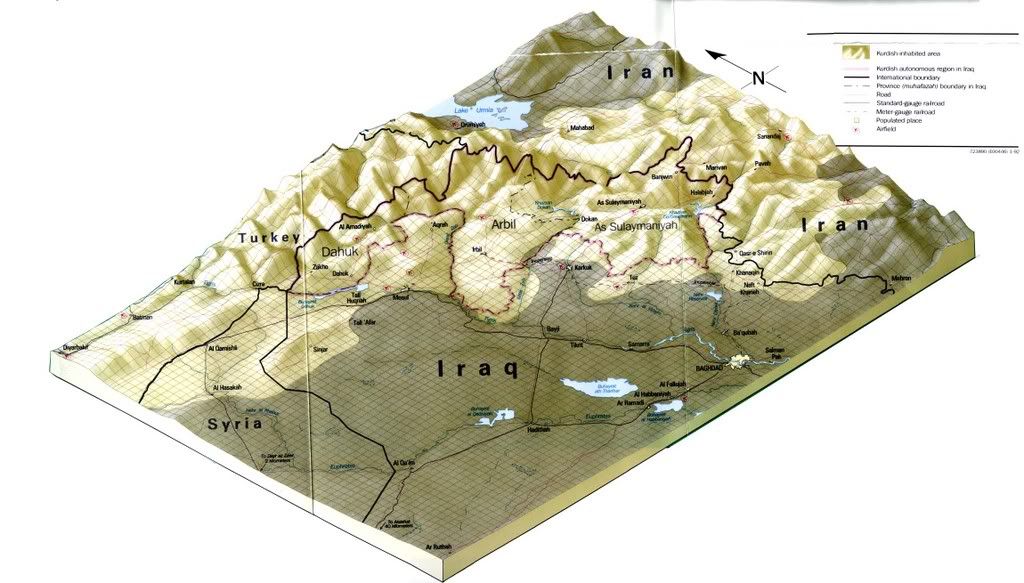
Tensions along the border with Iraqi Kurdistan rose as the Turkish military launched aerial and artillery attacks on Kurdish-held border areas and threatened a larger invasion strongly opposed by the United States (see this column in the June 9 Reporter). Iraqi Kurdish and Shiite leaders warned of a full-scale war in the event of invasion.

The Turkish build-up came amid an increased number of Kurdish attacks inside Turkey and just over a month before general elections, in which the nationalist military establishment hopes to unseat the relatively more moderate Erdogan government.

A number of Turkish commentators have linked the Turkish military’s show of force to efforts to discredit the government as weak on security. But according to the latest polling data, Erdogan’s Justice and Development Party is still close to winning enough votes to form a new government single-handedly.

Also on June 12, the Kurdistan Workers’ Party declared a unilateral cease-fire with Turkey. “We will not carry out attacks other than for self-defense,” its statement said.

Experts: Russia’s Azerbaijan radar offer doesn’t make technical sense

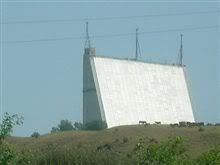
The little-known Russian military base in Azerbaijan was thrust into the news last week, when President Vladimir Putin offered the U.S. “joint use” of its early warning radar instead of building new radars in Central Europe (see this column in the June 9 Reporter). President George W. Bush and his officials found the proposal “interesting” and suggested that experts look into it.

Since then, at least two military experts questioned the feasibility of the radar’s use by the U.S.

On June 8, Duncan Lennox of the London-based Jane’s Strategic Weapons Systems told Radio Liberty that “the problem is that if you have the radar too close to the launch point [as the one in Azerbaijan is to neighboring Iran], the missile will overfly that radar and will then be going away from the radar.” It would thus be unable to guide interceptors to shoot down such a missile, and would only be useful in providing an additional early warning of a missile launch.

And in the June 13 issue of the Eurasia Daily Monitor published by the Washington-based Jamestown Foundation, one of Russia’s top military experts Pavel Felgenhauer noted that the purpose of Russia’s radar in Azerbaijan is to detect U.S. missile launches from the Indian Ocean, not those from Iran’s territory. This radar “cannot be moved, it cannot be retargeted,” he wrote.

Mr. Felgenhauer also argued that an installation located so close to a target country is vulnerable to a conventional attack. He suggested that while Russia’s offer to the U.S. is “technically senseless,” it may provide for “a politically attractive way to end the mounting confrontation” over missile defense.

Mr. Lennox suggests that Russia just wants to be in the loop on the U.S. plans. He said: “I believe the Russians are saying, ‘Look, why don't you talk to us first before deciding where to put things?’ That is the sort of feeling I get from what is being said.”

Bush wants Kosovo independence “sooner rather than later”

On the first-ever visit by a sitting U.S. President to the Balkan nation of Albania on June 10, President George W. Bush reiterated America’s support for the independence of the majority ethnic Albanian Kosovo, which broke away from Serbia with the U.S. and European help in the 1999 war.

News agencies quoted President Bush as saying that “America believes that Kosovo ought to be independent," and that "the time is now to move the Ahtisaari plan” – a proposal prepared by United Nations’ envoy Martti Ahtisaari that would formalize Kosovo’s internationally supervised independence ahead of eventual international recognition. President Bush reiterated the call during his visit to Bulgaria the next day.

Serbia and Russia, the latter with veto power on the UN Security Council, oppose Kosovo’s independence. Although, President Bush said that Kosovo should become independent "sooner rather than later," it appears that Russia’s objections are likely to postpone any UN action for now.

On June 11, State Department spokesman Sean McCormack said that while the U.S. wants to “move forward” on the issue as soon as possible, no dates have been set, and political consultations were underway. Western commentators suggest that unless Russia lifts the veto threat, Kosovo may be encouraged to declare unilateral independence with subsequent Western recognition.

Conversation with Dean Shahinian

Originally published in the Armenian Reporter on June 9 and 16, 2007

Washington’s Dean Shahinian straddles Congress, community

In May 25 interview with Washington editor Emil Sanamyan, Shahinian discusses his days as Armenian “guerilla diplomat,” battling corporate corruption through Congress, the challenges facing the Armenian Church and story behind the DC’s largest annual Armenian event.

***

Reporter: Can you say that your (so far) 27 years in the federal government have been rewarding? Would you recommend this line of work?

Shahinian: All in all yes. I have opportunity to exercise responsibility. [In this line of work] one has opportunity to try to formulate the law in a way that is appropriate or right. In my area of securities and banking, this has to do with trying to make relevant laws more fair, more righteous as it were. And because Congress makes law and regulatory agencies make regulations, you have a role in doing that.
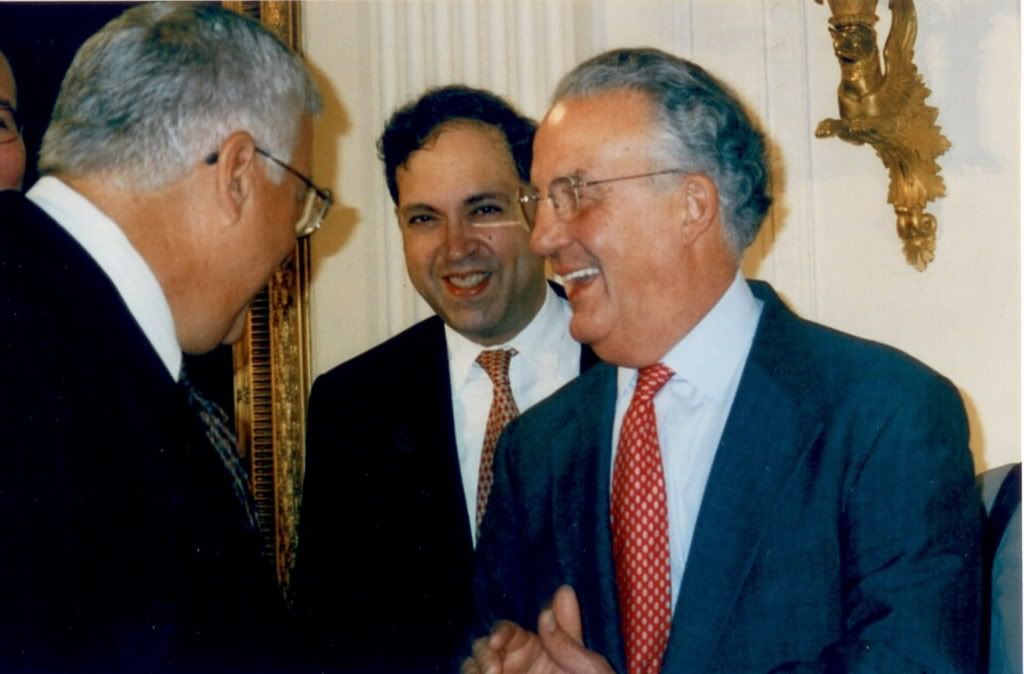
As an example, I was involving in drafting legislation that came out of what became known as the Enron scandals in the early part of this decade, the Sarbanes Oxley Act of 2002, named after then Chairman of the Senate Banking Committee Paul Sarbanes and Chairman of the House Financial Services Committee Mike Oxley.

We were faced with the scandal at Enron and other companies, massive dishonesty in certain segments of the professions: accountants, executives in public companies, stock analysts and also failure to perform duties by the Securities and Exchange Commission (SEC), as well as state regulators.

We had a massive problem, the stock market fell, savings were lost. So, what do you do? The Banking Committee under Sen. Sarbanes held ten hearings, and I staffed majority of them. As a result, we wrote legislation, and I drafted several titles of what became known as the Sarbanes-Oxley Act.

Reporter: As you were holding hearings and drafting legislation, was there an effort by companies through their interest groups to influence the process?

Shahinian: When the news was coming out, eleven congressional committees held hearings. That’s what Congress does, when there is a problem that people are upset about and it’s on TV – members of Congress make speeches, hold hearings or introduce legislation. Some of the committees invited former Enron executives, who by and large refused to testify, pleading the Fifth Amendment.

Sen. Sarbanes, a very brilliant man, and we at the Banking Committee decided to look not just at Enron, but also to see if there are systemic problems. Our staff was experienced in these issues. So we set up ten hearings, inviting people from the industry, as well as academics, former government officials.

At that point the industry started to get very active trying to prevent legislation from being enacted. Formally, lobbying members, and they were successful by and large until the WorldCom scandal hit the news. Until then, when we would try to have, for example, accounting representatives look at our draft legislation and provide suggestions, we would hear back from their lobbyists: “We are not going to help you make this bill any better.” And that was foolish on their part.

Reporter: More broadly, Congress is involved in many, many issues, some of which are on TV, and many more others that are not. When you do have serious corporate or government opposition on a legislative initiative, what typically makes or breaks legislation?

Shahinian: It depends. Some legislation is relatively uncontroversial, that type of legislation goes through if there are enough people who want it. But what if there some people who want, and some people who don’t what it? What can actually be enacted?

In my experience, when there is strong opposition, it is very difficult to get legislation through. There is a negotiations process, when some provisions might be eliminated. In the Enron case, there were lot of companies who cooked their books, and there was still a lot of opposition.

There were enough dishonest people [opposing reform], even though there was combination of media heat, so many instances of fraud, plus financial pain individuals felt. So, you had six or seven months of scandal in the media until WorldCom hit [and that created a momentum for passage.]

***

Reporter: Someone who straddles both the federal government and community life, why would you say there are so few Armenian Americans in government?

Shahinian: I think Armenians don’t generally get into the government for two reasons. One, they assume that truth will win out and therefore they don’t expend special effort to bringing truth or their concerns to the eyes of politicians. By and large, they are not involved in that.

Second, Armenians tend to go for professions such as lawyers, doctors, teachers, or for business, and they don’t view political involvement with the same degree of prestige.

Having said that, I am a lawyer and I am where I am because of legal background and work experience as a lawyer.

Reporter: For many years, there has been an effort by organizations, particularly by the Assembly and ANCA to bring young Armenian Americans as interns to Washington. From what I can tell, not too many have returned to make their careers here. Have you thought of ways more young Armenians could be attracted and do you even think there is a need for that?

Shahinian: I think it is a worthwhile goal. People could come and have responsible positions. Having said that, to do responsible work in Congress, you do need a graduate degree.

I think the best way to find out why so few come back, would be to ask those former interns. I don’t know, it may have something to do with internships they had. Because, in some of the internships, from what I hear, they Xerox copy papers and run errands. Well, that’s not a stimulating job description for anyone.

To the extent possible, you need to identify people who would really work with a student. I have had interns through the offices I worked at and I gave them responsible work, helping staff hearings and doing research. Some of them ended up going into financial services. The intern I had last summer just got a job on the House Financial Services Committee.

***
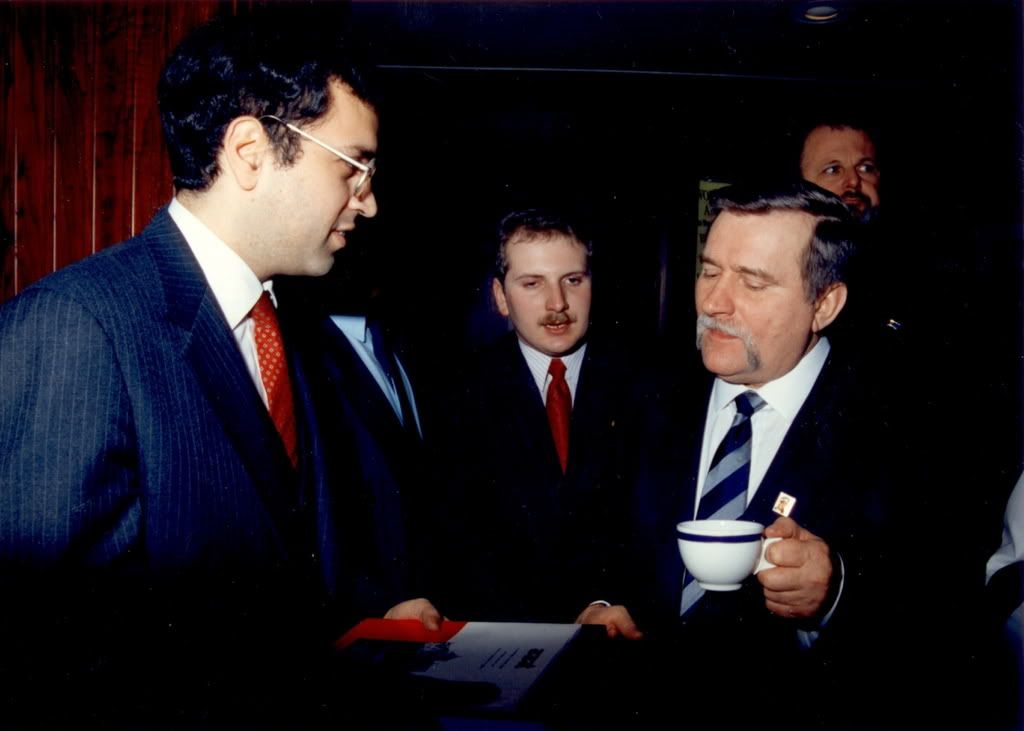
Shahinian: Years ago, after the earthquake, I started a small foundation, called the Ararat Foundation. And over the years we have done a bunch of different things.

Before the Embassy was established [in Washington in 1992], arrogant as I am, if there were visiting heads of state at a venue that I could get into, I would arrange to meet them and give a book or something about Armenia.

Prime Minister of Iceland, a delegation from Romania. And I remember Romanians kind of spooked me, because after it was over they said let’s get together and have a meeting. That was just after the dictator Nicolae Ceauşescu was overthrown.
***

Reporter: You have been active with the Armenian Church. Are you on the parish council?

Shahinian: No, but I am a Diocesan delegate, which means I represent my home parish, Washington’s St. Mary’s, the Church where I was baptized, at the Diocesan Assembly. I have also been elected by the Diocesan Assembly to serve on the Diocesan Council -- the board of directors -- of the Eastern Diocese of the Armenian Church in the U.S.

I have also been elected by the Diocesan Assembly to represent the Diocese as a member of the National Ecclesiastical Assembly – that’s the body that elects the Catholicos of All Armenians.

So I was a patgamavor or delegate in the 1995 and 1999 elections.

Reporter: What highlights do you recall from those elections?

Shahinian: In 1995, our pastor at St. Mary’s, Rev. Vertanes Kalayjian, shortly before the delegates were to leave for Armenia, gave a sermon where he said that here we are having a first National Ecclesiastical Assembly in forty years and we have no agenda.

Reporter: First in forty years because of passing of Catholicos Vazgen I? So the assemblies take place only when there is a need to elect a new Catholicos?

Shahinian: This is what has evolved. Well, I took Rev. Kalayjian’s words to heart. While the Diocese did not have an agenda, for me to go half way around the world, spend money to do it and take off from work, I should have some reason other than just to cast a ballot for a Catholicos – even though that is important.

So, I reflected on the potential of the Armenian Church and thought about what might make the Church better that could be addressed at this National Ecclesiastical Assembly. I read that this is the highest body in the Armenian Church, if they vote for something – that is it. In fact, they select the Catholicos.

I came with a four-part proposal which I offered in 1995 and again in 1999.

The first part was to allow married priests to be elected Primates [of Dioceses], because that would give us a larger pool of talent from which to select. If a married priest is chosen Primate, he may be more concerned with making the Diocese a better place for his kids. If you have a married priest with a wife who is caring for him, he might be better able to understand and help his clergy and laymen. And while an unmarried priest may be able to devote more time to his job, I don’t think there is anything that presumptively makes an unmarried priest a better Primate than a married priest.

Second, for married priests to be able to become consecrated bishops – this going back to ancient Armenian Practice and ancient Christian Practice. The great Patriarch Malachia Ormanian called for this a century ago.

Third, allow unmarried men to be ordained as priests without taking the vow of celibacy. And I think this is important, because to take a vow and say that “I am not going to get married” is presuming to know God’s will for the future. It may be that it is God’s will that a priest already ordained should get married, and we are precluding that. Marriage is a sacrament, why would we require someone vow not to take a sacrament in the church?

Finally, resume the practice of ordaining women as deaconesses.

Reporter: When was this last practice ended?

Shahinian: I understand there are still some women deaconessess [in the Armenian Church] in Turkey. And the doors to the Holy Etchmiadzin are dedicated to a deaconess.

Now in 1995 I presented this four-part proposal together with Rev. Dajad Davidian, who used to be the pastor in Watertown, Mass. and now serves in Armenia. It was presented to the Assembly after the election of the Catholicos. His Holiness Karekin I said: Oh that’s a very important proposal – too important to be discussed here; I am going to have another National Ecclesiastical Assembly in two years and we will discuss it and other issues then.

As it turns out, he did not call another Assembly and unfortunately passed away.

In 1999, I prepared the same proposal again and made 450 copies with background information translated into eastern Armenian, Russian, and English. My sense was that the overwhelming number of delegates could read at least one of those languages. The proposal was introduced and referred to something called the Proposals Committee, which I was informed was not actually in the [Church] charter at the time.

Reporter: Were there other proposals or was yours the only one?

Shahinian: Well, there may have been others, I do not recall. Archbishop Zaven Chinchinian told me it was given to the Proposals Committee chaired by the Patriarch [of Jerusalem] Torgom Manougian for potential discussion after the election at the Assembly. However, the election of the Catholicos coincided with the shootings in Parliament [on October 27, 1999], and when this occurred, the Assembly was stopped.

So, this proposal is still with the Proposals Committee.

Reporter: Was there any support for your proposals from other delegates?

Shahinian: There were several American and Canadian delegates who were supportive. Many Russian delegates said they were supportive, some said: some unmarried priests and bishops have wives and kids anyway, why not institutionalize it?

There would have been support.

Reporter: So, are you still technically a delegate to the Assembly, is there a term of some kind?

Shahinian: The term, to my knowledge, is just for one Assembly. In the U.S., there were special meetings of the Diocesan Assembly to elect the delegates for each NEA -- one representative for each 25,000 baptized Armenians living in the geographic jurisdiction of a diocese, based on a number stated by each diocese.

Reporter: And is that typically a competitive process?

Shahinian: In this diocese, there were three to four times the number of people who ran for the office than were elected. So it was competitive.

Reporter: How does it work with the process of the elections of the Catholicos?

Shahinian: Anyone can be elected Catholicos. But the Committee that organizes the election allowed each current bishop to be a nominee unless he asked that his name be taken off the ballot.

In 1995, after that process, there were eight clergymen whose names were left on the ballot. The next day, the delegates met inside the Cathedral of Holy Etchmiadzin to vote. The protocol was to call each delegate by name. He or she would sign a book, take a ballot, walk to a table in front of the altar and cross out the names of all the nominees except the one he wanted to vote for, and dropped the ballot into a tall wooden box.

After everyone voted, the box was emptied and each vote was announced and the votes counted in plain view of the delegates.

In 1995, on the first ballot, Garegin Catholicos was first, Garegin Arkepiskopos second, and Barkev Episkopos – third and no one had the majority. The Assembly voted to leave the top three nominees for the second ballot. So, we went through the same process of voting and Garegin Catholicos had more votes, but still did not have a majority.

So at that, Garegin Arkepiskopos said: “I give my votes to Garegin Catholicos,” which puzzled many delegates. But before most people could figure out what happened, the bells were ringing to announce to those outside the cathedral that a new Catholicos had been elected.
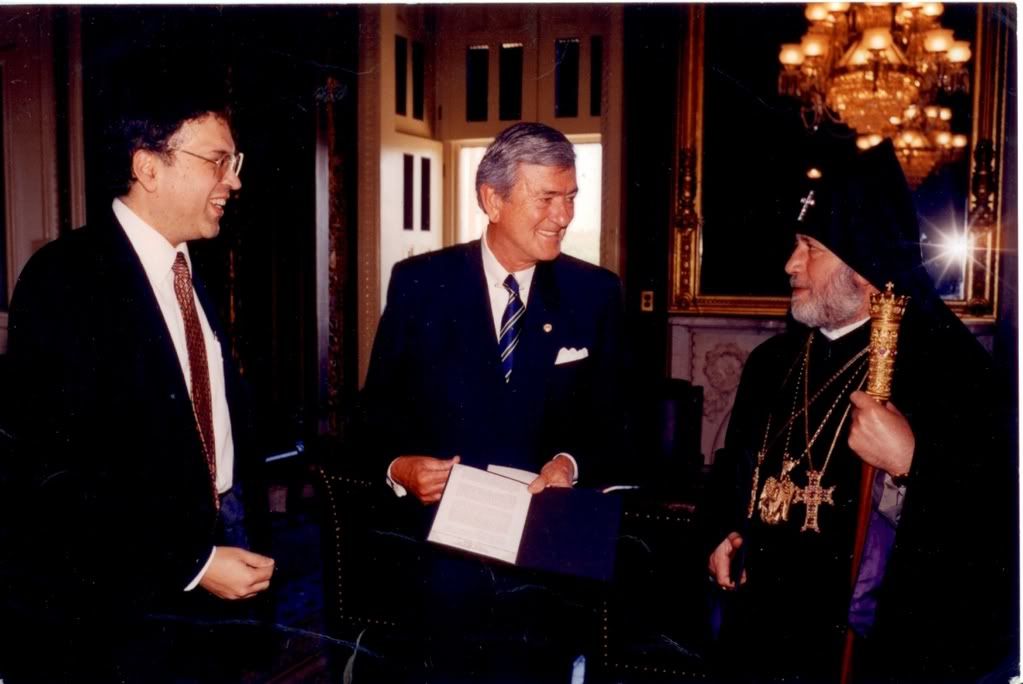
In 1999, only two clergymen allowed their names to be placed on the ballot and the delegates elected His Holiness Karekin II.

Reporter: This sounds like a generally straightforward, democratic process. But how does the lobbying of delegates go before the vote?

Shahinian: Each time it was different. In 1995, there were policemen all over Holy Etchmiadzin, in their uniforms, controlling where people could go. One policeman came up to me, asking “Oh, who are you going to vote for?” I told him, “I don’t tell anyone.” I thought “He is trying to intimidate me?”

In 1999, I recall that some Primates had meetings with their delegates and made comments about things to consider in voting. At both Assemblies, some clergy and lay delegates lobbied others.

***
Reporter: In general, what is your sense of where the Armenian Church is today? What are its major issues?

Shahinian: I’ll speak about the issues in U.S., because that is what I know about. The major issue is whether the Church will be a social club for first generation Armenian Americans, or will it aspire to be a church that reaches the third generation and beyond. Right now, it is positioned primarily for the first generation.

If one looks at the statistics, you see for example that in the last 10 to 15 years the number of dues-paying members in the Eastern Diocese has gone down, and that is in a period when immigration has brought tens of thousands, if not more, of Armenians into the geographic area of the diocese. Sociologists – and those who attend -- have found that the third generation is virtually gone from our parishes.

That speaks of an institution that meets the needs of a very limited number of Armenian-Americans. Church leaders’ notion that Armenians are there to serve the church may play well at the seminaries but that is not an operative concept for most Americans. A church needs to serve the needs of individuals.

The Diocese a few years ago adopted a statement of intent that it is significant in the life of every Armenian living in its geographic jurisdiction. But many people do not take this statement seriously, because the church has generally not been effective in achieving this goal. Some have noted that less than two percent of Armenians living in the diocese area are parish members.

We have some outstanding clergy, who have made important contributions in many people’s lives. But too few. We have many laymen who are talented and of outstanding character, who donate tremendous amounts of time and resources to heroically serve through the church. They need to be given more authority and visibility.

But when the church leadership does not articulate a true vision or demonstrate an ability to meet people’s needs, people leave. They may go to other churches, embrace false religions or become atheists or agnostics.

We have some fine seminarians here and new priests. However, a concern is the diocese’s inability to attract more clergy from among us. Some impediments need to be removed.

I think that these are among the primary challenges facing the church in the U.S.

Pastoral work is a key part of a growing church. Armenian-Americans live in a society that presents a lot of stress and problems, and it would be good for our leaders to provide or delegate to laymen to effectively counsel and encourage.

America is a Western country, a verbal country. People who profess Christianity here are challenged to justify their beliefs, to explain how Christianity impacts on their work, on their family life. To be meaningful our clergy and lay leaders have to provide thoughtful answers how to relate Christ to everyday life. There are too many people in too many parishes saying this is not happening.

Another issue involves inspiring trust and confidence in the Church leadership. Over the years, there have been too many instances, for example, of the Diocesan Assembly voting to take an action which the Diocese leadership does not implement, or voting against an action which the Diocese leadership takes anyway.

Information provided to delegates about significant issues has at times been inaccurately communicated or has omitted important facts necessary to correctly understand the issue. Too many talented and successful laymen have left the Church in frustration because their good ideas or constructive criticisms were ignored or not seriously considered by leadership. Changing these types of behaviors would engage more people and improve the vitality of the church.

Reporter: Are these cross-denominational issues in U.S. or are the challenges you describe peculiar to the Armenian Church as a more conservative institution?

Shahinian: In every area there are churches that are dying, and there are churches that are growing. It is not the case that all Christian churches are losing people or are deemed irrelevant. Having said that, if the Armenian Church leadership cared more about its people in ways that meet their needs, we would have a lot of people coming in – it is not like the market is saturated.

And there are enough churches that are doing this, so many Armenians leave and go to those.

Reporter: The fastest growing churches are the new protestant churches, what do you think attracts people there?

Shahinian: Part of the attraction is sermons that reflect an understanding of current the American culture and specifically suggest ways to faithfully address life’s challenges as a Christian.

The sermons are well-prepared and easy to understand. They are not overly sentimentalized. People learn things that they can use in their everyday lives.
Another attraction is their contemporary music. Their songs often are easy to sing and remember, and teach the faith.

In the Armenian Church we have a beautiful service, but some people have mistaken the form and language for substance of the faith for. Seems to me if you want people in your parish to learn about God or worship Him, you want to do it in a way they can understand. And why not at least have a service in modern Armenian so that some people can understand, instead of classical Armenian, which virtually no layman understands.

Reporter: Do you think there is a general fear of change? Perhaps related to fears of a schism?

Shahinian: Well, I am not advocating any change in theology, which you have, for example, with Episcopalians. Our theology is great.

What I would like to see happen is to improve the clarity and effectiveness of how our theology and faith are communicated.

And we are fortunate to have a church theology that has remained faithful to God. We have many qualities, like hospitality and informality, and a rich cultural heritage of Christian faith, on which we can build. And we have the good will of many wonderful parishioners who are working hard to provide vision and leadership in order for the community to be faithful to God and helpful to each other. With God, we have great potential.

***
Reporter: Can you tell me about the Alexandria Festival, how it came about?
Shahinian: After the earthquake in December 1988, citizens in Alexandria wanted to help. The City Council formed a committee to see how they could help. There were architecture students who were brought over [from Armenia to study]; there was artwork from Gyumri that was exhibited in Washington.

And they thought how can we fund some sort of ongoing relief? And they said, Alexandria has ethnic festivals, let’s do an Armenian one in addition to an Italian, Irish and so forth!

So we had a festival with food which St. Mary’s and Surb Khach Churches helped prepare, live entertainment and tables with arts and crafts, and had it all in front of the City Hall in Alexandria during spring, so that people could come by and participate. And we did it for another year and now we are in the fifteenth year. The proceeds, fairly modest, have been used to help children in Armenia, including orphans, at risk youth.

In the process, we try to showcase the local Armenian talent to make people aware of the Armenian culture and let Armenians be proud of it.

Reporter: Would you say this is the biggest Armenian event in Washington area?
Shahinian: Parks and recreation officers tell us that several thousands come to the Festival. I personally don’t think so, but we do get one to three thousand. But in terms of number of people that still makes us the largest regular Armenian event in the area, when youth Olympics take place here – they are certainly larger.

Reporter: How did you yourself get involved? Since 1998, when I moved here, I can’t remember a Festival without you.

Shahinian: What happened was on a Saturday morning, it was in 1990 I think, I got a phone call from the Der Hayr, Rev. Vertanes who had a very bad cold and said that he was supposed to go and testify before the Alexandria City Council on why we need this [Alexandria-Gyumri Sister-City] Committee. So, I went and testified, and since then I have been a Committee member and involved with the Festival.

In Brief: House foreign aid bill, Genocide resolution, Turkey and Kurdistan, Russia's Gabala offer, Caucasus journal

First published in June 9, 2007 Armenian Reporter

From Washington, in brief
By Emil Sanamyan

House subcommittee proposes Armenia, Karabakh aid levels


A key congressional subcommittee nearly doubled the Bush Administration’s foreign aid request for Armenia and proposed more aid to Nagorno-Karabakh in Fiscal Year 2008, Armenian-American advocacy groups and congressional sources reported on June 5 and 6.

Subcommittee allocations are typically endorsed without major changes in the Appropriations Committee and the House of Representatives’ votes, which are expected to take place later this month. But the bill would still need to be reconciled with the Senate version before being signed into law.

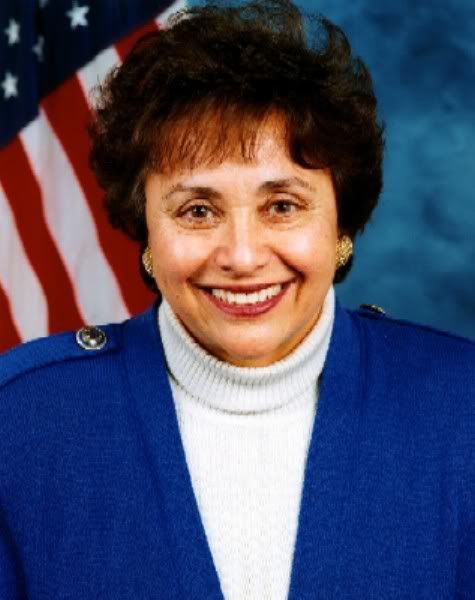
In its June 5 meeting, the House Appropriations Subcommittee on Foreign Operations, chaired by Rep. Nita Lowey (D-N.Y.), suggested $68 million in assistance to Armenia, $6 million to Karabakh, $18 million to Azerbaijan and an additional $3.3 million in military aid to Armenia and Azerbaijan each.

The military aid falls under the Foreign Military Financing (FMF) and International Military Education and Training (IMET) programs, and does not cover other security assistance, such as the eight-year $100-million Caspian Security program, which the U.S. has been implementing in Azerbaijan.

The administration’s budget request called for $35 million in economic aid to Armenia (and none for Nagorno-Karabakh). The proposed cut was part of an across the board reduction in U.S. assistance to the former Soviet Union from $509 million in FY06 to $356 million in FY08. Under the same request, Armenia would have received $3.3 million, and Azerbaijan $5.3 million under FMF/IMET programs.

The request was criticized by AAA, ANCA and USAPAC, who in recommendations submitted for the March 29 Subcommittee hearing urged Congress to provide equal amounts of military aid to Armenia and Azerbaijan, “not less than” $75 million in economic aid to Armenia and $10 million to Karabakh.

Similar recommendations were made in the March 16 letter the Armenian Caucus co-chair Rep. Frank Pallone (D-N.J.), Rep. George Radanovich (R-Calif.) and 29 other congressmen, sent to the Subcommittee chair Rep. Lowey and ranking member Frank Wolf (R-Va.). The current Subcommittee proposal comes close to meeting these recommendations.

Armenia is also set to receive U.S. developmental assistance under the $235 million, five-year Millennium Challenge Account (MCA) program, for which Congress provides funds in bulk, without country-by-country allocations. In the same funding bill, the Subcommittee proposed $1.8 billion for all countries that have qualified for MCA.

Newly-elected congressmen urged to support Genocide resolution

Freshmen Reps. Tim Walz (D-Minn.) and Gus Bilirakis (R-Fla.) sent a letter to 54 fellow congressmen newly elected in the 2006 elections, urging them to co-sponsor the House Resolution 106 affirming the Armenian Genocide.

Out of 196 congressmen that have already endorsed H. Res. 106, 19 are freshmen congressmen. In their June 6 Dear Colleague letter, a copy of which was made available by USAPAC, Reps. Walz and Bilirakis urged fellow congressmen to help reaffirm “U.S. commitment to acknowledging and studying past cases of genocide and working to ensure genocide never happens again.”

They also noted the Turkish government’s opposition to the measure, but argued that by threatening sanctions against the U.S. “Turkey has failed to take into account the damage that would be done to its own interests…. Furthermore, Turkey maintains normal relations with other nations who have officially acknowledged the Armenian genocide.”

Reports of Turkish invasion of Iraqi Kurdistan seen as a “trial balloon”

Anonymous Turkish security officials told the Associated Press on June 6 that a large number of Turkish soldiers, up to several thousand, crossed into Iraqi Kurdistan in “hot pursuit” of Kurdish rebel forces. The report was soon denied by the U.S., Turkish, and Iraqi Kurdish officials, but not before causing widespread concerns, and jolting Turkish and international financial markets.

A senior Iraqi Kurdish defense official, Jabar Yawir, told Reuters that on June 6 “10 Turkish helicopters… with around 150 soldiers” landed inside Iraqi Kurdish territory, but then quickly left without engaging Kurdish forces. A Turkish military official confirmed that a “limited” raid was conducted. A Kurdish commander, Bahouz Ardal, called the earlier report of a larger invasion and the raid a “test balloon from the Turkish army” to gauge U.S. reaction.

Turkish armed forces commander Gen. Yasar Buyukanit has for months called for a military operation inside Iraqi Kurdistan, a move opposed by the U.S., but backed by many Turks, frustrated with the recently increased tempo of rebel Kurdish attacks inside Turkey. On June 4, seven Turkish gendarmerie soldiers were killed in Tunceli province, long a hotbed of Kurdish resistance.

On May 30, U.S. forces in Iraq formally handed over security responsibilities for northern Iraq to the Kurdish regional government, which runs the area as an autonomous state. In the meantime, tens of thousands of Turkish forces have been concentrated near the border with Iraqi Kurdistan.

U.S. officials, most recently Defense Secretary Robert Gates, have repeatedly issued warnings to Turkey not to invade, fearing a Turkish-Kurdish war in Iraq.

Russia offers U.S. joint use of missile defense radar in Azerbaijan

After threatening to point its missiles at planned U.S. missile defense sites in central Europe, Russia offered to cooperate with the U.S. on missile defense in Azerbaijan, where Moscow has an early warning radar that illuminates Iran’s entire territory, AP reported on June 7.

U.S. National Security Advisor Steve Hadley called the proposal, which was made by Russia’s President Vladimir Putin during the G8 summit in Germany, “interesting” and added that “let’s let our experts look at it.”

Worried by Iran’s likely acquisition of longer-range missiles and development of nuclear weapons, the U.S. has sought to establish radar and interceptor sites in Poland and Czech Republic and at least one senior U.S. official has expressed interest in deploying a mobile radar in one of the Caucasus countries (see this column in the April 7 Reporter).

But the various Caucasus governments’ reaction to the idea has been far from enthusiastic -- most likely our of fear of likely Iranian retaliation. There have also been vocal concerns from the Czech Republic.

While missiles currently in Iran’s arsenal are not believed to be able to reach beyond the Black Sea, the country has been quickly upgrading its capabilities. The Caucasus, Czech Republic, and Poland all have mountainous areas lying on a hypothetical missile trajectory from Iran to Britain and further across the Atlantic. U.S. officials said they would go ahead with the program despite Russia’s concerns.

The Russian ballistic missile defense radar in northern Azerbaijan is part of the Soviet-era missile defense system. According to recent media reports, in the next five to six years Russia plans to replace it with new radar being built on the Russian side of the Caucasus Mountains.

Russia’s Ambassador to Azerbaijan previously floated the idea of “joint use” of Gabala on May 15. Presidents Bush and Putin may further discuss this and other issues during bilateral talks in the U.S. set for early next month.

DC think tank publishes journal on the Caucasus

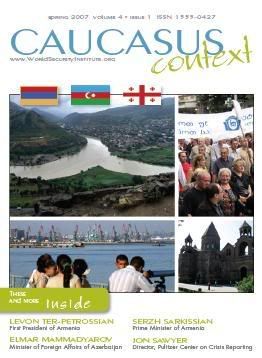
Beginning last month, the Washington-based World Security Institute (WSI) has been publishing the journal Caucasus Context. Prof. Jim Wertsch, a Georgia expert at the Washington University in St. Louis, Mo., first launched the journal together with Zurab Karumidze (Caucasus International Forum, Tbilisi) in 2004. They are now joined as editors by Fariz Ismailzade (Cornell Caspian Consulting, Baku) and Lilit Petrosyan (WSI, Washington).

The spring 2007 issue includes interviews with Nagorno-Karabakh’s President Arkady Ghoukasian, Armenia’s former Defense Minister (and now Prime Minister) Serge Sargsian, former Karabakh army commander Samvel Babayan, and Azerbaijan’s Foreign Minister Elmar Mamedyarov -- all conducted by American journalist Jon Sawyer in the summer of 2006.

The journal also carries a never-before-published English version of remarks then-President Levon Ter-Petrossian made at the January 1998 meeting of Armenia’s National Security Council. The disagreements on Karabakh policy aired at that meeting resulted in Ter-Petrossian’s resignation the following month. Visit www.worldsecurityinstitute.org to find out more.

In Brief: Darfur, Congress, Turkey, Genocide resolution, State Dept. report, rail road, nuclear energy

First published in the Armenian Reporter, June 2, 2007

From Washington, In Brief
By Emil Sanamyan

Bush announces new sanctions against Sudan


Citing continued outrages in the Darfur province of Sudan and its government’s opposition to introduction of effective international peacekeeping, President George W. Bush on May 29 announced a set of new sanctions against Sudan, international media reported. The violence in Darfur is believed to have claimed lives of hundreds of thousands and as been called Genocide by the Bush Administration.

The new measure bars 31 Sudanese-controlled companies from doing business with U.S. There are also sanctions against four Sudanese individuals, including two senior officials. It is unclear how significant of an impact the sanctions might have on Sudan whose main source of revenue comes from crude oil sold primarily to China and other Asian states.

Sen. Joe Biden (D-Del.), who chairs Senate Foreign Relations Committee, welcomed the new sanctions but said they were not sufficient: “We should enforce a No-Fly Zone, impose multilateral sanctions through the U.N., lead negotiations among all the parties for a lasting peace settlement, find the forces for a peacekeeping mission, and, if necessary, commit U.S. troops on the ground.”

House Foreign Affairs Committee Chairman Tom Lantos (D-Calif.) called Pres. Bush’s move “a dollar short and months late.” The congressman led congressional efforts to qualify Darfur violence as Genocide. At the same time, Rep. Lantos has not taken any action on the House Resolution 106 that affirms U.S. record on the Armenian Genocide and was referred to Lantos’ Committee last January. His staff has refused to comment on the matter.

Bush’s announcements of sanctions against Sudan and, on the next day, of a new $30 billion program to fight AIDS in Africa come shortly before the June 6-8 G8 Summit that is expected to focus on international trade and climate change. Reuters reports that the United States and Britain are considering expanding existing U.N. sanctions against Sudan, but have yet to receive the necessary support from China and Russia.

Eleven members of Congress go on “study tour” of Turkey

Six U.S. Congressmen and five Senators visited Ankara and Istanbul from May 26-June 1, Turkish NTV reported. During May 28 press conference, members of the delegation Sen. Ben Nelson (D-Neb.) and Rep. Ed Whitfield (R-Ky.) discussed their meeting with Prime Minister Recep Tayyib Erdogan.

The legislators reiterated U.S. opposition to a potential Turkish military operation in northern Iraq and suggested that the recent violation of Turkey’s airspace by U.S. F-16s “had no secret intention” and should not cause problems in relations, Turkey’s Cihan news agency reported. According to Rep. Whitfield “there was also discussion about the Armenian resolution that has been introduced in the U.S. Congress and if it passed the impact that it would have on the Turkish people.”

The trip was organized by the Congressional Study Group on Turkey (CSGT) established in 2005 through the U.S. Association of Former Members of Congress. According to the Turkish Coalition of America (TCA), it is underwriting CSGT expenses in 2007-2008. TCA itself was established last February and is led by former senior staff of the American Turkish Council and the Assembly of Turkish American Association, two groups that have long lobbied against the Armenian Genocide affirmation.

In addition to Rep. Whitfield, who co-chairs the Congressional Turkey Caucus, congressmen taking part included Reps. Dan Burton (R-Ind.), Stephen Cohen (D-Tenn.), Virginia Foxx (R-N.C.), Russ Carnahan (D-Mo.) and Rep. Luis V. Gutierrez (D-Ill). Reps. Carnahan and Gutierrez have both co-sponsored the House Genocide resolution (H. Res. 106).

Names of the other four U.S. Senators were not available at press time.

Greek American groups call for Genocide resolution passage

Reps. Carolyn Maloney (D-N.Y.) and Gus Bilirakis (R-Fla.), co-chairs of the Congressional Caucus on Hellenic Issues, called on fellow congressmen to co-sponsor the House Resolution 106, which is already supported by 196 members, but is yet to receive congressional consideration.

A Dear Colleague letter, circulated by Congresswoman Maloney on May 23, argued that “the United States must stand up for human rights everywhere by renewing its commitment to prevent similar atrocities and by acknowledging that the Armenian Genocide is a historical fact.”

The Hellenic Caucus has more than 125 members, many of whom are also members of the 152-member Armenian Caucus and have already co-sponsored H. Res. 106. The American Hellenic Institute and the United Hellenic American Congress have also called for the adoption of H. Res. 106, ANCA reported on May 25.

State Department responds to congressional concerns on Karabakh

A botched passage in the State Department’s 2006 Human Rights Report on Armenia continues to generate government correspondence. The Department made another effort to set the record straight in its May 24 letter to Rep. Joe Knollenberg (R-Mich.), made available to the Reporter.

As a reminder, that report first released in March incorporated Azerbaijan’s propagandistic lingo when describing the Nagorno Karabakh Republic, and claimed that Armenia “occupies” that Armenian republic. While U.S. officials admitted that the wording was wrong, the Department eventually opted not to correct it (see this column in the April 28 Reporter).

As was also reported in this column (May 12 Reporter), Rep. Knollenberg along with the fellow co-chair of the Congressional Armenian Caucus Rep. Frank Pallone (D-N.J.) sent a letter to the Secretary of State expressing their concern with the wording.

The State Department response signed by the Assistant Secretary of State for Legislative Affairs Jeffrey Bergner acknowledged that Nagorno Karabakh, “as well as large portions of surrounding territory” are not “occupied by Armenia,” as is claimed by Azerbaijan, but rather that “ethnic Armenian forces supported by the Government of Armenia control” them.

“Ethnic Armenian forces” is a previously used euphemism for the Defense Army of the Nagorno Karabakh Republic, which while not formally recognized is indeed supported by Armenia.

U.S. agency says “no plans” to support Armenia rail bypass

The Overseas Private Investment Corporation (OPIC) President Robert Mosbacher told the House Foreign Affairs Subcommittee on May 24 that his agency has “no plans” to support an Azerbaijani government-initiated project to build a railroad bypass around Armenia. Mosbacher made the comment in response to a question from Rep. Brad Sherman (D-Calif.), who chairs the Subcommittee on Terrorism, Nonproliferation and Trade and whose office reported the news.

The legislation passed last year prevents U.S. Export-Import Bank from funding the bypass, which generated little U.S. government or commercial interest. The project, estimated at more than $400 million, is part of Azerbaijan’s efforts to keep the Turkish-Armenian border closed. By building the bypass from Georgia to Turkey, Azerbaijan is seeking to alleviate concerns in Turkish regions that are most affected by that country’s closure of the border with Armenia.

Both OPIC and ExImBank provided public funding for the U.S.-backed Baku-Ceyhan oil pipeline, which helped create a more expensive route for taking Caspian oil to international markets than existing or alternate routes. The Azerbaijani government is likely to use some of its oil revenues to pay for the railroad bypass which is expected to take two years to complete.

Congressional Committee Approves Bill on International Nuclear Fuel Bank

On May 23, the House Committee on Foreign Affairs adopted the International Nuclear Fuel for Peace and Nonproliferation Act (H.R. 885) that authorizes $50 million in funds to establish the bank to be administered by the International Atomic Energy Agency (IAEA).

According to the Committee release “the bank would ensure that countries seeking the benefits of nuclear energy will not have to develop a capacity to produce their own nuclear fuel, which can also be used to produce nuclear weapons.” The funds authorized would “only be available for two years, pending another $50 million pledged from other sources.“ The Administration is said to support the bill, but as of now it is unclear how quickly, if at all, a functioning fuel bank could be established.

A reliable international source of nuclear fuel might potentially be good news for Armenia, which currently relies on Russia for its supplies. On May 30, President Robert Kocharian reiterated Armenia’s desire to build a new nuclear power plant before the existing reactor is decommissioned over the next decade. Armenia has initiated preliminary discussions with Russian and U.S. officials on the issue.

Conversation with Tom de Waal

First published in the Armenian Reporter, May 26, 2007

West’s top Karabakh expert: people’s aspirations for independence must be recognized
Conversation with Tom de Waal


De Waal is the Caucasus service editor at the London-based Institute for War and Peace Reporting (IWPR). With reporters on the ground throughout the region, IWPR (www.iwpr.net) prepares weekly news updates and in-depth stories from both the South Caucasus and Russia’s North Caucasus. De Waal is the author of books on the conflicts in Chechnya and Karabakh.

The “Black Garden: Armenia and Azerbaijan through Peace and War” (New York University Press, 2003) became the first and still the only major study to take an in-depth and non-partisan view of the conflict (for reviews of the book go to http://www.amazon.com/Black-Garden-Armenia-Azerbaijan-Through/dp/0814719449).

Earlier this month, de Waal was in Washington to participate in a conference on the Caucasus and deliver a lecture at the Center for Strategic and International Studies (CSIS) on May 14, where he again called the continued standoff over Karabakh “the most serious conflict in Eurasia.”

De Waal argued that the current status quo “is not sustainable in the long term” and that greater international attention is needed to prevent a new, potentially much more devastating conflagration.

While looking at the ways to address the conflict, de Waal noted that Kosovo’s independence will set a precedent for other secessionist conflicts.

He noted, that when looking at Karabakh and other breakaway regions in the Caucasus, one must understand that their “aspirations for independence are real” and have to be factored in into the peace process. And that the “idea of independence” must be made part of the talks and positively leveraged to encourage more democratic policies.

In the end some form of “surrender of sovereignty” by states involved “is the only way forward,” according to de Waal. “There is absolutely no way you can persuade [Karabakh]” to become part of Azerbaijan, he surmised.

***

On May 11 our Washington editor Emil Sanamyan spoke with de Waal about the book, its impact and more recent developments:

Reporter: Your Karabakh book is it available for the readers in the region?

De Waal: The Russian language version is available – there are copies in Moscow and in the region. Last November I went to Baku, Yerevan and Stepanakert and I did presentations of the Russian version of the book. The Armenian translation is finished and the Azeri translation is about to be finished. So some time later this year it should come out in both Armenian and Azerbaijani.

Reporter: What kind of an impact are you hoping to generate? And what has been the feedback so far?

De Waal: Obviously, it’s just one book. But I think there is some interesting information in there that puts the conflict in a different light that most people in the region have not seen or are not accustomed to seeing. My hope is that it might encourage more critical debate and self-criticism. That is the idea.

And a lot of readers have said that they enjoyed the book, enjoyed an outsider’s perspective.

Having said that, there is still very much the tendency to look for information that is negative to the other side and concentrate exclusively on the bad things the other side did, and not own up to any of the bad things on one’s own part.

Reporter: In terms of any of the criticisms that you have heard since the English version came out, have you re-thought anything in the book?

De Waal: The big debate in Armenia that we had was basically about the flight of Azeris from Kapan and Meghri. As far as I am concerned there is evidence that it happened some time before [the anti-Armenian pogroms in Sumgait in] February 1988…

Reporter: So at issue now are both Kapan and Meghri?

De Waal: Well, from Kapan basically, and these Azeris went to Baku and Sumgait. And I met an Azeri, sorry, an Armenian woman married to an Azeri, who said that she saw them at the railway station in Baku. So, I suppose there is evidence.

But since this became such an important issue in Armenia, my regret is that I did not do as much research on that particular issue. I did not go to Kapan.

For me, actually, it is not such a big issue. Because there were incidents, such as [anti-Armenian violence] in Chardakhlu [in Azerbaijan’s Shamkhor district in the fall of 1987] that pre-dated that. But obviously I can see where the Armenians are coming from, since if there was indeed violence in Kapan before February 1988 then that would mean that everything was not peaceful on the Armenian side before [Sumgait]. And that is very much a part of the Armenian narrative of Karabakh events – that “we are a peaceful people.” So I can see why this is an important point.

But I can just say that conflicts escalate gradually. They start with a smaller incident and lead to a bigger incident. And for met this was part of gradual escalation and I don’t particularly attach any great moral significance to that.

Reporter: The complaints from the Armenian side though focused on an impression that one might get from the book that events in Sumgait were being given same significance as whatever happened in Kapan, which was and still is largely unknown to most people on both sides. And that this was part of an effort to balance out the grievances…

De Waal: I am not trying to weigh one side against another. In any account of the war you will get a list of things from one and another side. But I am not making an effort to weigh them. Obviously, fewer people died in Sumgait than [during the Armenian capture of] Khojali, but I write more about Sumgait because it had more significance [for the conflict] and was kind of a “Chernobyl”* for the South Caucasus.

Reporter: On the Armenian side there have also been complaints about the book’s cover. [Note: The hardcover version has a picture of Shushi with a mosque front and center, and the Ghazanchetsots church in the background and barely visible. The paperback shows an Armenian volunteer with a machine gun and dead bodies in the background.]

De Waal: The hardcover was an attempt to contain both a mosque and a church, and it was in Shusha or Shushi and it summed up the complexity of the dispute. The paperback picture was picked out by my editor in New York who, since this was a book about war, though it better represented the drama. I don’t think the editor knew that this was a picture of an Armenian who participated in the killing of the Azeris.

Reporter: Well, that was in the way a problem. The picture’s caption identifies the man as Armenian and the civilian-looking dead behind him as Azeris, but without providing any context...

De Waal: As far as I am aware these were military people who have come down from Shushi and if they look civilian it is because the Azeri soldiers were so badly dressed.

[Note: The picture in question was taken by Jon Jones in January 1992 after Armenian self-defense forces beat back an Azeri attack on the Armenian village of Karintak, just outside Shushi.]

Reporter: So, Armenians complain that first impressions these covers leave is that this is either about a culturally Islamic region or about Armenian cruelty.

De Waal: I understand that. But there is also a certain game that people tend to play, counting the photographs, looking at indexes, and trying to see if I am biased towards one side or the other. And of course another accusation that I have is that I am trying to balance something that happened to one side, with something [similar] that happened to another.

And it is true that I do feel quite balanced in my views of the conflict. I spent so much time on both sides that I almost feel schizophrenic sometimes. On the other hand, I think there are things in the book that both Armenians and Azeris should be uncomfortable with. Because this is a war and nasty things happened.

And I kind of regret that there is almost no debate within the societies about what we have done wrong and what could have been done differently.

Reporter: Overall, what were the most vivid or memorable reactions that you got?

De Waal: Well, there were all kinds of reactions. That I work for Western intelligence services, that I am a Dashnak, or Armeniaphobe. But they are usually not really very specific.

In terms of positive reactions, I have heard from a couple of natives of Baku who left the city. They told me that finally they read a book that was about them and their experience. That they never felt part of the conflict and thought people around them have gone mad, and finally read a book that made them feel better about themselves.

Someone told me about a summer school here in U.S., where an Azeri student was lent a copy of the book and then disappeared for a few days and read it. And was very moved saying that he never knew about many of the things he read.

So, if it had a few readers like, then certainly it was worth it.

Reporter: Do you have any intention to build on this book. Take it into film, perhaps?

De Waal: Not really. To be honest I never expected such big impact in the region. It was more for the international audience. But I guess so little has been written about this conflict by non-partisan people or people who have been on both sides. And not to make a big thing out of it, in such a dry atmosphere it was like a glass of water.

*****

Reporter: Several months ago, our newspaper (see January 27, 2007 Reporter) carried your commentary that expressed strong concerns about a potential new escalation over Karabakh. Where do you see the situation going?

De Waal: There is kind of paradoxical situation. There are different signs of progress. But even if status quo changes in a positive way, things are shaken up and expectations are heightened. There is quite a lot of talk from people involved in the peace process that there would be a framework agreement between Presidents Kocharian and Aliyev based on Prague principles, involving withdrawals from occupied territories, a promise of a referendum on status.

And obviously that would be the way forward. Two central elements which are self-determination for Karabakh Armenians and returns of Azeri refugees, anything that addresses those two issues would be very welcome for me.

But I am worried that the same problems as before persists and that the two societies are completely uninvolved in any discussions in the peace process. The presidents regard it as a signature on the dotted line and yet it is the people who have to make peace, not the presidents.

And there is a lot of potential for destabilization, both domestically and cross-border, if a peace process begins to be implemented without sufficient public support.

And the other thing that worries me is the way the Presidents may try to manipulate the international community, essentially holding them hostage and saying “you can’t do anything to me, because I am the key to the peace process.”

Things like the arrest of Aleksandr Arzumanian in Armenia is obviously a disturbing development. Politically I don’t see much improvement in Armenia. There is still quite a bit of harassment of the opposition. [Note: The conversation took place a day before the most recent Armenian elections.]

In Azerbaijan, it is even more of an isolationist attitude, thinking they have a lot more money now [from oil revenue] and could arrest anyone they want.

So trends are negative. And I don’t think the better economic conditions will necessarily improve chances for democracy. Just look at Russia.

Reporter: In terms of public perception, and from the Armenian perspective, the situation is really terrible in how the conflict is being portrayed in Azerbaijan. It has gone from being an issue over territory, which is bad enough, to a war against all ethnic Armenians that involves all ethnic Azeris.

De Waal: I agree. And what particularly worries me is that the new generation in Azerbaijan seems to me more aggressive than the generation which actually fought in the Karabakh war.

If you are from the older generation and you watch something about Armenia on the [Azerbaijani] news, you do not typically take it at face value, taking it as propaganda. And they could also refer to their own memories of Armenians that they knew and remember that relations used to be fine.

But if you are from a younger generation, all you know about the Armenians is that “they took our land” and “they committed a massacre at Khojali.” And I meet Azeri students in London who are extremely aggressive and that worries me, because sooner or later these two nations will have to begin living together and to have such an aggressive generation in Azerbaijan is a big problem.

Obviously in Armenia there are less aggressive feelings, probably because the war has been won. But there are similar issues in Armenia - complete mutual isolation and very little knowledge about the other side.

Reporter: In term of isolation, Azerbaijan forbids virtually all ethnic Armenians from entering Azerbaijan, no matter how apolitical or even unaware of the conflict they may be. Most recently there was a case of a Turkish musician who was barred because he has an Armenian name. That approach used to be the approach of marginal groups of pogromshiks in Azerbaijan and it has now become government policy, which is quite creepy.

How do you move away from this to a more normal interaction, considering that status quo in the conflict is likely to persist for some time?

De Waal: It has to start at the top. I think President Aliyev is in a very secure position politically. The opposition there is very weak. I think it should be perfectly possible to say, while in a way continuing the current policy and just change the language and to say: “We still want Karabakh, we still regard it as part of Azerbaijan and we still have very serious issues with the Armenians. However, we want to live with them together in the future… we regret this [conflict] as a tragic error…” Basically, at least to try to change the language. Unfortunately, there is a very macho culture in the Caucasus, whereby to talk about peace is seen as a sign of weakness.

I was recently reading John F. Kennedy’s 1963 speech on peace and I think they should look at that speech and see how he could, while talking about peace, project himself as a strong President.


* De Waal is referring to the 1986 nuclear power at the nuclear power plant in Chernobyl, Ukraine – the word began to be used to signify great calamities, both natural and man-made.

In Brief: U.S. and Armenia, Iran, Russia, France, Azerbaijan

First published in the Armenian Reporter, May 26, 2007

From Washington, in Brief
By Emil Sanamyan

Congressional friends, advocacy groups note linkage between Armenian election and strengthened ties with U.S.


In a May 18 message to Armenian leaders, co-chairs of the Congressional Caucus on Armenian Issues, Reps. Frank Pallone (D-N.J.) and Joe Knollenberg (R-Mich.) welcomed the successful conduct of the May 12 parliamentary election. The vote was previously praised by international organizations, U.S. and European officials.

The co-chairs noted in their message that “the importance of this round of elections was well-understood and carried out honorably by your government.” In his May 21 speech on the congressional floor, Rep. Pallone further noted that the election “will most certainly enhance and deepen U.S.-Armenia relations, while also elevating Armenia's reputation regionally and internationally.”

The congressman also urged continued robust U.S. assistance to Armenia and noted that the improved electoral conduct “also addresses concerns expressed by the Millennium Challenge Corporation [MCC]” and that the “MCC [should] fully fund its compact with Armenia in an expeditious manner.”

Last year, the U.S. and Armenia concluded a five-year agreement on the provision of $235 million in U.S. assistance -- conditional on Armenia’s improved handling of elections.

The international praise for the election was also welcomed by the Armenian Assembly, the Armenian National Committee, and the U.S.-Armenia Political Action Committee. In a May 18 letter to the MCC’s CEO Ambassador John Danilovich, USAPAC’s Executive Director Ross Vartian stressed that MCC’s performance-based assistance program offered Armenia a “powerful incentive for meeting the goal of substantially improved elections” and expressed hoped that the “MCC Board will also be encouraged by Armenia’s substantial electoral improvement.”

U.S. steps up pressure on Iran amid international criticism of its nuclear program

In an open show of force, nine U.S. Navy vessels, including two aircraft carriers, carrying 17,000 military personnel, sailed through the Persian Gulf on May 23, international news agencies reported. President George W. Bush has not ruled out using military force to prevent Iran, Armenia’s southern neighbor, from acquiring nuclear weapons.

The move came as the International Atomic Energy Agency (IAEA) issued a report criticizing Iran for failing to halt its nuclear program. Also this week France’s new President Nicolas Sarkozy added to the U.S.-led international pressure, calling a nuclear-armed Iran “unacceptable,” the Economist reported.

But the news magazine added that “despite the show of force and the reports of the IAEA [that may lead to tougher international sanctions], there is little sign that Iran is ready to back down.”

On May 22, ABC News cited current and former officials as saying that President Bush authorized “non-lethal” covert action against Iran that includes propaganda and disinformation through the media and efforts to undermine the Iranian economy through currency manipulation. Similar revelations, as well as claims of more lethal U.S. efforts, were made months ago in The New Yorker magazine.

Tehran has long suspected that U.S. support extends to irredentist groups that have conducted deadly terrorist attacks within Iran; the clerical regime recently intensified its crackdown on individuals it suspects of ties to the U.S. government.
But recently retired senior U.S. intelligence official Bruce Riedel told ABC News that the administration has so far concluded that “a military strike has more downsides than upsides."

Washington ponders relations with Russia

On May 15, U.S. Secretary of State Condoleezza Rice arrived in Moscow in an apparent effort to mend existing tensions, just as the U.S. seeks international support against Iran.

The list of disagreements is long and includes the future status of Kosovo (Russia opposes its independence), the future of the Ukraine and Georgia (Russia opposes their pro-Western orientation), U.S. criticism of Russia’s domestic policies, as well as U.S. plans to deploy missile defenses in central Europe and to undermine Russia’s dominance in European energy markets.

Mediamax news agency reported that Assistant Secretary of State Dan Fried,who accompanied Rice on the trip, talked about “conflicts in the South Caucasus” with a Russian deputy foreign minister, with no details reported. Joint U.S.-Russian efforts (which also include France) to manage the Karabakh conflict are frequently mentioned as a bright spot on the mostly contentious bilateral agenda.

But larger issues continue to cloud the horizon. The House Foreign Affairs Committee chair Tom Lantos (D-Calif.) said in a statement for the May 17 hearing that he spoke with Secretary Rice after she left Moscow and that “she was not very optimistic.” In a throwback to Cold War days, that hearing was titled “Russia: Rebuilding the Iron Curtain,” and focused on Russia’s democratic shortfalls.

General pessimism about the relationship also dominated the World Russian Forum 2007 held at the U.S. Congress. The conference was primarily sponsored by LUKOil -- the largest Russian company doing business in the U.S. -- and drew prominent experts who focus on the two countries’ relations.

One of the organizers, Edward Lozansky, president of the American University in Moscow, complained that many invited members of Congress shunned the event. Two congressmen who did speak were the chair of the U.S. Helsinki Commission Alcee Hastings (D-Fla.) and presidential hopeful Dennis Kucinich (D-Ohio).

One of the Moscow experts speaking was Prof. Andranik Migranyan (an informal Kremlin advisor), who began with a personal note that “after Moscow and Yerevan, he loves Washington more than any other city.” But then Mr. Migranyan launched into criticism of a Washington that “loves” dealing with weaker states and wants a Russia that it could order around.

“But [Russia is] not a defeated nation like Germany or Japan” after World War II, Mr. Migranyan said, arguing that it would not follow the U.S. lead in a similar manner. He described the current relations not as “cold war,” but as a natural competition for power and influence, and only some ad-hoc cooperation.

French cabinet formed: Devedjian to lead ruling party

On May 17, veteran French Parliament member and former cabinet minister Patrick Devedjian was appointed secretary-general of the ruling center-right Union for Popular Movement, news agencies reported. The post was previously held by President Sarkozy.

This column previously referred (in the Reporter's May 12 edition) to Turkish concerns that the 62-year-old Devedjian might be appointed Foreign Minister. That post went instead to the former senior Socialist Party member Bernard Kouchner, who supported removing Iraq’s Saddam Hussein from power. President Sarkozy also appointed current Ambassador to the U.S. Jean-David Levitte to head a newly created National Security Council, and economist Jean-Pierre Jouyet as minister for the European Union (EU).

These appointed officials are viewed as proponents of closer U.S.-French relations, as well as being relatively more amenable to Turkey. On May 22, Agence France Presse quoted Mr. Jouyet as reiterating President Sarkozy’s pre-election opposition to full EU membership for Turkey, while supporting a “special partnership” with Ankara, in part through a proposed “Mediterranean Union” that would also comprise some of the countries of the Near East and North Africa.

In the meantime, the Economist reported on May 9 that during the April 24 Armenian Genocide commemoration, Paris Mayor Bertrand Delanoë proposed to name one of the city’s streets after Turkish-Armenian journalist Hrant Dink, assassinated last January. The news magazine cited official estimates that French “citizens of Armenian descent in the Paris region number between 150,000 and 180,000.”

Azerbaijan’s media crackdown intensifies, with regime’s critics cast as “Armenian agents”


The U.S. Embassy in Azerbaijan and the Organization for Security and Cooperation in Europe (OSCE) have criticized the Azeri government’s decision to force a closure of the Realny Azerbaijan newspaper on May 20, local agencies reported.

The move came as the newspaper’s editor Eynullah Fatullayev -- already imprisoned for allegedly diverging from the government’s narrative of the Karabakh conflict (see the Reporter's April 28 edition) -- is facing new charges of “terrorism” and, according to the Regnum news agency, the Azeri government sought to implicate him in “cooperating with Armenian special services.”

Fatullayev is known for his investigative reporting exposing government corruption. He came under increased pressure after visiting Karabakh in early 2005, a trip Azerbaijani officials denounced as “treasonous.” An article written last month based on that trip resulted in Fatullayev’s being sentenced to two and a-half years in prison. He now faces a potentially longer prison term.

The U.S. Embassy statement described Realny Azerbaijan – the largest circulation periodical in Azerbaijan -- as a “very important newspaper,” and urged the government to allow it to publish. OSCE’s media freedom envoy Miklos Haraszti, who also criticized the crackdown, noted that Azerbaijan now has seven journalists in prison, more than any other OSCE member state.

Earlier this month, the New York-based Committee to Protect Journalists (CPJ) identified Azerbaijan as one of 10 countries worldwide where media freedoms have deteriorated the most. But President Ilham Aliyev’s aide Ali Hassanov dismissed the finding, alleging that CPJ is “working under the influence of the Armenian lobby,” Day.az reported on May 7.

Analysis: Republican victory in Armenia elections

First published in the Armenian Reporter on May 19, 2007

NEWS ANALYSIS: Local control, split in diminishing protest electorate decisive for Republican victory
By Emil Sanamyan


WASHINGTON – Discussion of the just concluded parliamentary election in Armenia has focused primarily on its conduct.

But while legality of the process is unquestionably important, elections themselves at their core remain a contest between political forces for power. And political forces come to this day with various levers, both hard and soft.

Grassroots, money, organization, as well as powers of persuasion, credibility and promise are all factors that in combination bring victory to some and defeat to others.

The Republican phenomenon

Armenia’s ruling party began in 1989 as a small self-defense force with a big name. The “Army of Independence” was created by members and sympathizers of the National Self-Determination Union (AIM) then as now led by Soviet-era dissident Paruir Hairkian.

As the first post-Soviet Armenian government began to execute the Soviet government’s order to disband the military, the “Army” became the Republican Party (HHK) led by another former dissident Ashot Navasardian.

The main opposition force in 1991, AIM garnered about one percent of the national vote in 2003 and sat out this year’s election. In the meantime, HHK, a small opposition force in the early 1990s, has grown into the largest political party in Armenia.

What is its secret?

First, it did not abhor power. In 1995 parliamentary election, it became a marginal part of the Hanrapetutiun Bloc, dominated by the Armenian Pan-National Movement (HHSh), which swept that vote in a more decisive and substantially less democratic fashion than HHK did this year.

Second, while in power HHK retained its core principles that reflected Armenia’s traditionally conservative mainstream. In 1997, HHK together with Vazgen Sargsian’s faction within HHSh left the ruling Bloc over its leaders’ intention to agree to serious compromises in Artsakh.

Finally, once in power and led in turn by Vazgen Sargsian, Andranik Margarian and now Serge Sargsian, HHK went about consolidating its influence and entrenching it locally. While opposition parties dreamt about a revolution in the streets of Yerevan, HHK swept municipal elections virtually unopposed, established a large youth wing and recruited many of the country’s biggest businessmen.

Controlled protest

In the 1990s, in Armenia as in other post-Soviet states the economic decline, accompanying breakdown in the rule of law and governments’ inability or unwillingness to manage these challenges resulted in a large protest electorate. This large stratum included people with different priorities. For many it was overcoming poverty or re-gaining lost political influence, for others – a credible democratic government.

In Armenia, starting in 1996, and again in 1998, 1999 and 2003 presidential and parliamentary elections, the existence of this protest electorate resulted in strong challenges to incumbent governments. Inevitably, these challenges were led by the so-called counter-elites – former Prime Minister Vazgen Manukian, former Soviet Armenian leader Karen Demirchian and most recently his son Stepan Demirchian.

But in recent years, as economic growth began to benefit an increasing number of Armenians, the protest electorate began to shrink. For a growing number of people, their personal well-being began to be connected directly or indirectly to the powers that be, also affecting their voting preferences.

For many of those still in poverty or otherwise at odds with their local Republican-dominated bosses the office of President Kocharian offered an alternative: the Prosperous Armenia Party led by simultaneously simple, powerful and humanitarian Gagik Tsarukian. In a fairly brief time he was able to fill much of the void left by Karen Demirchian.

The fact that opposition parties ran without forming electoral alliances had at least one positive results – it provided citizens with more choice than ever before and probably helped the turnout. But in the end, together with 15 percent of the vote that went to Tsarukian, this helped dilute the still significant protest vote – 25 percent of all of the votes went to mostly opposition parties that failed to overcome the five percent threshold.

With exception of the ARF Dashnaktsutiun, Orinats Yerkir (Country of Law) and Heritage, the three parties that did win seats in parliament, as well as the United Labor Party (MAK), the other political players appeared to count not on turning out the vote, but their residual popularity, some form of vote falsification or streets protests.

Making political history

Gurgen Arsenian's MAK was one of many businessmen-established entities to run in 2003 parliamentary elections. But unlike several other richer individuals, Mr. Arsenian focuses on a single goal – winning over 60,000 people to cast their votes for his relatively unknown party so it could overcome the five percent threshold and enter the parliament. And it did.

MAK set the same goal in this year’s elections and it succeeded, but with the higher overall voter turnout this voting bloc now amounted to only 4.2 percent of the total and Mr. Arsenian was left out of Parliament.

MAK, along with Shavarsh Kocharian’s small National Democratic Party (it received under one percent of the vote) and even more surprisingly, Artashes Geghamian’s National Unity Party (3.6 percent) made Armenian political history by publicly admitting that they were defeated.

This was indeed unlike any of the past elections.

In Brief: U.S. and Armenia elections, Reagan, Gephardt, Holbrooke, Caucasus studies

First published in May 19, 2007 Armenian Reporter

From Washington, In Brief
By Emil Sanamyan


U.S.: Armenia election step in right direction


As in the past, the State Department aligned with the OSCE monitoring mission’s assessment on the Armenian election. Asked by the Reporter for comment, Deputy Spokesperson Tom Casey said during the May 14 Department briefing that the United States “congratulate[s] the Armenian people on their parliamentary elections and share[s] with the international observers who were present the view that the election infrastructure has been greatly improved and that this is a step in a right direction towards meeting international standards.”

Mr. Casey added that the U.S. hopes that the Armenian government “aggressively investigates allegations of electoral wrongdoing” and prosecutes any violators. “So all in all, I think this is an improvement over past elections; though certainly if you look at what the observers said, […] there is still some way to go before you would have an election that fully meets all international standards,” he said.

In last month’s message to Prime Minister Serge Sargsian, President Bush said that good electoral conduct would “serve as a serious stimulus for developing relations between the two countries.”

Also last month, Assistant Secretary of State Dan Fried, citing past U.S. criticism of Armenian elections, said that “we don't expect to go from deeply flawed to perfect, but we do expect to see substantial forward progress.”

Asked following the briefing why the State Department, unlike the European Union, avoided using the terms “free” and “fair” for the election, Mr. Casey said that the U.S. was just going by the OSCE preliminary report, withholding final judgment until after that organization’s final report is issued.

But later that day the State Department web site www.state.gov headlined with “U.S. Welcomes Fair Conduct of Armenia Election.”

GOP congressmen urge colleagues to “join Reagan” in Genocide affirmation

Citing a passage from the 1981 speech by President Reagan that referred to the Ottoman Armenian experience as “genocide,” Congressmen Joe Knollenberg (R-Mich.) and George Radanovich (R-Calif.) urged their Republican colleagues to co-sponsor the House Resolution 106 affirming the U.S. record on the issue.

The text of the May 14 “Dear Colleague” letter circulated by the two of the resolution’s six main co-sponsors was made available by USAPAC. At this time 53 of the resolution’s 193 supporters are Republicans. The House Democratic leadership has yet to schedule formal consideration of the measure.

Past affirmation supporter Gephardt now employed by Turkey


In their May 8 “Dear Colleague” Members of Congress Frank Pallone (D-N.J.), Adam Schiff (D-Calif.) and Anna Eshoo (D-Calif.) reminded fellow Democratic Representatives that one Turkey’s main lobbyists opposing the House Resolution was himself a supporter of the Armenian Genocide affirmation.

The former Democratic congressional leader Richard Gephardt (D-Mo.), who made an unsuccessful bid for presidential nomination in 2004, now works at a DC lobbying firm DLA Piper hired by the Turkish government to lobby the Democratic congressional majority.

As part of the effort the firm distributes Genocide denial literature, including a book co-authored by Justin McCarthy, to Congress members. A copy of the book, which presents the genocide as an “Armenian rebellion,” was made available to the Reporter.
But in his September 12, 2000 letter Mr. Gephardt urged the then House Speaker Dennis Hastert (R-Ill.) to promptly schedule a vote on an earlier congressional Genocide resolution, expressing his “commit[ment] to obtaining official U.S. Government recognition of the Armenian Genocide.” ANCA noted in its release that the Mr. Gephardt had repeatedly backed affirmation efforts since the 1980s.

Clinton Administration official laments deterioration in U.S.-Turkish relations

“The deterioration in U.S. – Turkish relations since 2003 [Iraq war] is deeply distressing to all of us who have worked so hard to strengthen our friendship,” said former senior Clinton Administration official Richard Holbrooke at the May 10 Brookings Institution lecture sponsored by Turkey’s Sabanci Group, a large business conglomerate.

Amb. Holbrooke appeared to blame the Bush Administration for “not communicating sufficiently clearly with Turkey” on Iraq issues resulting in persistent tensions. He described Turkey as an “indispensable front-line state against extremism” and said he believed “in a future for Turkey as an integral part of the Western world, its alliances and its institutions, including eventually the EU.”

While saying that “it is entirely up to the people of Turkey, acting democratically, to decide how to proceed both internally and with respect to the dangerous neighborhood in which Turkey lives,” Amb. Holbrooke cautioned Turkey on its recently intensified ties with Russia and Iran. On Iran in particular, he expressed a hope that “rumors that one hears [about Turkish-Iranian cooperation] are not true.”

Referring to Turkey’s threats to invade Iraqi Kurdistan, Amb. Holbrooke recalled that the Clinton Administration approved a “limited” Turkish operation in 1995, but that things have changed since then. He said that while he is not “advocating” Iraqi Kurdish independence, it needs to be acknowledged that most of the Kurds in northern Iraq want it.

Amb. Holbrooke also briefly alluded to Turkey’s issues with Armenia, which he said are marked by “the burden history still places upon that ancient relationship.”
While expressing a wish “not to interfere in [Turkey’s] internal political issues… at a fragile moment in [its] history,” Amb. Holbrooke emphasized that as Turkish political process should “demonstrate conclusively that in Turkey… the rule of law is paramount.”

The Turkish military recently forced the government to hold an early election prompting a warning from the European Union but eliciting no reaction from the Bush Administration (see April 28 Reporter for the relevant analysis.) The early general election is now scheduled for July 22.

A former U.S. Ambassador to the United Nations, who in the 1990s led the U.S. effort to deal with conflicts in the Balkans, Amb. Holbrooke has long been seen a top pick for the Secretary of State in a potential future Democratic Administration.

Caucasus experts gather in Washington

On May 10-11, the Kennan Institute at the Woodrow Wilson Center for International Scholars hosted several dozen experts from U.S., Europe and Russia for an inter-disciplinary conference on the Caucasus chaired by the retired U.S. Ambassador Richard Miles.

Amb. Miles, who was the first U.S. Ambassador to Azerbaijan (1992-93) and later to Georgia (2002-05), as well as another former U.S. government official in the audience Wayne Merry noted that there is very little government-academia cooperation on the subject of the Caucasus.

Discussions of the wider region, both the independent states of the South Caucasus and the Russian North Caucasus included consideration of politics and economics together with anthropology and sociology. Speaking at a concluding session, Tom de Waal of the London-based Institute for War and Peace Reporting (IWPR) described the Caucasus with its intersection of cultures as a “post-modern region” where no overarching theory explains particular behaviors.

Many discussants highlighted the persistence of the Soviet past in the region. Sufian Zhemukhov from Russia’s Kabardino-Balkaria argued that the fall of the Soviet Union resulted in the “loss of future” for many in the Caucasus, leaving a vacuum that has not been filled by either the West or neighboring Turkey or Iran. Georgi Derluguian of the University of Chicago suggested similarity with the French colonial Africa, with individuals losing opportunities for social mobility and as a result frequently turning to extremism.

De Waal noted that Russia’s influence on the Caucasus, while receding, remains unparalleled by any other power. (See the next Reporter for an interview with de Waal about his 2001 book on the Karabakh conflict, which he terms the region’s “biggest problem” and his view of what to do about it.)

Jews and Genocide resolution, Kasparov, Karabakh and Congress, Iraq coalition, Sarkozy of France

First published in the May 12, 2007 Armenian Reporter

From Washington, In Brief
By Emil Sanamyan


Jewish groups weigh in on congressional resolutions

In May 5 letters sent to the House Speaker Nancy Pelosi (D-Calif.) and Senate Majority Leader Harry Reid (D-Nev.), the Jewish Community of Armenia (JCA see www.jewish.am) urged congressional recognition of the Armenian Genocide.

The letter, signed by the community leader Rimma Varzhapetyan-Feller noted that “Jews and Armenians share a tragic history of discrimination and genocide. Despite thorough documentation of the Holocaust, the Jewish community worldwide is witnessing attempts to deny this undeniable fact of history. The Jewish Armenian community lives among a people who are facing the denial of their own genocide.”

“For these reasons, we, perhaps more than any other people, understand the pain of the Armenian Genocide and appreciate the Armenian people’s efforts to secure international recognition of this crime,” the letter stressed. “We must reject those who, for reasons of expediency, counsel silence or, even worse, denial in the face of crimes against humanity.”

The JCA letter followed an earlier communication from a Turkish Jewish organization which urged against congressional consideration of the resolutions citing Turkey’s relations with Israel and the U.S. That letter was forwarded to Congress by the American Jewish Committee (AJC), Anti-Defamation League (ADL), B’nai B’rith International and the Jewish Institute for National Security Affairs (JINSA).

On April 26, the Turkish Daily News interpreted this as opposition to the resolutions. The Jewish Journal reported on May 4 that JINSA supported the letter’s view opposing the affirmation and that in comments to the Jewish Telegraphic Agency ADL appeared to align with the Bush administration’s position. AJC and B’nai B’rith have not taken a public position on the resolutions.

At the same time, the Jewish Journal wrote, there is considerable solidarity within the Jewish American community with the Armenian American effort. It cited the House resolution’s original sponsor Rep. Adam Schiff (D-Calif.) as noting that the resolutions have been endorsed by 21 out of 30 House members and eight out of 11 Senators who are of Jewish descent. Overall, the House Resolution 106 is supported by 190 Congressmen and its Senate counterpart by 31 Senators.

Kasparov: Jewish organizations’ opposition to Genocide recognition - “a policy of double standards”

“You can’t talk about the Holocaust and deny the Armenian Genocide in Turkey,” leader of the Russian opposition United Civil Front Garry Kasparov said in a response to a question about reports that some Jewish organizations, like ADL, oppose congressional affirmation of the Genocide.

Kasparov told the National Public Radio’s “On Point” program on May 2 that he has “no doubt that Turkey will have to recognize the Genocide if it wants to join the European Union and I don’t think there is any other way but for Turkey to recognize these horrible massacres of 1915.”

“And if there are activities of [Jewish groups] supporting Turkey in their attempt to stifle the recognition of the Genocide, then it is of course another policy of double standards. And that I reject most of all.” Kasparov, who is of Armenian and Jewish descent, was forced to flee Baku during anti-Armenian pogroms there in January 1990.

The longest reining chess champion (1985-2000) made it on the Time magazine’s 2007 list of “100 People Who Shape Our World.” Time cited Kasparov’s political activism in opposition to Russia’s President Vladimir Putin.

Congressmen express displeasure with State Department Report

Co-chairs of the Congressional Armenian Caucus Reps. Frank Pallone (D-N.J.) and Joe Knollenberg (R-Mich.), together with a House Foreign Affairs Committee member Rep. Joe Crowley (D-N.Y.), sent a letter to the Secretary of State Condoleezza Rice expressing concern with the wording of the State Department’s annual report on human rights, ANCA reported on May 3.

The report incorporated Azerbaijan’s propagandistic lingo when describing Nagorno Karabakh. While U.S. officials admitted that the wording was improper, the Department eventually declined to correct it. (See this column in April 28 Reporter).

Congressmen argued that the wording set “a troubling precedent by allowing a foreign state to shape the assessments of our human rights report” and urged the Department to set the record straight.

On May 7, Rep. Pallone also addressed the issue on the congressional floor, noting that “under the Soviet Constitution, the people of Nagorno-Karabakh declared their independence. They then conducted a referendum as set forth in the same Soviet Constitution, and they are now an independent republic and should be recognized as a Nation.”

He said that any misrepresentations undermine U.S. “credibility as an impartial mediator and jeopardize prospects for successful peace negotiations.”

Forces from 25 U.S. allied countries still in Iraq

About 160,000 U.S. forces in Iraq are still augmented by over 13,000 troops from the so-called “Coalition of the Willing,” Dr. Nile Gardiner of the Heritage Foundation said on May 9.

Testifying at the House Foreign Affairs Subcommittee on International Organizations, Gardiner said that at this time, the largest contingents come from Great Britain (7,000), South Korea (2,300), Poland (900), Georgia (900), Romania (600), Australia (550) and Denmark (460).

While Polish forces are expected to start pulling out later this year, Georgia is planning to double its contingent to 2,000. The Georgian Army Deputy Chief of Staff Lt. Col. Vladimir Chachibaia told IWPR that the reinforcement will be deployed in the town of al-Kut.

"The Georgians will have their own area of activity," Mr. Chachibaia said. "Units from around nine countries will be subordinate to them.” This may also include the small Armenian contingent now based in al-Kut. Last December, the Armenian Parliament extended the deployment by another year.

New President of France elected

Center-right candidate Nicolas Sarkozy was elected President of France after defeating Socialist Ségolène Royal in the second round on May 6. In a message of congratulations, President Robert Kocharian, who first met then Interior Minister Sarkozy last February, expressed certainty that bilateral ties will continue to expand.

Last September, France’s outgoing President Jacques Chirac became the first major Western leader to visit Armenia. Like Mr. Chirac, 52-year-old President-elect Sarkozy has been a supporter of the Armenian Genocide affirmation.

Mr. Sarkozy is also seen as a proponent of closer relations with the United States. At the same time, he has been in open opposition to Turkey’s bid for European Union membership, something that U.S. administrations have long encouraged.
Turkish media reported this week that Ankara, already concerned with Sarkozy’s position on membership, is also worried that a veteran MP and Sarkozy advisor Patrick Devedjian may be appointed France’s Foreign Minister. Mr. Devedjian is being mentioned as one of several possible candidates for the position.

Military vs. Government in Turkey

First published in the Armenian Reporter on May 5, 2007

NEWS ANALYSIS: Turkish military forces early election
EU worried, U.S. remains confident in Turkish democracy
By Emil Sanamyan


WASHINGTON - Only last week the Justice and Development Party (AKP)-dominated Turkish Parliament was set to elect Foreign Minister Abdullah Gul as the country’s next President. But this week, Prime Minister Recep Tayyib Erdogan of AKP is being forced to call an early general election and risk losing parliamentary majority.

What happened?

While AKP has been in power in Turkey since its 2002 victory in general elections, the party remained largely outside the military-dominated Kemalist establishment, the so-called “White Turks,” that has been in charge of Turkey since the 1920s.The military previously forced four Turkish governments it did not like into early retirement, sometimes jailing or even executing its leaders.

The military has always been suspicious of AKP’s non-Kemalist agenda and Islamist roots. But through a combination of efforts to move forward Turkey’s membership bid in the European Union (EU), political bankruptcy of secular nationalists and restraint exercised by the previous armed forces chief Gen. Hilmi Ozkok, AKP was able to take charge of the government.

Five years later, Turkey has more than recovered from an earlier economic crisis and even achieved some headway in talks with the EU. As part of EU-mandated democratization, AKP has also managed to somewhat limit the military’s influence in domestic affairs.

But Turkey’s courts, secular opposition parties, much of the media and especially the state bureaucracy, including the presidency remained the bastion of nationalists who oppose what they see as AKP’s “Islamization through democratization” agenda.

Since his selection as Turkish military’s chief last year Gen. Yasar Buyukanit said, and repeated this view during his February visit to Washington, that, in his assessment, the “Turkish Republic has never faced as many threats as it faces now.” Stalling talks with EU and the crisis in Iraq only added to the nationalists’ perpetual concerns, but also gave them more freedom for action.

Murder of Hrant Dink and subsequent dead-end investigation sent yet another unmistakable signal to those who may have had doubts of Turkish nationalists’ ability to bite. While Erdogan pointed to the role of “deep state,” Turkish security officials congratulated the murderers.

Showdown

As the term of the military-friendly president Ahmet Necdet Sezer began to run out (it will on May 15), the generals and their allies warned the government not to nominate Mr. Erdogan or another Islamist candidate for the presidency. Well-attended and well-organized demonstrations were held in Ankara and Istanbul to show the public’s concern with “Islamization.”

But with more than ample majority in Parliament, the way appeared open for AKP to nominate one of its leaders for president, which in Turkey is selected by Parliament. Perhaps since Mr. Gul was seen as less irritating to the military and well liked in the West, he was eventually the one nominated.

On April 27, probably sensing AKP was letting itself be pushed back, the Turkish military made an announcement which said, in so many words, that it will do all it can to stop an election of a president it does not like.

The military-allied parliamentary opposition appealed to the Constitutional Court to annul the first round of presidential elections on the grounds that two-thirds of all parliament members did not participate in the vote. Never mind that Turkey’s constitution demands that only one-third be present for any parliamentary session to be legal. The pro-military Court complied.

While the EU warned the military to stay out of politics, U.S. officials remained stoic in face of apparent breaches in due process. During April 30 and May 1 briefings, a State Department spokesperson repeatedly expressed “real confidence in Turkey’s democracy” and “faith in Turkish constitutional process.”

The Washington Post suggested in a May 1 editorial, that the Bush Administration was keeping a low profile “mindful of its low standing among Turks.” But that factor rarely stops U.S. from expressing its views. A more likely reason for lack of U.S. reaction is that Washington officials have been, or think that they have been, better informed of Turkish leaders’ intentions than have Europeans.

Whatever is the case, it is quite likely that many U.S. policy makers may see a secular “correction” in Turkey as beneficial to U.S. interests. Indeed, Turkey’s leaders, both AKP and the military, have been less that helpful to U.S. efforts in Iraq and containment of Iran.

But while the source of AKP’s opposition appears ideological (Islamist solidarity), the military’s concerns are rooted firmly in real politic – and first and foremost making sure an Iraqi Kurdish state can not shift the regional balance of power against Turkey.

Prospects

The Constitutional Court ruling means that any future presidential candidate could be blocked by minority parties. (Unless of course the ruling is ignored as the Constitution was this time around.)

Still exuding confidence about his and his party’s popularity, Mr. Erdogan is now saying he is ready for early elections to be held about forty days from now. But, in return, the military’s allies in parliament are asked to support a proposal to make the presidential post popularly elected, potentially shifting the balance of power within Turkey away from prime minister.

Mr. Erdogan said, "the parliamentary democratic system has been blocked. The only way to get rid of this blockage, and to lift the domination of a [parliamentary] minority over the majority, is to go to the nation... and let the people elect their president with an election system of two rounds."

But parliamentary opposition leader has so far refused to negotiate on terms of early elections. Deniz Baykal, the chairman of the People's Republican Party (CHP), told reporters in Ankara on May 1 that early elections were "a constitutional requirement." Mr. Baykal said, "A parliament that cannot elect a president should hold elections. The only thing that the Turkish parliament can do is to [call for early elections]. A negotiation on that is not possible."

Should negotiations on early elections take place after all, CHP and other secular nationalists that were left outside the Parliament in 2002 are likely to make proposals of their own that would help improve their representation in next Parliament by, for example, lowering the 10 percent threshold for entry. That change, or alternative an electoral alliance of several nationalist parties, might mean that Turkey’s next government may not include AKP at all.

In Brief on Turkey's denial, U.S. foreign aid, terrorism and globalization

First published in the Armenian Reporter, May 5, 2007

From Washington, In Brief
By Emil Sanamyan


U.S. Commission: Turkey’s refusal to recognize Genocide strains relations with West

Turkey’s continued refusal to address the Armenian Genocide remains a source of tension between U.S. and other Western democracies and Turkey, said the U.S. Commission on International Religious Freedom (USCIRF) in its annual recommendations released on May 2.

USCIRF is a bi-partisan federal body created by Congress through the International Religious Freedom Act of 1998 “to monitor the status of freedom of thought, conscience, and religion or belief abroad, […] and to give independent policy recommendations to the President, the Secretary of State, and the Congress.”

In the Turkey portion of its 2007 report, USCIRF details formal restrictions and other violations of freedom of religion for both majority Muslims and minority Christian communities. It notes, however, that “the consequences of some of Turkey’s state policies toward religion have been particularly detrimental for religious minorities,” such as Armenians.

“Built into the founding of Turkish identity was the implicit understanding that citizens other than ethnic Turks residing in Turkey are potentially suspect, since they allegedly harbor a secret desire to secede from and hence, dismember the country,” says the report.

“This fear of dismemberment, which has fueled a strain of virulent nationalism in Turkey, continues to hold sway in some sectors of society, resulting in state policies that actively undermine ethnic and minority religious communities, and, in some cases, threaten their very existence. The Commission learned in meetings that the Greek Orthodox and Armenian Orthodox communities are focal points for this perception and its resultant policies.”

The report points to prosecution and subsequent murder Hrant Dink over ““insulting” the Turkish state because of his use of the term “Armenian genocide” in his public remarks and written publications” as “just one example” of such policies.

The report says that even though “during the Commission’s visit, the issue of the Armenian genocide was not raised by any interlocutors, the continued refusal of the Turkish government to recognize the event continues to be a source of controversy in Turkey’s relations with other western countries, including the United States.” Visit http://www.uscirf.gov to read the full report.

Top U.S. foreign aid official resigns over prostitution link

The official in charge of all of U.S. foreign assistance programs resigned on April 27, after admitting to using services of a company currently charged with running a high-end prostitution ring, which is illegal in Washington, local TV stations reported.

Ambassador Randall Tobias (featured on this page on March 17) was the U.S. Director for Foreign Assistance, a rank equivalent to Deputy Secretary of State. Mr. Tobias resigned even though according to local NBC 4 he said that “no sex was involved and he only used [the] massage services.”

Asked during April 30 briefing if the State Department had problems with employees getting massages, spokesman Sean McCormack said that he would not comment on “matter that is of current litigation.” He said that Deputy Secretary of State John Negroponte will handle funding decisions before a new foreign aid director is appointed.

State Department chronicles world-wide rise in terrorism incidents, related fatalities

There was a more than 28 percent increase in incidents of terrorism in 2006, with about half of them occurring in Iraq, according to the State Department’s latest “Patterns of Global Terrorism,” a congressionally mandated report released on April 30. The increase in incidents also led to more than a 40 percent rise in terrorism-related fatalities from 2005 to 2006.

In a section that briefly discusses individual countries the report noted that “with substantial U.S. assistance, Armenia continued to strengthen its capacity to counter the country's few perceived terrorist threats.” (Overall, Armenia continues to remain largely off limits to jihadist organizations, but there have been cases of Azerbaijani-sponsored domestic terrorism in the past.) The report also mentions Armenia’s continued support for U.S. efforts in Iraq and Afghanistan.

Unlike the Department’s other publications, such as those on human rights and narcotics, Azeris’ Karabakh conflict-related allegations did not make it into the “Patterns…” The only mention of the conflict comes in a sub-section dealing with U.S. government’s “Outreach through Broadcast Media.” It says that in 2006 U.S.’ Radio Free Europe / Radio Liberty “provided comprehensive coverage of intensified negotiations over a settlement to the longstanding dispute over Nagorno-Karabakh…”

Poll: Armenians, others like globalization and trade, worried about jobs

Most Armenians believe that globalization and increased international trade are good for their country and for them personally, according to a joint study of the Chicago Council on Global Affairs and WorldPublicOpinion.org, released on April 26. The survey included 17 other countries. The Armenia polling was conducted by the Armenian Center for National and International Studies (ACNIS) in December 2006.

Like in most other countries, the opinion in Armenia was divided as to whether international trade was good (37 percent) or bad (36 percent) for the environment. In the case of U.S., for example, views were similarly divided (49 percent – bad, 45 – good). Armenians were also in favor of incorporating environmental controls (82 percent) and labor standards (79 percent) in trade agreements.

Of all countries polled, Armenians were particularly anxious over trade’s impact on jobs, with 84 percent saying that “protecting the jobs” should be a “very important” foreign policy goal for Armenia (83 percent said so in Australia and 76 - in the United States.) 35 percent of Armenia respondents thought their government should oppose potential adverse rulings by the World Trade Organization (WTO), while 38 were undecided or said “it depends” and 26 percent would comply. (South Korea was the only other public where this was the most common view).

April 24 - as marked in Yerevan and Washington


In Brief on Amb. Evans, State Dept. report, Fatullayev, Dink murder, Elections in Turkey and France

First published in the Armenian Reporter on April 28, 2007

From Washington, in Brief
By Emil Sanamyan

Amb. Evans sees Turkish government’s role in his forced retirement


Pressure by Turkey may have played a role in his forced retirement, former U.S. Ambassador John M. Evans said at the National Press Club in Washington on April 24. Asked if he thought the Turkish government was involved, Mr. Evans said “I believe possibly so. I want to tell this story in my [upcoming] book. I do know that there were some telephone calls made.”

Last September, in a letter to the Senate Foreign Relations Committee, the State Department admitted that three of its officials were contacted by Turkish lobbyists from the Livingston Group within days of Mr. Evans’ comments in February 2005.

Mr. Evans also mentioned that he “did not write the apology” that was issued in his name following the remarks. “It was dictated to me and it was posted on the web site,” he said. That statement described his remarks as “personal” and “improper.”
Asked if there was a written State Department directive not to use the word Genocide in the reference to the Armenian experience, Mr. Evans responded “I have never seen such a piece of paper. It is more an omission that it is a commandment. It is simply a kind of a taboo.”

In April 2005, Mr. Evans was selected for the American Foreign Service Association’s Constructive Dissent Award. “That announcement was made in a State Department telegram signed by [the Secretary of State Condoleezza] Rice,” he recalled. But in June 2005 Mr. Evans was summoned to Washington and “interrogated about the fact that [he] did not decline the award.” The award was ultimately withdrawn on a technicality.

Speaking in reference to the proposed House Resolution 106 (H. Res. 106), Evans said that “I do believe this Congress should pass [the Armenian Genocide] resolution.” He argued that unless there is political pressure on Turkey on this issue, the “natural default reaction” there will prevail and no substantial steps towards Armenian-Turkish normalization would be taken.

A book by Mr. Evans about his experience and views on ways to address the Armenian Genocide issue is currently with an editor and is expected to be released in spring 2008.

State Department flip-flops on controversial passage in Human Rights report

The latest annual State Department Report on Human Rights Practices, first released on March 6, caused controversy in Armenia because of a sentence that sounded like official lingo in its suggestion that Armenia “continues to occupy the Azerbaijani territory of Nagorno-Karabakh and seven surrounding Azerbaijani territories.”

The sentence was at odds with the carefully crafted U.S. policy language on Karabakh. While the U.S. recognizes Azerbaijan’s territorial integrity in principle (as it does that of Iraq, for example), U.S. officials typical clarify that “Karabakh’s status is a matter negotiations.”

The implication is that while the U.S. does not officially recognize Karabakh’s de-facto independence from Azerbaijan, it does not side in favor of Azerbaijan’s claim on Karabakh either.

Furthermore, every known peace proposal that U.S. mediators have helped draft in the last seven years would, if implemented, open the way to international recognition of Karabakh’s secession.

Foreign Minister Vartan Oskanian took issue with the report’s wording and Armenian officials have requested that State Department correct the language. According to Mr. Oskanian, U.S. officials said it was an “obvious mistake on their part” and promised to “try to make a correction in that document.” Such corrections are rare because of the bureaucratic hurdles involved.

Last week, the text was revised to say that “Armenian forces occupy large portions of Azerbaijan territory adjacent to Nagorno-Karabakh. Armenian officials maintain that they do not "occupy" Nagorno-Karabakh itself.”

While the revised version included a strange negation of the obvious (Iraqi Kurds are not accused of “occupying” Iraqi Kurdistan, for example), and the Azerbaijan portion of the report remained unedited (another bureaucratic hurdle), the change still “caused bewilderment” in Baku, which protested by calling off a previously planned official visit to Washington.

On April 26, State Department, apparently as a result of the Azeri protest, went back to the initial language. The Mediamax news agency cited Armenia’s Foreign Ministry spokesman as saying that the second change was a reflection of “frivolous attitude” to the report.

Asked by the Reporter to clarify the issue, State Department’s Deputy Spokesman Tom Casey admitted that his agency can be “fallible,” but stressed that “the bottom line here is that U.S. policy with respect to Karabakh is long-standing and it has not changed.”

Azerbaijan imprisons journalist for [allegedly] taking a moderate line on Karabakh

The frequently persecuted Azerbaijani journalist Eynulla Fatullayev was sentenced to 2.5 years in prison on charges of “libel” on April 20, local and international news agencies reported. International organizations and media watchdogs criticized the move.

Mr. Fatullayev is the editor of the twice shut down “Realny Azerbaijan” and former deputy editor for even more frequently shut down “Monitor.” That publication finally closed after the March 2005 assassination of its chief editor Elmar Huseynov (who, Mr. Fatullayev believes, was killed with government’s involvement; perpetrators have not been found to date).

Unlike most of Azerbaijan’s media, Mr. Fatullayev, and the late Mr. Huseynov before him, allowed for relatively free discussion of issues related to the Karabakh conflict and refused to tow the government’s anti-Armenian hate-mongering. Mr. Fatullayev first earned nationalists’ ire after he visited Nagorno Karabakh in 2005, shortly before Mr. Huseynov’s murder.

The current “libel” charges arose from accusations that Mr. Fatullayev was “an Armenian agent of influence” who played down Azerbaijani civilian deaths during the Karabakh war, which he says he did not. In a sense, Mr. Fatullayev’s prosecution is similar to that of Hrant Dink, who was charged with writing what he did not and targeted for assassination as a result.

Turkish media soul-searching again, as Dink investigation appears stalled

Following the heinous murder of three Christians in the town of Malatya on April 18, the Turkish media is again full of introspective articles on the nature of nationalist violence in Turkey. The Turkish Daily News editor Yusuf Kanli wrote on April 20 that murders such as those in Malatya, that of Hrant Dink last January and others, continue to take place because “the real culprits,” those who organized the crimes are still “at large.”

Investigators have arrested 11 individuals in connection to Dink’s murder. The 11 are assorted nationalists from the Black Sea city of Trabzon and include the self-confessed assassin and the head of the local chapter of the nationalist Grand Unity Party. (For investigation details see February 24 Reporter). But none of the security officials believed to be involved have been legally sanctioned.

Asked by the Reporter on April 17, when organizers of the murder might be found, Chairman of the Turkish Parliament’s Foreign Relations Committee Mehmet Dulger produced a copy of a Turkish newspaper with a picture of crowds at Dink’s funeral and said that it showed how “Turkey is fed up with allegations concerning its behavior towards Armenians.” He said that “investigation is continuing and there may be some secrecy.”

Gul set to become Turkey’s President, French race still undecided

Turkey’s majority Justice and Development Party (AKP) selected Foreign Minister Abdullah Gul as their choice for Turkey’s next President, news media reported. Since presidents in Turkey are elected for a single seven-year term in a vote by Parliament (where AKP currently has a majority) Gul’s election is virtually assured. The nomination came about after AKP leader and Prime Minister Recep Tayyib Erdogan decided not to seek the presidency himself. The move is seen as a partial concession to the military-secular establishment, which has campaigned against Erdogan’s election. The formal parliamentary votes will be held in three rounds on May 2, 9 and 15.

In France, Nicolas Sarkozy from the ruling right-of center party and Socialist Segolene Royal advanced to the second round of elections on May 6. In the first round held on April 23, Sarkozy and Royal received 31 and 26 percent of the vote, respectively. Incidentally, both are supporters of the Armenian Genocide affirmation. Sarkozy, the current favorite, is also strongly opposed to Turkey’s membership in the European Union.